
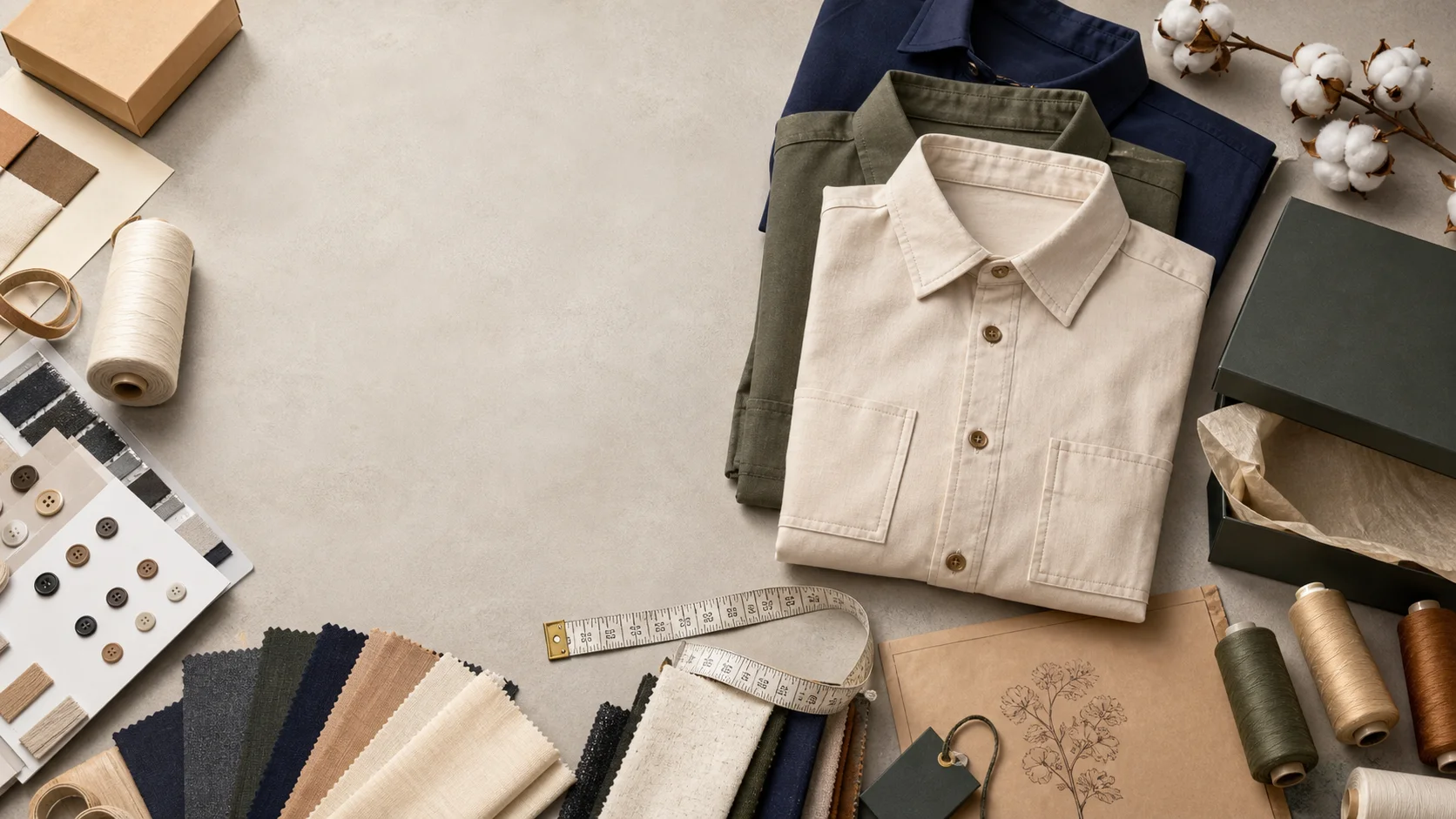
Apparel Ecommerce Unboxing with checks for samples, fit, MOQ, QC evidence, pricing terms, and delivery risk.
Fast answer: Apparel Ecommerce Unboxing: Box Strength, Inserts, Finish, and Cost should be judged by production evidence, not by a generic sourcing promise. The buyer needs sample proof, cost breakdowns, QC checkpoints, and delivery buffers in writing.
Ask for recent sample photos, measurement tolerances, fabric or print test assumptions, decoration test notes, packing examples, and a named inspection checkpoint. These details show whether the team can repeat an approved sample at bulk volume.
Separate garment cost, decoration, labels, packaging, sampling, testing, freight, and rush charges. When every cost line is visible, it becomes easier to reduce colorways, adjust size depth, or reserve more time for sampling.
The return label may be what brings the parcel back, but the unboxing is what decides whether the customer remembers your brand at all. That is where the premium unboxing experience for apparel ecommerce starts. I have watched shoppers size up a $35 tee and a $180 sweater with the same quick scan: weight in hand, sound at the tear strip, and how neatly the garment sits inside. Fit may send the order back, but presentation decides whether the brand gets another chance.
After visiting factories across China, Portugal, Vietnam, Italy, India, Turkey, and the United States, I can say this plainly: expensive materials rarely win on their own. Insert design does. Folding discipline does. Pack-out consistency does. A millimeter off on a belly band, a care card tucked under the sleeve instead of beside it, or tissue that tears during closing can wipe out a $2 packaging upgrade in seconds. At one knitwear plant in northern Portugal, QC spent 22 seconds per unit checking fold symmetry. In Shenzhen, a similar check took 8 seconds because the line had tighter work instructions and a better tray system.
The price band matters, but not in the way many brands assume. A $35 tee packed in a rigid mailer with calibrated tissue, a sharp sticker seal, and a clean insert can feel more premium than a $180 sweater rattling inside a thin polybag. Tactile cues carry the memory. Customers do not measure board thickness; they feel stiffness, clarity, and order. Those first seven seconds after opening can shape review language, repeat rate, and social sharing, especially where gifting and self-purchase overlap. According to ISO standards on quality management, consistency is not a cosmetic extra. It is process discipline.
Premium presentation is not decoration. It is a controlled sequence of cues that must match the brand promise, from doorstep to drawer.
A real premium package is a stack, not a single box. Outer mailer first. Tissue, seal, insert card, thank-you note, care card, return-ready structure, optional secondary wrap — then the heavy lifting starts. When I toured lines producing for contemporary labels in Milan and Ho Chi Minh City, the brands that looked most expensive on camera were rarely the ones with the thickest board. They were the ones with the cleanest sequence. First the seal. Then the tissue. Then the garment, folded to hold its shape. Then a card that tells the customer what to do next.
Luxury, premium, and mass-market packaging choices split in obvious and subtle ways. Luxury leans into magnetic closures, 1200 GSM rigid board, custom inserts; premium may use a 400-600 GSM mailer with FSC paper and a branded tissue wrap; mass-market often falls back on generic polybags and a single label. But the practical details are where value leaks out. Print alignment tolerance of 1-2 mm matters. Tissue opacity matters when a black tee shows through cheap white paper. Adhesive residue matters when stickers lift ink. Fold memory matters when a garment creases across the chest after 3,000 kilometers of transport.
Customers notice more than visual design. Scent, sound, and material stiffness all influence perceived value without changing unit cost dramatically. A crisp tissue crack, a low-noise mailer closure, a board that does not collapse under pressure: those things register as quality. If you work with private label clothing services, specify packaging alongside the garment, not after production. Brands using cut and sew manufacturing should ask for pack-out mockups during sample approval, because packaging failures usually show up only once the tee, hoodie, or woven shirt is in motion. You can private label clothing services into that process early and avoid last-minute fixes.
My decision framework is simple.
Premium works when each layer earns its place. Anything else is theater.
Packaging expectations move hard by ticket size. For apparel priced at $25-$60, buyers want protection, clean branding, and a presentable reveal — not a jewelry-box ceremony. Between $60-$150, they start noticing finish quality and paper stock. At $150+, the package has to perform like a luxury object even if the garment is a simple merino knit. In my notes, I often keep those three bands side by side: $25-$60, $60-$150, and $150+ apparel packaging expectations.
Region changes the economics. In parts of Asia, rigid board and specialty paper can be cheaper, but shipping sample iterations takes longer if artwork keeps changing. In some European markets, premium papers arrive faster, sometimes within 7-10 days, yet labor can be 20-35% higher than comparable plants in Asia. North American suppliers often win on speed for smaller runs, especially 300-1,000 units, but tooling and freight costs can spike fast once you move past a few thousand pieces.
Labor is not a footnote. Hand-folding, tissue wrapping, and QC steps can add 20-90 seconds per unit. At 10,000 units, that is 56 to 250 labor hours. The math changes quickly. I have seen a 48-second pack-out process turn into a bottleneck that delayed a launch by 6 days. Counterintuitively, some higher-priced brands spend too much on the outer box and too little on garment protection and return logic. Beautiful exterior. Wrinkled interior. Expensive vanity.
The best return on spend usually sits in three places: a better first reveal for gifting behavior, stronger repeat purchase cues, and packaging that customers want to photograph. A rigid mailer or presentation box can earn its cost back if it lifts social content by even 2%-4% and reduces damage claims by 0.5%-1.0%. If you need a starting point for assortment planning, browse our product catalog and compare structural formats before locking artwork. The right box is not the fanciest one. It is the one that matches the product margin and the customer’s expectations.
The tension between premium cues and sustainability claims is real. The numbers are less forgiving than brand decks suggest. A rigid box can weigh 80-180 grams before inserts. A flat mailer may weigh 25-50 grams. That difference matters on freight, especially in cross-border shipping where every additional 100 grams compounds across 5,000 or 50,000 orders. Data from Trade.gov and logistics benchmarks consistently shows that packaging mass affects transport emissions, even when the garment itself is light.
Materials carry different trade-offs. Kraft paper feels honest and is easy to recycle. FSC-certified paper gives buyers a third-party signal without shouting about it. Molded fiber protects well and works for inserts. Rigid board delivers structure and a premium hand feel, but it often uses more material than necessary for a tee or hoodie. Reusable fabric pouches look attractive, yet they can cost $0.90-$3.50 per unit and may sit unused in a drawer. I have seen brands pay for pouches that customers kept, but not always in a way that improved margin.
Print coverage and coatings change the end-of-life story. Heavy lamination, foil-heavy coverage, and soft-touch finishes can reduce recyclability or complicate local sorting. On the factory floor, I have seen brands reject a 100% recycled paper spec because a glossy coating pushed the piece outside the local recycling stream. Then they paid 12%-18% more for a lower-coverage matte version that still looked premium. The trick is not to avoid finishes entirely. It is to pick finishes that do not fight the substrate.
Reduced ink coverage often reads more premium than a full-bleed print job, especially on off-white or natural stock. A simple logo, one accent color, one clean fold line can feel far more expensive than a busy box covered in illustrations. According to Textile Exchange, material choices matter not just for garment content but for the broader sustainability narrative brands now have to defend. My checklist is short: mono-material where possible, FSC paper, recycled content where feasible, minimal coatings, and no decorative layer that cannot justify its weight. Premium should not become packaging waste with a better font.
Visual hierarchy drives perceived value more than logo size. The strongest packages I have seen use restraint: one mark, one supporting line, one color family. Flashy layouts often cheapen the reveal, especially on a phone screen. A box with 2 colors and 1 foil accent can outperform a 5-color design if the typography is calm and the spacing is disciplined. The customer sees order before identity. Then branding. Then copy.
Finish choices should be selective. Soft-touch coating adds tactility, embossing gives depth, foil gives contrast, and spot UV catches light. In practice, one finish is usually enough. A matte kraft mailer with blind embossing can look more expensive than a glossy box with three treatments fighting each other. On factory visits, I have watched teams in Italy spend 30 minutes adjusting foil pressure to avoid edge burn, while a supplier in Vietnam hit the same visual effect with a simpler plate and tighter color control. The difference was not drama. It was discipline.
Garment presentation inside the mailer matters just as much. Standardized folds reduce wrinkling, and size labels placed consistently help warehouse staff avoid mix-ups. Inserts that stop shifting are worth more than decorative stickers. A tee should sit chest-up or chest-forward in a way that creates an immediate read. For woven shirts, collar shape and cuff alignment tell the story. For knitwear, the fold must avoid hard compression at the shoulder. If the garment arrives crushed, the premium promise collapses. I have seen a $110 sweatshirt look like a $22 clearance item because the insert was 1 cm too short.
A premium reveal depends on order.
Avoid overfilling, because puffy boxes read sloppy. Avoid wrinkled tissue, because it photographs badly. Avoid mismatched materials, because a kraft exterior paired with a high-gloss insert can feel like a bad compromise. In cut and sew manufacturing, packaging should be specified alongside the final garment dimensions so the box is built around the product, not the other way around. If you need a technical supplier conversation, you can cut and sew manufacturing with pack-out requirements from the start.
Unit price is only the headline. Real cost comes from structure, print, finishing, assembly, and freight. A simple premium mailer may land at $0.45-$1.10 per unit before fulfillment labor. A mid-tier rigid box often sits at $1.80-$4.50 depending on board thickness and inserts. A luxury presentation box can climb to $6.00-$14.00, especially at low quantities or with magnetic closures. Add assembly at 12-40 seconds per unit, and the quote shifts fast. At 5,000 units, even a 15-second difference can add more than 20 labor hours.
MOQ is where many founders get surprised. A die tool may cost $150-$600. Plate setup can add $80-$350 per color. If artwork changes twice, the sample round can stretch from 5 days to 3 weeks. That is before freight or storage. The first-order economics often matter more than the per-unit quote because you may pay for 1,000 units when you only need 300. I tell brands to compare not just quote lines, but the cash tied up in dead stock, rework, and mismatch risk.
When I evaluate a manufacturer, factory, or supplier, I ask five things: sample speed, color accuracy, structural engineering, QC process, and change-order discipline. A supplier that sends a physical sample in 4 days but misses the fold lock-up is worse than one that takes 9 days and gets it right. I also ask about transit damage rates, because a package that looks beautiful in the sample room may fail after automated sorting. Ask for a real drop test, real tape performance, and a repack test. Then ask again after the supplier has changed one thing. That is where discipline shows.
If you are trying to prevent hidden costs, ask these questions before signing off.
If the answers are vague, the quote is not complete. That is when you should get a free quote and request a sample plan before placing production money.
Pretty packaging is not proof. You need data from live orders, not mood boards. I test repeat purchase rate, review sentiment, social mentions, damage rate, and fulfillment speed. A better box that slows the line by 20 seconds may look good in photos and still hurt margin. I have seen brands celebrate a 7% lift in Instagram mentions while ignoring a 1.5% increase in fulfillment errors. That is a trade-off, not a win.
A/B testing does not need to be complex. Split 500 to 2,000 orders across two packaging variants and compare outcomes over 30-45 days. Use the same product, same carrier mix, same warehouse team. Measure AOV lift, gift conversion, and return anxiety reduction through post-purchase surveys. If a premium wrap increases gift orders by 3% and adds $4.20 to average margin, the case is clearer. If it only adds compliments, it is probably too expensive for scale.
Beauty alone is not enough. The package must survive automated sorting, multi-zone shipping, and customer repacking when the item is returned. That means real warehouse staff should test it, not only the brand team. I always want a box to go through a conveyor, a polybag toss, and a manual repack. That is where adhesive fails, tissue tears, and inserts shift. The unboxing experience should still feel deliberate after a 1,000-kilometer trip and a rough delivery route.
When you have the data, decide with restraint. Keep the version that improves repeat rate, protects the garment, and does not choke throughput. Everything else is decoration with a spreadsheet attached.
Build the rollout in 30 days. Week 1: define brand promise, target price bands, and the three packaging tiers you will test. Week 2: request samples, check print accuracy, and verify protection for the most fragile SKU. Week 3: photograph the options, run warehouse trials, and measure pack-out time. Week 4: approve operations, confirm freight, and sign off on production. The order matters: protection, presentation, sustainability, then cost.
Do not let premium packaging slow pick-pack beyond reason. Even a 15-second delay per order can hurt throughput at scale, especially once you pass 3,000 orders a month. If your team cannot assemble the package cleanly in 25-40 seconds, simplify it. The strongest premium unboxing experience for apparel ecommerce is the one that survives real operations and still earns a higher repeat rate. That is profit discipline, not vanity.
Most apparel brands spend $0.45-$1.10 for a premium mailer, $1.80-$4.50 for a mid-tier rigid box, and $6.00-$14.00 for a luxury presentation box before freight. Assembly can add 12-40 seconds per unit, which often matters as much as materials.
The core stack is an outer mailer or box, tissue or wrap, a seal, an insert card, care instructions, and return-ready protection. For higher-ticket items, add a secondary wrap or a structured insert that keeps the garment from shifting during transit.
A practical rollout usually takes 30 days if suppliers are responsive. Sampling alone can take 5-21 days depending on tooling, print changes, and regional lead times, and first production often adds another 1-2 weeks for sign-off and freight.
Yes, if the brand uses FSC paper, recycled content, mono-material structures, and limited coatings. Heavier boxes raise freight emissions, so flat-pack premium formats and reduced ink coverage often perform better on both cost and sustainability.
Start with protection and fold discipline, then add one visible premium cue such as better paper stock or a single finish. Test 500-2,000 orders before scaling, and compare damage rate, repeat purchase rate, and fulfillment time before committing to a larger run.