
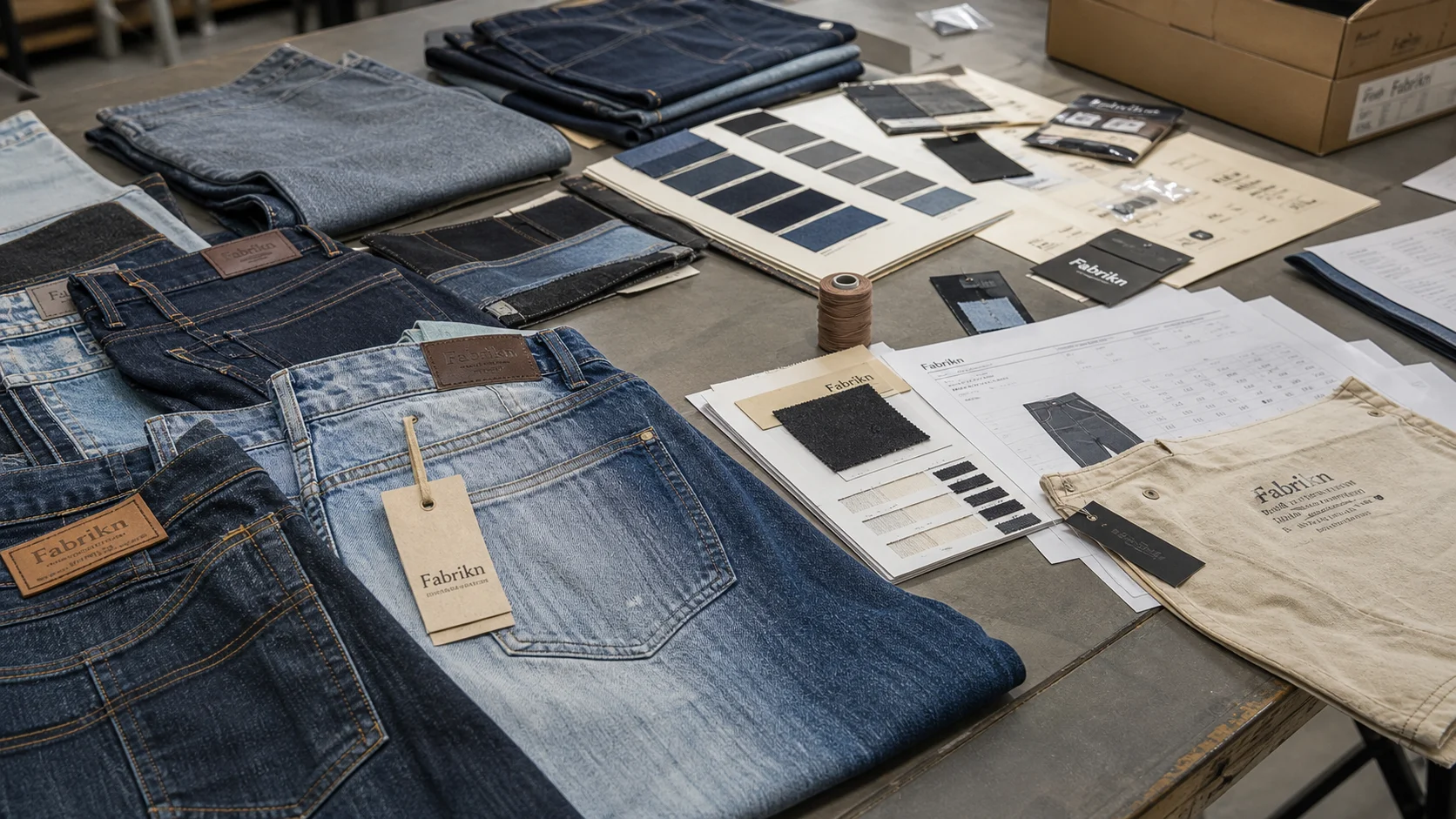
Print on Demand vs Bulk with checks for samples, fit, MOQ, QC evidence, pricing terms, and delivery risk.
Fast answer: Print on Demand vs Bulk: Cost Breakdown for Custom Clothing should be judged by production evidence, not by a generic sourcing promise. The buyer needs sample proof, cost breakdowns, QC checkpoints, and delivery buffers in writing.
Ask for recent sample photos, measurement tolerances, fabric or print test assumptions, decoration test notes, packing examples, and a named inspection checkpoint. These details show whether the team can repeat an approved sample at bulk volume.
Separate garment cost, decoration, labels, packaging, sampling, testing, freight, and rush charges. When every cost line is visible, it becomes easier to reduce colorways, adjust size depth, or reserve more time for sampling.
When sourcing custom clothing, brands must confront a pivotal decision: should they opt for print on demand or commit to bulk production? Both models promise unique advantages, but their cost structures diverge significantly. For businesses navigating the custom apparel landscape, understanding the cost breakdown of each approach is more than just an accounting exercise—it determines scalability, fulfillment speed, risk, and ultimately profitability.
As a manufacturing partner deeply embedded in the B2B clothing world, Fabrikn is committed to equipping brands with the clarity they need to make strategic production decisions. This article unpacks the total cost picture for print on demand versus bulk custom clothing, revealing how each model aligns with different business goals and operational realities.
Every production model is informed by a set of core cost areas. Whether you are printing a single tee on demand or commissioning thousands of hoodies in bulk, these components influence your final per-unit price.
The base garment cost makes up a significant share of every quote. Premium fabrics, specialty blends, or performance textiles will raise costs irrespective of production volume. However, bulk orders frequently offer better pricing on raw materials because vendors can negotiate volume discounts, especially when sourcing inherently expensive fabrics.
Whether screen printing, direct-to-garment (DTG), embroidery, or heat transfer, customization is the heart of value for custom clothing. In print on demand, digital printing technology allows for single-unit personalization with minimal setup, while bulk production often leverages screen printing or embroidery, which comes with setup fees but benefits from economies of scale.
Labor costs cover the workforce needed to print, inspect, and pack garments. Print on demand workflows are typically more labor-intensive per unit because each item may be unique. Bulk production spreads labor hours across many units, reducing per-piece labor costs.
Fulfillment strategies vary widely. Print on demand often integrates directly with eCommerce platforms and includes drop shipping, which can minimize warehousing costs but increase per-unit shipping expenses. Bulk orders usually require centralized warehousing and fulfillment, demanding more upfront logistics planning but offering lower per-item shipping in large batches.
This category comprises machinery depreciation, utilities, and facility expenses. Bulk operations justify these fixed costs across large runs. Print on demand may include investments in automation or digital infrastructure, but the per-unit overhead tends to stay higher unless volumes grow substantially.
Print on demand (POD) has become synonymous with flexibility. It suits brands launching new collections, limited drops, or test products without risking inventory. Yet, with flexibility comes a distinct cost profile.
POD is priced on individual units. A single printed tee might range from $12 to $20, depending on garment quality and print complexity. As orders remain small, the bulk discounts that come from ordering a thousand units simply don’t factor in, keeping per-item pricing elevated.
Playfully, this is both POD's biggest advantage and cost driver. With no minimum, you can create collections without upfront inventory—ideal for startups and niche lines. But it also means you can’t tap into the volume leverage that slashes material or labor costs via mass ordering.
POD thrives on digital printing technologies like DTG that don’t need setup. That eliminates screen setup fees, making costs predictable. However, more intricate customization requiring embroidery or special finishes may introduce pricing markups per item.
POD platforms often ship products directly to customers individually. While this reduces warehousing, it inflates shipping costs, as each order incurs its own courier charge. Also, faster fulfillment timelines may require expedited shipping, further raising expenses.
With POD, misprinted or damaged items affect a small number of orders but can still be costly due to the labor and materials per item. Quality management is critical. Some POD services offer guarantees, but refunds and reprints might still carry overheads.
Many POD services charge platform or integration fees for connecting to your storefront. These can include monthly subscriptions, transaction commissions, or premium features for faster turnaround. While these may seem modest per month, they add to the cost base.
Bulk production represents the classic manufacturing formula: order large quantities, minimize per-unit costs, and manage inventory. For many established brands, this remains the cornerstone of cost optimization.
Purchasing fabrics, trims, and packaging materials in large quantities drives purchasing power. Suppliers often provide tiered pricing, where reaching thresholds (e.g., 1,000 units) unlocks significant savings. This advantage can make bulk production considerably cheaper per garment.
Bulk printing often relies on screen printing, which requires artwork separation, screen creation, and setup. While these set-up costs can be hundreds of dollars per design, they are amortized across the entire run. A large order absorbs this fixed expense, resulting in lower per-unit charges.
In bulk runs, workflows are highly efficient. Operators perform repetitive tasks with specialized machinery optimized for high throughput, and quality checks are applied linearly. This translates to lower labor costs per garment compared to the unit-by-unit approach of POD.
Here lies a pivotal trade-off. Bulk production ties up capital in inventory. Warehousing and storage maintenance can become substantial over time, especially for seasonal products. However, when managed correctly with reliable demand forecasting, inventory holding becomes a calculated expense that supports faster fulfillment.
Bulk orders shipped to distribution centers or warehouses benefit from freight discounts, particularly when using consolidated shipping. The cost per item drops dramatically compared to individual fulfillment, though initial shipping invoices can be large.
Bulk manufacturing fosters consistent quality controls, with inspection protocols applied uniformly. Bulk runs often allow for pre-shipment samples, which ensure that the final product meets expectations before the full deck ships.
Bulk production typically has longer lead times—from sourcing to manufacturing to shipping—often ranging from 4 to 12 weeks depending on complexity. These lead times require careful planning but give the brand time to prepare marketing and delivery strategies.
Understanding the specific pros and cons of each model requires looking at the cost metrics side-by-side.
Print on demand charges more per item due to individual printing, lack of bulk discounting, and fulfillment per piece. Bulk production spreads costs across many units, yielding markedly cheaper per-unit pricing. A $15 POD tee might cost $6 to $8 when produced in bulk.
POD requires minimal upfront capital since each garment is made to order. Bulk requires a substantial investment before items sell, creating cash flow pressure but enabling economies of scale.
POD excels in flexibility—you can launch new designs, offer personalization, or pivot quickly with minimal waste. Bulk trades flexibility for predictability; once the order is placed, changes are difficult and costly.
With POD, subtle customizations and unique prints are more manageable. Bulk excels when repeating the same design across a large run but can become costly when frequent design swaps are necessary.
POD often includes direct-to-customer shipping, which simplifies logistics but incurs higher shipping costs. Bulk typically involves fulfillment centers and wholesale distribution, offering more shipping efficiency per item.
Bulk production has stringent quality checkpoints that keep defects low. POD depends heavily on the precision of digital printers and operators, which can vary between providers.
Selecting the best cost approach is context-dependent.
Early-stage brands benefit from POD to test products with limited risk. As revenue scales, bulk production becomes enticing because it reduces per-unit costs and increases margins.
Multi-color designs or full-coverage prints may be easier and cheaper with POD's digital workflows, whereas simpler or repeat designs benefit from bulk screen printing.
Brands selling directly to consumers online may appreciate the quick fulfillment of POD. However, wholesale partners or retail distribution channels usually expect consistent pricing and inventory, aligning with bulk production.
Print on demand preserves cash flow by avoiding inventory build-up, while bulk production requires capital but delivers economies of scale. Choosing the right model depends on how much working capital a brand can allocate.
Predictable demand favors bulk production; unpredictable demand makes POD safer. Some brands adopt a hybrid approach, ordering core styles in bulk while offering experimental designs through POD.
A boutique brand wanted to test four new designs without committing to inventory. By choosing print on demand, they launched the collection within weeks, only printing items after orders came in. Although each item cost about $3 more than bulk, the lack of unsold stock justified the expense, and the designs that performed well were later re-ordered in bulk.
An activewear brand with consistent high demand opted for bulk production. They ordered 10,000 units across three styles, benefiting from material cost reductions and standardized screen printing setups. The per-unit cost dropped to $7.80, boosting margins and supporting retail partnerships requiring prompt restocks.
A streetwear label blended both models. Their core bestsellers were produced in bulk for wholesale, while limited edition drops and artist collaborations used print on demand. This strategy allowed them to maintain a steady revenue stream while keeping the brand fresh and responsive to trends.
Print on demand and bulk production represent two sides of the custom clothing cost equation. POD offers unmatched flexibility and low risk for new or experimental products, while bulk production delivers lower per-unit costs, consistent quality, and scalability for established lines. The optimal approach depends on your brand’s lifecycle, demand certainty, and capital availability.
Many brands find a hybrid strategy appealing: use POD to test ideas, warm up audiences, or handle limited drops, then shift winning designs into bulk production for long-term runs. Throughout either strategy, collaborating with a trusted manufacturing partner like Fabrikn ensures consistent communication, cost transparency, and production excellence. Learn more about how we support brands through every phase by visiting our services page or connect with our team via the contact us page. To understand our approach to manufacturing and partnerships, explore our about us page.
Get a free quote from Fabrikn — your trusted B2B clothing manufacturer with 10+ years of experience. MOQ as low as 200 pieces.
Get a Free Quote →Per-unit quantity, design complexity, material quality, and fulfillment needs drive cost outcomes. Bulk gains advantages from volume discounts and amortized setup costs, while POD stays flexible with minimal upfront investment.
Yes. Many brands start with POD to validate concepts and transition to bulk once demand stabilizes. The key is capturing sales data early and partnering with a manufacturer that can handle both models.
Generally yes, due to lower per-unit costs. But margins depend on effective inventory management, quality control, and demand forecasting. Excess inventory or long lead times can erode profits if not managed strategically.
POD is rarely used for wholesale due to higher costs and slower bulk shipping. Wholesale partners typically expect uniform pricing and faster fulfillment, which bulk production meets more reliably.
Fulfillment influences shipping costs, storage, and delivery speed. POD’s per-order fulfillment is convenient but costlier, whereas bulk fulfillment benefits from consolidated shipping but requires warehousing.