
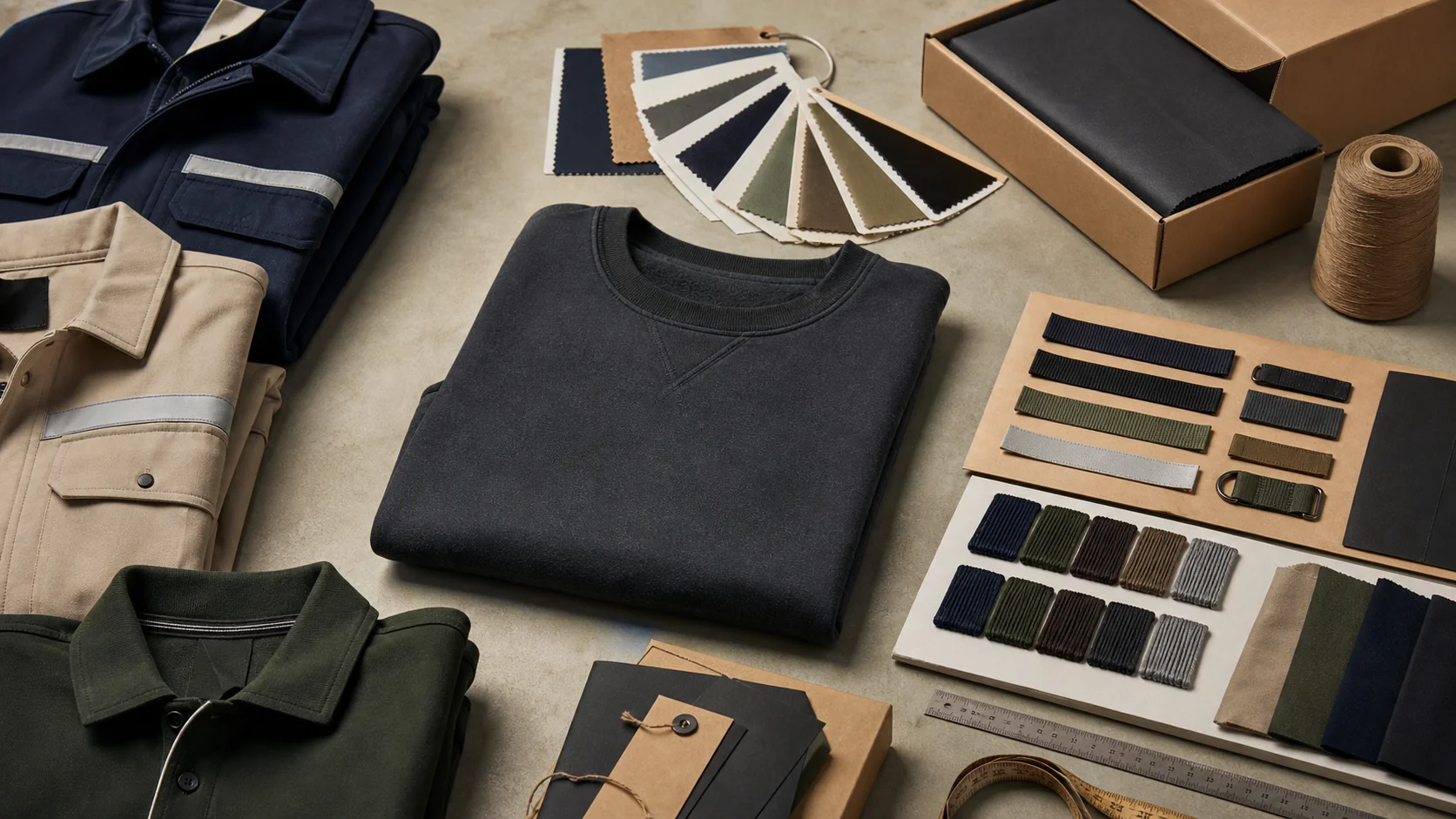
Print On Demand vs. Bulk Custom with checks for samples, fit, MOQ, QC evidence, pricing terms, and delivery risk.
Fast answer: Print On Demand vs. Bulk Custom: Choosing the Right Path should be judged by production evidence, not by a generic sourcing promise. The buyer needs sample proof, cost breakdowns, QC checkpoints, and delivery buffers in writing.
Ask for recent sample photos, measurement tolerances, fabric or print test assumptions, decoration test notes, packing examples, and a named inspection checkpoint. These details show whether the team can repeat an approved sample at bulk volume.
Separate garment cost, decoration, labels, packaging, sampling, testing, freight, and rush charges. When every cost line is visible, it becomes easier to reduce colorways, adjust size depth, or reserve more time for sampling.
The custom clothing market continues to expand as brands and creators seek ways to deliver personalized apparel while maintaining strong margins and consistent quality. Two dominant approaches have emerged to meet diverse customer needs: print on demand (POD) and bulk custom production. Each path comes with its own advantages, constraints, and ideal use cases. Choosing between print on demand and bulk custom is not simply a matter of preference; it’s about aligning production strategy with business goals, demand forecasts, and brand standards.
In this article, we’ll compare print on demand versus bulk custom in depth, sharing insights into cost structures, quality control, production timelines, inventory management, and sustainability. Whether you operate a new online storefront, a branded merchandise program, or a retail line, understanding the right path will empower you to make strategic decisions that drive long-term success.
Print on demand has transformed the way small businesses and independent creators bring apparel to market. Instead of pre-producing large quantities of stock, POD allows brands to print each item only after a customer places an order. This approach drastically minimizes inventory risk and enables rapid experimentation with new designs.
Core features of print on demand include:
The appeal of POD is evident: brands can launch collections quickly, test new ideas without upfront investment, and offer a vast design catalog without the headache of surplus stock. However, the trade-off lies in pricing, production limitations, and perceived quality, which we’ll explore in greater depth.
Bulk custom production, by contrast, involves manufacturing a significant quantity of garments per style, often with custom fits, fabrics, trims, and embellishments. This approach has long been the standard for established fashion and uniform programs, where economies of scale help reduce per-unit costs.
While bulk custom requires more planning, lead time, and upfront investment, it is often the preferred choice for brands selling through wholesale, brick-and-mortar stores, or large-scale e-commerce operations where customer demand is predictable.
One of the most significant decision-making factors is cost. Both print on demand and bulk custom involve different cost components that should be carefully analyzed.
Print On Demand Cost Structure:
Bulk Custom Cost Structure:
Comparing the two, print on demand emerges as a cost-effective option for small volumes and experimentation, whereas bulk custom offers superior margins for established, consistent demand. When evaluating cost, factor in fulfillment, shipping, and potential markdowns for unsold inventory so you see the true total cost of ownership.
Quality perception can directly impact brand reputation. While POD has made strides in achieving consistent results, the limitations remain when compared to bulk custom.
Print On Demand Considerations:
Bulk Custom Quality Control:
The short version: if your brand demands unmatched quality control and cohesive garment construction, bulk custom production gives you the toolbox to execute your vision. Print on demand is suitable for proof-of-concept launches and light-demand catalog items where ultimate premiumization is not a priority.
Production speed is another critical component, especially when responding to seasonal trends, viral moments, or marketing campaigns.
Print On Demand:
Bulk Custom:
That said, bulk custom production doesn’t necessarily mean slow. With an experienced manufacturing partner and streamlined workflows, Fabrikn can compress timelines, provide transparent milestones, and align expectations to meet seasonal deadlines.
Inventory management is where the contrast between POD and bulk custom is most stark.
Print On Demand:
Bulk Custom:
Though bulk custom involves more inventory handling, it also allows you to own your product lifecycle, enabling faster reorders and replenishment of best-selling styles. Balancing inventory risk with marketing plans is key to maximizing the benefits of each approach.
Consumers increasingly expect brands to embrace sustainable practices. Both production paths offer sustainability benefits, albeit in different ways.
Both approaches can align with sustainability goals depending on the brand’s priorities. Print on demand minimizes upfront waste, while bulk custom can support long-term sourcing strategies built around responsible fabric selection and durable construction.
Understanding real-world scenarios can help you decide which production strategy fits your business model.
Ideal Print On Demand Use Cases:
Ideal Bulk Custom Use Cases:
In practice, many brands use a hybrid approach. For instance, you might start with print on demand to validate a concept and later transition best-sellers into bulk custom production for improved margins and product differentiation.
To help you decide between print on demand and bulk custom, consider building a decision framework using these criteria.
Apply this framework to each product you launch. Some goods may be better suited for POD, while others belong in your bulk custom catalog.
At Fabrikn, we understand that every brand’s journey is different. Whether you’re evaluating print on demand to test a design or looking to scale through bulk custom manufacturing, we support both paths with bespoke solutions.
Our services include:
Curious how we can help scale your next collection? Explore our services or reach out via our contact us page. Want to learn more about our mission and team? Visit about us for the story behind our approach.
Get a free quote from Fabrikn — your trusted B2B clothing manufacturer with 10+ years of experience. MOQ as low as 200 pieces.
Get a Free Quote →A strong brief makes the supplier's job narrower and the quote more reliable. For print on demand vs. bulk custom, include the target customer, sales channel, expected order quantity, size range, decoration needs, packaging requirements, and delivery market. Then call out the details most likely to affect the result, especially artwork limit, thread or ink test, and placement tolerance.
The brief should also explain what cannot change. Some brands care most about hand feel, some about price, some about launch timing, and some about retail compliance. When those priorities are not written down, suppliers tend to optimize for whatever is easiest to quote. Clear priorities help the factory make better tradeoffs before the first sample is cut or printed.
Ask the supplier to respond with assumptions, not just a price. A useful reply states MOQ, sample route, production capacity, inspection plan, packing method, and freight handoff. If the answer is vague, the project may still work, but it needs a tighter pre-production stage before money and calendar pressure build up.
The best time to catch problems is before the pre-production sample is approved. Check measurements, color, placement, material behavior, shrinkage, construction, labels, and packaging in the same review instead of approving each item in isolation. Many bulk issues are not caused by one dramatic mistake; they come from several small unchecked assumptions.
For print on demand vs. bulk custom, pay special attention to wash result, bulk defect rule, and strike-off approval. These details often look minor in an email but become expensive once cutting, printing, sewing, packing, or shipping begins. A simple checklist with owner, due date, and approval status keeps the brand team and factory aligned.
Bulk production should not start until the supplier can explain how the approved sample becomes a repeatable production standard. That means reference sample storage, line instructions, inline checks, final inspection, and defect handling. A factory that can describe this process clearly is usually safer than one that only promises speed.
Price differences are useful only when the quotes cover the same work. Compare sample cost, material source, trims, decoration, packaging, testing, inspection, and freight assumptions. A low unit price can become expensive if it excludes items the brand needs before launch.
Timeline promises deserve the same scrutiny. Ask what happens if the first sample needs revision, whether materials are in stock, when the production slot is reserved, and how export packing is handled. The most reliable supplier is often the one that gives a realistic calendar instead of the fastest optimistic answer.
Print on demand produces garments individually after an order is placed, ideal for low-volume, flexible catalog items. Bulk custom involves manufacturing larger quantities at once, optimizing cost per unit and allowing for more extensive customization.
Yes. Many brands use print on demand to test designs and later switch winning styles to bulk custom production for better margins and quality control.
Consider demand predictability, budget, quality expectations, and timeline. If you need rapid iterations with minimal risk, POD is a strong start. If you’re scaling with consistent demand and want premium touches, bulk custom is likely the better choice.
Absolutely. Fabrikn works with brands to map out the full spectrum of production needs, offering guidance whether you’re exploring POD, bulk custom, or a hybrid approach.