
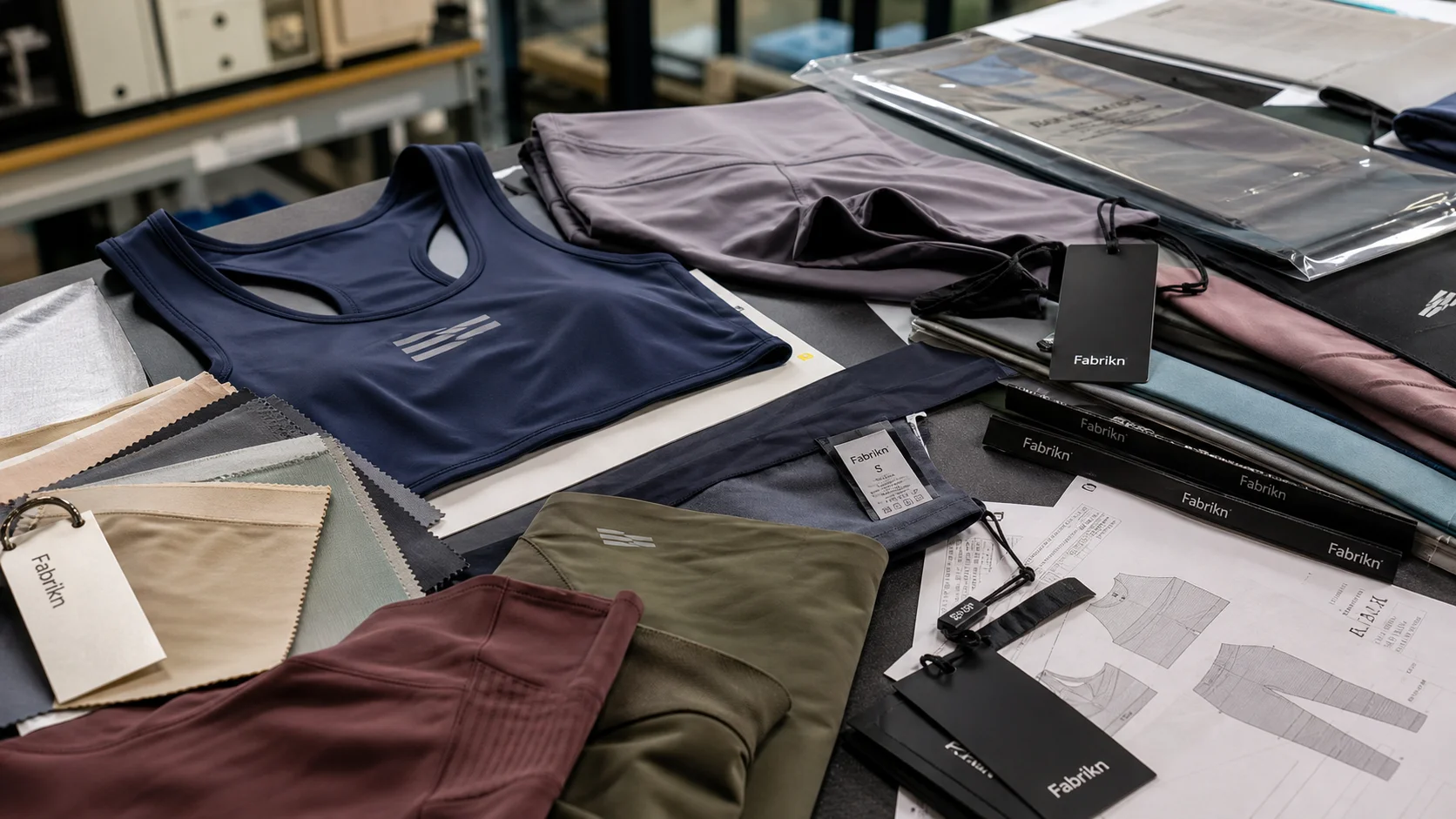
Private Label Clothing Distribution Strategy compared by sample evidence, fabric or trim specs, MOQ, AQL terms, cost lines, delivery timing, and rework...
Fast answer: Private Label Clothing Distribution Strategy: Material, Print, MOQ, and QC Terms should be judged by production evidence, not by a generic sourcing promise. The buyer needs sample proof, cost breakdowns, QC checkpoints, and delivery buffers in writing.
Ask for recent sample photos, measurement tolerances, fabric or print test assumptions, decoration test notes, packing examples, and a named inspection checkpoint. These details show whether the team can repeat an approved sample at bulk volume.
Separate garment cost, decoration, labels, packaging, sampling, testing, freight, and rush charges. Clear cost lines make it easier to reduce colorways, adjust size depth, or reserve more time for sampling.
Private Label Clothing Distribution Strategy: How to Build a Scalable Route to MarketBuilding a successful private label clothing brand is about more than great product design. It also requires a distribution strategy that can move products efficiently, preserve margins, support brand growth, and scale as demand increases. Without a clear route to market, even a strong private label collection can struggle to reach the right customers at the right cost.
A strong private label clothing distribution strategy aligns production, inventory, pricing, sales channels, and fulfillment into one repeatable system. For startups, it provides a launch plan. For established brands, it creates a framework for expansion. In both cases, the goal is the same: get product into the market in a way that supports profitability and long-term growth.
In this article, we will break down how private label clothing distribution works, which models are available, and how to build a scalable route to market that fits your brand. If you are evaluating production or supply chain support, you can learn more about our capabilities on the Fabrikn services page.
Private label clothing distribution refers to the process of moving apparel products manufactured under your brand name from production to end customers through selected channels. Unlike branded manufacturing for a third party, private label brands own the customer relationship, the pricing strategy, and the market positioning.
Distribution is not just shipping cartons from factory to warehouse. It includes the full path to market: sourcing, manufacturing coordination, inventory management, channel selection, wholesale relationships, e-commerce fulfillment, and retail delivery. The better the distribution system, the easier it becomes to grow without losing control of quality or profit.
For private label clothing businesses, distribution strategy often determines whether the brand stays small or becomes scalable. A well-designed route to market ensures that products are available where customers expect them, in the right quantities, and at the right price points.
Many apparel brands focus heavily on product development and branding, but distribution has a direct impact on commercial success. The same garment can perform very differently depending on whether it is sold through direct-to-consumer e-commerce, wholesale, marketplaces, or retail partners.
A strong distribution strategy helps you:
It also helps you avoid one of the biggest challenges in apparel: mismatched supply and demand. Clothing is seasonal, size-dependent, and style-driven, which makes inventory planning more complex than in many other categories. A scalable distribution strategy allows your brand to respond faster to demand shifts and market trends.
There is no single best distribution model for all private label clothing brands. The right choice depends on your target market, budget, product category, and growth stage. Most successful brands use a mix of channels rather than relying on just one.
DTC distribution means selling directly to customers through your own website, social commerce, or branded online store. This model gives you the most control over pricing, storytelling, and customer data.
Advantages include:
Challenges include the need for strong marketing, fulfillment management, and customer service capabilities. DTC is often ideal for brands that want to build awareness and control the customer relationship from day one.
Wholesale distribution involves selling products to retailers, boutiques, department stores, or chain stores that resell them to end customers. This channel can drive volume and help build brand visibility faster than DTC alone.
Benefits include:
However, wholesale usually comes with lower margins and requires strong account management, reliable lead times, and retail-ready packaging and compliance. Brands must also manage the risk of over-distribution, which can dilute exclusivity.
Marketplaces such as Amazon, Zalando, or other regional platforms can provide access to large customer bases with built-in traffic. This can be useful for testing demand or moving volume quickly.
Pros include convenience and fast access to shoppers. Cons include high competition, platform fees, limited brand control, and pricing pressure. Marketplace distribution works best as part of a broader strategy rather than the sole sales channel.
Hybrid distribution combines DTC, wholesale, and sometimes marketplace selling. This is often the most scalable model for private label clothing because it balances margin, reach, and customer insight.
For example, a brand may use DTC to validate products, wholesale to grow volume, and marketplaces to clear seasonal inventory or expand into new markets. The key is ensuring each channel has a defined purpose and clear rules to prevent internal competition.
A scalable route to market starts with a clear understanding of your product, customer, and operational capacity. The distribution strategy should not be built in isolation. It should align with manufacturing, inventory planning, and brand positioning from the beginning.
Start by identifying who your products are for, where they live, and how they prefer to shop. Private label clothing brands often serve specific niches such as activewear, basics, workwear, luxury casualwear, or children’s apparel. Each segment has different distribution needs.
Ask questions like:
Once you understand the customer, it becomes easier to choose channels and set pricing expectations.
Early-stage brands should usually prioritize channels that require less complexity and allow rapid learning. DTC is often the most accessible starting point because it offers direct feedback and avoids retailer requirements. As the brand proves demand, wholesale and B2B partnerships can expand reach.
Established brands may use more advanced strategies, such as regional distribution centers, retail partnerships, and multi-country sales structures. The right channel mix should reflect your operational readiness and growth goals.
Inventory is at the center of distribution. Too little inventory creates lost sales and delays. Too much inventory increases cash pressure and markdown risk. A scalable strategy uses sales forecasting, size curve planning, and replenishment rules to keep inventory aligned with demand.
For clothing brands, this includes monitoring:
Private label brands should also plan for production lead times, minimum order quantities, and safety stock so they can replenish quickly without overcommitting capital.
Each distribution channel has different cost structures. DTC may require higher marketing spend, while wholesale usually includes lower unit prices and larger order volumes. Marketplaces often involve fees that can reduce profitability.
To build a scalable strategy, calculate fully loaded costs for each channel, including:
Your pricing should allow room for profit while supporting the channel’s commercial reality. A profitable brand is more scalable than a high-volume, low-margin one.
Distribution strategy and manufacturing strategy must work together. If your brand plans to sell through boutiques, for example, production should support consistent fit, stable quality, and retail packaging. If you are focused on DTC, you may need more flexibility for fast restocks and product variation.
A strong manufacturing partner can help adapt production to your channel strategy. Fabrikn supports apparel brands with production and development capabilities designed to help create market-ready clothing. You can explore more about our company on the about us page.
Choosing channels is one of the most important decisions in a private label clothing distribution strategy. The best route to market often depends on matching product type with the right sales environment.
DTC works especially well for brands with a strong visual identity, clear niche, and enough marketing capability to drive traffic. It is useful for testing products, launching limited collections, and building a direct community.
Wholesale is suitable when you want to expand quickly into new regions or categories. Retailers can provide validation and access to customer segments that may be harder to reach directly. To succeed in wholesale, brands need a clean line sheet, dependable replenishment, and trade terms that protect profitability.
Selective retail placements can help elevate a brand if the store environment matches the brand’s positioning. Premium private label clothing brands often use curated retail partners to build authority and prestige.
Marketplaces can support awareness and volume but should be managed carefully. They often work best for entry-level products, inventory clearance, or market testing rather than premium brand building.
Even the best distribution strategy fails if operations cannot support it. Scalable private label clothing distribution requires efficient logistics from factory to final delivery.
Brands should decide early whether fulfillment will be handled in-house, through a third-party logistics provider, or via a hybrid model. Each option has trade-offs in cost, speed, and control.
If you plan to sell globally, you must account for customs, duties, VAT, labeling requirements, and shipping times. Apparel is especially sensitive to compliance issues because sizing, fiber content, and country-of-origin labels may vary by market.
International growth can be highly rewarding, but only if the supply chain is structured to handle complexity. Start with the markets that offer the best demand-to-complexity ratio.
Pricing is not just a brand decision; it is a distribution decision. A product priced for DTC may not work in wholesale unless the cost structure supports retailer margins. Similarly, a product that performs well on marketplaces may not deliver enough profit after fees and advertising.
To create a scalable route to market, brands need a pricing architecture that accounts for all channel costs and leaves room for growth investments. This means understanding contribution margin at the SKU and channel level.
Successful private label clothing brands often create separate profitability targets for each channel. For example, DTC may have higher margin potential but also higher customer acquisition costs, while wholesale may have lower margins but larger order size and lower fulfillment overhead.
As distribution expands, maintaining brand consistency becomes more difficult. Different channels can create different customer expectations, and without proper control, the brand experience can become fragmented.
To protect brand control:
Private label brands should also avoid overextending into too many channels too early. Controlled expansion often leads to stronger long-term performance than rapid, unmanaged growth.
Data is essential for scaling distribution intelligently. Brands that track channel performance can make better decisions about inventory, pricing, and customer acquisition.
Useful metrics include:
Technology tools such as ERP systems, inventory management platforms, and demand forecasting software can reduce errors and improve visibility. This becomes more important as your private label clothing distribution strategy expands into multiple sales channels and regions.
Many private label clothing brands make avoidable distribution mistakes that slow growth or damage profitability.
The most effective distribution strategies are built on focus, flexibility, and operational discipline. Rather than trying to be everywhere at once, successful brands establish a strong core channel and expand based on data.
A private label clothing distribution strategy is the foundation of scalable brand growth. It connects product development, manufacturing, inventory, pricing, and sales into one commercial system. When done well, it helps your brand reach the right customers, maintain healthy margins, and expand into new channels without losing control.
The most successful private label brands treat distribution as a strategic asset, not just a logistics function. They choose channels intentionally, build operational systems around demand, and protect brand consistency as they grow. Whether you are launching your first collection or preparing to expand internationally, a clear route to market can make the difference between short-term sales and long-term scale.
If you are looking for support in developing private label apparel products and preparing them for market, explore Fabrikn’s services or contact us to discuss your project.
Get a free quote from Fabrikn — your trusted B2B clothing manufacturer with 10+ years of experience. MOQ as low as 200 pieces.
Get a Free Quote →It is the plan for how private label apparel products move from manufacturing to customers through channels such as DTC, wholesale, retail, or marketplaces. It includes logistics, pricing, inventory, and channel selection.
The best model depends on your brand stage and goals. DTC offers control and margin, wholesale offers scale, and hybrid distribution often provides the most flexibility for growth.
Start with one or two channels, align production with demand, use data to track performance, and expand only when your operations and margins can support it.
Common risks include poor inventory planning, low margins, channel conflict, fulfillment delays, and brand dilution from uncontrolled discounting or overdistribution.
Wholesale can generate larger orders, increase brand visibility, and help a brand scale faster, especially when paired with a strong DTC or marketplace strategy.
Yes. Fabrikn supports apparel brands with manufacturing and production services designed to help bring private label clothing to market. Visit our services page or contact us for more information.