
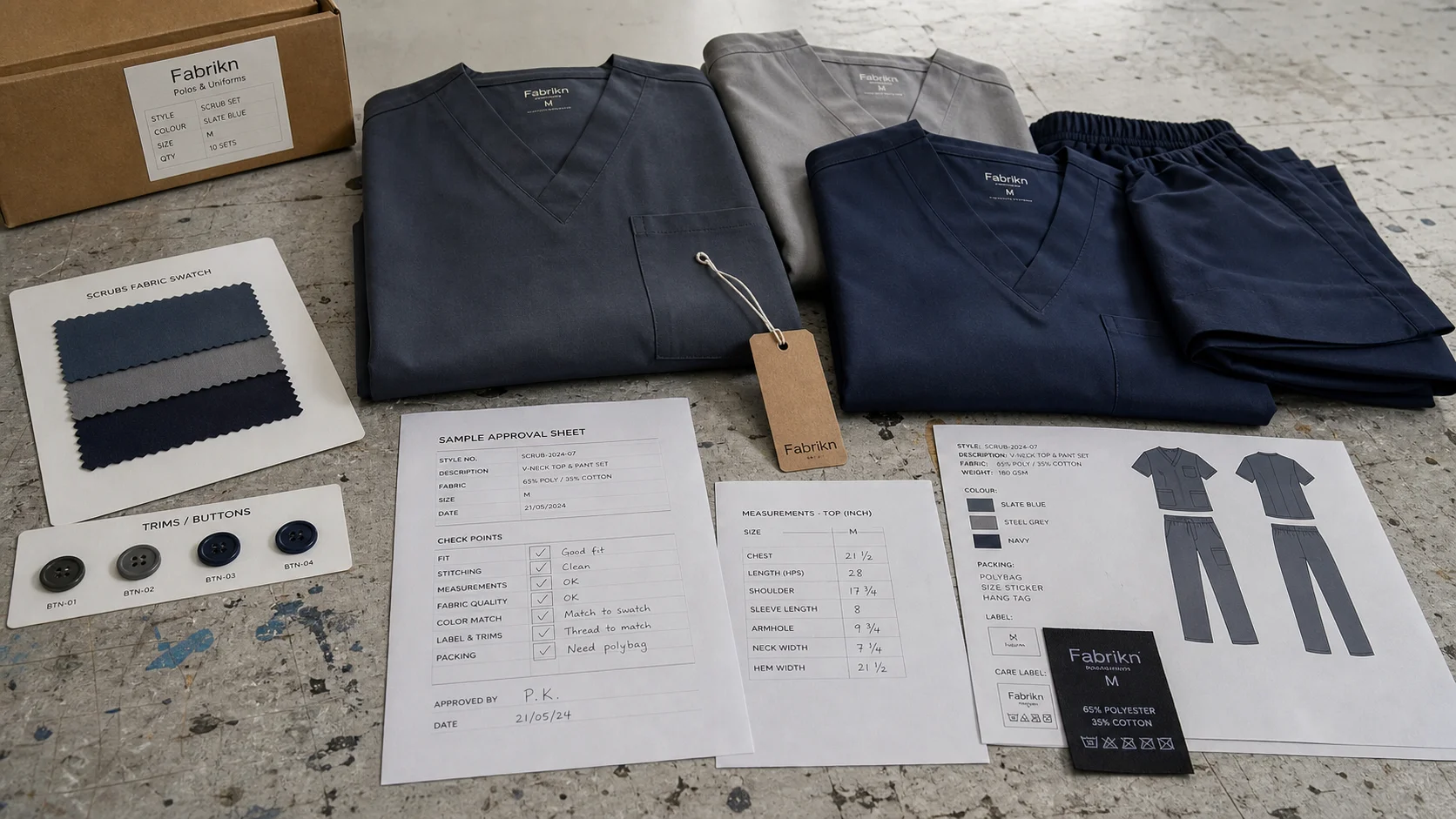
A focused outline for medical uniform brands evaluating private label scrubs sourcing cost, with sections tied to scrub sets, fabric specs, trims, compliance, and production cost drivers.
Private Label Scrubs Sourcing Cost for Medical Brands - Fabrikn production reference
Private label scrubs sourcing cost for medical uniform brands is rarely just a fabric-and-sewing question. It is a full cost stack that includes product development, fabric performance requirements, trim choices, pattern complexity, order volume, inspection controls, packaging, and freight planning. In a typical woven scrub program, FOB cost can shift by $1.20 to $3.50 per set once lab dips, fit revisions, added pocket operations, branded trims, carton rules, and final inspection are included. Brands that underestimate any one of these layers often end up with a quote that looks competitive at first and becomes expensive after revisions, testing, delays, or quality claims.
For medical apparel, cost pressure is constant. Buyers want softness, durability, stretch, color consistency, and a professional fit, but target price points are usually tight. In many mid-market programs, brands try to keep FOB scrub tops near $5.50 to $9.00 and pants near $6.50 to $10.50 at 500 to 1,000 pieces per style-color. That makes sourcing discipline more important than headline FOB price. A low quote on private label scrubs can easily hide weaker fabric recovery, unstable dye lots, pocket construction issues, or limited size grading support. Those problems show up later as returns, reorder friction, and margin loss.
Scrubs sit in a practical part of the apparel market. Purchasing teams usually care less about trend storytelling and more about wear life, wash performance, and repeatability. That changes how costs should be evaluated. Fabric weight, fiber blend, shrinkage tolerance, bartack placement, seam durability, and trim standardization matter as much as aesthetics. Typical buyer tolerances are often within 3% to 5% for shrinkage after wash and within 0.5 to 1.0 inch on key POMs depending on size. In many cases, the cheapest supplier is not the lowest-cost option over a full selling season.
Medical brands entering private label production should expect cost to move based on style count, color count, size range, and the level of customization requested. A basic V-neck top and jogger pant program with stock fabric and standard trims will source very differently from a multi-style collection with antimicrobial claims, contrast panels, custom packaging, branded elastic, and broad inclusive sizing. Adding extended grading such as XXS to 5XL, for example, commonly increases pattern and marker complexity and can add 3% to 8% to fabric consumption on the upper size break. The larger the development brief, the more the hidden cost categories matter.
If your team is still mapping supplier capabilities, it helps to review a manufacturer’s production support scope before discussing commercial terms. Fabrik’s services page is a useful reference point for the kinds of sourcing and development functions buyers often need in a private label program, including tech pack review, trim sourcing, PP sample control, and final AQL inspection planning.
The main cost drivers for private label scrubs are not complicated, but they interact in ways that buyers sometimes overlook. The first layer is product construction. A scrub top with one chest pocket and side vents is cheaper to make than a style with multiple utility pockets, hidden compartments, pen holders, contrast piping, and shaped paneling. Every added operation increases labor minutes. A basic V-neck top may run around 18 to 24 SAM, while a more detailed top with multiple pockets and piping can reach 28 to 36 SAM. That directly affects cut-make-trim cost.
The second layer is material specification. Scrubs are frequently sourced in polyester-rayon-spandex or polyester-cotton-spandex blends, often with weights around 160 to 220 GSM depending on hand feel and coverage target. Common constructions include 72/21/7 poly-rayon-spandex twill, 64/33/3 poly-cotton-spandex plain weave, and 100% polyester mechanical-stretch dobby for more price-sensitive programs. Mechanical stretch woven options can reduce elastane cost in some cases, but may not deliver the same recovery or comfort. Brushed finishes, peached hand feel, moisture management, antimicrobial treatments, and wrinkle resistance all add cost, and not every finish performs equally after repeated industrial or home laundering. Typical finish add-ons can range from $0.20 to $0.80 per yard depending on chemistry and minimums.
Order scale is another major factor. Small runs push up cost because fabric booking, marker planning, line setup, and quality management are spread across fewer units. For most private label scrub programs, lower MOQs usually come with higher per-piece pricing, fewer fabric options, or limits on customization. It is common to see a $0.70 to $1.80 per piece increase when moving from a 1,000-piece order to a 300-piece order in the same fabric and construction. Buyers often need to choose between flexibility and efficiency.
Branding details also matter. Woven labels, printed heat-transfer main labels, size tabs, branded drawcord tips, logo embroidery, custom polybags, barcode stickers, and retail-ready packaging each look minor in isolation. Together, they can materially change the final unit cost. As a typical guide, a woven main label and size tab set may add $0.08 to $0.18, embroidery can add $0.35 to $1.20 depending on stitch count, and custom printed polybags with suffocation warning and barcode sticker often add another $0.12 to $0.30 per piece. Medical uniform brands selling through distributors or hospital groups may need simpler packaging than DTC brands, and that choice can protect margin.
Compliance and testing can also affect the sourcing budget. If the brand requires colorfastness testing, dimensional stability reports, seam strength checks, or restricted substance screening, suppliers may build those costs into development or production pricing. Common buyer requirements include OEKO-TEX STANDARD 100 chemical compliance for fabrics, WRAP or BSCI social compliance for facilities, and GOTS for organic cotton programs when applicable. Third-party fabric or garment testing commonly adds about $150 to $400 per report, and needle policy, metal detection, and carton drop-test requirements may add process time even when the direct fee is low. That is usually money well spent when consistency matters.
Private label scrub pricing varies by region, order size, fabric program, and product complexity, so no blanket number fits every sourcing situation. Still, practical budgeting ranges help brands evaluate early supplier conversations.
For a basic private label scrub top in standard woven stretch fabric with simple branding, many sourcing programs fall in a rough FOB range of about $5.25 to $8.50 per piece at 500 to 1,000 pieces per style-color. Matching scrub pants often land around $6.25 to $9.75 per piece, depending on waistband construction, pocket count, cuff styling, and fabric consumption. Jogger silhouettes usually cost more than straight-leg basics because of cuff operations, elastic application, and pattern shaping, often adding about $0.60 to $1.40 per piece over a straight-leg equivalent.
Premium programs can move much higher. If the brand requests specialty finishes, elevated hand feel, detailed branding, broad size grading, and more rigorous packaging, scrub tops may reach $9.50 to $14.00 or more, with pants moving into roughly $10.50 to $16.50 or higher. Programs using peached 4-way stretch woven fabric, YKK zippers on cargo pockets, branded silicone-dipped drawcords, and fold-pack retail presentation usually sit at the upper end of those ranges. Those figures are not guarantees. They are working ranges that help filter unrealistic expectations.
Extremely low quotes deserve scrutiny. A number that looks far below market often signals one of several tradeoffs: lower fabric weight than spec, weaker stretch recovery, minimal allowance for defects, simplified construction, untested trims, or assumptions that the buyer will accept color variation. For example, a supplier quoting $4.00 to $4.75 FOB for a woven stretch scrub top at 500 MOQ may be assuming 145 to 155 GSM instead of 180 to 190 GSM, no enzyme wash, fewer bartacks, and no third-party inspection. The quote may still be valid, but it needs line-by-line confirmation.
Buyers should also separate FOB, EXW, and landed cost discussions. A supplier may quote attractively on an EXW basis while leaving local transport, export handling, documentation, freight, and destination charges outside the headline number. For medical uniform brands planning a realistic margin model, FOB is usually a clearer starting point than EXW, and landed cost is the number that matters most. As a typical working example, a $7.20 FOB scrub top can become $8.10 to $9.00 landed before domestic fulfillment once duty, brokerage, and inbound freight are added.
MOQ is one of the first commercial pressure points in scrub sourcing. Most factories prefer volume because fabric procurement and line planning become more efficient with scale. For private label scrubs, a typical MOQ can range from 300 to 1,000 pieces per style-color, with some suppliers offering flexibility closer to 150 to 300 pieces when stock fabric and standard trims are used. Programs with custom-dyed fabric, multiple branded components, or specialized finishes often require higher commitments, and custom fabric runs commonly start around 800 to 1,500 meters per color depending on mill policy.
It is important to clarify what MOQ actually means. Some suppliers quote MOQ per style, others per color, and others per total order with restrictions on size ratio. A brand may hear “300 pieces MOQ” and assume broad flexibility, only to learn later that the factory expects 300 pieces per color for each style. That changes inventory exposure immediately. It is also common for factories to limit size splits below 5% per size because very small marker ratios can create cutting inefficiency and leftover stock risk.
Medical brands launching a new scrub line often do better with fewer colors and fewer silhouettes in the first order. Concentrating volume into two tops and two pants can lower unit cost more effectively than spreading the same order budget across eight SKUs. In practice, moving from eight style-colors at 150 pieces each to four style-colors at 300 pieces each can trim $0.50 to $1.25 per unit through better fabric yield and line efficiency. The tradeoff is reduced assortment breadth, but the gain is cleaner production execution and better reorder clarity.
Stock-supported fabrics can help lower MOQ. If a supplier already books a proven scrub fabric in core shades such as navy, black, ceil blue, or wine, the brand may avoid custom dye minimums. That is useful for market testing. Custom shades, by contrast, can trigger fabric MOQs measured in hundreds or thousands of meters, which may exceed the garment MOQ itself. Buyers should also confirm whether the supplier is using mill stock greige plus dye-to-order, because lab dip approval can add 4 to 7 business days before bulk fabric is released.
Sampling is where many first-time buyers underbudget. Private label scrub development usually includes pattern creation or adjustment, size spec alignment, proto sample, fit sample, revised fit sample, salesperson sample or photo sample in some cases, pre-production sample, and approval comments at each stage. If fabric or trim substitutions are still open, sampling rounds can multiply quickly. A standard calendar is often 5 to 7 business days for proto sampling, 7 to 10 business days for revised fit samples, and another 5 to 7 business days for PP sample approval once bulk fabric and trims are confirmed.
Typical sample charges for scrubs may range from around $50 to $150 for straightforward styles and can go higher when specialty fabrics, embroidery, or repeated revisions are involved. For more detailed jogger pants or contrast-panel tops, sample costs commonly land around $80 to $180 per piece, while courier charges can add $25 to $60 per shipment depending on weight and destination. Some suppliers refund sample costs against a bulk order; others do not. Buyers should clarify that policy before development starts.
Pattern and fit work also deserve close attention because scrub customers are sensitive to mobility and pocket placement. Common checkpoints include chest ease, hip ease, rise depth, inseam tolerance, armhole mobility, and whether pens, phones, or badge reels pull the garment out of shape in wear trials. If the supplier digitizes patterns in Gerber AccuMark or Lectra and grades a full size run before production, fit consistency is usually more reliable than manual grading done only on a base size.
Pre-production cost is not only about samples. Buyers should ask whether the supplier charges separately for lab dips, strike-offs, embroidery tape-outs, screen fees for heat transfers, wash tests, or pattern amendments after fit sign-off. Typical lab dip charges may be waived in bulk, but embroidery digitizing often costs around $20 to $60 per logo and heat-transfer setup can add another $30 to $80. These are not large numbers individually, but they often appear late if the development process is loose.
Fabric is usually the single largest cost component in a scrub garment, and small specification changes can materially affect margin. Common scrub fabrics include 72/21/7 polyester-rayon-spandex twill, 74/19/7 polyester-rayon-spandex plain weave, and 64/33/3 polyester-cotton-spandex blends in the 170 to 210 GSM range. At typical order volumes, base fabric cost can range from roughly $1.80 to $3.80 per yard for standard woven blends, while peached, high-stretch, or certified specialty fabrics can move beyond $4.50 per yard.
Construction details matter because they affect both wear life and sewing cost. A common scrub pant may use 1 cm seam allowances, 4-thread overlock seam assembly, single-needle topstitching, bartacks at pocket corners, and 1.5 to 2.0 inch elastic inside a tunnel waistband. Switching to flat-felled seams, double-needle topstitching, hidden zipper pockets, or mesh pocket bags can improve performance but usually adds labor and trim cost. Buyers should specify stitch density, SPI targets, and bartack count at stress points rather than leaving them open to interpretation.
Trim choices also add up quickly. Basic dyed-to-match drawcords are usually inexpensive, but branded cord ends, logo snaps, molded zipper pulls, and printed waistband elastic can add $0.20 to $0.90 per piece depending on order size. If zippers are required, common sourcing practice is to specify a known supplier such as YKK, SBS, or other approved equivalent, because low-grade coil zippers are a common failure point on cargo scrub pants.
Performance claims need to be treated carefully. Moisture management, anti-odor, stain release, and antimicrobial finishes are all common requests in medical apparel, but each one should be tied to a test method and expected wash durability. A finish that performs for 5 washes is commercially different from one that remains effective for 30 or 50 home-laundry cycles. If the brand uses organic cotton content, GOTS certification is the relevant chain-of-custody check, while OEKO-TEX STANDARD 100 is commonly used to support restricted-substance expectations on fabrics and trims.
Production timing for private label scrubs usually depends on fabric readiness, trim approval, line availability, and the number of active SKUs. For repeat orders in stock fabric with no construction changes, a typical lead time is often 18 to 22 business days after PP sample approval. For first orders with custom dyeing or multiple branded trims, 35 to 55 business days is more common because lab dips, bulk fabric weaving or booking, trim development, and line scheduling all have to align.
Capacity tradeoffs matter because scrub programs often look simple on paper but become operationally heavy once sizes and colors multiply. A factory may be able to sew 8,000 to 15,000 simple tops per month on a dedicated line, but output falls when the order includes jogger cuffs, many pocket variations, or frequent color changes. Cutting is typically done with straight-knife or automatic spreader and cutter systems, while sewing lines commonly rely on JUKI single-needle lockstitch, overlock, bartack, and Kansai special elastic-waist machines. More operations mean more balancing pressure on the line.
Lead time also depends on approval discipline. Delays in size spec confirmation, label artwork, polybag text, carton markings, or wash-care content can easily push production back by 3 to 7 business days. If custom shades are involved, a failed lab dip or bulk shade band approval can add another week. Buyers should confirm the exact start point for lead time counting, because “30 days production” may mean 30 days only after all fabric, trims, and PP comments are cleared.
Rush production is possible in some programs, but it usually carries tradeoffs. Expedited orders may require overtime, smaller line runs, air shipment of trims, or use of available stock fabric instead of custom fabric. Those choices can add $0.40 to $1.50 per piece in manufacturing cost before freight is considered, so the speed premium should be compared against the value of earlier inventory arrival.
Quality control costs are often underestimated because they are not always visible in the initial quote. In scrub production, common defect risks include uneven shade between lots, seam puckering, skipped stitches at pocket edges, twisted legs on joggers, elastic tunneling issues, and inconsistent placement of chest pockets or cargo pockets. If the brand does not define checkpoints early, these issues are discovered later when fixes are more expensive.
A practical QC flow usually includes fabric inspection, inline sewing checks, measurement audits, and final random inspection before shipment. Many buyers use a 4-point fabric inspection system at incoming stage and AQL 2.5 for final inspection, though some hospital or institutional programs request AQL 1.5 on critical appearance or measurement criteria. Useful checkpoints typically include GSM verification, shade continuity, shrinkage wash test, seam strength, SPI consistency, bartack security, zipper function, label accuracy, and carton assortment count.
Inspection cost itself is usually modest compared with claim cost. A third-party final inspection may cost around $250 to $400 per man-day, while an in-line inspection day can be in a similar range depending on provider and country. By comparison, one failed shipment with 8% to 12% measurement nonconformance or major shade variation can wipe out the savings from choosing the cheapest supplier. This is why many experienced buyers build one inline checkpoint at 20% to 30% output and a final inspection at 80% to 100% packed quantity.
Compliance records also matter in vendor selection. Common sourcing requirements include WRAP or BSCI social audit status, needle control logs, metal detection policy for packed garments when metal trims are used, and documented CAPA procedures for recurring defects. These are not only paperwork items. They indicate whether the supplier has the discipline to repeat acceptable quality over multiple purchase orders.
True landed cost goes beyond the quoted garment price. Medical brands should build a model that includes FOB or EXW price, inland transport, export documentation, origin handling, freight, insurance, duty, customs clearance, destination drayage if applicable, warehouse receiving, and any relabeling or fulfillment prep fees. A common mistake is to focus on a $6.80 FOB pant and ignore the additional $0.90 to $2.20 per unit that can appear before the goods are ready to sell.
Packaging assumptions should also be included. Individual polybags, size stickers, master carton quality, hanger use, fold boards, and barcode labeling all affect cost and cube. For example, upgrading from simple flat pack to retail fold pack with insert card and branded outer sticker can add $0.20 to $0.55 per piece and may reduce pieces per carton, which increases freight cost per unit. Carton dimensions and packing ratio are small details that become large numbers over a full container.
Freight mode has a major impact on landed cost and should be planned early. Ocean freight usually offers the lowest unit cost for replenishment orders, while air freight can add several dollars per garment on lower-volume urgent shipments. As a rough planning range, moving a 5,000-piece scrub order by air instead of ocean can add $2.50 to $5.00 per piece depending on weight, season, and route. That is why lead-time reliability is financially important, not just operationally convenient.
Brands should also reserve a buffer for claims, rework, and payment terms. If a supplier requires 30% deposit and 70% before shipment, the carrying cost differs from a program using net terms after receipt. Even a conservative landed-cost sheet should include an allowance for testing, inspection, and a small defect reserve, often 1% to 3% of order value for planning purposes on newer vendors.
The most effective way to reduce sourcing cost is usually simplification, not aggressive price negotiation. Standardizing fabric across multiple tops and pants can improve mill booking efficiency and reduce leftover liabilities. Many brands save more by using one core 190 GSM woven stretch fabric across six SKUs than by pushing for a $0.10 sewing concession on every style.
Construction standardization helps too. Reusing the same pocket bag shape, waistband elastic width, drawcord type, care label format, and carton spec across the line can trim both development cost and bulk errors. Removing one unnecessary pocket or replacing a custom metal trim with a dyed-to-match plastic alternative often saves $0.15 to $0.60 per unit without affecting perceived value in the market.
Order planning also matters. Consolidating colors into core shades such as navy, black, ceil blue, and wine can improve MOQ efficiency and reduce custom dye risk. If the brand needs fashion colors, it is often more cost-effective to test them in a second order after core fits and reorder demand are proven. This approach typically shortens the first-order calendar and reduces exposure to dead stock.
Quality discipline is another cost lever. Approving a clear tech pack, graded spec, stitching requirements, and packaging SOP before production starts is usually cheaper than solving preventable defects after bulk completion. Brands that lock PP comments, inspection checklist, and labeling details before cutting commonly avoid the rework costs that make a low FOB quote expensive in practice.
Buyers should ask for more than a target price. A useful supplier discussion should cover fabric composition, GSM tolerance, stretch and recovery standard, shrinkage expectation, colorfastness performance, pocket construction method, seam type, and recommended wash care. If the supplier cannot explain whether a scrub pant uses 4-thread overlock with single-needle topstitch or where bartacks are placed, the quote is not detailed enough for comparison.
Commercial questions should also be specific. Ask for MOQ by style-color, sample charge policy, FOB versus EXW basis, expected lead time from PP approval, and what assumptions are built into the quote. It is common to request a cost breakdown by fabric, trim, CMT, packaging, and testing so that later value engineering is possible without guessing.
Operationally, buyers should ask which approvals are on the critical path. Typical examples include lab dip approval, bulk fabric booking, embroidery strike-off, label artwork sign-off, and PP sample confirmation. A supplier that can map these dependencies clearly is usually easier to manage than one that offers only a broad production promise.
Compliance questions are equally important. Ask whether the factory or nominated partners hold WRAP or BSCI audit records, whether fabrics can be supplied with OEKO-TEX STANDARD 100 documentation, and whether GOTS chain-of-custody is available if organic cotton is part of the program. Those details help filter serious suppliers from traders quoting beyond their control.
Get a free quote from Fabrikn — your trusted B2B clothing manufacturer with 10+ years of experience. MOQ as low as 200 pieces.
Get a Free Quote →What is a typical starting MOQ for private label scrubs? For stock fabric programs, 300 to 500 pieces per style-color is common, while more flexible suppliers may accept 150 to 300 pieces with limited customization. Custom-dyed fabric or multiple branded trims often push the practical MOQ closer to 800 to 1,000 pieces per style-color.
How much do private label scrub samples usually cost? Straightforward tops and pants often cost about $50 to $150 per sample, while more detailed or revised samples commonly reach $80 to $180 plus courier. Embroidery digitizing, heat-transfer setup, or lab dip fees may be charged separately unless they are credited back against bulk.
How long does production usually take? Repeat orders in approved stock fabric commonly take 18 to 22 business days after PP approval. First orders with custom dyeing, new trims, or several style-color combinations usually take 35 to 55 business days, depending on approval speed and fabric readiness.
Which certifications are relevant for scrub sourcing? OEKO-TEX STANDARD 100 is commonly requested for restricted-substance confidence on fabrics and trims, GOTS applies when certified organic cotton is used, and WRAP or BSCI are typical social compliance references during supplier screening.
What quality checks matter most for scrubs? Common checkpoints include GSM, shade consistency, shrinkage after wash, seam strength, stretch recovery, SPI, bartack security, zipper function, measurement tolerance, and final AQL inspection results. These checks are especially important on pocket-heavy styles and jogger constructions.