
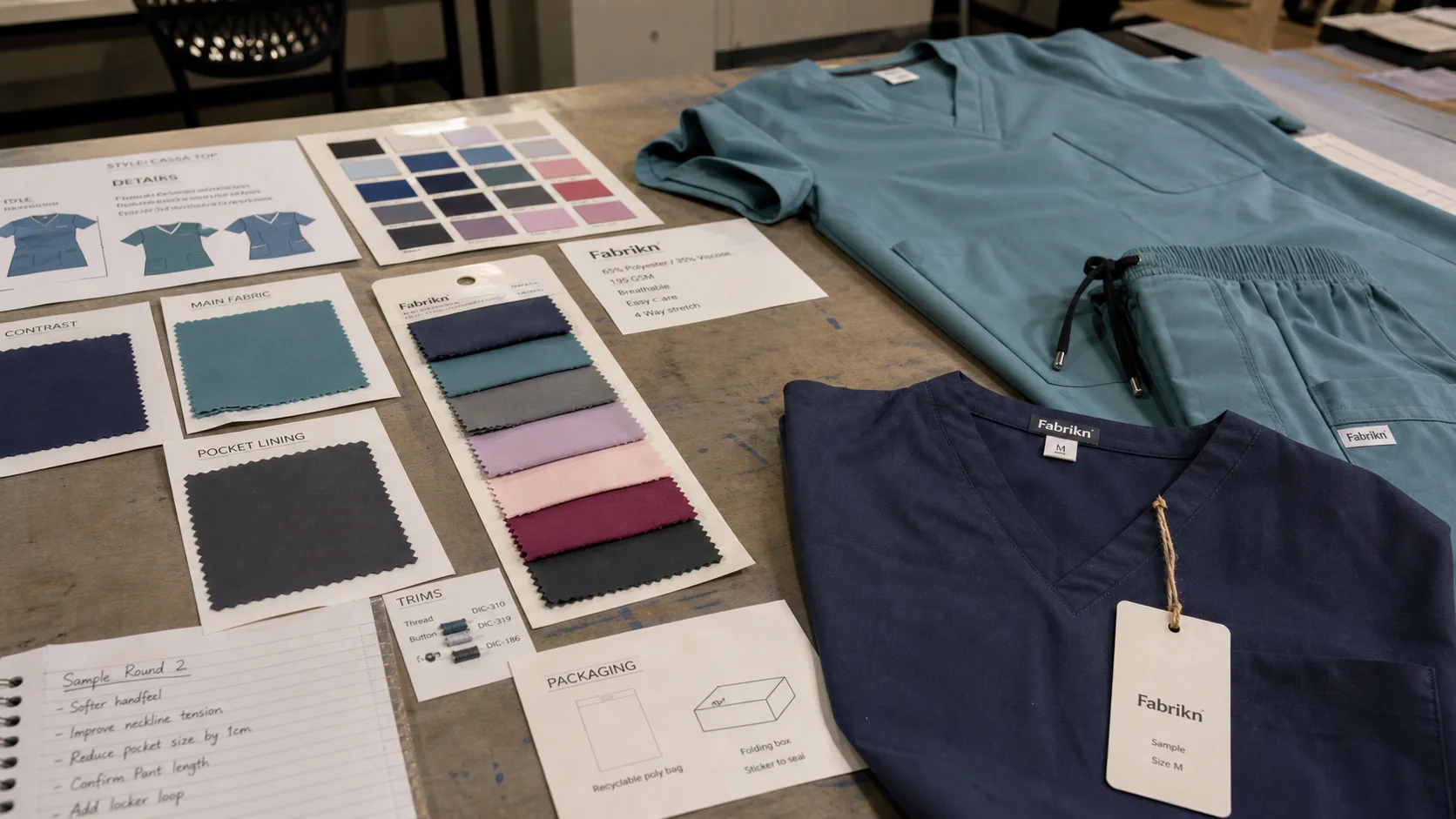
A practical outline for nursing retailer buyers evaluating wholesale scrubs size grading, fit consistency, cost impact, and sourcing decisions across MOQ-sensitive programs.
Wholesale Scrubs Size Grading for Nursing Buyers - Fabrikn production reference
Nursing retailers do not usually lose margin on scrubs because the category is weak. They lose margin because the size architecture is wrong, the grading is inconsistent, and replenishment decisions are made too late. In wholesale scrubs, size grading is not a technical side issue handled only by pattern teams. It is a buying issue, a fit issue, and a stock-risk issue that directly affects sell-through. In common private-label scrub programs, a 2-4 point rise in return rate caused by fit inconsistency can erase the apparent savings from choosing a supplier that is only $0.30-0.60 per unit cheaper.
For nursing retailer buyers, the term “wholesale scrubs size grading” covers the planned measurement changes between sizes across tops, pants, jackets, and unisex or gender-specific fits. A supplier may offer attractive pricing and acceptable fabric quality, yet still create return pressure if the grade between sizes is too aggressive in the hip, too tight in the bicep, too short in the rise, or poorly balanced between top and bottom. Typical scrub fabrics in this category include 65/35 polyester-cotton poplin at 145-160 GSM for value lines and 72/21/7 polyester-rayon-spandex or 90/10 polyester-spandex stretch woven at 170-210 GSM for mid-range programs.
That matters even more in medical apparel because scrub users work long shifts, move constantly, and often buy for practical repeat use. If the size jump from medium to large is too small, customers size up twice. If the inseam grading is too flat, tall users abandon the line. If the neckline, shoulder, and thigh ease are not aligned with actual wear conditions, the garment may technically match the chart while still failing in use. Common inseam splits are 28-29 inches for petite, 30-31 inches for regular, and 33-34 inches for tall, with some suppliers adding 0.5 inch tolerance on finished inseam after wash and pressing.
Buyers evaluating factories or private label programs should treat size grading as part of sourcing control, not a late-stage correction. The right supplier should be able to explain its base size, grade rules, fit block logic, tolerance standards, and sample approval flow with clarity. If that information is vague, the risk usually appears later in the form of inconsistent packed goods. Typical tolerance standards for woven scrub tops are often ±0.5 inch on chest, waist, and hip, and ±0.25 inch on shoulder width and neck opening, though buyers should confirm whether these are garment tolerances or pattern tolerances.
Retailers comparing suppliers can also use grading review as a shortcut to judge operational maturity. A factory or vendor that can organize fit comments, spec sheets, pattern revisions, and size-set approvals is usually easier to work with across repeat orders. Buyers should also ask whether the supplier controls patterns in Gerber AccuMark, Lectra Modaris, or a similar CAD system, because digital pattern control makes repeat POs more stable than manual pattern edits. Buyers exploring support options for development and production coordination can review service details at https://fabrikn.com/services/.
Size grading is the method used to increase or decrease a garment pattern from a base size into a full size range. In scrubs, that usually means adjusting chest, waist, hip, sweep, shoulder width, armhole, sleeve opening, body length, rise, thigh, knee, leg opening, and inseam according to a pre-set rule. In production, those grade rules are typically nested in CAD before marker making, then checked again at sample stage against a graded spec sheet.
Many buyers see a size chart and assume grading is settled. It is not. A size chart only shows the target finished measurements or body measurements. The grade rule behind it determines whether each size grows in a balanced way. That is where wholesale scrub programs often differ. Common sourcing practice is to request both the finished measurement chart and at least one graded nest or grade rule table for review before bulk approval.
A common example is a women’s V-neck scrub top built from a medium base size. The supplier may grade the chest by 2 inches per size, waist by 2 inches, hip by 2 inches, shoulder by 0.5 inch, and body length by 0.5 inch. Another supplier may use similar chest grading but less increase at the hip and no length change at all. Both charts can look acceptable on paper, but one may fit a wider customer base while the other creates stress points around movement. For a typical woven V-neck top with side vents, buyers often see a medium finished chest around 40-42 inches, body length around 27-28.5 inches, and sleeve opening around 14-15 inches.
In scrub pants, grading decisions are just as important. Buyers should review not only waist grading, but also hip ease, front rise, back rise, thigh room, and inseam options. A vendor that grades waist cleanly but compresses thigh increments can create complaints from wearers who squat, bend, or move equipment all shift. On jogger or tapered pants, common checkpoints include front rise increase of 0.25-0.375 inch per size, thigh increase of 0.75-1 inch per size, and leg opening control so the cuff does not become too tight at XL and above.
Grading also needs to reflect the fit concept:
If the garment category, fabric stretch, and intended wearer are not aligned, the grade becomes unstable. That leads to a familiar sourcing problem: one size fits well during salesman sample review, but the extended size run underperforms at retail. Buyers should therefore ask whether fit samples and pre-production samples were sewn in the same fabric composition and GSM as bulk, because grading feedback is less reliable when the fit sample uses substitute fabric.
Retail buyers need grading consistency because scrubs are often replenishment products rather than one-time fashion purchases. Repeat sales depend on customer confidence. When a nurse buys a medium top and medium pant in one color, then finds the same nominal size fits differently in the next delivery, the retailer absorbs the trust loss. In established scrub programs, buyers commonly track returns by size and style, and a shift of even 1.5-2.0 percentage points in fit-related returns is usually enough to trigger a pattern review with the supplier.
There are four practical business effects tied to grading quality.
Accurate grading helps each size serve a real body range. Poor grading compresses demand into only a few workable sizes. That leaves slow stock in fringe sizes and shortages in the middle. A common planning ratio for core women’s scrub tops might cluster 55-70% of units in S, M, and L, so if the M-L grade is off, the distortion affects the highest-volume sizes first.
A scrub set may pass workmanship inspection and still be commercially wrong if the fit is inconsistent. Returns caused by “too tight in hip,” “pants too short,” or “top too boxy” are often grading issues, not sewing failures. Many buyers treat anything above roughly 5-8% fit-related return rate in replenishment styles as a signal to recheck grade rules, especially on newly introduced size blocks.
When the grade is stable and proven, buyers can place cleaner assortments by store, channel, or customer type. A retailer serving hospital group orders may need a different ratio from an online scrub boutique. Grading confidence makes those decisions easier. For example, hospital uniform programs often skew more heavily to unisex core sizes, while DTC e-commerce programs more commonly require separate petite, regular, and tall inventory planning.
Reliable grading supports continuity. If the supplier quietly changes the pattern block or grade rule between purchase orders, the retailer faces hidden risk even if the fabric and color remain the same. Buyers should ask for pattern revision history or at minimum a version-controlled spec sheet on every reorder, which is common practice when suppliers manage patterns in PLM or CAD-based systems.
For nursing apparel, fit consistency often matters as much as styling. Buyers should treat size grading documents as commercial control points, not just technical attachments. A practical control point is to compare the current PO spec against the last approved bulk spec line by line before fabric cutting starts.
Most wholesale scrub suppliers do not offer one universal size run. They build assortments based on target market, MOQ constraints, and production efficiency. Buyers should expect variation in how size grading is offered across stock programs and private label orders. Stocked programs typically offer faster repeat fulfillment, while made-to-order private label runs often depend on greige fabric availability, dyeing capacity, trim sourcing, and line booking.
Typical scrub size structures include:
From a buying standpoint, the key question is whether the supplier is using one grade rule across all sizes or shifting to a different pattern strategy for extended sizes. The second method is usually better for fit, but it may increase development time and MOQ. In practice, adding a separate plus block or separate petite-tall pant block often adds 5-10 business days to development because additional pattern grading, fit samples, and size-set review are required.
Core programs often have lower barriers. For stocked wholesale lines, MOQs may begin around 50 to 150 pieces per color or mixed style order, depending on whether the goods are ready inventory or made to order. Private label scrub developments usually start higher. Buyers commonly see MOQs in the 300 to 1,000 piece range per style-color combination, with some factories willing to negotiate mixed sizes within that total. Specialty categories such as petite-tall splits or extended plus-size blocks may push the effective MOQ upward because the marker efficiency and cutting plan become less favorable. As a typical cost range, basic 65/35 poplin scrub tops and pants often land around $2.50-4.00 per unit at 500-piece MOQ, while stretch scrub sets with branded trims, antimicrobial finish, or jogger construction commonly run $6.50-11.00 per unit at similar volumes.
That does not mean buyers should avoid wider size runs. It means they should evaluate size architecture against realistic order volume. Offering too many sizes without enough throughput creates dead stock risk. Offering too few creates lost sales and channel frustration. A common sourcing compromise is to carry full extended sizes online or for institutional orders while limiting store-floor depth in fringe sizes until reorder data is established.
This is where many scrub buying programs become expensive without intending to. Retailers may request broad inclusivity, but the sourcing structure is often built around a single base pattern and simplified grade increments. That shortcut rarely performs well across all body types. In manufacturing terms, separate blocks mean more pattern work, more sample iterations, more markers, and often lower cutting efficiency, so buyers should budget for both higher development cost and a slightly longer approval calendar.
Extended sizes should not always be treated as a simple continuation of standard grade increments. Once the size range moves beyond the core block, proportion changes often need adjustment in armhole depth, sleeve width, body length, neckline drop, rise, thigh, and seat shaping. A vendor that merely adds inches evenly around the garment can produce a larger scrub that still fits poorly in motion. Common practice is to rebalance the block from around 1X or 2X onward rather than extending the missy block unchanged through 5XL.
Buyers should ask whether plus sizes use:
Construction details matter here as well. On plus-size pants, buyers often get better wear performance when the waistband includes 1.5-2 inch elastic plus a drawcord channel, and when the crotch seam is reinforced with 4-thread overlock and a lockstitch or coverstitch finish at high-stress points. These are common build choices in scrub factories focused on repeat-use durability.
Petite and tall programs are not only about changing inseam. In better-developed scrub blocks, petite sizes may also reduce front rise, back rise, knee position, pocket placement, and top body length, while tall sizes may increase those points proportionally. A supplier that only changes inseam can still leave the garment visually and functionally off-balance. Typical increments are 1.5-2 inches between petite and regular inseam and 2-3 inches between regular and tall, with corresponding knee placement shifts of roughly 0.75-1.25 inch.
From a sourcing standpoint, petite and tall options also affect marker utilization and bundling during cutting. Because the same style may require multiple length markers, factories often need a higher effective volume before they can quote the same FOB price as regular-only pants. Buyers should therefore confirm whether petite and tall are priced at parity or carry a common surcharge of around $0.20-0.60 per unit at smaller MOQs.
Unisex scrubs can simplify inventory, but they are not automatically easier to fit. Most unisex blocks are built with broader shoulders, straighter side seams, and more seat ease, which can work well for institutional accounts but may underperform in fashion-oriented retail channels. Common unisex tops are cut with a boxier chest-to-hip ratio and less waist shaping, while unisex pants often depend on elastic waist plus drawcord to absorb body variation.
Buyers considering unisex programs should ask whether the supplier uses the same shoulder slope, sleeve pitch, and rise balance across the whole range or has adjusted the block after wear-test feedback. In practical sourcing terms, unisex can reduce SKU count, but it does not remove the need for fit trials across male and female wearers before bulk approval.
Buyers should request a scrub tech pack that goes beyond a simple size chart. At minimum, common best practice is to ask for a graded measurement spec, construction sheet, bill of materials, artwork or trim placement page, and packing method details before sample confirmation.
A useful scrub tech pack commonly includes:
Where relevant, buyers should also request certification copies or audit status. In scrub sourcing, common documents include OEKO-TEX STANDARD 100 for fabric chemical safety, GOTS for organic cotton-based programs, and social compliance audit references such as WRAP or BSCI where the supplier claims them. These do not replace fit control, but they are common checkpoints in vendor qualification.
If the supplier cannot provide a clean measurement spec and construction sheet before sampling, development usually slows later. Typical lead-time dependency is that pattern correction, fabric lab dip or color approval, and trim strike-off approval all need to close before pre-production sample signoff can happen without delay.
MOQ, cost, and grading breadth are tied together. The more blocks, inseam options, and specialty size runs a buyer adds, the more the supplier has to manage in pattern grading, marker planning, cutting, sewing line balance, and packing segregation. Those extra steps are real cost drivers even when the style looks simple.
As a typical market range, stocked basic scrubs may be available below private-label pricing, but for custom development buyers often see FOB costs around $2.50-4.00 per unit for basic woven separates at 500 MOQ, $4.50-7.50 per unit for better-fabric tops or pants with stretch and multiple pockets, and $6.50-11.00 per unit for coordinated premium sets with jogger styling, contrast trims, or specialty finishes. Prices move with fabric blend, GSM, pocket count, embroidery, print, and packaging complexity.
Lead times also vary by program structure. Ready-stock programs can sometimes ship in 3-7 business days. Made-to-order repeats in approved fabric and color often run about 18-22 business days for cutting, sewing, finishing, and packing after material availability is confirmed. New private-label developments commonly take 45-75 days including sampling, approvals, fabric booking, and bulk production, and can extend further if custom dyeing, embroidery digitizing, or separate petite-plus blocks are added.
Buyers should also ask how the supplier prices size complexity. Some quote one average unit cost across all sizes, while others add common surcharges for 4XL-5XL or tall lengths. Clarifying that point before PO issue helps avoid hidden margin erosion on extended-size programs.
Sample approval should not stop at one showroom sample in one size. For scrub programs, a common validation path is proto sample, fit sample, revised fit sample if needed, size set, pre-production sample, and then bulk. Skipping the size set is one of the most common reasons buyers discover grading problems too late.
At fit stage, buyers should validate movement as well as static measurement. Typical wear-test checkpoints include reaching forward, bending, squatting, sitting, and repeated pocket loading. For pants, common failure points are back rise coverage, thigh restriction, and knee placement; for tops, they are bicep comfort, bust pull, shoulder mobility, and gaping at the neckline.
In better-controlled programs, the supplier will measure each sample against the approved spec, then attach a measurement report showing actual versus tolerance. Buyers should also confirm whether samples were cut on the same grainline and sewn with the intended bulk construction, such as 4-thread overlock assembly, single-needle topstitching, bartacks at pocket corners, and coverstitch or twin-needle hems where specified.
Lead time depends heavily on comment turnaround. A typical sample cycle may take 5-7 business days for a simple revision when fabric is already on hand, but 10-14 business days if pattern recutting, new trims, or another wash/finish test is required. Faster approvals are possible, but only when comments are consolidated and clearly marked by point of measure.
Scrub programs often pass basic visual inspection but still fail at retail because the inspection checkpoints are too shallow. Buyers should review both workmanship and measurement control, especially when the order includes multiple size blocks or inseam options.
Common inspection checkpoints include:
For bulk orders, common practice is to run in-line inspection during sewing and final random inspection after pressing and packing. Where buyers use AQL, a typical final inspection level may be AQL 2.5 for major defects and 4.0 for minor defects, though the exact standard depends on the retailer. Measurement checks should include at least a few units per key size rather than only the base size carton.
Another frequent risk is bulk drift after sample approval. This can happen if the factory substitutes elastic width, changes seam allowance handling, relaxes pressing shape, or cuts on a different marker than the approved sample. Buyers should therefore ask whether the pre-production sample was made from bulk fabric and approved before cutting starts, which is a common control point in reliable programs.
Before placing a PO, buyers should ask direct questions that connect fit, cost, and production reality. Common useful questions include:
These questions are useful because they force vague supplier claims into operational details. A capable vendor can usually answer them with a spec sheet, sample timeline, and production assumptions instead of general assurances.
Get a free quote from Fabrikn — your trusted B2B clothing manufacturer with 10+ years of experience. MOQ as low as 200 pieces.
Get a Free Quote →What is a typical MOQ for custom wholesale scrubs?Common MOQs are often 300-500 pieces per style-color for simpler private-label programs, with 800-1,000 pieces more common when buyers want custom fabric, multiple inseam options, or separate plus-size blocks.
How long does scrub production usually take?For repeat styles in available fabric, a common production window is 18-22 business days after approvals. New developments more often run 45-75 days once sampling, material booking, and bulk line scheduling are included.
What fabric is most common for wholesale scrubs?Basic programs commonly use 65/35 polyester-cotton poplin around 145-160 GSM, while mid-range and premium programs often use stretch woven blends such as 72/21/7 polyester-rayon-spandex or 90/10 polyester-spandex around 170-210 GSM.
Do plus sizes need separate grading?Commonly, yes. Better-fitting scrub programs often shift to a separate base block around 1X or 2X instead of extending the missy block unchanged, especially when the range goes to 4XL or 5XL.
Which certifications are relevant in scrub sourcing?Common certifications and audits buyers ask for include OEKO-TEX STANDARD 100 for chemical safety, GOTS for organic cotton programs, and WRAP or BSCI for social compliance review where applicable.