
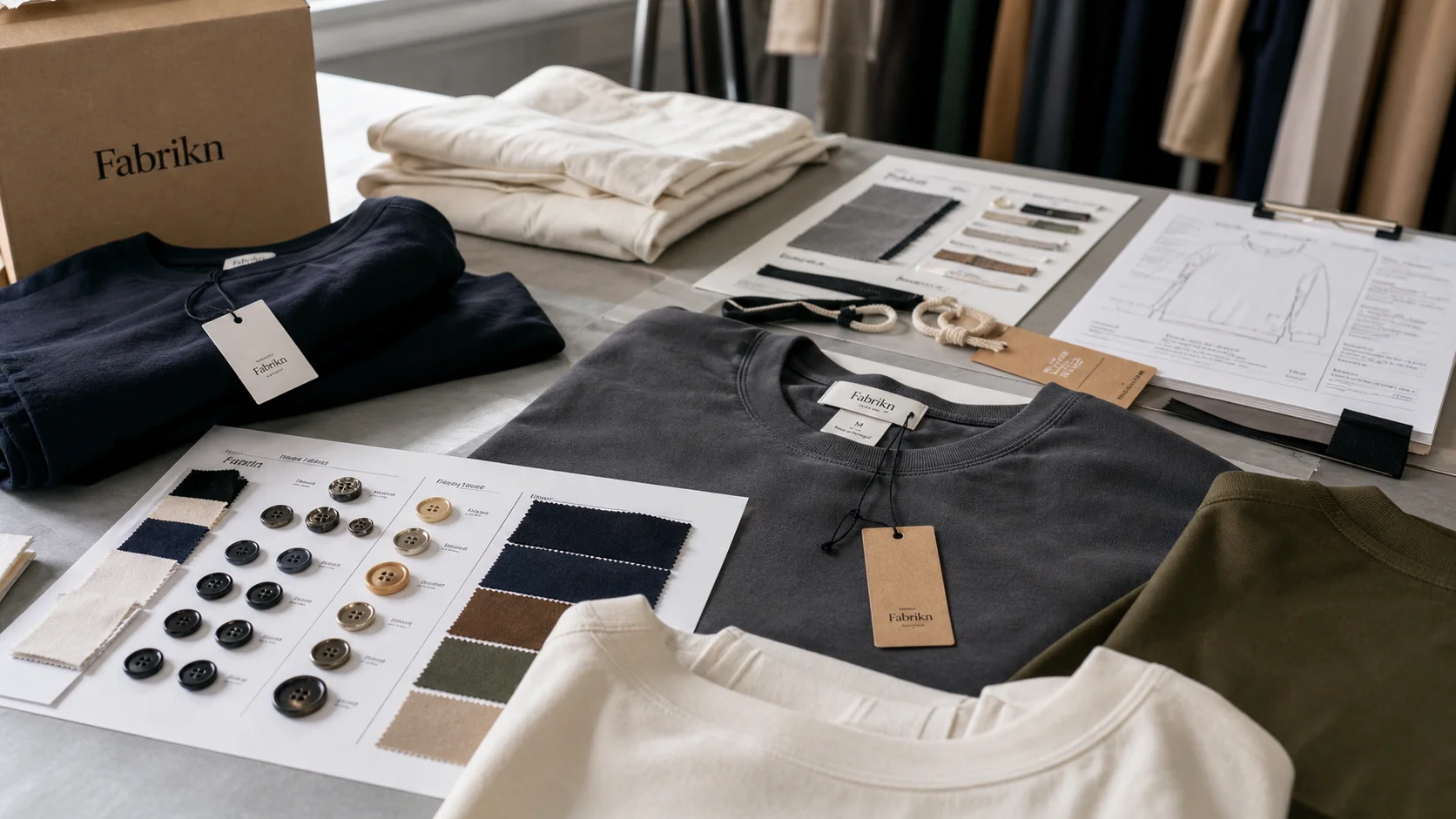
Private Label Clothing Packaging Supplier China with checks for samples, fit, MOQ, QC evidence, pricing terms, and delivery risk.
Fast answer: Private Label Clothing Packaging Supplier China: Costs, Quality should be judged by production evidence, not by a generic sourcing promise. The buyer needs sample proof, cost breakdowns, QC checkpoints, and delivery buffers in writing.
Ask for recent sample photos, measurement tolerances, fabric or print test assumptions, decoration test notes, packing examples, and a named inspection checkpoint. These details show whether the team can repeat an approved sample at bulk volume.
Separate garment cost, decoration, labels, packaging, sampling, testing, freight, and rush charges. When every cost line is visible, it becomes easier to reduce colorways, adjust size depth, or reserve more time for sampling.
Three seconds. That’s all a buyer gives you before deciding whether your product deserves a second look. I’ve watched it happen at trade shows in Shanghai, Los Angeles, and Milan; the garment often hasn’t even been opened yet. So yes, a private label clothing packaging supplier china matters: the wrapper, insert, and tag do part of the selling before the fabric gets touched.
Retail data backs it up. According to U.S. trade guidance on export and sourcing and multiple marketplace audits I’ve reviewed, brands with cleaner, more consistent pack-outs tend to win better wholesale acceptance and fewer intake damage claims. In my own factory visits, boutiques have rejected 200 units of perfectly decent knitwear because the polybags were cloudy, wrinkled, and mismatched in print. Garments fine. Presentation not.
That split matters most in private label clothing, where the margin structure is already tight. For value basics, a 28-35 micron polybag, a simple size sticker, and a folded insert may be enough at $0.06-$0.18 per unit. Premium labels need more. Rigid mailers, branded tissue, foil hangtags, and a calm, precise fold can push landed cost closer to $0.70-$1.80 per set. Same shirt. Different signal.
Here’s the counterintuitive bit from factory visits: smaller garment factories with MOQ 500-1,000 pieces often offer more flexible packaging customization than larger export-only suppliers chasing 20,000-unit apparel programs. Big exporters are efficient, but they can be stubborn about stock cartons, fixed print plates, and standard tissue sizes. Smaller teams, especially around Dongguan and parts of Zhejiang, will sometimes change a mailer color or add a branded sticker for 3-5% more because problem-solving is baked into their workflow.
China can be a cost leader. China can also be a risk market. I’ve seen beautiful packaging from a factory quoting $0.12 per carton and sloppy packaging from a supplier charging $0.46. Country stereotypes are lazy. Supplier selection decides whether your first 500 units look like a brand or a clearance rack mistake. If you’re building private label clothing for boutiques, marketplaces, or department stores, packaging is not an afterthought. It’s part of the product.
A private label clothing packaging supplier china does far more than print a box. The best manufacturer, factory, and supplier teams coordinate printed cartons, mailers, hangtags, tissue paper, stickers, garment bags, size labels, care labels, and protective inserts so every touchpoint feels connected. In practice, they sit between the brand, the garment factory, and the freight forwarder, turning a creative idea into something that survives folding, stacking, compression, and customs handling.
Most buyers first meet a supplier because they need one item, like a poly mailer or a folding carton. Then the order grows. A brand wants 1,000 hangtags at $0.08 each, 2,000 tissue sheets at $0.03 each, and 500 branded stickers for sleeve seals. If the supplier can manage the pack-out logic, the result is cleaner and often cheaper because fewer handoffs mean fewer mistakes. I’ve seen brands save 8-12% on total packaging cost by consolidating work instead of splitting it across three vendors.
The customization ladder is straightforward. Stock packaging is the cheapest: plain mailers, generic cartons, and off-the-shelf tissue. Light branding adds one-color logos, size stickers, or a printed insert. Fully custom printed packaging means custom dimensions, PMS color matching, and embossed or matte finishes. Multi-item branded sets combine several of those pieces, and that’s where a supplier’s coordination skills show up fast.
Buyers often forget to ask about paper weight, ink safety, adhesive performance, foldability, and pack-out efficiency. Those details affect whether a shirt ships flat, whether labels peel in humid transit, and whether the carton closes with 2 mm of tolerance or 12 mm of bulge. For kidswear, I’m stricter still. A supplier serving custom baby clothing manufacturing orders needs stronger compliance discipline because packaging gets handled by parents, warehouses, and carriers multiple times.
Separate the players. Packaging factories are not the same as trading companies, and neither is identical to an integrated garment manufacturer offering packaging as a side service. Factory direct sourcing can be cheaper, while trading companies can help with mixed orders and communication. Integrated garment mills are convenient, but packaging is rarely their core skill unless they have a dedicated packaging line. I usually ask who prints, who laminates, who die-cuts, and who inspects. If the answers stay vague, the supplier is probably reselling capacity rather than controlling it.
I judge packaging quality the same way I judge garment construction: by what fails first. Core checks are color consistency, logo sharpness, die-cut accuracy, glue strength, compression resistance, and moisture tolerance. A carton that looks good in a sales deck can still warp after 72 hours at 85% humidity. A mailer with a crisp logo can still delaminate when a warehouse worker opens it twice.
Material verification should be boring and specific. Ask for GSM on paper, board grade, and coating type. A 250 GSM art card is not the same as 300 GSM duplex board, and an aqueous coating behaves differently from a gloss lamination in transit. If the supplier cannot explain those differences in plain language, I slow down. According to ISO packaging and transport testing references and OEKO-TEX guidance on textile safety, compression and transit performance depend on measurable material properties, not promises.
Regional patterns matter. Coastal export hubs such as Shenzhen and Dongguan usually sample faster, often in 5-7 days for simple items and 10-14 days for custom sets. Inland suppliers may quote 8-15% lower, but they sometimes need tighter communication on specifications because their sample rooms are less export-oriented. That doesn’t make them worse. It means the buyer has to be clearer.
When I visited factories, the red flags were repetitive. Missing QC records. Samples made in a separate workshop that looked nothing like the main production line. Vague claims like “high-quality paper” without a GSM sheet. Reorders that drifted in color or size by 3-5 mm. Those aren’t minor issues. They turn into 2,000-unit headaches when a carton no longer fits the garment fold.
I ask for AQL standards, drop tests, transit tests, and pre-shipment photo evidence. A real supplier should be able to show stacked cartons, corner crush results, adhesive pull checks, and random sample photos from the final pack-out. If they can also show how they handle reprint tolerance and replenishment consistency, I know they understand repeat business. Packaging is not only about the first order. It’s about the fourth one arriving exactly the same.
Packaging pricing looks simple until you break it into pieces. The real cost stack includes raw material, plate or mold fees, printing method, finishing, labor, internal packaging, and export handling. On a clean quote, I want each line item separated. If the supplier only gives one lump sum, I assume there’s room for surprise charges later.
Stock packaging is cheap because the tooling already exists. A plain kraft mailer might cost $0.05-$0.11 each at 1,000 units, while a fully custom printed mailer can climb to $0.18-$0.42 once plates, color matching, and finishing are included. Add a matte laminate, hot foil, or embossed logo, and the price can jump another 15-30%. Small design changes matter more than buyers expect. A 2-color print is not just “slightly more” than a 1-color print. It often changes the whole press setup.
MOQ drives unit price hard. A startup ordering 500-3,000 units pays for setup inefficiency, while a brand ordering 10,000 units plus usually sees much better per-piece economics. I’ve seen folding cartons drop from $0.36 at 1,000 units to $0.14 at 10,000 units with the same board grade and print spec. Rigid boxes are even more dramatic because the hand labor is heavier. Garment bags can sit anywhere from $0.08-$0.22 for stock PE versions to $0.45-$1.10 for custom woven or laminated options.
Hidden costs are the ones that sting. Sampling fees can run $20-$80 per round. Color matching may cost an extra $40-$150 if you need multiple proofs. Special coatings, carton overfill, and packaging rework after size changes can erase the savings from a cheap quote. I’ve watched brands lose $600-$1,200 on a single packaging revision because the garment size changed after the carton die line was approved. If the supplier also handles clothing packaging solutions, ask whether art edits and structural changes are priced separately.
Finishing choices drive price faster than almost anything else. A simple recycled kraft sleeve can be under $0.10 at 5,000 units. A rigid presentation box with soft-touch coating, magnetic closure, and foil stamp can land at $0.90-$2.20 depending on volume. That range is not a typo. The difference is labor, not just material. Brands selling premium denim or cashmere can absorb that. Brands shipping $18 tees usually cannot.
The fastest packaging orders are not the prettiest. They’re the ones with clean specs from day one. A realistic timeline starts with brief and quote, then artwork, sampling, revisions, production, QC, packing, and shipping. For stock items, I’ve seen a 7-10 day cycle from deposit to dispatch. Fully custom printed packaging usually takes 20-35 days, and that can stretch if the buyer keeps changing logos, colors, or carton sizes.
Sampling speed is a useful tell. A supplier that can turn around a simple dieline sample in 3-5 days is usually organized. One that needs 2 weeks for a basic paper sleeve is probably understaffed or outsourcing the sample room. Mass production is different. Once the plates are approved and material is in stock, a 5,000-piece mailer order might finish in 10-14 days. A 20,000-piece rigid box job can take 25-40 days, especially if hand assembly is involved.
Peak season changes everything. Chinese New Year can add 1-3 weeks before the holiday and 1-2 weeks after. Q4 retail rush and port congestion can add another 2-6 weeks, especially when buyers wait too long to lock artwork. If you need a faster path, expedited material sourcing or air freight can cut time but add 20-60% to logistics cost. That trade-off makes sense only when a launch date is fixed and retail penalties are real.
I plan packaging alongside garment production, not after it. A carton that arrives two weeks after the clothing creates warehouse chaos and extra double-handling. If the apparel is being built through cut and sew manufacturing, I want packaging dielines approved before bulk sewing starts, not after. That keeps size labels, fold dimensions, and pack ratios aligned. The cheapest freight is the freight you only pay for once.
China is not one sourcing market. It’s several, and the differences are material. Shenzhen tends to be strongest on export maturity, speed, and communication. Dongguan often balances cost and service well. Ningbo is efficient for paper-based packaging and port access. Inland regions can offer lower labor costs, sometimes 10-18% below coastal quotes, but the buyer may need to work harder on sampling detail and QC discipline.
Factory-direct sourcing usually gives better margins because one layer of markup disappears. Trading companies can still be useful if you need mixed orders, fast translation, or coordination across more than one factory. I’ve worked with both. Direct factories are strong when the spec is stable and the order repeats. Trading firms help when the order is messy, the deadline is short, and the buyer is coordinating three product categories at once.
Price point changes the supplier profile too. Premium fashion labels want exact Pantone matching, tight tolerances, and premium finishes, which often means higher quotes and lower defect rates. Mid-market brands need a sensible balance: a clean box, decent board, reliable adhesives, and reordering stability. Value basics care most about price, pack-out speed, and low damage rates. If your product sells at $12, a $0.28 box may be too expensive. If it sells at $120, a $0.28 box can look cheap.
Here’s how I rank priorities by brand stage: startup brands should focus on minimum cost and decent response time; growth brands need design support, repeatability, and compliance; mature brands should push for consistency, transit testing, and reorder accuracy. If you are sourcing private label clothing packaging supplier china options for a first launch, ask for three quotes, two sample rounds, and one transit test before you approve bulk. The supplier who answers clearly in 24 hours is usually worth more than the supplier who promises 5% less but takes 5 days to reply.
Good packaging orders start with a spec sheet that leaves little room for confusion. I list the packaging format, dimensions, paper grade, print colors, finish, label count, carton quantity, and target price before I send anything to a supplier. That one habit cuts revision loops by at least 1-2 rounds in most projects. It also makes comparison easier because every supplier is quoting the same brief.
Prepare these documents before you ask for price: dielines, Pantone references, logo files, MOQ, and shipping destination. If you do not have a dieline, ask for one and confirm whether it is free or charged at $20-$100. Request comparable quotes based on the same material and the same finish. A quote for 1,000 units means nothing if another supplier has priced 5,000.
I use a scorecard with five columns: quality, price, response time, compliance, and repeatability. Quality is not just print sharpness. It is whether the second order matches the first. Response time matters because missed emails usually predict missed deadlines. Compliance matters if you sell into the EU, the UK, or large U.S. retail chains. Repeatability matters because one-off wins do not scale. This is especially true for buyers ordering seasonal programs in 3-4 colorways and 2-3 size runs.
Negotiate payment terms, remake policy, defect tolerance, and who pays for sampling revisions before you approve production. I ask about 30/70 payment splits, reprint responsibility if the supplier makes a color error, and whether defects above 2%-3% trigger replacement. The cheapest quote rarely wins if it creates delays, damage, or weak brand perception. I’ve seen brands save $120 on packaging and lose $1,200 in retail credibility. That is not efficiency. It is false economy.
For custom mailers, expect roughly $0.18-$0.42 per unit at 1,000-3,000 pieces, depending on board type, print colors, and finish. At 10,000 units, some quotes drop to $0.11-$0.24 each.
Stock items can ship in 7-10 days. Fully custom packaging usually needs 20-35 days, and Chinese New Year or Q4 congestion can add 2-6 weeks.
Send dielines, logo files, Pantone references, carton dimensions, target MOQ, and the shipping destination. If any of those are missing, revisions usually add 3-7 days.
Yes. Many suppliers will do 500-1,000 units for simple boxes, stickers, or tissue sets. Expect a higher unit price, often 15%-40% above larger runs.
Stock packaging is usually cheaper by 20%-50% because there are no new plates, dies, or color setups. Fully custom packaging becomes economical only when your order reaches about 5,000-10,000 units.