
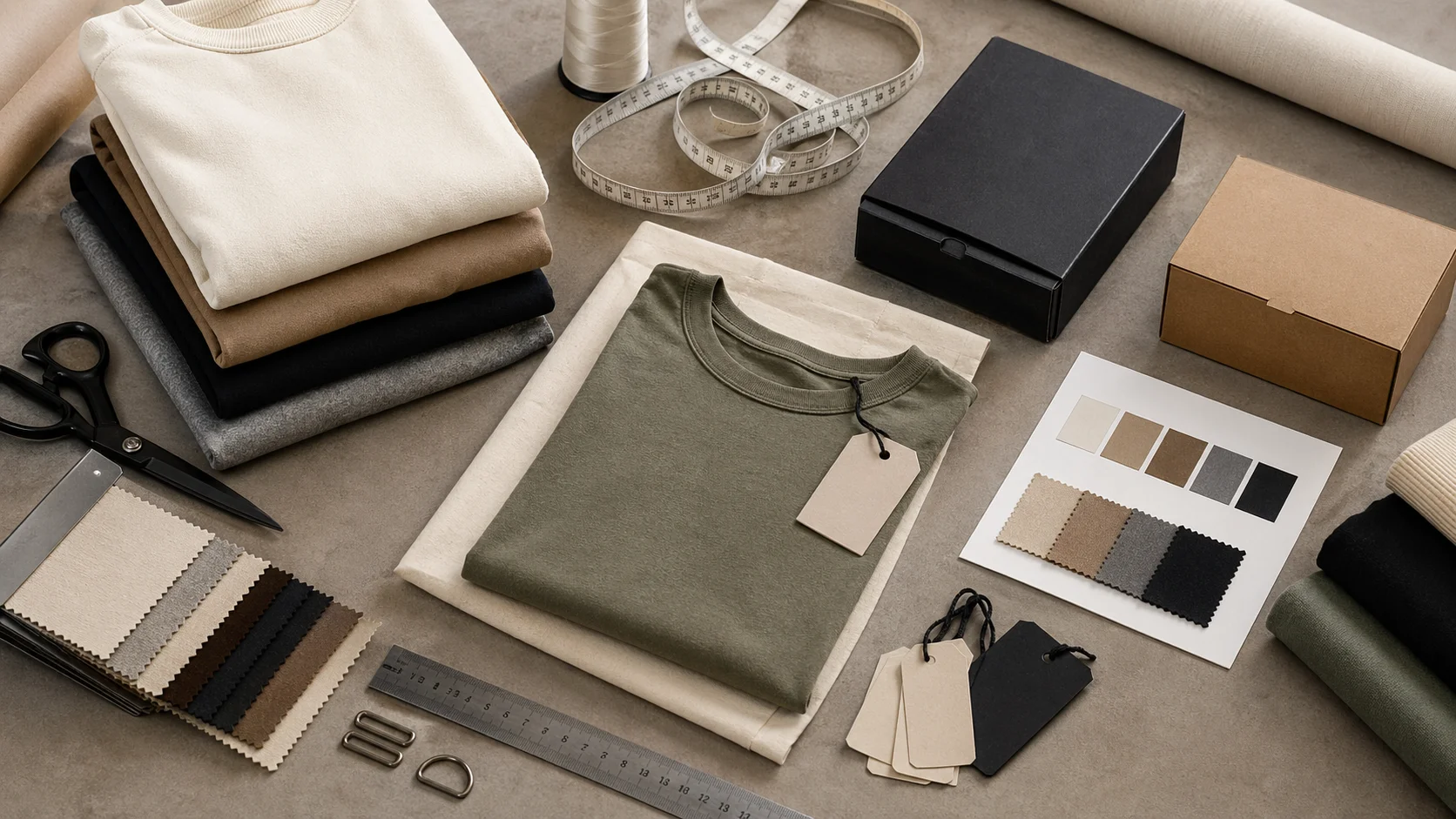
Private Label Clothing Packaging Solutions with checks for samples, fit, MOQ, QC evidence, pricing terms, and delivery risk.
Fast answer: Private Label Clothing Packaging Solutions: Costs, Specs, Timing should be judged by production evidence, not by a generic sourcing promise. The buyer needs sample proof, cost breakdowns, QC checkpoints, and delivery buffers in writing.
Ask for recent sample photos, measurement tolerances, fabric or print test assumptions, decoration test notes, packing examples, and a named inspection checkpoint. These details show whether the team can repeat an approved sample at bulk volume.
Separate garment cost, decoration, labels, packaging, sampling, testing, freight, and rush charges. When every cost line is visible, it becomes easier to reduce colorways, adjust size depth, or reserve more time for sampling.
I’ve stood in factories where a $0.03 hangtag was ignored and a $4.80 rigid box was treated like a brand decision. No one argued. That gap decides margin more often than a fabric upgrade does, so private label clothing packaging solutions deserve attention before the first carton leaves the sewing floor. In Guangzhou’s Baiyun District, finishing houses run 490 GSM SBS board through Heidelberg Speedmaster XL 106 presses and Bobst SP 102 die-cutters, yet even those shops still treat WRAP and BSCI certificates as footnotes while a soft-touch board carries the real cost.
Across 200-plus factory visits in eight countries, the same mistake kept showing up. Production teams approve the garment, then scramble on packaging once buyers ask about presentation. By then, the freight quote is fixed, the warehouse plan is locked. No wiggle room. A poly mailer at 28 to 35 grams may seem invisible, but a rigid box can add 180 to 260 grams per unit. On a 5,000-piece order, that difference can shift airfreight by hundreds of dollars and sea freight by more than you’d expect once dunnage and outer cartons are counted. You end up paying more than you planned. In Dhaka, I’ve seen LDPE bags made on a Reifenhäuser blow film line clock 18-22 business days of lead time when the local customs broker holds a carton, yet the same producer can turn a low-cost custom sleeve in 7 days when it stays within domestic lines.
The box, bag, or hangtag also changes perceived value. Everything matters to the person opening the parcel. A DTC shopper buying a $42 tee expects a cleaner unboxing than a wholesale buyer opening a 24-piece assortment carton. In Germany, I saw mid-tier basics succeed with matte folding cartons and a simple belly band; in the US, the same price point often needed a sturdier mailer to reduce returns tied to wrinkling. Marketplace orders are harsher still. Amazon-style fulfillment punishes loose inserts and oversized packs, while luxury wholesale buyers in Japan and the Gulf often judge a line by the precision of the fold, not the stitch count. Near Ho Chi Minh City, sleeve producers use UV-curing varnish stations and a rolling creasing table to deliver panels that stay flat for travel, so those shipments rarely trigger FMCG-style penalties.
It matters. Garment construction can be nearly identical across brands. I’ve compared 220 GSM jersey tees, enzyme-washed hoodies, and 320 GSM French terry sweatshirts made in the same region, with similar seam quality and identical MOQ 500 pieces. The packaging became the signal. One label used a soft-touch box and a 1-color insert card; another shipped in a plain sleeve. Same product. Different margin story.
Private label clothing packaging solutions should follow channel, not vanity. Pick the format that fits the customer’s journey. Mailer boxes work best for DTC apparel, gifting, and premium basics, especially when the garment is folded to a predictable 30 x 24 x 4 cm or similar footprint. Folding cartons are cheaper, usually faster, and easier to stack in wholesale, where shelf presence matters but crush resistance matters less than throughput. For lightweight tees and kidswear, a folding carton can hold the line between a tidy presentation and a swollen freight bill.
Poly bags still dominate high-volume basics because they cost little and travel well. They stack light and keep cartons slim. I’ve seen clear LDPE bags priced around $0.04 to $0.08 per piece at volume, while compostable films often run $0.12 to $0.28, sometimes more if print coverage rises above 30 percent. Garment sleeves sit in the middle: enough structure for premium hang, less bulk than a box, and strong on retail rails. For fashion brands shipping 1,000 to 10,000 units per drop, sleeves often beat boxes on both storage density and pack-out speed. In Ho Chi Minh City, blown-film lines feed anilox rollers with water-based inks so the resulting 70 GSM PBAT/PLA blend meets GRS and OEKO-TEX Standard 100 requirements for skin contact.
Tissue, stickers, and cards are where brands fake luxury cheaply, and sometimes successfully. Cheap tricks that work: a two-color tissue wrap plus one branded card can lift presentation for under $0.18 per set if sourced cleanly. Once you add foil, embossing, or specialty inks, that figure can jump to $0.40 to $0.85. The hidden trap is that some factories print boxes fast but outsource inserts. I’ve seen a 7-day box promise become a 21-day delay because the belly bands were subcontracted to a different city. For boxes with multi-panel inserts, the laminator, UV coater, and hot-stamping station all add changeover hours, which is why a Guangzhou short-run plant charges $2.50-4.00 per unit at 500 MOQ for a pop-top rigid box that includes hot foil and micro-embossed detail.
Sustainability claims need discipline. According to Textile Exchange, material sourcing claims should be traceable, not vague. No vague words. For compliance-minded brands, OEKO-TEX Standard 100 and GOTS certificates give confidence when packaging touches skin-contact programs or branded soft goods, while GRS keeps recycled board claims honest. “Eco-friendly” means little without a resin code, certification, or clear end-of-life guidance. Compostable bags must carry a credible standard, and recycled board should state post-consumer content, not just “recycled materials.” For brands pairing apparel with private label clothing development, packaging should match the garment story. Otherwise, the label says one thing and the parcel says another. The factories in Istanbul that support fast European drops usually hold both WRAP and BSCI audits, so they can trace the blade steel in their embossing presses back to a certified supplier while meeting customers’ sustainability checklists.
The thing nobody tells you: a cleaner-looking package can increase damage in transit if it trades compression strength for aesthetics. I’ve watched a soft-touch box fail a 1-meter drop test while a plain kraft mailer survived. Pretty is not protective.
At 5,000 units, private label clothing packaging solutions math changes fast. A basic LDPE bag at $0.05 becomes $250 total. And a custom printed mailer at $0.22 lands at $1,100 before freight. A premium rigid box at $1.40 pushes the order to $7,000, and that number grows once magnetic closures, foil logos, or custom inserts appear. On a 20,000-unit run, the same choices can create a six-figure swing in cash tied up before sales even begin.
China still offers the widest mix of cost and capability, especially for printed cartons, tissue, and mixed-format packaging with MOQs around 1,000 to 3,000 pieces. Vietnam is competitive on simple bags and sleeves, often with shorter regional transit for Southeast Asia, but specialty finishing may require extra sourcing time. Turkey tends to be stronger for fast-turn European programs, where lead times of 10 to 18 days beat ocean shipping, though unit prices can run 10 to 30 percent higher than an export hub in Asia. And local production is the speed play. I’ve seen domestic box suppliers quote 3 to 7 days for a repeat order, but only if the design is already plate-ready and the board grade is in stock.
A strong brief makes the supplier's job narrower and the quote more reliable. For private label clothing packaging solutions, include the target customer, sales channel, expected order quantity, size range, decoration needs, packaging requirements, and delivery market. Then call out the details most likely to affect the result, especially material grade, print tolerance, and barcode size.
The brief should also explain what cannot change. Some brands care most about hand feel, some about price, some about launch timing, and some about retail compliance. When those priorities are not written down, suppliers tend to optimize for whatever is easiest to quote. Clear priorities help the factory make better tradeoffs before the first sample is cut or printed.
Ask the supplier to respond with assumptions, not just a price. A useful reply states MOQ, sample route, production capacity, inspection plan, packing method, and freight handoff. If the answer is vague, the project may still work, but it needs a tighter pre-production stage before money and calendar pressure build up.
The best time to catch problems is before the pre-production sample is approved. Check measurements, color, placement, material behavior, shrinkage, construction, labels, and packaging in the same review instead of approving each item in isolation. Many bulk issues are not caused by one dramatic mistake; they come from several small unchecked assumptions.
For private label clothing packaging solutions, pay special attention to folding method, pack-out sequence, and retail compliance. These details often look minor in an email but become expensive once cutting, printing, sewing, packing, or shipping begins. A simple checklist with owner, due date, and approval status keeps the brand team and factory aligned.
Bulk production should not start until the supplier can explain how the approved sample becomes a repeatable production standard. That means reference sample storage, line instructions, inline checks, final inspection, and defect handling. A factory that can describe this process clearly is usually safer than one that only promises speed.
Price differences are useful only when the quotes cover the same work. Compare sample cost, material source, trims, decoration, packaging, testing, inspection, and freight assumptions. A low unit price can become expensive if it excludes items the brand needs before launch.
Timeline promises deserve the same scrutiny. Ask what happens if the first sample needs revision, whether materials are in stock, when the production slot is reserved, and how export packing is handled. The most reliable supplier is often the one that gives a realistic calendar instead of the fastest optimistic answer.
Before making the final decision, write down the specification, approval owner, delivery expectation, and the one or two risks that would cause the most trouble if missed. For private label clothing packaging solutions, this usually means checking material grade, print tolerance, barcode size, and the support process after the order is placed.
This last review does not need to be complicated. It simply makes the decision easier to repeat, easier to explain, and easier to verify when the finished product or jewelry arrives.
One useful way to pressure-test the decision is to ask what would happen if the order had to be repeated in six months. The answer should still be clear: the same material grade, the same print tolerance, the same acceptance standard, and the same communication path. If a second order would depend on memory or guesswork, the first order is not documented well enough yet.
Another useful check is to separate preference from requirement. Preference is the look, wording, or finish the brand likes. Requirement is the measurement, tolerance, certificate, material, or delivery condition that cannot fail. Good buying decisions keep both visible, so the final choice is not pushed around by the last email, the cheapest quote, or the prettiest sample photo.
Finally, ask who owns each approval. A project with one accountable owner for sample review, one owner for final content or artwork, and one owner for delivery sign-off usually moves faster than a project where every decision is shared loosely across a team. Clear ownership reduces delays and makes the finished result easier to judge.
The finished result should be judged against the approved standard, not against a vague idea of what looked good at the start. Compare the delivered item with the approved sample, written specification, photos, and any measurement or certification notes. If the result meets those points, the project is easier to reorder and easier to improve later.
If something is off, record it in practical terms: where the issue appears, how often it appears, whether it affects use, and what change would prevent it next time. That turns a complaint into a useful production note and helps the next order become more consistent.