
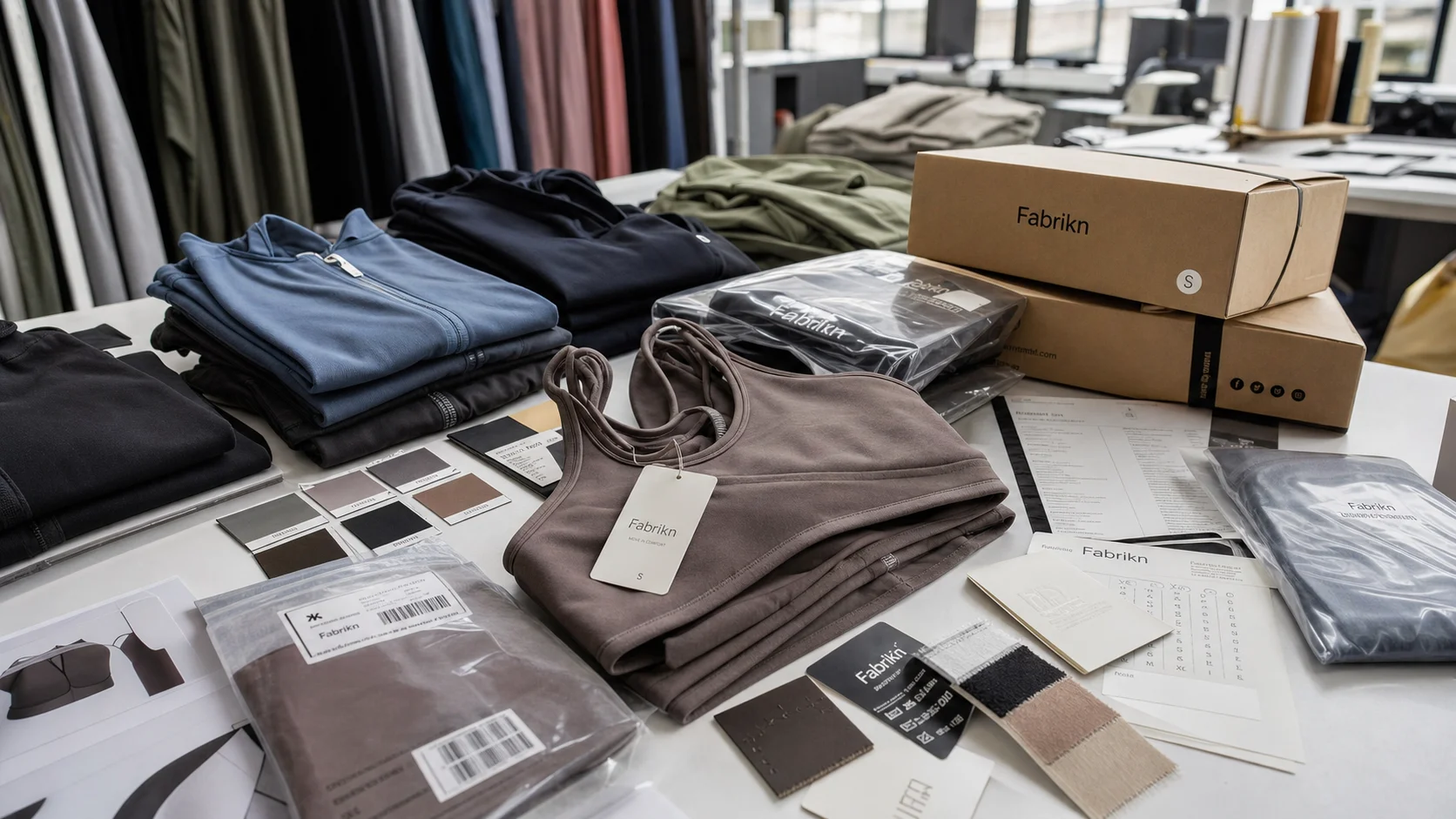
Private Label Hang Tags for Clothing with checks for samples, fit, MOQ, QC evidence, pricing terms, and delivery risk.
Fast answer: Private Label Hang Tags for Clothing: Costs, Specs, and Sourcing should be judged by production evidence, not by a generic sourcing promise. The buyer needs sample proof, cost breakdowns, QC checkpoints, and delivery buffers in writing.
Ask for recent sample photos, measurement tolerances, fabric or print test assumptions, decoration test notes, packing examples, and a named inspection checkpoint. These details show whether the team can repeat an approved sample at bulk volume.
Separate garment cost, decoration, labels, packaging, sampling, testing, freight, and rush charges. When every cost line is visible, it becomes easier to reduce colorways, adjust size depth, or reserve more time for sampling.
A hang tag can cost $0.06 to $0.42 and still steer a $42 purchase in under eight seconds. In many buying rooms, private label hang tags for clothing are the first tangible proof that a garment deserves its price. I’ve watched buyers in Bangladesh, Portugal, and Vietnam handle paper stock before they ever touched the fabric.
Same tee, two treatments. In factory showrooms, I’ve seen a $3.10 basic dressed with a flimsy satin string, then the same $3.10 basic upgraded with a thick uncoated tag, blind emboss, and crisp black type. Suddenly it reads like a $12 tee. Retail tests I reviewed from mid-market brands showed a 4% to 9% lift in perceived quality scores when packaging cues were tightened, and return comments about “cheap feel” dropped by 6% when presentation matched price.
The garment stayed put. The story changed. Premium brands know it and spend on paper they never wear. A $28 sweatshirt in the US can carry a tag budget of $0.22 to $0.55 per unit, while a $9 fast-fashion top may spend only $0.04 to $0.12.
Region changes the brief. Europe tends to be more restrained: smaller formats, recycled stocks, fewer claims on the front. In parts of North America, brands push bigger tags, QR codes, and multiple hangers to build the story. Southeast Asia runs on a different clock; the same manufacturer or cut and sew manufacturer services">factory may quote three lead times for the same tag: 5-7 days for stock paper, 10-12 days for custom foil, and 15-20 days when recycled pulp and specialty die cuts enter the picture.
So I treat tag sourcing as a commercial decision, not a decorative one. Shelf appeal, checkout confidence, brand recall, launch speed, approval count, Private label clothing manufacturer services">supplier risk — all of it sits inside the spec. I’ve seen brilliant garments underperform because the tag looked like an afterthought, and modest basics sell through because the paper did the heavy lifting. If your brand is building private label clothing, the tag belongs in the product economics, not beside them.
Paper comes first. Coated stock gives sharp photographs and dense blacks, but it can feel glossy and a little cheap on value-driven items. Uncoated stock absorbs ink, reads more tactile, and fits heritage or sustainable positioning. Kraft paper, usually 250 to 400 GSM, signals natural simplicity, while textured cotton or felt-mark stocks can push a tag into boutique territory.
Synthetic options exist too, usually for swimwear or outdoor gear where moisture resistance matters, though they often complicate recyclability. Thickness needs to be named before the quote starts. A 300 GSM tag cuts differently from a 450 GSM tag, and that changes print registration and machine speed.
Size matters just as much. A 50 x 90 mm rectangle with one hole is quick to run. A folded 70 x 100 mm tag with corner rounding, two holes, and a stitched insert can slow production by 20% to 35%. Want the line to move fast? Keep the die line simple.
Finishes change both cost and shelf impact. Foil stamping can add $0.03 to $0.12 per tag at 5,000 pieces, embossing can add $0.02 to $0.08, and spot UV usually lands somewhere in the middle depending on coverage. Recycled content may dull the visual punch if the pulp is too speckled, but it can strengthen the sustainability story when the garment supports the claim.
FSC-certified paper is widely available in China, India, and Europe, and I’ve seen buyers pay 3% to 7% more for it without a fight. Attachment is not a footnote. Cotton string, elastic loops, plastic pins, metal fasteners, and paper ties all alter the final impression. Plastic-free fastening is easier to defend in a sustainability audit, while metal pins work better for heavy outerwear and denim.
Hole placement should match the garment. Center holes suit front-facing tags; side holes are faster on some automated lines; dual holes help prevent twist on oversized pieces. For clothing packaging solutions, tag, fold, and fastening need to be specified together or the quote will drift after sampling. One simple rule kept showing up across 200-plus factory visits: cleaner structure, better yield.
A two-sided tag with one ink color, one hole, and no lamination is easier to reproduce than a four-panel brochure tag with mixed finishes. That simplicity can save 2 to 4 days in proofing and cut waste by 5% to 8% on the press floor.
Typography does more than decorate. Thin serif fonts can make a tag feel editorial and expensive, while bold sans serif type reads cleaner and more contemporary. I’ve seen the same brand name feel like $18 or $48 after nothing more than a shift in letter spacing and contrast. On a black tag, white type gives authority; on an ivory tag, charcoal feels softer than pure black.
New labels often think the logo is the hero. Legibility wins first. Luxury tags usually keep the front quiet: brand name, size, maybe one line of origin. Mass-market tags crowd the front with discounts, slogans, barcodes, QR blocks, and social prompts.
That density can work in outlet or promotional retail, but it weakens perceived price on a premium garment. I watched a $16 knit wear a tag packed with five claims and a coupon box. The garment looked apologetic before anyone touched it. On the back, give people something useful.
Care cues, origin, fiber content, QR code, and one proof point are enough for most categories. If you want social proof, use one line, not a paragraph. “Made in Portugal” can help in knitwear. “Designed in New York” can help if the sewing quality supports it.
For kidswear, especially when working with custom baby clothing manufacturing, clarity matters more than cleverness because parents read safety and care information first. The stronger the eco claim, the more evidence buyers request later. Print “carbon neutral” or “plastic-free” without backup, and you’re not building trust — you’re creating audit work.
I’ve seen brands lose 2 to 3 weeks in verification because the tag moved faster than the paperwork. A simple recycled-content statement backed by invoices and certification is safer than a grand promise with no file trail. Color should fit the category. Athletic wear tolerates bright contrast, denim works well with kraft and navy, and premium basics often sell best with restrained palettes.
A busy design may look energetic on screen, but on a crowded table it reads like discount noise. The strongest tags I’ve seen usually do three things: name the brand clearly, give one reason to believe, and stay quiet enough to let the garment speak.
The unit price is only the beginning. For a 1,000-piece order, I’ve seen basic 300 GSM uncoated tags quote at $0.18 to $0.38 each, while foil-stamped or embossed versions land closer to $0.32 to $0.62. At 10,000 pieces, those same tags may fall to $0.05 to $0.14 and $0.10 to $0.28, because setup costs spread out.
At 50,000 pieces, the range narrows further, often down to $0.03 to $0.09 for simple work and $0.07 to $0.18 for premium finishes. Scale changes everything. Setup fees are where beginners get surprised. A dieline may cost $25 to $120, depending on complexity and whether the supplier already has the format in its system.
Plates, proofing, and color matching can add another $40 to $300. If your tag uses special die-cut corners, a fold, or a custom hole pattern, expect a tooling line. Sampling may be free on some quotes, but express freight is not. A 2 kg sample box shipped from Shenzhen to Los Angeles can cost $28 to $65 by courier, more if weekend delivery is needed.
Freight can erase a “cheap” quote fast. I’ve seen offshore wholesale production win on unit price and lose on landed cost because the buyer ignored carton volume, customs delay, and air freight for missed deadlines. A domestic printer may quote $0.21 when an overseas plant quotes $0.09, yet the domestic order can arrive in 7-10 days rather than 18-28 days, and it may avoid $180 to $600 in expedite charges.
For a launch tied to a retail window, the faster line often wins. The lowest unit price can still create the highest total cost if defects or delays hit. That happens when a factory misses Pantone matching, uses inconsistent hole placement, or sends tags with trimming burrs that snag on string.
I watched one 12,000-piece order turn into a 15,000-piece problem after 8% of the tags were rejected for color drift. Reprint, freight, and time loss turned a low quote into an expensive lesson. If your garment line includes complex cut and sew manufacturing, the tag schedule should sit beside the production schedule, not behind it.
China, India, and Vietnam usually win on volume pricing. The US, Italy, and Portugal often win on speed, short-run flexibility, or closer communication. Trade data from the International Trade Administration shows that global textile and apparel trade remains highly cross-border, which is exactly why lead time and freight should be priced with the unit cost. I tell buyers to compare three numbers: unit price, landed cost, days to dock.
When I modeled a recent order for a mid-tier label, the numbers told the story. A 5,000-piece recycled tag with one-color print and cotton string cost $0.11 per unit offshore, $0.17 domestically, and $0.14 landed from a nearshore garment manufacturer after freight. The offshore option looked cheapest until the brand needed a 6-day remake because the first proof missed the fiber claim. In fashion, the quote sheet rarely shows the full bill.
The best supplier is not always the largest. I’ve visited plants that run six product families and deliver sharper print than factories juggling sixty. Narrower product ranges often mean tighter color control, fewer setup errors, and better training on repeat jobs. That’s one reason small specialists can beat big generalists. The machine matters, but the workflow matters more.
My first questions are blunt. What paper stocks do you keep in house? How many finishes do you run each week? Can you show a pre-production proof with actual material, actual hole placement, and actual string type? What is your cut tolerance, and how do you check color against Pantone? A strong supplier answers in hours, not days, and doesn’t hide behind vague “similar” terms.
If the reply sounds like a sales brochure, I keep looking. Samples reveal more than a PDF. I look for color consistency across 20 or 30 tags, clean edges, and punch accuracy within 1 to 2 mm. If the batch shows different cut depth or faded blacks, the quality system may be stretched.
Brokers can help when multiple items are being sourced, but direct manufacturers usually give better control on print and reorders. The trade-off is coordination. Brokers simplify communication; factories simplify accountability. Certifications and traceability should be part of the conversation. Ask for FSC paperwork if you are buying certified paper, batch traceability if recycled content is claimed, and any testing relevant to adhesives or inks.
For regulated categories, especially children’s apparel, label content and safety phrasing need more discipline than a fashion buyer sometimes expects. I’ve seen teams save time by asking the supplier for a single document pack: spec sheet, proof, certification copies, and dispatch timeline. One last filter: communication speed. If a supplier takes 48 hours to answer a basic material question, they won’t be quick when a print error appears.
A good partner keeps you updated on substrate availability, machine capacity, and packing method. That discipline matters whether you’re launching 500 units or 50,000. With private label hang tags for clothing, responsiveness is part of the product.
Start with a spec sheet, not a mood board. I want garment type, tag size, paper weight, finish, hole placement, string type, print colors, quantity, delivery address, and target date in one file. If you’re ordering 3 SKUs, list each separately. If you need 2 versions for different regions, note the compliance differences now.
Clear brief, clean quote. I’ve seen a 30-minute spec call prevent a 3-week delay. The workflow should stay simple: brief, quote, proof, sample, production, delivery. Each step needs sign-off.
For standard tags, I usually see 7-10 days for quote and proofing, 10-15 days for samples, and 10-20 days for production. Rush orders can shrink that to 5-8 total working days if the manufacturer already has stock paper and a simple die line. Custom finishes stretch the timeline to 20-30 days, especially if foil, embossing, or a special string is involved.
I keep one hard rule: no mass production before the sample matches the brief. That includes color, cut, fold, and string length. A tag that is 3 mm too wide can look fine in a file and fail on the garment rail. If the line uses multiple styles, approve one master sample and one variant for each finishing family.
Slower up front. Faster than remaking 8,000 units. Seasonal planning needs to start earlier than most buyers think. For autumn collections, I’d place a tag order 6 to 8 weeks before pack-out. For spring, 4 to 6 weeks can work if the design is stable.
Reorder points should account for size runs and sell-through by channel. A brand with 5 retailers and 2 e-commerce warehouses does not need one stock position; it needs a replenishment map. Tags are small, but the wrong inventory assumption can strand a launch. Don’t forget packaging coordination.
If your hang tag arrives after the garments, you create a bottleneck at the packing table. If it arrives too early, you may lose time to storage and counting. I’ve seen teams coordinate tags, care labels, and polybags in the same shipment, which reduces receiving work and lowers the chance of mix-ups. That’s where disciplined planning beats last-minute heroics.
Sustainability claims on tags need proof, not poetry. “Made with recycled paper” is usually safe if you have invoices or a chain-of-custody file. “Compostable” is trickier and should be tied to a real standard and local disposal conditions. “Plastic-free” is straightforward only if the string, lamination, and fasteners are also plastic-free.
Buyers now ask for the same discipline they expect from the garment. The tag cannot be greener than the product without evidence. Recycled stock often costs 5% to 15% more than virgin paper, and FSC-certified paper may add 2% to 8%, depending on region and quantity. Those premiums are modest next to the brand risk of a claim challenge.
According to OEKO-TEX guidance and related compliance standards, material claims should be supported by documentation that matches the actual supply chain. I’ve seen European buyers reject a tag line because the wording suggested full recyclability when the fastening was not recyclable. Regional compliance differs. In the EU, packaging wording and waste instructions can be scrutinized more closely than in some other markets.
In the US, buyers may focus more on substantiation and less on a specific disposal format, though state rules can vary. In Australia and parts of Asia, local recycling infrastructure changes what “recyclable” means in practice. That is why disposal messaging should be practical. If the tag uses a cotton string and a paper tie, say so. If it needs separation before recycling, say that too.
There is a commercial upside to clean claims. Brands selling into premium or conscious segments often find that better-tagged sustainability information supports a slightly higher retail price, especially when the garment itself uses low-impact fibers or reduced-water dyeing. But the packaging must match the footprint. A 95% organic cotton tee wrapped in heavy plastic and paired with a vague green tag reads as performative.
Buyers notice. Retail teams notice faster. For additional sustainability context and sourcing standards, brands often review guidance from Textile Exchange before finalizing claims and materials. For private label hang tags for clothing, that homework is worth doing before the first proof.
Basic tags usually cost $0.03 to $0.14 each at 10,000 pieces, while premium finishes like foil or embossing can push that to $0.10 to $0.28. Small orders of 1,000 pieces often cost more, around $0.18 to $0.62 per tag depending on paper and finish.
Standard production usually takes 10 to 20 days after proof approval. Rush orders can be done in 5 to 8 working days if the supplier uses stock paper and a simple die line, while custom finishes may take 20 to 30 days.
At minimum, include brand name, size, fiber content or key material note, care cue if needed, and country of origin where required. Many brands also add a QR code, sustainability statement, or short brand story on the back.
Yes, recycled paper is common and usually increases cost by 5% to 15% versus virgin stock. Ask for FSC or recycled-content documentation, and make sure the string, pin, or laminate does not clash with your sustainability claim.
If speed matters, use a wholesale partner with stock paper, in-house printing, and pre-existing die lines. Domestic or nearshore printers can often deliver in 7 to 10 days, while offshore reorders may take 18 to 28 days once freight is included.