
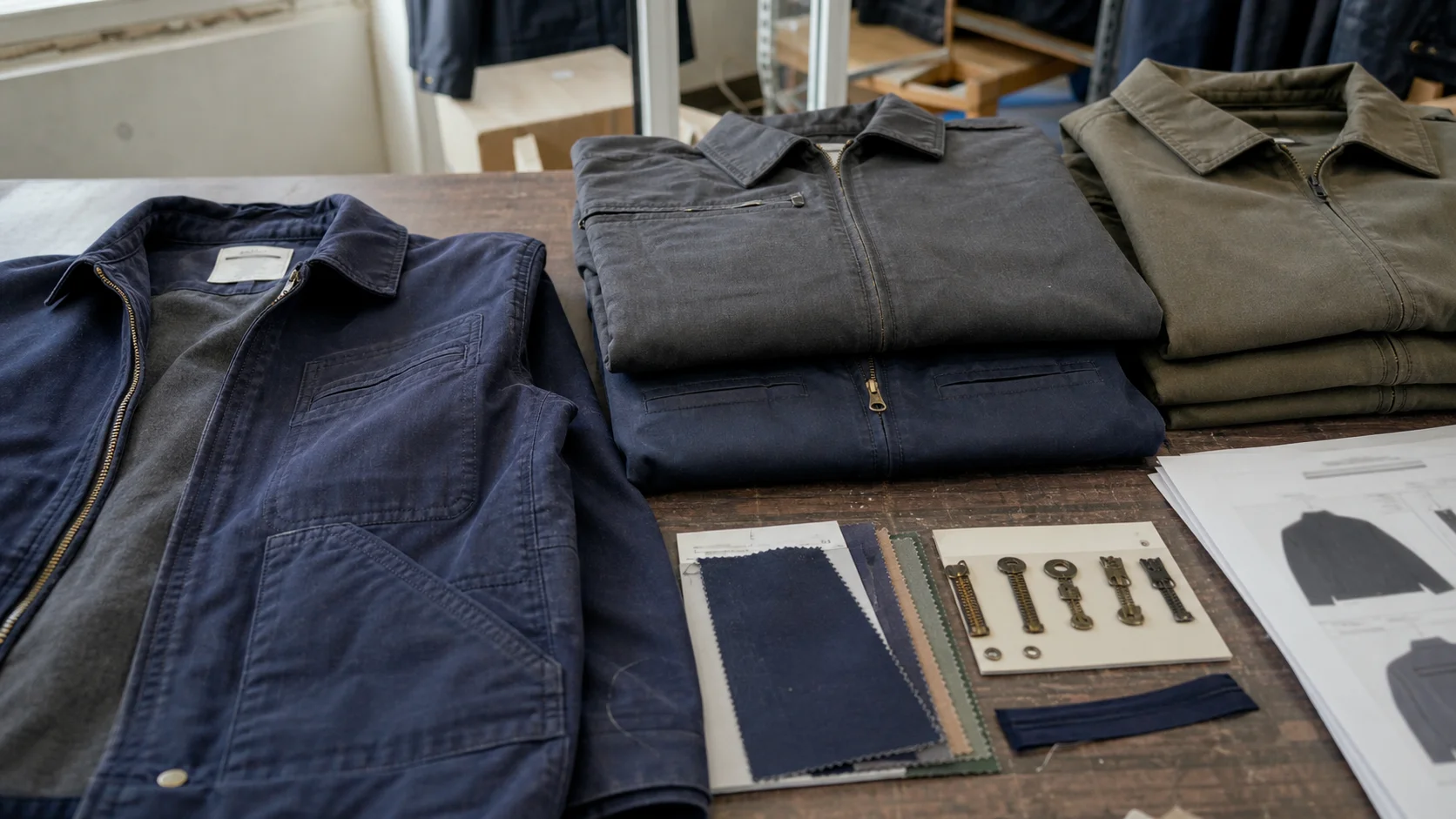
A focused outline for buyers comparing private label jacket heat transfer MOQ options for corporate event teamwear, including decoration specs, size runs, sampling, turnaround, and production-ready artwork details.
Private Label Heat Transfer Jackets MOQ for Teamwear - Fabrikn production reference
Private label jackets with heat transfer branding are a practical choice for corporate event teamwear, especially when buyers need a clean logo finish, moderate customization, and faster branding changes than embroidery usually allows. For sourcing teams, the main question is rarely whether heat transfer can work. The real question is how the MOQ lines up with event quantities, size ratios, budget limits, and delivery deadlines.
In the activewear and teamwear category, MOQ for private label jackets is not one fixed number. It changes based on jacket construction, fabric source, trim customization, color count, logo placement, packaging, and whether the supplier is working from stock materials or making the garment from scratch. Buyers planning corporate event jackets often assume the printed logo method drives the entire minimum. In practice, the jacket body and trim package usually set the commercial floor, while the heat transfer application affects setup cost, approval time, and defect risk.
For event use, private label jackets tend to sit in a middle ground between fully custom sportswear and simple promotional outerwear. That creates an important purchasing tradeoff. Buyers want brand consistency and a polished look, but they also need flexibility on quantity because event headcount can shift late. This is where MOQ strategy matters.
A useful benchmark is that fully custom cut-and-sew private label team jackets often start around 300 to 800 pieces per style-color, with some factories accepting 150 to 250 pieces if the fabric is in stock and the trim package is simple. Stock-body programs with private label relabeling and heat transfer logo application can sometimes begin around 50 to 150 pieces per colorway, though sizing breakdown and decoration placements still influence feasibility. Ultra-low MOQs are possible in certain cases, but unit cost usually climbs sharply, and consistency risks rise if production is pieced together outside a standard line setup.
For brands and procurement teams evaluating suppliers, it helps to compare MOQ together with fabric composition, waterproof or water-resistant finish, seam construction, transfer durability, and lead-time reliability. The cheapest MOQ offer is not automatically the best teamwear buy if the shell fabric feels thin, the bonding fails after light wear, or logo adhesion breaks down during packing and transit.
If you are structuring a sourcing brief for private label outerwear, it is worth reviewing a manufacturer’s broader production capabilities before discussing price alone. Fabrik’s services page is a useful starting point for understanding development and production support expectations.
Heat transfer branding fits corporate event jackets because it delivers a neat visual result on technical shells, softshells, lightweight windbreakers, and hybrid activewear layers where embroidery can distort fabric or leave a heavier hand feel. It is especially suitable for event logos, sponsor marks, department identification, and short-run campaign branding.
There are several transfer options used in jacket decoration. PU or TPU-based heat transfers are common for logos with solid color fills. Reflective transfers are used when visibility matters for outdoor events or logistics crews. Silicone and high-density transfers create a more premium raised look, but they require tighter approval because thickness, edge finish, and adhesion performance vary by fabric surface.
The biggest advantage for teamwear buyers is flexibility in artwork. Heat transfer handles sharper small text, cleaner geometric marks, and easier multi-placement branding than many basic embroidery programs. That matters when the same jacket needs a chest logo, back event branding, and a sleeve identifier.
There are limits. Heat transfer is only as reliable as the base fabric, coating, press settings, and wash-use expectations. Jackets with heavy DWR coatings, unstable ripstop surfaces, brushed fleece backings, or highly textured laminates may need adhesion testing before bulk approval. A supplier that skips pre-production transfer testing is creating avoidable risk.
For one-off or annual corporate events, heat transfer also helps when branding changes frequently. A company can keep a consistent jacket silhouette and update the event identity without rebuilding the full garment program. That can reduce development complexity, though it does not always reduce MOQ if the jacket itself is fully custom.
MOQ in private label teamwear usually reflects several layers, not a single factory rule. Buyers should separate these four cost and minimum drivers before comparing quotations:
This distinction matters because one supplier may quote a low decoration minimum while still requiring a higher body MOQ. Another may accept a smaller garment order only if the buyer uses stock fabric colors and standard trims.
For corporate event teamwear, the most common MOQ structures are:
Production Type Typical MOQ Range Best Use Case Stock jacket with relabel + transfer logo 50-150 pieces per style/color Short event runs and urgent programs Custom jacket using stock fabric 150-300 pieces per style/color Mid-volume branded teamwear Full custom cut-and-sew with custom trims 300-800 pieces per style/color Longer-term uniform or recurring event programs Premium technical jacket with special laminated fabric 500+ pieces per style/color High-performance outerwear collectionsThese ranges are only practical benchmarks. A buyer can sometimes negotiate lower entry quantities by limiting size spread, reducing custom trims, or accepting fewer colorways. The tradeoff is usually a higher FOB cost and less room for factory efficiency.
It is also important to define whether MOQ applies per color, per total order, or per logo variant. Corporate teams sometimes split one event order into multiple departments with different back logos. That can create hidden sub-minimums if artwork changes require separate transfer batches or extra application handling.
MOQ moves up or down according to how complicated the jacket is to make and decorate. Buyers usually get better terms when they simplify inputs early.
If the supplier can use in-stock polyester woven, bonded softshell, or interlock-backed shell materials, minimums are easier to manage. Custom-dyed or custom-laminated fabrics raise the threshold. Mills often require their own minimums, and those may exceed the garment factory’s willingness to cut a small run.
One style in one or two standard colors is easier to produce at a lower MOQ. Four or five event colorways can push the order into inefficient territory unless total volume is high enough to spread line setup costs.
Custom woven neck labels, printed care labels, branded zipper pullers, drawcord tips, polybags with warnings in multiple languages, and retail hangtags all carry separate trim minimums. For a corporate event order, many buyers can reduce MOQ pressure by using standard trims and limiting custom branding to the main label plus transfer logo.
Jacket orders with an unusually wide size curve, such as XXS through 5XL, create planning issues. Some factories accept the total MOQ but resist very small counts per size because cutting efficiency and packing balance suffer. A small total order with broad size dispersion often results in either surcharge pricing or restricted size availability.
Single-color chest logos are straightforward. Multi-placement branding with reflective layers, personal names, or different department identifiers adds labor and raises error risk. That does not always increase the formal MOQ, but it changes the factory’s willingness to accept low-volume programs at a competitive price.
Individual name stickers, size sorting by team, or kit-style packing for event distribution can turn a simple jacket order into a semi-fulfillment project. Buyers should not treat that as free service. Small-run custom packing often tightens minimums or adds manual handling charges.
Not every jacket silhouette suits heat transfer branding equally well. Buyers should match the garment type to the event setting and expected use after the event.
Softshell is one of the most common choices for corporate teamwear. A typical spec may use 94% polyester and 6% elastane bonded to microfleece, with fabric weights around 280 to 340 gsm. It offers a professional look, moderate weather resistance, and good chest-logo presentation. MOQ is often manageable if standard fabric colors are available.
These jackets are practical for outdoor campaigns, sports events, and volunteer crews. Common specs include 100% polyester with water-resistant coating, 75D to 150D shell weight, mesh or unlined interiors, and elastic cuffs. Windbreakers are usually price-sensitive, so buyers should watch transfer adhesion on coated surfaces.
Hybrid jackets combine woven panels with knit sleeves or side panels. They can look more modern and athletic, but construction is more complex, and mixed-surface decoration needs careful approval. MOQ often rises because sewing operations and pattern parts increase.
These work well for colder climates and premium staff outfitting. They also create more branding constraints because transfer logos must be placed on stable panels with enough flat pressing area. Small logos on the left chest are common. Large back prints are less reliable if the filling and quilting interfere with pressure consistency.
For many corporate event programs, a softshell or lightweight shell is the best balance of presentation, repeatability, and MOQ flexibility. Buyers chasing the cheapest windbreaker often save on first cost but lose on perceived value and rewear potential.
Many sourcing delays come from incomplete logo specifications. A factory cannot finalize costing and production planning if the buyer only sends a basic artwork file without placement and performance requirements.
At a minimum, the tech pack or decoration sheet should confirm:
Corporate event jackets are often not heavy-wash garments, but buyers should still ask for adhesion testing aligned with expected use. If the jackets are for logistics crews, field teams, or repeat outdoor wear, the transfer has to survive more than a single event cycle.
It is also smart to specify whether the transfer should be applied before or after certain sewing steps if the panel shape affects pressing access. On some jackets, pocket construction, seam taping, or lining assembly can limit flat application areas. That detail can prevent warped logos and inconsistent placement.
A disciplined sample process is the easiest way to control MOQ-related mistakes. Small and medium event orders are especially vulnerable because buyers often compress development timelines and approve from photos. That is risky when outerwear fit, shell texture, and transfer adhesion all matter.
A practical approval sequence looks like this:
For stock-body programs, the process may be shorter, but buyers should still request a branded pre-production sample. A blank jacket is not enough if the transfer is the key visual element.
One common failure point is approving the logo swatch separately from the actual jacket fabric. A transfer that looks fine on a flat test swatch may behave differently on a water-resistant shell, brushed backing, or stretch laminate. The safer route is approval on the actual base material and, ideally, on a fully assembled sample.
If you need to discuss development flow, relabeling scope, or factory communication before placing an order, the contact page is the logical point for a sourcing inquiry.
Lead time for private label heat transfer jackets depends on whether the order uses stock components or custom materials. Buyers planning corporate events should work backward from the wear date, not the shipping date. Distribution, customs clearance, final sorting, and internal handout time are often underestimated.
Typical lead-time planning looks like this:
Order Type Typical Development Time Typical Bulk Production Time Stock-body relabel + transfer 1-2 weeks 3-5 weeks Custom jacket with stock fabric 2-4 weeks 5-8 weeks Full custom with custom dye/trims 4-6 weeks 8-12 weeksThese ranges can stretch when artwork approvals lag, fabric sourcing changes, or size ratios are revised after sample signoff. Event buyers often cause their own delays by adding people’s names, switching logo placements, or splitting the shipment too late in the process.
There is also a difference between factory-ready date and delivered date. Air freight can reduce transit time but will raise landed cost sharply for bulky jackets. Sea freight improves unit economics on larger orders, but only if the event calendar allows enough buffer.
The purchasing judgment here is simple: if your event date is fixed and the team count is still moving, a stock-body private label program is often safer than forcing a fully custom run. The brand detail may be lighter, but delivery control usually improves.
Private label outerwear for corporate use should be inspected as apparel, not treated like simple promo merchandise. Heat transfer jackets can look acceptable in a sales sample and still fail during packing, transport, or first wear if process control is loose.
If the order is significant, an inline inspection plus final random inspection is the safer route. Inline checks catch decoration issues before the full quantity is branded. Final inspection alone is less useful if the defect comes from transfer settings that have already affected the whole batch.
Compliance needs depend on market and end use. Buyers may require REACH-related chemical considerations, restricted substance controls for prints and trims, or testing tied to corporate procurement standards. That should be confirmed early, not after the sample is approved. A supplier profile review on the about us page can help frame the conversation, but buyers still need to request the exact documentation relevant to their market.
The cleanest way to buy private label heat transfer jackets is to treat MOQ as one lever among several, not the only target. A low MOQ can look attractive, yet still produce weak overall value if it brings expensive sampling, poor fabric choice, or manual production shortcuts.
There are four common sourcing paths:
For one-time or annual corporate event teamwear, most buyers should resist over-engineering the product. A fully custom jacket with custom zipper pullers, branded taping, contrast linings, and multiple logo placements may look impressive in a presentation. It also increases MOQ exposure, delays approvals, and complicates size replenishment later.
In many cases, the best purchasing decision is a standard silhouette with strong fabric hand feel, reliable zipper quality, a custom main label, and one or two well-placed heat transfer logos. That combination usually protects both brand appearance and operational simplicity.
Another important tradeoff is reorder potential. If the event program repeats every year, a buyer may justify a higher initial MOQ by carrying the same body forward and updating only artwork. If the event is one-time only, keeping the package simpler is usually the better commercial move.
Buyers get better outcomes when they brief suppliers with the final use case in mind, not just a mood board. Corporate event teamwear needs consistent presentation, workable lead times, and quantity flexibility more than fashion-level customization.
A strong sourcing brief should include:
Suppliers can then advise whether a stock-supported private label route or a full custom run makes more sense. That conversation saves time because the MOQ discussion becomes tied to an actual production model rather than a vague request for “the lowest minimum.”
The most efficient buyers also leave room for substitute options. If the exact shell fabric pushes MOQ too high, a good factory should be able to suggest an in-stock alternative with similar weight and performance. If the back logo is too large for stable transfer on a padded jacket, the buyer should be open to a cleaner chest-and-sleeve layout instead of forcing a weak application.
From a procurement standpoint, private label heat transfer jackets are a good fit for corporate event teamwear when the buyer keeps the program disciplined. Control the number of variables, seal the sample carefully, and do not confuse a low opening MOQ with low total risk.
That is the core buying judgment: in teamwear, the best jacket order is not the one with the smallest minimum. It is the one that balances brand image, wearability, delivery certainty, and acceptable unit economics for the event.
Get a free quote from Fabrikn — your trusted B2B clothing manufacturer with 10+ years of experience. MOQ as low as 200 pieces.
Get a Free Quote →Typical MOQ often starts around 50 to 150 pieces for stock-body jackets with relabeling and heat transfer branding. Fully custom private label jackets usually begin around 150 to 300 pieces at the low end, with many programs landing between 300 and 800 pieces per style-color depending on fabric and trim customization.
Yes. Using stock fabric colors, standard zippers, standard packaging, and limited custom branding is one of the most practical ways to reduce MOQ. The tradeoff is that the jacket will be less exclusive than a full custom program.
They can be, provided the transfer type matches the jacket fabric and the supplier validates adhesion before bulk production. Durability depends on shell surface, coating, press settings, and how the jackets will be used after the event.
Softshell jackets are often the safest all-around choice because they present well, feel more premium than basic windbreakers, and usually handle chest-logo heat transfer cleanly. Lightweight woven jackets are also common when budget or packability is the priority.
Stock-body relabel and branding programs can move in roughly 3 to 5 weeks for bulk after approvals. Full custom jackets often require 5 to 12 weeks depending on material sourcing, sample revisions, and artwork complexity.
At minimum, buyers should approve the garment fit, fabric, color, label package, heat transfer type, logo placement, and a pre-production sample representing the intended bulk standard. For larger or more size-sensitive orders, a size set is also a sensible checkpoint.