
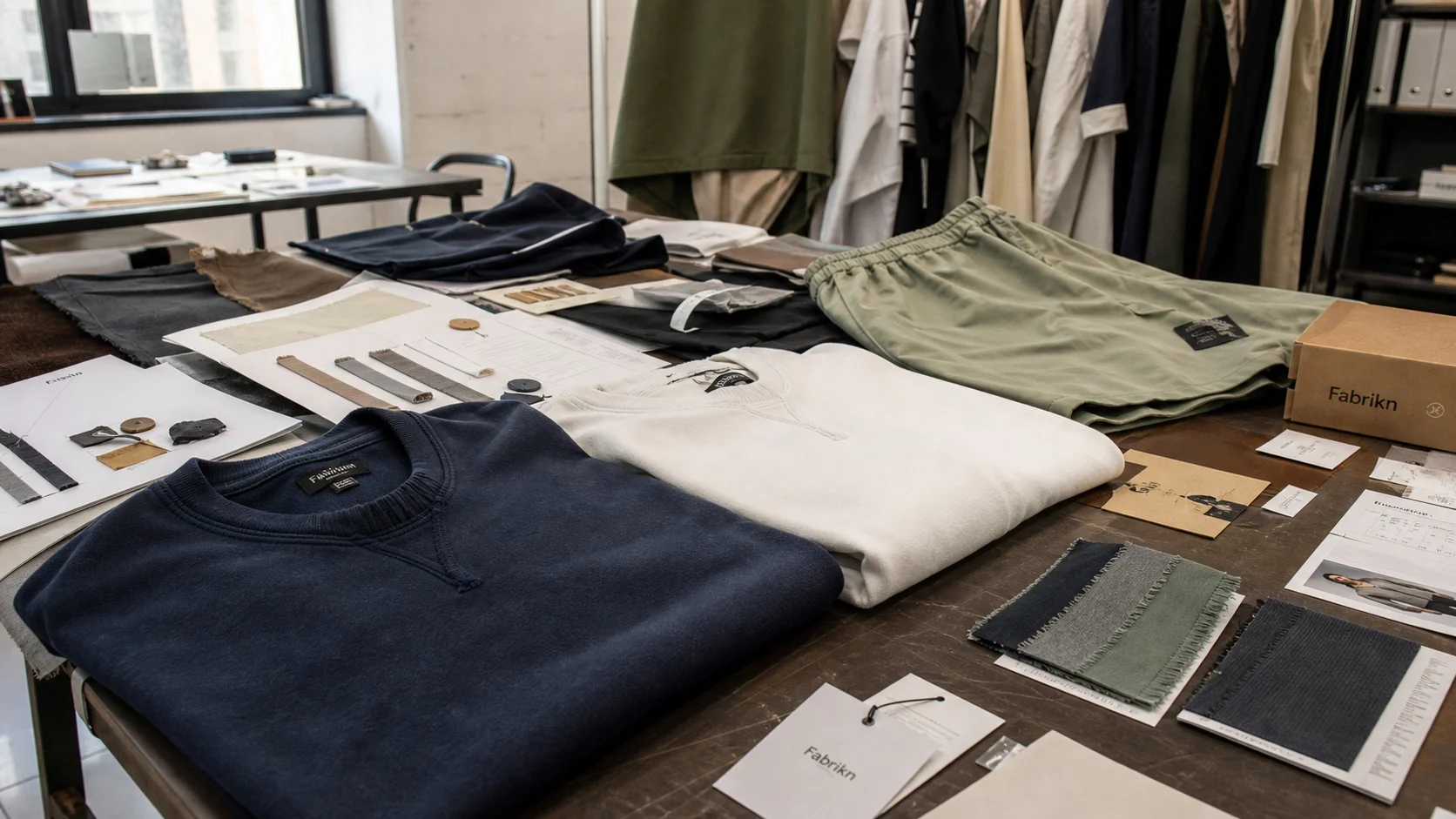
Private Label Hoodie Factory with Samples compared by sample evidence, fabric or trim specs, MOQ, AQL terms, cost lines, delivery timing, and rework...
Fast answer: Private Label Hoodie Factory with Samples: Material, Print, MOQ, and QC Terms should be judged by production evidence, not by a generic sourcing promise. The buyer needs sample proof, cost breakdowns, QC checkpoints, and delivery buffers in writing.
Ask for recent sample photos, measurement tolerances, fabric or print test assumptions, decoration test notes, packing examples, and a named inspection checkpoint. These details show whether the team can repeat an approved sample at bulk volume.
Separate garment cost, decoration, labels, packaging, sampling, testing, freight, and rush charges. Clear cost lines make it easier to reduce colorways, adjust size depth, or reserve more time for sampling.
The hoodie that looks perfect on paper can turn costly the moment it meets a real factory floor. When you work with a private label hoodie factory with samples, the first sample is where the dream either survives contact with production or quietly falls apart. And a wrong hood height, a pocket placed a few millimeters off, or a shrinkage issue can do more damage across 1,000 units than any sample fee ever will. I have watched brands save $3,000 to $12,000 simply by treating sampling as a paid test, not a favor. A private label hoodie factory with samples is selling risk reduction, plain and simple. In Guangzhou and Ho Chi Minh City, I have seen factories add carded cotton twill tape and 10 percent elastane cuffs after a fit sample revealed folding stress.
In Vietnam, Portugal, and China, the strongest operators use samples to expose shrinkage, print alignment, and hood shape long before bulk cutting begins. But cheap suppliers often quote fast, sometimes 10 to 20 percent below market, and the sample tells a sharper story: GSM drifts from 280 to 320, stitch density drops from 10 to 7 stitches per inch, and dye fastness fails after one wash. Those are not cosmetic flaws. They are brand damage. Factories in Istanbul and Dhaka with WRAP, BSCI, and OEKO-TEX Standard 100 certifications document those deviations on the same day the sample leaves the sewing line.
And showroom prototypes can look flawless under controlled lighting, then unravel once they hit the line. Real line-made samples, cut from bulk fabric and sewn by the same team that will make the order, tend to reveal fewer surprises. That difference matters whether you are buying French terry 320 GSM hoodies for DTC or brushed fleece for wholesale that is dyed with reactive dyes on a Gerber four-needle coverstitch machine.
ISO testing frameworks call out repeatable measurement and process control as the only way to turn subjective approval into a defensible production decision. Buyers need to pay attention to sample programs that measure, record, and label everything: shrinkage after wash, rib recovery, seam strength, and color delta. If a manufacturer cannot show those numbers, it is asking you to trust a feeling. Leading suppliers in Guangzhou provide FLIR analysis on thermal bonding for bonded kangaroo pockets and attach an inspection sheet with each sample.
The cheapest sample is often the most expensive one in disguise. A $35 sample that triggers two revisions, one delayed shipment, and a failed bulk lot can end up costing more than a $120 development sample from a disciplined factory. And sample-first sourcing does not slow a launch. It protects speed, price, and brand control at the same time. In systems running on a Yamato heat-sealing machine, you can see 18-22 business days go by quickly when the sample is wrong.
The cleanest sampling starts with a tech pack a factory can actually sew from. I want measurements in centimeters, fabric type, construction notes, logo placement, wash standard, packaging, and target retail price. A strong brief might specify 320 GSM brushed fleece, 2x2 rib with 8 percent spandex, double-needle topstitching, and a kangaroo pocket reinforced at the bartacks. Leave one of those out and the supplier will guess. Guessing is expensive. I also ask for the fabric mill name, such as a GOTS-certified ring-spun cotton supplier in Dhaka or a GRS-certified recycled polyester knit from Ho Chi Minh City, plus needle thread specs for the Toyota Juki industrial machines on site.
The best factories ask hard questions early. That is not resistance. It is competence. They want to know if the hoodie is for retail at $42 or $78, if the fit is oversized or regular, and whether the buyer needs XS to XXL or a size run from S to 3XL. Those choices affect marker efficiency, fabric yield, and sample turnaround. They also adjust operations: a Guangzhou factory with automatic spreading machines can handle 500 meters of fleece daily, while a smaller Istanbul operation cutting by hand needs weekday lead time buffers.
The sequence matters. Start with a proto sample to test the concept, usually in 7 to 14 days. Next comes the fit sample, the one you pull a live body or mannequin into to check those critical measurements. The pre-production, or PP, sample locks fabric, trims, and workmanship before bulk. Finally, a size set sample proves grading consistency across the full run, often from 5 to 8 pieces per size. Skip any of these and bulk production gets riskier. Proto sampling may require 3D virtual fit scans and a rack of 240-lumen lights to evaluate drape on an adjustable torso.
Last year I worked with a brand that tried to jump from sketch to PP sample in one step. They saved 12 days and lost 6 weeks fixing a hood that sat too high and cuffs that recovered poorly after wash. That pattern repeats because the sampling chain is the contract between idea and factory reality. Their Hong Kong agent eventually rerouted to a Guangzhou facility where a pre-production checklist on a spreadsheet recorded 96 percent conformance.
Turnaround differs by region. Established Asian factories often move proto to PP in 10 to 21 days when fabric is in stock. Smaller domestic shops may need 2 to 5 weeks because they have less internal capacity and source trims in smaller lots. If your launch is tied to a seasonal drop, this timing can decide whether you hit the shelf or miss it. In Dhaka, some suppliers quote 18 to 22 business days for an end-to-end sample that includes yarn dyeing, fabric washing, and final pressing on a steam press operated by a 5-year veteran.
For buyers building a broader assortment, private label clothing programs often benefit from the same discipline: clear measurements, documented revisions, and sample approvals tied to costed materials. That structure keeps the hoodie from becoming a guessing game.
Sample pricing is not one number. It is a stack of costs: development fee, pattern fee, material sourcing, sample sewing, and courier. I have paid $25 for a basic development sample and $180 for a complex fleece hoodie with custom embroidery, metal eyelets, and a specialty enzyme wash. The spread is normal. The problem is when the quote hides what is inside it.
Local makers with low volume shops often charge $40 to $120 per sample, with production MOQ around 50 to 200 pieces. Mid-tier export factories may quote $60 to $150, then credit part or all of that against a bulk order over 300 or 500 pieces. Larger cut-and-sew operations can ask $100 to $250 for development, especially when sourcing a custom dye lot or private label trim package. If you are evaluating custom hoodie manufacturing, ask whether the sample fee is refundable, and get the credit terms in writing before the first stitch is sewn. In Istanbul, a factory providing both OEKO-TEX Standard 100 and WRAP certification will often offer a $2.50-4.00 per unit impact on the initial sample fee with a 500 MOQ.
The comparison I use looks like this. A startup order of 100 units at $18 landed cost may look affordable, but one failed sample revision can add $90 to $300 in courier and remake fees. At 500 units, the same hoodie might land at $11.50 to $14.80 depending on fabric origin, print count, and trim selection. At 1,000 units, a better factory can bring that down to $9.20 to $12.40, yet only if the sample approval was disciplined enough to prevent rework. Those numbers assume the factory is using actual production dye from Guangdong mills and layered onto a Sturm rolling cutter rather than a subbed cheaper lot.
The thing nobody tells you: the cheapest sample often becomes the most expensive rerun. A single rushed development leaves hidden issues that pop up in the middle of a run and send crews back to the drawing board. Spend the extra on a thorough set of revisions now and the bulk order will feel easier to manage.
A strong brief makes the supplier's job narrower and the quote more reliable. For private label hoodie factory with samples, include the target customer, sales channel, expected order quantity, size range, decoration needs, packaging requirements, and delivery market. Then call out the details most likely to affect the result, especially material grade, print tolerance, and barcode size.
The brief should also explain what cannot change. Some brands care most about hand feel, some about price, some about launch timing, and some about retail compliance. When those priorities are not written down, suppliers tend to optimize for whatever is easiest to quote. Clear priorities help the factory make better tradeoffs before the first sample is cut or printed.
Ask the supplier to respond with assumptions, not just a price. A useful reply states MOQ, sample route, production capacity, inspection plan, packing method, and freight handoff. If the answer is vague, the project may still work, but it needs a tighter pre-production stage before money and calendar pressure build up.
The best time to catch problems is before the pre-production sample is approved. Check measurements, color, placement, material behavior, shrinkage, construction, labels, and packaging in the same review instead of approving each item in isolation. Many bulk issues are not caused by one dramatic mistake; they come from several small unchecked assumptions.
For private label hoodie factory with samples, pay special attention to folding method, pack-out sequence, and retail compliance. These details often look minor in an email but become expensive once cutting, printing, sewing, packing, or shipping begins. A simple checklist with owner, due date, and approval status keeps the brand team and factory aligned.
Bulk production should not start until the supplier can explain how the approved sample becomes a repeatable production standard. That means reference sample storage, line instructions, inline checks, final inspection, and defect handling. A factory that can describe this process clearly is usually safer than one that only promises speed.
Price differences are useful only when the quotes cover the same work. Compare sample cost, material source, trims, decoration, packaging, testing, inspection, and freight assumptions. A low unit price can become expensive if it excludes items the brand needs before launch.
Timeline promises deserve the same scrutiny. Ask what happens if the first sample needs revision, whether materials are in stock, when the production slot is reserved, and how export packing is handled. The most reliable supplier is often the one that gives a realistic calendar instead of the fastest optimistic answer.
Before making the final decision, write down the specification, approval owner, delivery expectation, and the one or two risks that would cause the most trouble if missed. For private label hoodie factory with samples, this usually means checking material grade, print tolerance, barcode size, and the support process after the order is placed.
This last review does not need to be complicated. It simply makes the decision easier to repeat, easier to explain, and easier to verify when the finished product or jewelry arrives.
One useful way to pressure-test the decision is to ask what would happen if the order had to be repeated in six months. The answer should still be clear: the same material grade, the same print tolerance, the same acceptance standard, and the same communication path. If a second order would depend on memory or guesswork, the first order is not documented well enough yet.
Another useful check is to separate preference from requirement. Preference is the look, wording, or finish the brand likes. Requirement is the measurement, tolerance, certificate, material, or delivery condition that cannot fail. Good buying decisions keep both visible, so the final choice is not pushed around by the last email, the cheapest quote, or the prettiest sample photo.
Finally, ask who owns each approval. A project with one accountable owner for sample review, one owner for final content or artwork, and one owner for delivery sign-off usually moves faster than a project where every decision is shared loosely across a team. Clear ownership reduces delays and makes the finished result easier to judge.