
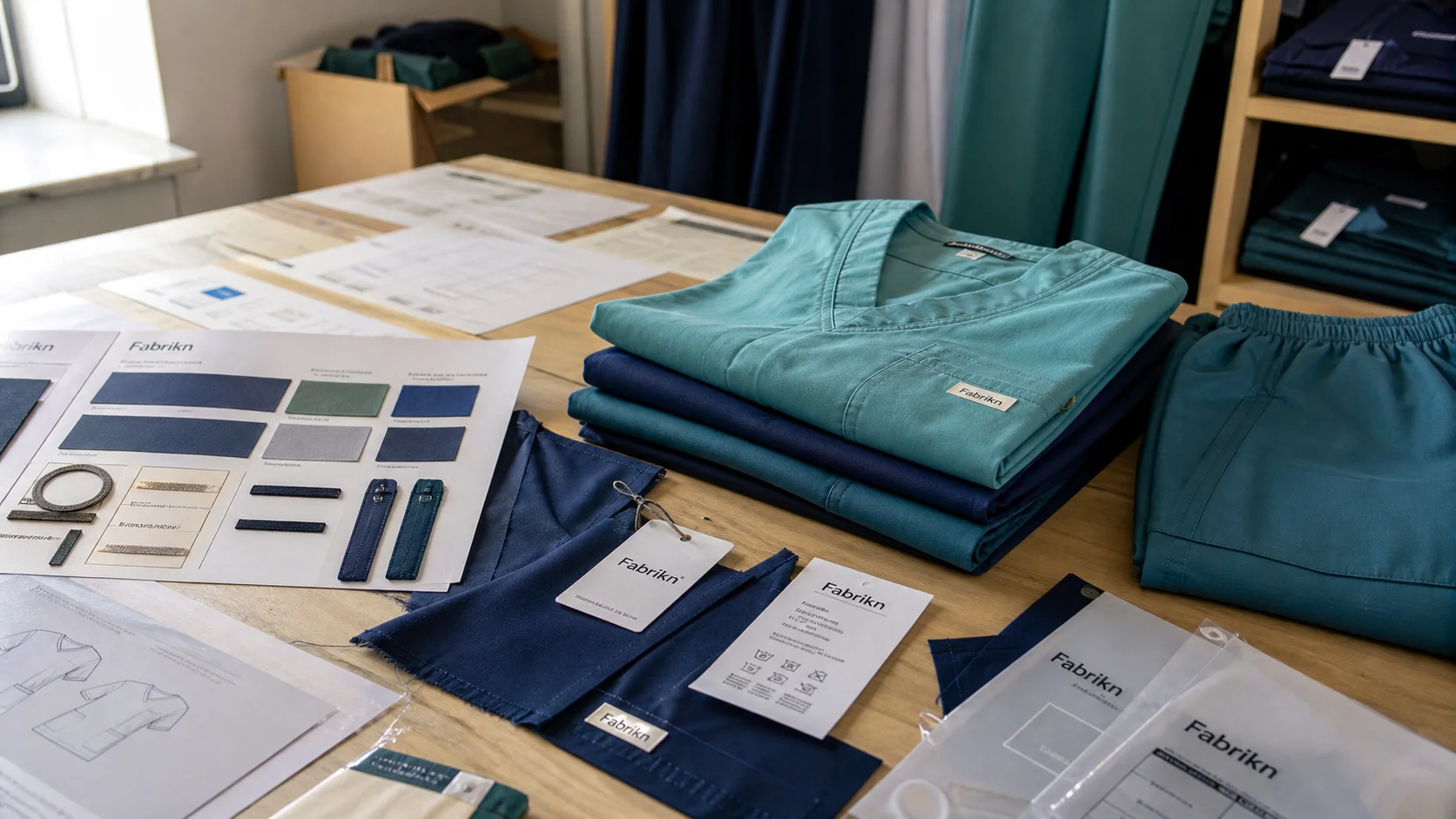
A focused outline for cleaning contractors sourcing wholesale uniforms, centered on how colorfastness affects replacement rates, laundering performance, and total uniform cost.
Wholesale Uniforms Colorfastness Cost for Cleaning - Fabrikn production reference
In cleaning contractor sourcing, uniform cost is rarely just the quoted unit price. Buyers in activewear and teamwear categories already know that a low ex-factory price such as $2.50-4.00 per polo at a 500-piece MOQ can become expensive once garments start fading, bleeding, greying out, or losing a consistent brand appearance after repeated laundering. That is where the subject of wholesale uniforms colorfastness cost for cleaning becomes commercially important.
Cleaning crews wash uniforms hard and often. In many contractor programs, polos and housekeeping tops are laundered 2-4 times per week, while high-turnover hospitality programs may target 50-75 commercial wash cycles as a practical appearance-life benchmark. Garments may be exposed to detergents, alkaline cleaners, stain removers, 40-60°C wash cycles, friction from bulk loads, and sun exposure during drying or jobsite use. If the fabric, dyeing method, or finishing quality is not matched to that use case, the cleaning contractor ends up paying in three places: more replacements, more sorting and wash management, and more complaints about appearance.
For sourcing teams, the right question is not simply, “What does this polo, tee, jogger, or housekeeping top cost?” The better question is, “What is the cost of keeping this uniform presentable through its expected wash life?” In practical terms, buyers commonly compare a lower-cost shirt that holds acceptable color for only 15-20 industrial washes against a slightly higher-cost version that remains serviceable for 40-60 washes. That is the real decision point behind wholesale uniforms colorfastness cost for cleaning contractor sourcing.
Colorfastness performance affects contract image, employee presentation, and reorder stability. It also affects whether dark shades can be washed together, whether contrast panels migrate color into light trims, and whether printed logos still look aligned with the base fabric after dozens of cycles. For example, a navy body with white tipping or a red side panel on a light grey top should be reviewed for wash fastness and crocking before bulk approval. Those are not minor quality details. They are operating cost variables.
Buyers comparing supply options should look beyond price-per-piece and ask for controlled performance data, realistic sample testing, and practical manufacturing transparency. Suppliers with experience in performance apparel and branded uniform production should be able to explain suitable fabric constructions such as 160-180 GSM polyester birdseye or 200-220 GSM CVC pique, expected wash limits, and the points where cost savings create risk. It is also common to ask whether the mill or factory works to standards such as OEKO-TEX, WRAP, BSCI, or GOTS when cotton content is promoted as a sustainability feature. Buyers who need support structuring those specifications can review sourcing capabilities at /services/ or discuss project requirements through /contact-us/.
Colorfastness is the fabric’s ability to retain its original shade and resist color transfer during use, laundering, rubbing, perspiration exposure, and light exposure. In cleaning uniforms, the most relevant types are wash fastness, crocking resistance, perspiration fastness, and light fastness. A common buyer target for contractor uniforms is grade 4 minimum for color change and staining after domestic-style wash testing, with dark shades sometimes negotiated at grade 3-4 depending on fabric and end use. When uniforms are used in active movement and frequent cleaning cycles, each one matters.
A navy polo that looks fine at delivery can still become a sourcing problem if it fades unevenly after ten commercial washes. A red trim panel can create even larger issues if it bleeds into a white body panel during laundering. The replacement cost is obvious, but the hidden cost is often larger: mixed shade inventories, inconsistent team presentation, and the need to separate wash loads by color risk. In sourcing practice, color migration risk is highest where reactive-dyed cotton panels are combined with pale trims or where deep shades have not been properly soaped off after dyeing.
For cleaning contractors, uniforms often function like light-duty performance wear. Staff move constantly, sweat during shifts, kneel, stretch, and work across indoor and outdoor environments. That means garments need not only visual durability but also comfort and mobility. This is why activewear and teamwear construction methods increasingly appear in uniform programs, especially in moisture-management polos, stretch tops, lightweight jackets, and jogger-style service pants. Common details include 4-way stretch polyester-spandex jersey, coverstitch seams, bartack reinforcement at pocket openings, and heat-transfer neck labels to reduce abrasion.
Colorfastness expectations should be tied to the actual service environment. A reception uniform worn twice a week and home-laundered has a different requirement than a housekeeping shirt worn daily and washed in a centralized facility. Buyers who treat both categories the same often under-specify the tougher program. As a practical sourcing detail, centralized laundering usually justifies requesting wash testing closer to the intended process temperature and chemistry rather than relying only on generic off-the-shelf fabric claims.
If the uniform is washed frequently, exposed to strong detergents, and expected to represent a visible brand standard, colorfastness is not a premium extra. It is a core cost-control specification.
The phrase wholesale uniforms colorfastness cost for cleaning is really about total ownership cost. A garment with better dye stability may cost slightly more upfront, often by $0.20-0.60 per unit on common contractor styles, yet reduce replacement frequency enough to produce a lower annual spend. That tradeoff deserves a direct, practical review.
Fading and shade change shorten the usable appearance life of a uniform, even when the garment is still structurally intact. Many cleaning contractors replace garments because they look tired before seams or fabric fail. Dark colors such as black, navy, charcoal, and bottle green are especially sensitive because fading is easy to spot across teams. In many programs, a low-cost dark polo may need visual replacement within 3-4 months, while a better-dyed equivalent can often stay presentable for 6-9 months under the same washing schedule.
When buyers cannot trust color stability, laundries compensate by sorting more carefully. That raises labor cost and slows throughput. Bleeding risk in contrast-color uniforms can also require lower-temperature washing or separate loads, which reduces operational efficiency. Even an extra 10-15 minutes of sorting per 100 garments becomes meaningful over weekly volume, so buyers should ask whether body, collar, cuff, piping, and logo colors have been tested together as a full garment rather than as fabric alone.
Reorders become complicated if the original bulk production was not well controlled. A contractor may receive a second batch that technically matches the approved lab dip but still looks different next to garments that have already faded quickly in service. Stronger colorfastness helps maintain a more consistent visual standard over the life of rolling replenishment orders. It is common to lock a Pantone reference, bulk fabric swatch, and approved wash-tested seal sample before mass production, especially when replenishment orders are likely every 60-90 days.
Cleaning contractors often work in hotels, hospitals, offices, schools, and managed facilities where visible professionalism matters. Uniforms with patchy fading or color transfer can undermine service perception. That does not always show up as a direct invoice line, but it does affect contract presentation. For buyer budgeting, even a 5-10% increase in early replacements across a 1,000-piece program can add more cost than the initial savings from choosing the cheapest fabric option.
Uniform programs often include embroidery, heat transfers, reflective trims, piping, mesh inserts, or woven labels. If the base fabric fades faster than the logo thread or transfer film, the garment can look inconsistent long before it wears out. If trim colors bleed, the issue is even more obvious. Common sourcing checkpoints include matching polyester embroidery thread to the approved body shade, testing reflective heat-transfer adhesion after 5-10 washes, and confirming that white mesh or collar tipping does not pick up staining from dark adjacent panels.
Fabric selection has the biggest influence on colorfastness performance and cleaning cost. Buyers sourcing wholesale uniforms for cleaning crews should look at both fiber content and dye route, not just GSM and hand feel. Typical contractor programs compare 160-180 GSM lightweight polos, 180-220 GSM standard service polos, and 240-280 GSM jogger or trouser fabrics depending on season and duty level.
Polyester polo knits, interlocks, and performance jerseys generally offer better color retention than many cotton-rich alternatives, especially for dark shades and repeated laundering. Common options include 100% polyester birdseye, polyester pique, and 92/8 or 95/5 polyester-spandex blends used in active uniform tops. These materials often suit moisture-management needs and hold shade well when properly dyed with disperse dyes on high-temperature jet dyeing machines or package dyeing systems.
The tradeoff is comfort perception. Some low-cost polyester fabrics can feel harsh, trap odor, or show snagging if the yarn quality is weak. Buyers should specify fabric weight, filament or spun yarn preference, yarn count where available, and finishing expectations rather than assuming all polyester uniforms perform the same. A common sourcing detail is to ask whether moisture wicking is achieved through yarn cross-section and knit structure or only by a topical finish, since topical finishes may weaken after repeated laundering.
Cotton offers comfort and familiarity, but color loss can be more visible over repeated industrial washing, especially in saturated shades. Poly-cotton blends such as 65/35 or 60/40 can offer a practical middle ground for T-shirts and some service polos. The exact dye process, enzyme treatment, and finish control matter a great deal here. Reactive dyeing with proper soaping and fixation is commonly preferred for cotton-rich dark shades, while inadequate wash-off is a frequent cause of crocking and bleeding claims.
For cleaning contractors with high laundering frequency, cotton-rich dark uniforms should be approached cautiously unless tested against actual wash conditions. Buyers often choose cotton for comfort, then absorb higher replacement cost later. If cotton claims are important for brand positioning, it is reasonable to ask whether the material is certified to GOTS or OEKO-TEX, but certification alone does not replace wash-life testing.
Chief Value Cotton and Tetron Cotton blends are common in uniform manufacturing. They can be cost-effective, but the colorfastness outcome depends heavily on how the blended fabric is dyed and finished. Shade consistency in blended fabrics can become a problem if process control is uneven. For example, a 60/40 CVC pique may give a softer hand than a standard TC blend, while a 65/35 TC poplin used in housekeeping tunics can offer sharper appearance and lower cost but may show differential fading between fiber components over time.
In some programs, solution-dyed polyester may offer stronger long-term color performance because pigment is integrated earlier in the fiber production stage. This can improve fade resistance, though it is not always suitable for every style, MOQ level, or color flexibility requirement. It is more common in larger repeat programs where buyers can commit to shade continuity and higher yarn minimums.
Minimum order quantities for specialized yarn routes tend to be higher, often starting around 1,000-3,000 pieces per color depending on the fabric platform, and color range flexibility may be narrower. Still, for large uniform programs with year-round replenishment, the higher entry point can be commercially sensible if it reduces shade drift and replacement cost.
Before placing a bulk order, buyers should request a written specification sheet that covers fabric, color, construction, and testing rather than approving only a salesman sample. A practical spec commonly includes fiber content tolerance, finished fabric weight such as 180 GSM ±5%, color reference, shrinkage target, and wash-care method aligned to the intended use.
For color performance, common requests include wash fastness, dry and wet crocking, perspiration fastness, and light fastness results. Many buyers set a minimum target of grade 4 for wash fastness and dry crocking, with wet crocking sometimes accepted at grade 3-4 on dark shades if disclosed in advance. If garments include white trims, contrast panels, or prints, it is common to ask for whole-garment testing rather than relying only on base fabric lab data.
Construction details also matter because heavy laundering exposes weak assembly quickly. Typical checkpoints include collar and cuff matching, SPI levels appropriate to the fabric, overlock and coverstitch balance, bartacks at stress points, placket shape retention, and heat-transfer or embroidery durability after repeated wash cycles. If a buyer is sourcing polos or active tops, mentioning flatlock, overlock, or coverstitch construction in the tech pack reduces avoidable factory assumptions.
On compliance, buyers commonly ask suppliers to confirm OEKO-TEX material status and social compliance frameworks such as WRAP or BSCI for finished-garment production. Where organic cotton is part of the brief, GOTS transaction scope should be confirmed before booking the order rather than after sample approval.
Sample approval should move in stages, not straight from a fit sample to bulk production. A common sequence is lab dip approval, fabric test confirmation, proto sample, size set, pre-production sample, and then a short wear test under realistic conditions. For uniform programs, that process typically adds 7-14 calendar days, but it is often cheaper than correcting a failed bulk run.
Wear testing is especially important for cleaning uniforms because lab data does not always reflect real use. A practical buyer method is to issue 10-20 garments to staff for 2-3 weeks, track wash count, and compare color change, collar edge wear, logo appearance, and any staining or crocking after repeated laundering. This is where issues such as white undercollar staining, side-panel bleeding, or patchy chest fading often appear first.
Pre-production approval should also include trim confirmation. Buyers commonly check embroidery thread shade, heat-transfer film type, zipper tape color, reflective trim wash durability, and whether labels or size marks remain legible after washing. If the supplier uses subcontracted printing or embroidery, that dependency should be identified before bulk lead time is agreed.
MOQ and lead time have a direct effect on fabric choice and colorfastness risk. For stock-supported polyester pique or birdseye, a common MOQ is 300-500 pieces per color, while custom-knitted and custom-dyed fabrics often start around 800-1,500 pieces per color. Lower MOQs can be convenient, but they may limit buyers to available shades or substitute fabric platforms that were not developed for heavy laundering.
Typical bulk lead time for a straightforward reorder in an existing fabric can be 18-22 business days after final approval, while a first order with custom lab dips, knitting, dyeing, and logo application more commonly lands in the 30-45 business day range. If the order includes special yarns, solution-dyed polyester, or multiple decoration processes, lead time often extends further because fabric mill, dye house, embellishment, and sewing lines must all align.
There is also a pricing tradeoff. A basic contractor polo in a standard polyester knit may commonly price around $2.50-4.00 per unit at 500 MOQ, while a better-controlled 180-200 GSM moisture-management polo with stricter color testing and more durable trim package may land closer to $4.20-6.50. The gap is usually not driven by sewing alone; it often comes from fabric platform, dye process, testing, and reject allowance.
Buyers should also ask what happens if bulk fabric fails shade or fastness checks. Some suppliers can re-dye or re-knit within the same season, while others depend on external mills and may add 7-14 more days for correction. That dependency is a real sourcing factor, especially for time-sensitive contract launches.
Inspection for colorfastness-sensitive uniforms should start before final packing. The most useful checkpoints are usually in-line fabric shade review, panel matching during cutting, pilot-run sewing review, and final random inspection after pressing and packing. Waiting until finished cartons are closed makes color problems slower and more expensive to correct.
Common risk points include body-to-collar shade mismatch, left-right panel variation, trim staining, embroidery thread mismatch, and color transfer after spot cleaning or pressing. Where dark garments are packed with light trims or white logo elements, buyers often ask for a simple rub test and wash confirmation on pre-production pieces before full cutting begins.
For a stricter program, final inspection can include carton sampling, measurement checks, workmanship review, and retention samples from each color lot. It is also common to record fabric roll numbers, dye lot numbers, and packing dates so any later claim can be traced back to a specific production batch. If the factory uses an AQL-based final inspection, buyers typically still benefit from adding a color-focused checklist rather than relying on a generic workmanship template alone.
Compliance and process control are also useful screening signals. A supplier operating under WRAP or BSCI requirements, and using material inputs documented to OEKO-TEX or GOTS where relevant, is not automatically better at colorfastness, but it often indicates a more structured documentation culture around incoming materials, process records, and corrective action.
For cleaning contractors, colorfastness should be treated as a sourcing specification with measurable commercial value, not as a vague quality preference. The most economical option on paper is often not the lowest-cost option in service, especially when garments are washed several times per week and must maintain a consistent branded look.
In practical sourcing terms, buyers usually get the best result by locking fabric composition, GSM, dye route, color standard, trim package, and test thresholds before bulk booking. Common winning combinations for this category include polyester-rich pique or birdseye polos, carefully controlled CVC tops for softer hand feel, and construction details such as reinforced plackets, stable collars, and tested logo applications.
The right supplier should be able to explain typical MOQ breaks, realistic lead times, likely price bands, and the inspection points used to control shade and wash performance. That level of detail is usually a better indicator of readiness than a low quotation alone.
Get a free quote from Fabrikn — your trusted B2B clothing manufacturer with 10+ years of experience. MOQ as low as 200 pieces.
Get a Free Quote →What colorfastness level is commonly requested for cleaning contractor uniforms?Many buyers commonly request minimum grade 4 for wash fastness and dry crocking, with wet crocking sometimes accepted at grade 3-4 for dark shades if the end use is disclosed and approved.
What fabric is typically safest for dark contractor polos?100% polyester birdseye, polyester pique, and polyester-spandex performance knits are commonly viewed as lower-risk than dark cotton-rich options, especially when dyed on a controlled disperse-dye process and tested as a finished garment.
What MOQ is typical for custom uniform production?For common stock-supported programs, 300-500 pieces per color is typical, while custom-knitted or custom-dyed fabrics often require around 800-1,500 pieces per color, with specialized solution-dyed routes sometimes higher.
How long does production usually take?A repeat order in an existing fabric may commonly ship in 18-22 business days after final approval, while a new custom program with sampling, lab dips, testing, and trim booking more often runs 30-45 business days.
Which certifications are relevant?OEKO-TEX is commonly requested for chemical safety at the material level, while WRAP and BSCI are frequently referenced for social compliance. If the brief includes organic cotton, buyers commonly ask for GOTS scope confirmation before order placement.