
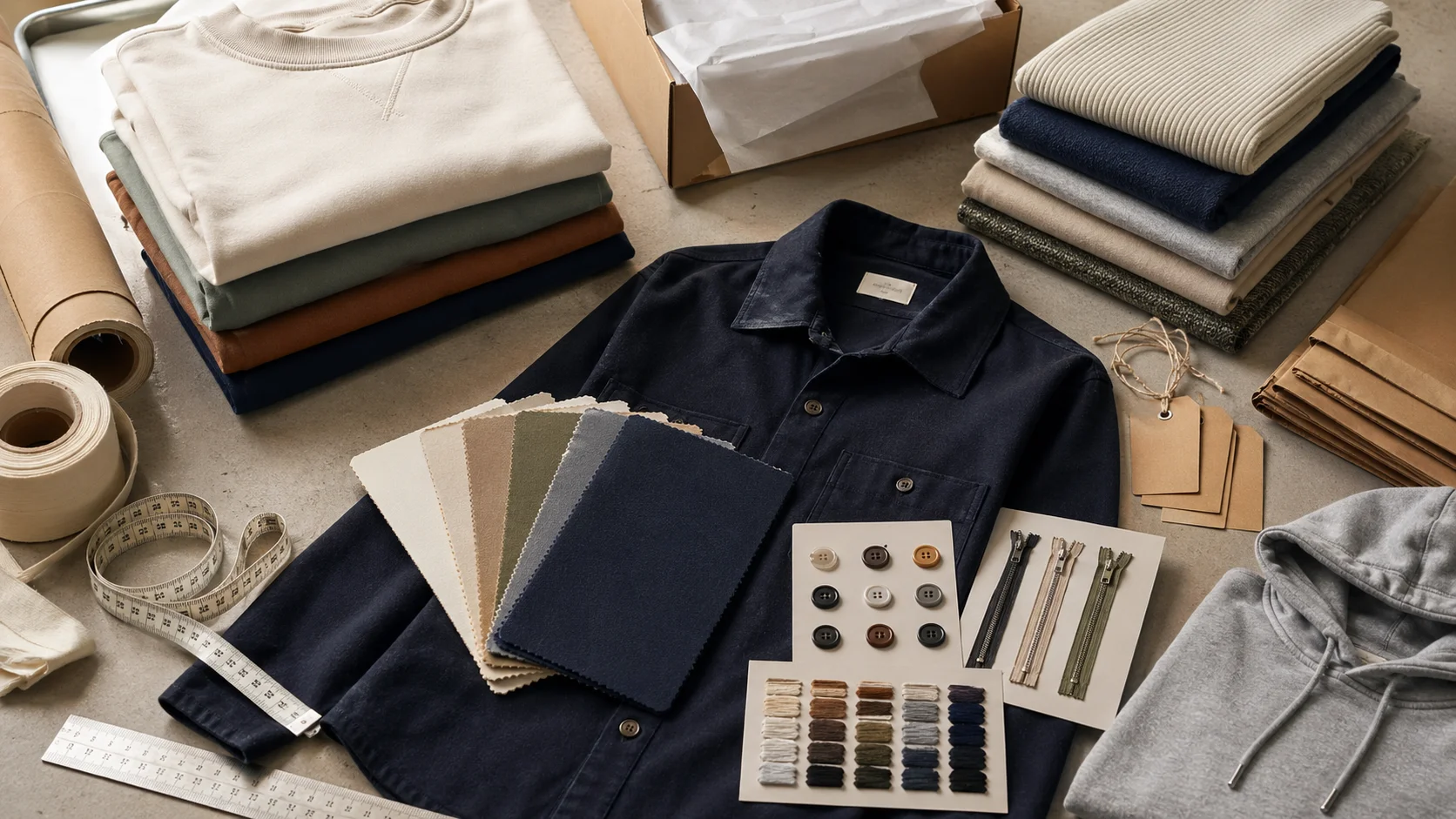
Recyclable Mailer Bags for Clothing Ecommerce with checks for samples, fit, MOQ, QC evidence, pricing terms, and delivery risk.
Fast answer: Recyclable Mailer Bags for Clothing Ecommerce: What Works should be judged by production evidence, not by a generic sourcing promise. The buyer needs sample proof, cost breakdowns, QC checkpoints, and delivery buffers in writing.
Ask for recent sample photos, measurement tolerances, fabric or print test assumptions, decoration test notes, packing examples, and a named inspection checkpoint. These details show whether the team can repeat an approved sample at bulk volume.
Separate garment cost, decoration, labels, packaging, sampling, testing, freight, and rush charges. When every cost line is visible, it becomes easier to reduce colorways, adjust size depth, or reserve more time for sampling.
Apparel ecommerce throws away a staggering amount of packaging, and returns make it worse. In audits I’ve reviewed, soft-goods parcels can see return rates of 20% to 40%, while packaging waste often adds 8 to 12 grams per shipment before the garment even leaves the warehouse. That is why recyclable mailer bags for clothing ecommerce are moving from niche request to standard spec.
Brands also want packaging that looks cleaner, is easier to open, and feels less wasteful. Factory floors tell a messier story. I’ve stood beside lines where “recyclable” meant a mono-PE structure with a 50-micron film, then walked into another plant where it meant a paper bag with a plastic window no municipal program would touch. Same word. Very different bag.
North America still leans on durable poly mailers for lightweight apparel because parcel networks are rough, transit times run 3 to 7 days, and damage claims hurt. Europe pushes harder on material reduction, so thinner mono-material bags and paper mailers are common for 1 to 2 item orders. Asia is split: cross-border fashion brands often use 60 to 80 micron PE mailers for moisture resistance, while domestic premium labels adopt printed paper or recycled-content film when their returns sit below 15%.
When I visited factories in Vietnam and Turkey, the pitch sounded almost identical: recyclable, eco, compliant. The production floor said otherwise. A bag can be technically recyclable and still fail if the seal is weak, the film is too thin, or the print layer contaminates the stream. One supplier showed me a 100% PE mailer with glossy ink coverage that looked premium but still depended on consumer action and local collection to actually get recycled. Another sent 5,000 samples with a hand-test tear rate under 1%, then failed 200-meter drop testing because the side weld ran unevenly.
That gap costs money. A bag that breaks in transit creates a lost sale, a re-ship charge, and a bad review. I’ve seen brands spend $0.18 more per unit and cut complaint rates by 30% because the bag fit better and tore less often. Packaging is not decoration. It rides with the product, and customers judge it in seconds.
Three main builds dominate: PCR film, mono-material PE, and paper-based structures. PCR means post-consumer recycled content, usually blended into PE film at 30% to 80%. Mono-material PE keeps the whole bag in one polymer family, which makes the recycling route cleaner in theory. Paper-based mailers use kraft or coated paper, sometimes with a small internal barrier layer; that helps stiffness, but can also complicate recycling if the layers are bonded too tightly.
In practice, the recycling path depends on local collection systems. Many curbside programs accept clean PE film only through special store drop-off or dedicated film bins, not in mixed paper streams. Paper mailers can go into curbside paper recycling only if they are dry, free of plastic windows, and under contamination thresholds that change by municipality. I checked 3 plants in Europe where paper bags were sold as recyclable, yet the coating made them rejectable in standard mills. That is not a small detail. It is the whole story.
PCR content changes strength, clarity, and cost. A 50% PCR PE bag may save virgin resin, but it often looks hazier and can stretch less evenly than a virgin-film equivalent. Costs usually rise by 4% to 12% because PCR pellets need tighter sorting and more quality control. At 80% PCR, results can still be decent, but only if the bag stays thick enough. Higher recycled content can backfire when thickness drops too low. A 40-micron bag with 80% PCR may fail more often than a 50-micron bag with 30% PCR, especially in cold warehouses where brittle films crack faster.
For brands selling premium basics or custom baby clothing manufacturing runs, I usually advise testing 30% to 50% PCR first. Babywear is small, soft, and margin-sensitive, so a bag that tears after 2 manual handling steps costs more than the sustainability story it tells.
According to ISO guidance on materials testing, Textile Exchange on recycled input systems, and OEKO-TEX on chemical safety expectations, the best claims are the ones backed by composition, traceability, and performance results, not adjectives.
Fit drives both cost and damage. A tee in a 250 x 350 mm mailer sits flat and ships well. A folded knitwear set usually needs 300 x 400 mm. Denim often wants 350 x 450 mm or a gusseted format, while outerwear can push into 400 x 500 mm and beyond. If the bag is oversized by 25% or more, freight density drops, the product shifts, and corners rub through.
I’ve seen warehouses pack 3 tees into a mailer meant for 1 and then pay for it twice: once in extra postage, again in crushed product returns. A fill-rate target of 70% to 85% is the sweet spot in most factories I’ve visited. Below 60%, the parcel looks sloppy and wastes void space. Above 90%, seal failure jumps because the closure has too much pressure against it.
Seal strength matters more than marketing copy. A standard hot-melt or pressure-sensitive closure should hold through 2 to 3 handling cycles and a 1-meter drop without peeling. For humid routes, especially into Southeast Asia or coastal U.S. states, moisture resistance matters as much as tear resistance. A 60-micron mono-PE bag with a strong side weld outperforms a thinner 45-micron version if the route includes 5 to 8 days in a hot depot.
Opacity is another quiet issue. If the bag is too transparent, customers can see color shifts, labels, or branded inserts before opening, which can hurt the unboxing moment. Too much opacity from heavy inks can interfere with recycling. I prefer restrained print coverage, usually under 30% of the surface, unless the brand is paying for a sorted recovery stream and can prove it.
For brands building private-label apparel programs, bag size should be planned alongside garment ratios and folding specs from day one. That is where private label clothing services and packaging specs should be written in the same worksheet, not as separate afterthoughts.
Pricing changes sharply with volume. At low MOQ, say 1,000 to 5,000 pieces, recycled-content mailers often land around $0.14 to $0.28 per bag in Asia, $0.22 to $0.40 in Eastern Europe, and $0.30 to $0.55 domestically in North America, depending on size, print colors, and thickness. At 50,000 to 100,000 pieces, those ranges can fall by 20% to 35% because material waste, setup time, and press efficiency improve.
Asia still offers the lowest base unit cost, but freight exposure is real. A $0.16 bag can turn into a $0.27 landed cost once ocean freight, duties, and inland trucking are added. Eastern Europe often sits in the middle. Lead times of 3 to 5 weeks and shorter truck routes into the EU can outweigh a higher ex-factory price. Domestic sourcing is the fastest, usually 7 to 14 days after approval, yet labor and polymer pricing can push the unit cost up by 25% to 60%.
Recycled content and certification shift the price as well. Moving from virgin PE to 50% PCR typically adds 5% to 10%. Requiring traceable chain-of-custody or third-party test reports can add another $500 to $2,000 per production run, depending on the supplier’s documentation maturity. Print complexity matters too. One-color flexo may add $0.01 to $0.03, while a full-coverage design with matte finish can add $0.04 or more.
The real mistake is pricing bags alone. I always build landed cost with 4 buckets: ex-factory price, testing and compliance, freight, and failure cost. For a 20,000-piece order, that might look like this: $0.19 unit bag, $700 in testing, $1,100 in freight, and a 2% contingency for damage or rework. That puts the real cost near $0.25 to $0.27 per shipped unit, not the glossy factory quote.
Brands using cut-and-sew partners should make packaging part of the same sourcing conversation. If your production runs already involve cut and sew manufacturing, you can align carton size, fold method, and mailer dimensions before the first sample is approved.
For brands that want a direct quote, I would still compare 3 regions, 2 thicknesses, and at least 2 print specs before committing. When the package mix is right, you protect margin without pretending packaging is free.
Start with documents, not promises. Ask for material data sheets, recyclability claims, chain-of-custody evidence, and test reports for seal strength, drop performance, and ink adhesion. If a supplier cannot produce resin origin, thickness tolerance, and recycled-content verification within 48 hours, that is a warning sign.
Greenwashing usually hides in mixed structures. A bag described as recyclable may contain a PE outer layer, an OPP print layer, and a paper insert. That may look neat, but it can break the recycling path entirely. Another common trick is vague language like “widely recyclable” without naming the region. In reality, whether the item is accepted depends on local infrastructure, contamination, and whether the consumer removes labels and closures.
On factory visits, I see quality failures start in 3 places. First, resin inconsistency: one batch stretches differently from the next. Second, weak seals: the weld is beautiful at the edges and thin in the center. Third, poor print adhesion: ink flakes after 24 hours of rubbing or humidity exposure. Those failures are not theoretical. They appear in the first 200 parcels, then show up as complaints 2 weeks later.
Before signing, verify capacity and compliance with a practical checklist:
If the supplier is also offering white-label production, tie the packaging review to the garment review and ask for sample packs alongside the size set. That is especially useful for brands developing private label clothing services at speed.
For broader procurement benchmarking, the U.S. International Trade Administration offers useful market guidance at trade.gov, especially when you are comparing import regions and compliance expectations.
The cleanest rollout is a pilot, not a wholesale switch. I recommend 30 days, then 60, then 90. In the first month, test one size, one route, and one fulfillment center. Ship 500 to 2,000 orders using the new mailer while tracking damage rate, pack time, and complaint rate against the old baseline.
By day 60, expand to 3 garment categories and at least 2 thickness levels. If tees ship well in a 45-micron bag but denim needs 60 microns, make that split explicit. Warehouse teams need folding guides, picker training, and a print proof sheet so they can spot the correct bag without slowing the line. Artwork approvals should happen before inventory lands, not after. A 2-week delay on print sign-off can burn a freight booking.
By day 90, move to broader rollout only if the metrics hold. I watch 4 numbers closely: damage rate below 1.5%, pack time within 5% of baseline, shipping weight reduction of at least 3 grams per order, and complaint rate under 2%. If any one of those misses badly, the format is not ready.
Returns need separate thinking. A mailer that is easy to reopen and reseal can reduce customer frustration, but a weak return closure creates leakage. Build a returns test with 50 to 100 parcels, then simulate a second trip through the network. The best suppliers will tell you where to reinforce the flap and where to avoid extra glue because it ruins recyclability.
If you need a fast starting point, use the packaging pilot to build a quote request with inventory assumptions and launch dates, then get a free quote before placing the first production order.
The best suppliers do not always look the cheapest on paper. A bag priced $0.02 lower can cost more later if the seal is inconsistent, the print scuffs, or the scrap rate hits 4% instead of 1%. Premium suppliers usually charge more for tighter gauge control, better ink adhesion, and cleaner edge trims. Budget suppliers may win on ex-factory price but lose on rework and customer perception.
Regional economics matter. Labor in parts of Eastern Europe can be 15% to 25% higher than some Asian hubs, but energy costs, transit times, and polymer access can balance the equation. In humid factories, I’ve seen lower-cost bags fail more often in cold-chain freight or tropical transit because the film becomes brittle or the adhesive weakens after 7 to 10 days in storage.
Here’s the buyer’s lens I trust: durability first, recyclability second, brand feel third. A bag that survives the trip, fits the garment, and is accepted by the right recovery stream is worth more than a greener-sounding spec sheet. That is the difference between packaging as a cost line and packaging as proof that the brand understands operations.
When you compare a manufacturer, factory, or supplier, ask for sample photos, line capacity, production records, and QC tolerances. The best partners can support custom sizes, wholesale programs, and bulk replenishment without letting quality drift as MOQ increases.
At the end of the day, recyclable mailer bags for clothing ecommerce work best when the claim matches the route, the bag matches the garment, and the supplier can prove both. Get those three things right, and the packaging stops being a gamble and starts doing its actual job.
They are usually made from mono-material PE, PCR-blended PE, or paper-based structures. Mono-PE is the easiest to sort in film recovery streams, while PCR content commonly ranges from 30% to 80%. Paper versions can work well if they are dry, uncoated, and free of mixed layers.
At low MOQ, prices often run from $0.14 to $0.55 per bag depending on region, size, and print. At 50,000 pieces or more, unit pricing usually drops by 20% to 35%. Testing, freight, and certification can add another $0.02 to $0.08 per shipped unit.
Factory lead times are often 3 to 5 weeks in Asia, 2 to 4 weeks in Eastern Europe, and 7 to 14 days domestically after final approval. Add 1 to 2 weeks for artwork sign-off, testing, and freight booking if the design is new.
Yes, but the closure must survive a second trip. I recommend testing 50 to 100 return parcels with reseal strips and checking for leakage, tearing, and label adhesion. If the bag fails after one reopen cycle, it is not suitable for return-heavy apparel.
Small runs are usually easiest from domestic suppliers or regional converters that accept 1,000 to 5,000 pieces. Expect a higher unit price, but faster turnaround and lower freight risk. If you need custom print and fit, plan on at least 2 sample rounds before production.