
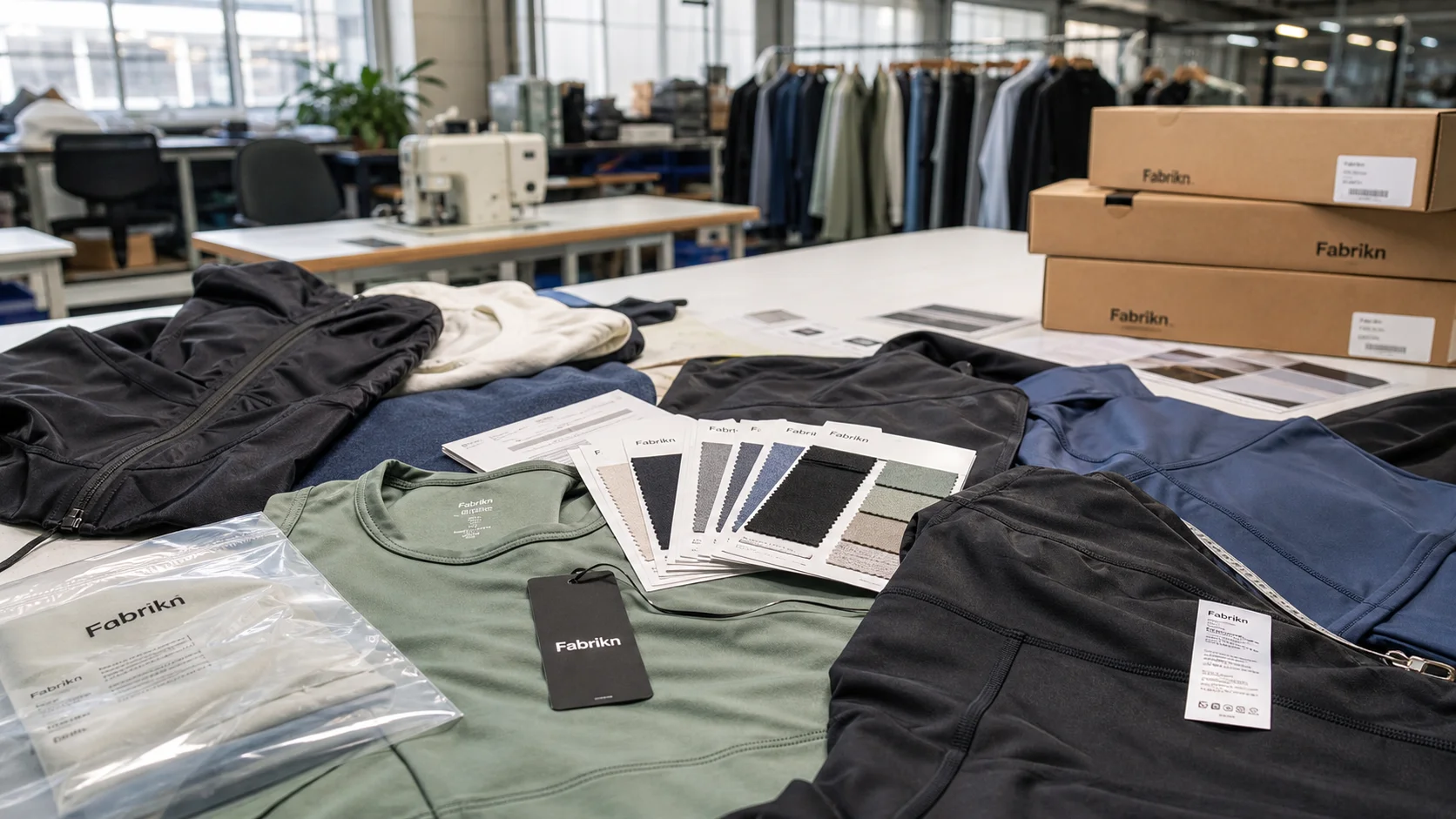
Recyclable Mailer Bags for Ecommerce Clothing compared by sample evidence, fabric or trim specs, MOQ, AQL terms, cost lines, delivery timing, and rework...
Fast answer: Recyclable Mailer Bags for Ecommerce Clothing: Material, Print, MOQ, and QC Terms should be judged by production evidence, not by a generic sourcing promise. The buyer needs sample proof, cost breakdowns, QC checkpoints, and delivery buffers in writing.
Ask for recent sample photos, measurement tolerances, fabric or print test assumptions, decoration test notes, packing examples, and a named inspection checkpoint. These details show whether the team can repeat an approved sample at bulk volume.
Separate garment cost, decoration, labels, packaging, sampling, testing, freight, and rush charges. Clear cost lines make it easier to reduce colorways, adjust size depth, or reserve more time for sampling.
The humble mailer has become fashion’s quiet reputation test. Global parcel volumes passed 161 billion in 2022, and apparel returns can push a single order through two or three bags before it settles in a customer’s closet or a warehouse bin. recyclable mailer bags for ecommerce clothing are no longer a branding flourish. They are a visible cost, a compliance signal, and a waste problem measured in seconds.
A one-garment order can leave a factory in a 12 gram poly mailer, ride 4,000 kilometers, get opened for a 30 second try-on, then return in a second bag with a fresh label. The fabric may be premium. The packaging looks disposable because it is. In North America, customers usually expect a curbside bin or store drop-off. In much of Western Europe, collection systems are clearer, and packaging claims get checked against local rules. In parts of Asia, access varies street by street, so a “recyclable” claim can mean little if the nearest collection point is 3 bus rides away.
Fashion brands are judged on packaging almost as much as fiber content. That is especially true in DTC apparel, where a box or mailer is often the only physical brand touchpoint. In my factory visits, I have seen brands spend $28 on a hoodie and $0.18 on the mailer, then lose trust because the mailer felt cheap, greasy, or impossible to sort.
Here is the factory-floor reality check: recyclable does not always mean actually recycled. If the material is accepted in theory but rejected by the local waste stream, the claim collapses. I have seen brands pay for recycled content and still ship mixed-layer bags that never had a real recovery path. That gap is where buyer diligence begins.
Most recyclable mailer bags for ecommerce clothing are built from polyethylene film. The common options are virgin LDPE, recycled LDPE, PCR blends, compostable alternatives, and paper-based mailers. For clothing, mono-material PE is usually the most practical choice because it balances tear resistance, printability, and recovery potential without creating a sorting headache.
Virgin LDPE is the cleanest in performance. Recycled LDPE lowers fossil input. PCR blends usually mix post-consumer resin with virgin material, often 10% to 60% PCR, depending on supply and color. Compostable mailers sound attractive, but they need the right industrial conditions and a clear end-of-life pathway. Paper-based mailers can work for light apparel, but once moisture, seams, or return friction enter the picture, performance can fall quickly.
Resin codes matter, but not as much as local acceptance. A number 4 PE bag may carry a recycling symbol, yet curbside programs differ widely. That is why How2Recycle-style labeling, resin identification, and local disposal instructions need to align with the destination market. For brands comparing claims, guidance from ISO packaging standards, WRAP recycling guidance, and OEKO-TEX material standards can help separate marketing language from real recoverability.
Mixed-layer films, metallized coatings, and glitter inks are trouble. They can block optical sorting or contaminate the stream. Recycled content claims also get confused with recyclability claims. A bag with 50% PCR is not automatically better at end of life than a 100% virgin mono-PE mailer. The first speaks to feedstock. The second speaks to what happens after delivery. Those are different tests.
Pricing moves fast with quantity. At 5,000 pieces, plain stock mailers often land around $0.08 to $0.18 each. At 25,000 pieces, I usually see $0.05 to $0.11. At 100,000 pieces, $0.03 to $0.08 is realistic for standard sizes, depending on thickness and origin. Custom printing adds another $0.01 to $0.05 per bag, and setup fees can run $80 to $400 on the first order.
Thickness changes the quote more than most buyers expect. A 40 micron bag may be cheaper than a 60 micron bag by $0.01 to $0.03, yet the thicker film can raise freight weight and sometimes increase seal inconsistency. Recycled content also affects price. A 30% PCR blend is often easier to source than 100% PCR, especially in white or pastel colorways, and the premium can be $0.01 to $0.04 per unit. Tear strips, dual-adhesive closures, and reseal strips each add their own small but cumulative cost.
Print coverage matters too. A one-color logo on 15% of the surface is far less expensive than a full-bleed design across both sides. I have seen brands move from six-color graphics to one color and save 18% to 27% on the bag alone. If the supplier uses imported film and the brand ships into the US or EU, landed cost can rise another 8% to 16% from freight, duties, and carton volume.
For a brand mailing 30,000 parcels per month, a mid-range custom mailer at $0.09 each costs $2,700 monthly, or $32,400 annually. Add $0.015 for a return strip and $0.02 for print, and the annual bill climbs by $12,600. That is not trivial. It is often larger than the annual cost of a basic packaging redesign project, which is why buyers should model total spend, not unit price alone.
When I worked with a brand that also used custom baby clothing manufacturing for its infant line, packaging became a margin issue. Small garments packed in small mailers kept freight low, but premium finishes kept pushing the quote up by 6% to 9%. The lesson was simple: SKU size, not just brand ambition, drives packaging economics. In adjacent product lines, private label clothing services often need the same math.
Apparel needs different protection than books or cosmetics because garments are soft, compressible, and often shipped in uneven bundles with zippers, tags, snaps, and poly inserts. A mailer can pass visual inspection and still fail in transit if the seal opens, the side seam splits, or the print rubs off in sorting. I ask suppliers for drop tests, puncture resistance data, seal integrity results, and print rub resistance before I approve samples.
Hot, humid lanes are brutal. A 60 micron PE bag that performs well in a dry warehouse can warp in 35°C humidity and lose seal consistency. Cold routes are different. In winter shipments, some films stiffen and crack near the closure fold. I have seen South Asia to Middle East routes perform better with slightly more elastic film, while Northern Europe routes reward better seal strength and cleaner closure geometry.
Factory samples can look perfect because they are hand-checked under ideal conditions. Couriers are not ideal. Bags get compressed, dragged, stacked, and sometimes punctured by box corners from other parcels. That is why I insist on a 1 meter drop test, a 5 kg puncture check for larger sizes, and at least 50 seal cycles on production-equivalent samples. If the print is custom, rub resistance should be checked after 24 hours and again after 72.
The thing nobody tells you: a thicker film can fail more often if it destabilizes the heat seal. I have seen 70 micron bags split at the seam while 50 micron bags from the same line held perfectly. Thickness helps only when the seal window, pressure, and cooling time are tuned together.
Closure choice affects reuse too. A single adhesive strip is simple for outbound shipping. A dual-strip closure makes returns easier, which matters for fashion categories with 20% to 40% return rates. In cut and sew manufacturing, I have seen teams improve pack-out speed by 12% just by standardizing mailer opening direction and closure placement.
China still offers the deepest mix of extrusion, co-extrusion, printing, and converting capacity, with lead times often at 20 to 35 days after sample approval. Vietnam can be faster on smaller runs, usually 18 to 30 days, but its print and finishing options are narrower in some clusters. India often competes on labor cost and access to regional resin, though quality varies sharply by plant. Turkey and Eastern Europe can win on freight into the EU, with 10 to 25 day transit windows and lower customs friction.
Across factory visits, I see the same pattern repeat. The best plants recover post-industrial scrap at rates near 85% to 95%, regrind it carefully, and keep documentation clean. Weaker plants report “recycling” but mix scrap loosely, which can create gauge swings of 8% to 12% from one batch to the next. That hurts seal strength and increases rejection rates.
Energy mix matters. A plant running on coal-heavy power in one region can erase part of its material advantage if freight is long and defect rates are high. A slightly more expensive bag made 1,500 kilometers closer to the fulfillment center can have lower total impact than a cheaper bag shipped halfway around the globe. I have seen buyers save $0.01 per unit on sourcing and spend $0.03 more on freight and losses.
Lower price often hides slower correction cycles. Some factories quote aggressively, then need two extra sample rounds to fix color drift or seal wrinkles. That adds 2 to 4 weeks before launch, and in fashion that delay can miss a season. A supplier that charges $0.02 more but delivers a stable 1.5% defect rate may beat a cheaper plant that runs at 4% or 5% rejects.
My supplier audit starts with paperwork, not price. I ask for material spec sheets, recycled-content certificates, dye safety documentation, chain-of-custody records, and test data for seal strength and puncture resistance. If the supplier claims PCR, I want proof of origin and batch traceability. If they say the bag is recyclable, I want the exact country or waste stream where that claim holds.
The next question is structural. Does the supplier own extrusion lines, or are they a broker reselling stock? That answer changes control, lead time, and margin. An actual manufacturer can usually support MOQ 5,000 to 20,000 pieces for semi-custom work and 25,000 to 100,000 for full custom runs. Brokers can be useful for speed, but they often hide the real plant behind vague photos and recycled marketing language.
Red flags are easy to spot. No gauge measurements. No lab data. “Recyclable” without a resin code. PCR percentage mentioned without proof. Color matching promises that ignore print limitations. I also watch for suppliers who say every bag is 60 microns, then ship samples at 52 or 68 microns. That kind of drift creates warehouse problems within the first 3 deliveries.
If a brand wants premium branding without undermining recoverability, I recommend simple two-color print, black or dark navy on natural PE, and one clear disposal instruction panel. For highly branded apparel lines, request a custom packaging quote only after confirming the artwork does not rely on mixed coatings or metalized effects. Those details save headaches later.
I never approve a full roll-out without a 90-day pilot. Start with one SKU family, ideally 2,000 to 5,000 parcels, then test sample approval, courier handling, warehouse packing, and customer service scripts before scaling. That pilot should include one outbound route, one returns route, and at least 2 packaging sizes if your assortment spans tees and outerwear.
Track four numbers from day one: damage rate, returns friction, unit cost, and customer feedback on packaging. If damage stays below 0.5%, packing speed improves by 10% or more, and complaints about waste or opening difficulty stay under 2%, the format is probably ready to expand. If the bag tears at the label seam or jams on the packing line, fix the spec before buying 50,000 more.
Artwork and disposal instructions need market-specific versions. A bag headed to Germany may need clearer sorting language than one sold in Texas. A Japan-bound shipment may need different size labeling and more precise film disclosure. For brands with mixed categories, I like one brief packaging sheet that covers procurement, operations, and design in a single 2-page document. It keeps everyone from making a different promise.
The decision framework is straightforward. Stock mailers work for speed and low MOQ, semi-custom works for moderate branding and better control, and fully custom makes sense only when monthly volume passes 25,000 units or when the packaging is part of the brand story. If you are still mapping the supply chain for a broader apparel line, the best next move is to request a custom packaging quote, ask for test samples, and compare at least 3 factories on the same spec sheet.
Most are made from mono-material polyethylene, usually LDPE or recycled LDPE. The most common thickness range is 40 to 60 microns, with PCR content often between 10% and 60% depending on supply and print requirements.
At 5,000 pieces, plain stock bags often run $0.08 to $0.18 each. At 25,000 pieces, expect $0.05 to $0.11, and at 100,000 pieces, $0.03 to $0.08 is common before freight, duties, and setup fees.
Lead time is often 20 to 35 days after sample approval in China, 18 to 30 days in Vietnam, and 10 to 25 days of transit if you source from Turkey or Eastern Europe into the EU. Custom print can add 1 to 2 weeks.
Yes, if the bag has a second adhesive strip or a durable closure area. Reuse rates improve when the bag keeps its seal after opening and the printed instructions are clear enough to encourage returns or resale.
Buy from a manufacturer or supplier who can prove material specs, test data, and actual manufacturing capability. A factory with extrusion and converting lines usually gives better control than a broker, especially when you need 25,000 to 100,000 pieces and tight gauge tolerances.