
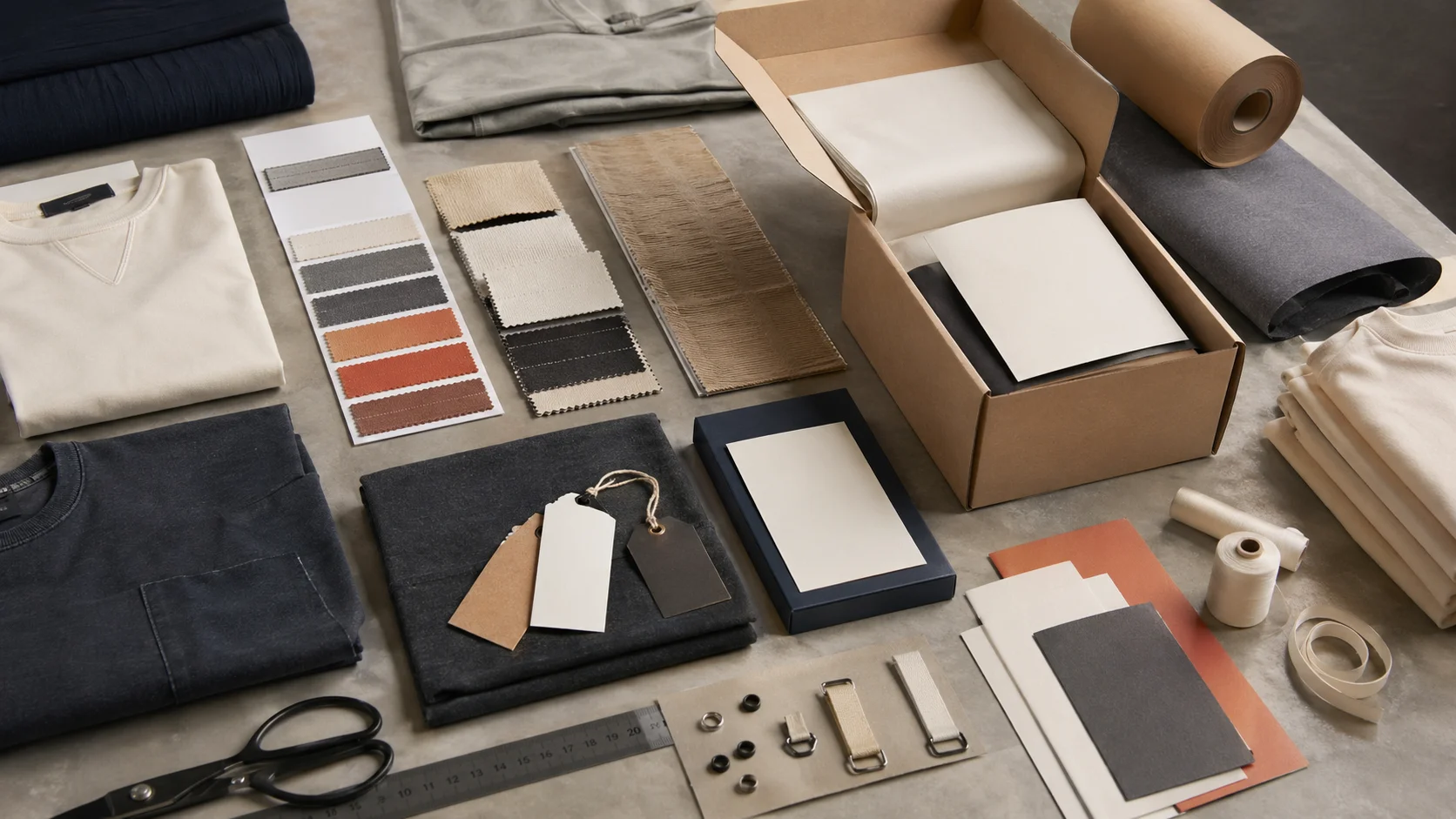
Custom Paper Mailer Bags for Clothing with checks for samples, fit, MOQ, QC evidence, pricing terms, and delivery risk.
Fast answer: Custom Paper Mailer Bags for Clothing: Paper Weight, Closure, Print, and Freight should be judged by production evidence, not by a generic sourcing promise. The buyer needs sample proof, cost breakdowns, QC checkpoints, and delivery buffers in writing.
Ask for recent sample photos, measurement tolerances, fabric or print test assumptions, decoration test notes, packing examples, and a named inspection checkpoint. These details show whether the team can repeat an approved sample at bulk volume.
Separate garment cost, decoration, labels, packaging, sampling, testing, freight, and rush charges. When every cost line is visible, it becomes easier to reduce colorways, adjust size depth, or reserve more time for sampling.
A DTC brand shipping 20,000 units a month tested custom paper mailer bags for clothing brands in one warehouse lane for six weeks, and packaging complaints dropped from 4.8% to 2.9% while unboxing photos rose by 31%. On a packing line moving 800 parcels a day, the paper packs looked more deliberate. Plain and simple.
That reaction is not just vanity. Consumer surveys repeatedly show a preference for paper-based packaging over plastic, with paper winning on perceived recyclability and cleanliness, even when buyers cannot name the exact material grade. Swap a 15 g poly mailer for a 32 g paper mailer, and about 15 metric tons of plastic disappear per 1,000,000 shipments, or 15 kg per 1,000 shipments. The savings add up fast.
Premium brands usually gain the most. A $70 knitwear label can justify a kraft mailer with a two-color print because the mailer becomes part of the product story. Mid-market brands in the $28 to $55 range see mixed results: paper can lift brand perception, but only if the design is tidy and the return rate stays below 12%. Value brands under $20 often get less brand lift because customers focus on shipping speed and price first.
Paper does win in a few clear places. It photographs better, it feels less disposable, and it can make a basic T-shirt order look intentional. It also creates risks. Moisture resistance is weaker than polyethylene, and a poor seal can split if the parcel is crushed under 3 to 5 kg in transit. I have seen this happen in humid routes from Shenzhen to Sydney and from Leicester to Hamburg.
The strongest paper mailers I handled in factories were often the ones buyers dismissed as “too basic.” A 90 GSM kraft outer with a 50 GSM recycled liner can feel lighter than a glossy poly bag, yet it freighted cheaper than many buyers expected because it packed flatter and stacked better in cartons of 250.
The choice is not only about sustainability. It changes damage risk, print quality, and margin. A brand that ships 5,000 units a month can absorb a 6 to 8 cent premium for paper if it trims complaint handling, but a brand with thin gross margins and high moisture exposure may need a hybrid plan. That trade-off starts with the product, not the packaging trend.
Most custom paper mailer bags for clothing brands start with kraft paper, recycled paper, laminated paper, or paper mailers with an inner barrier liner. Kraft paper is the workhorse: strong, relatively cheap, and available in 60 to 120 GSM. Recycled paper varies more. In Europe, I saw mills offering 70% to 100% post-consumer content with FSC or PEFC paperwork; in parts of Southeast Asia, recycled fiber supply was less consistent, but pricing could land 8% to 15% lower on comparable specs.
GSM matters because it changes puncture resistance, stiffness, and print finish. A 70 GSM bag works for lightweight tees and socks. An 80 to 100 GSM structure handles knitwear better. At 120 GSM, the mailer begins to feel rigid, which helps with premium presentation and edge protection, though it can increase fold memory and raise material cost by roughly 10% to 18% versus 80 GSM.
Laminated paper adds a thin film or coating for moisture resistance, but that can complicate recyclability if the layer blocks fiber recovery. Barrier liners help when the shipping lane is humid or when the garment includes dyes that can transfer. According to ISO guidance on material testing, performance should be verified with real-use conditions, not marketing language alone. I have seen “recyclable” bags fail simple wet-rub tests after 20 minutes in a loading bay at 86°F.
Regionally, Asia tends to offer faster sampling, broader print capability, and lower piece pricing at 5,000 to 20,000 units. Europe often brings stricter certification culture and better post-consumer fiber availability. North America usually has shorter transit times for domestic brands, but recycled stock can be tighter and lead times stretch from 3 weeks to 6 weeks during peak demand. The paper itself is rarely the problem.
The thing nobody tells you: many failures come from weak seams or poor adhesive performance, not the sheet. On the factory floor, I have torn open dozens of rejected bags where the seam opened before the paper punctured. That is a process issue, not a paper issue.
For apparel categories, the fit is straightforward. Tees, socks, and accessories work well in 70 to 90 GSM kraft. Knitwear and leggings usually need 90 to 100 GSM. Denim, hoodies, and heavier outerwear may need 100 to 120 GSM, or a box insert if metal trims and zippers can scratch the bag wall. Brands building out private label clothing lines should match the mailer to the heaviest SKU, not the average one.
Fit drives everything when sourcing custom paper mailer bags for clothing brands. A folded adult T-shirt often lands around 10 x 12 inches, so a 13 x 15 inch mailer gives enough room for a tissue wrap and a card without ballooning volume. A hoodie folded to 13 x 15 inches usually needs a 14 x 17 or 15 x 19 inch format, depending on fleece weight. Dresses vary more. A viscose slip dress can slide into a compact 12 x 16 bag, while a lined midi may need 15 x 20 inches and a broader side gusset.
Overpackaging in paper creates its own waste. A mailer that is 25% too large behaves like corrugation without the crush strength: more air, more carton space, and more freight per parcel. On a pallet of 2,400 units, an extra 0.4 inches in width can reduce stack efficiency enough to add one more carton layer, which means more warehouse handling and sometimes 3% to 5% higher outbound charges.
Strength must match the garment. Lightweight tops survive well in paper mailers if the seal is strong and the bag is not overfilled. Hoodies and denim do better with 100 GSM paper or a secondary insert. Heavy jackets, sharp hardware, and bulked-up knits can still use paper, but I prefer a reinforced format or a flat box when the brand ships in rain-prone regions.
Too much empty space can create a premium unboxing look. It can also increase shipping cost by volume. I have seen brands pay for a generous-looking bag that cost them an extra 18 cents in cubic weight charges on cross-border orders. The smartest operators test both aesthetics and logistics on the same SKU before placing a 25,000-unit run.
Seal types matter more than most teams expect. Peel-and-seal strips are simple and fast for 500 to 5,000 parcels a day. Tear strips add tamper evidence, which reduces customer uncertainty on marketplace orders. Some brands use dual seals for returns processing. For fulfillment teams handling 2-minute pack targets, a bad strip design can slow line speed by 8 to 12 seconds per parcel. That sounds small until you multiply it by 1,200 orders.
For larger apparel programs, I like to align packaging with construction. If a brand already invests in careful cut and sew manufacturing, the mailer should carry the same discipline. A sloppy bag around a well-made garment is a mixed message.
Paper is rarely the cheapest unit price. Poly mailers can start around $0.06 to $0.12 each at 5,000 units, while custom paper mailer bags for clothing brands often land around $0.14 to $0.28 at the same volume depending on GSM, print colors, and coating. At 25,000 units, paper may drop into the $0.10 to $0.19 range, and at 100,000 units some factories can reach $0.08 to $0.14 if the design is simple and the board is standard.
The landed cost is bigger than the unit price. I break it into material, printing, freight, storage, damage, and returns. A paper mailer may cost 4 to 9 cents more than poly on the purchase order, but if it cuts brand complaints by even 0.5% on a 50,000-unit run, the avoided service cost can be meaningful. For a brand with $7 to $10 in average shipping and handling per complaint, that math changes quickly.
Poly still wins in cubic efficiency. It is thinner, easier to pack, and less sensitive to humidity during storage. Paper wins in print presentation and perceived value. Data from trade.gov shows apparel e-commerce continues to rise in several export markets, which means packaging has to do more work at first contact because the consumer may never touch the fabric before judging the brand.
Below is the table-style view I use with buyers.
Hidden costs sit in the details. Sample rounds can add $60 to $250 each. Tool changes for custom sizes may add $150 to $500. Artwork revisions often trigger another proof cycle of 5 to 10 days. Moisture-resistant treatments can add 7% to 20% depending on the coating. If a supplier quotes paper at “only” 12 cents more than poly, ask what that number excludes.
Buying for custom baby clothing manufacturing programs often shifts the equation again. Parents notice softness, safety, and presentation, so a slightly higher packaging cost can make sense if the bag supports trust and the product line skews giftable.
Print method affects everything from color accuracy to lead time. Flexo is economical for 1-color to 3-color runs and can keep setup costs low on orders above 10,000 units. Offset gives richer detail and smoother solids, which is useful for fashion labels with photographic art or delicate type. Digital printing is the fastest path for 500 to 3,000 test units, but unit price can be 20% to 40% higher than flexo on larger runs.
Minimal design often beats loud graphics. A premium basics label with a 1-color logo, 1 line of copy, and a clean return address can look more expensive than a bag covered in gradients and icons. That matters because buyers decide in 3 seconds whether the parcel feels intentional. I have seen conversion from repeat buyers improve when a brand reduced its visual clutter from 7 elements to 3.
Factory visits keep reminding me that tactile cues work. A matte uncoated surface says “natural,” while a soft-touch varnish says “premium” without shouting. Tear strips, double seals, and even the sound of the bag opening shape memory. One brand I visited changed only the inside message and the seal color; repeat purchase rate rose 6% over 8 weeks, with no change to the garment itself.
For channel mix, the design brief shifts. Subscription shipments benefit from consistency and fast pack speed. Marketplaces need stronger tamper evidence and clearer SKU labeling. DTC brands can push the envelope on storytelling. Wholesale fulfillment usually demands simpler branding because retailers often want their own insert systems and carton labels. If a brand sits between channels, I prefer a restrained mailer that can travel across all three.
Think of packaging as a finishing layer for the product. A well-made bralette line has little in common with outerwear, which is why brands investing in custom bra manufacturing often need a different mailer feel than a heavy fleece program. The bag should mirror the garment’s promise, not fight it.
Paper sounds virtuous, but the documents matter. Ask for FSC or PEFC chain-of-custody, recycled content certificates, and any compostability claims only when the end-of-life pathway is real for your market. If a supplier says 80% recycled fiber, ask for the certificate number and the audit date. If they say “FSC paper,” ask whether the converter, printer, and bag maker are all covered.
Paper mailers are not automatically better. Coatings, inks, and barrier liners can block recycling streams or reduce fiber recovery. A white, heavily printed bag with a plastic film liner may look eco-friendly and still perform poorly in the bin. Regional collection systems differ sharply. In some European cities, paper packaging collection is broad; in parts of the United States and across many export markets, actual recovery rates lag far behind technical recyclability.
Factory audits show a pattern I have seen too often: “eco” bags sold with no chain-of-custody proof and no test data on coatings. That is not a paper problem. That is a compliance problem. Data from Textile Exchange consistently shows buyers are demanding clearer material claims across supply chains, and packaging is now being scrutinized with the same intensity as fabric. For packaging standards and trade guidance, OEKO-TEX and trade.gov are also useful references when comparing claims and export requirements.
Use this checklist before you approve product-page copy.
If the bag is for a niche line such as premium intimates or private label clothing, the cleaner the claim, the safer the brand. Greenwashing is expensive. It also erodes trust fast.
Start with a brief. I ask brands for target SKUs, folded dimensions, monthly volume, print colors, shipping lanes, and whether the parcel must survive rain, cold storage, or long-haul trucks. Then I shortlist 3 suppliers, not 12. Too many quotes create noise, and one weak sample can hide a stronger technical fit elsewhere.
Order 3 sample variants. One should match your intended specification, one should be lighter and cheaper, and one should push the upper limit on strength or finish. Test them in the warehouse under real conditions: 200 packs, 2 packers, 1 full shift. Check burst strength, seal integrity, ink rub, moisture resistance, and fit on the actual folded garment. A sample that looks good on a desk can fail once it sees tape guns, humidity, and speed.
Timing is usually 2 to 3 weeks for sampling, 3 to 6 weeks for first production, and 2 to 4 weeks for repeat orders if artwork does not change. Custom tooling can stretch the first run by another 5 to 10 days. If you are planning a seasonal launch, lock packaging before final garment approval so you are not waiting on both fabric and mailer in parallel.
I have seen brands overcomplicate the final decision. The simple rule is this: choose paper when brand presentation, consumer perception, and recycled fiber claims matter enough to justify a higher landed cost. Choose poly when price, moisture exposure, and speed dominate. Choose a mixed strategy when your catalog has both premium and value SKUs. That hybrid route often works best for clothing companies shipping 1,000 to 50,000 units a month.
For brands scaling assortments through custom baby clothing manufacturing or other sensitive categories, the packaging brief should travel with the line sheet. The bag is not an afterthought. It is a specification. If you need a manufacturing partner, a packaging supplier, or a China-based factory with custom production and wholesale bulk support, align MOQ, quality, and lead time before you place the first order.
They are used to ship folded apparel such as T-shirts, knitwear, accessories, and lightweight outerwear in a branded paper format. Most brands choose them for DTC and marketplace orders of 500 to 100,000 units, especially when presentation matters.
At 5,000 units, expect roughly $0.14 to $0.28 per bag, depending on GSM, print colors, and coatings. At 25,000 units, pricing often drops to $0.10 to $0.19, and at 100,000 units it can reach $0.08 to $0.14.
Sampling usually takes 2 to 3 weeks. First production runs often take 3 to 6 weeks after approval, while repeat orders may ship in 2 to 4 weeks if the artwork and size stay the same.
No. Paper works well for tees, socks, leggings, and many knit items, but heavy jackets, sharp hardware, and moisture-sensitive routes may need reinforced paper, a box, or a mixed packaging strategy. I usually set the bag spec against the heaviest SKU in the line.
Ask for FSC or PEFC chain-of-custody, recycled content certificates, and test data for coatings and liners. If a supplier cannot produce documents, treat the claim as unverified and rewrite your product copy only after proof is in hand.