
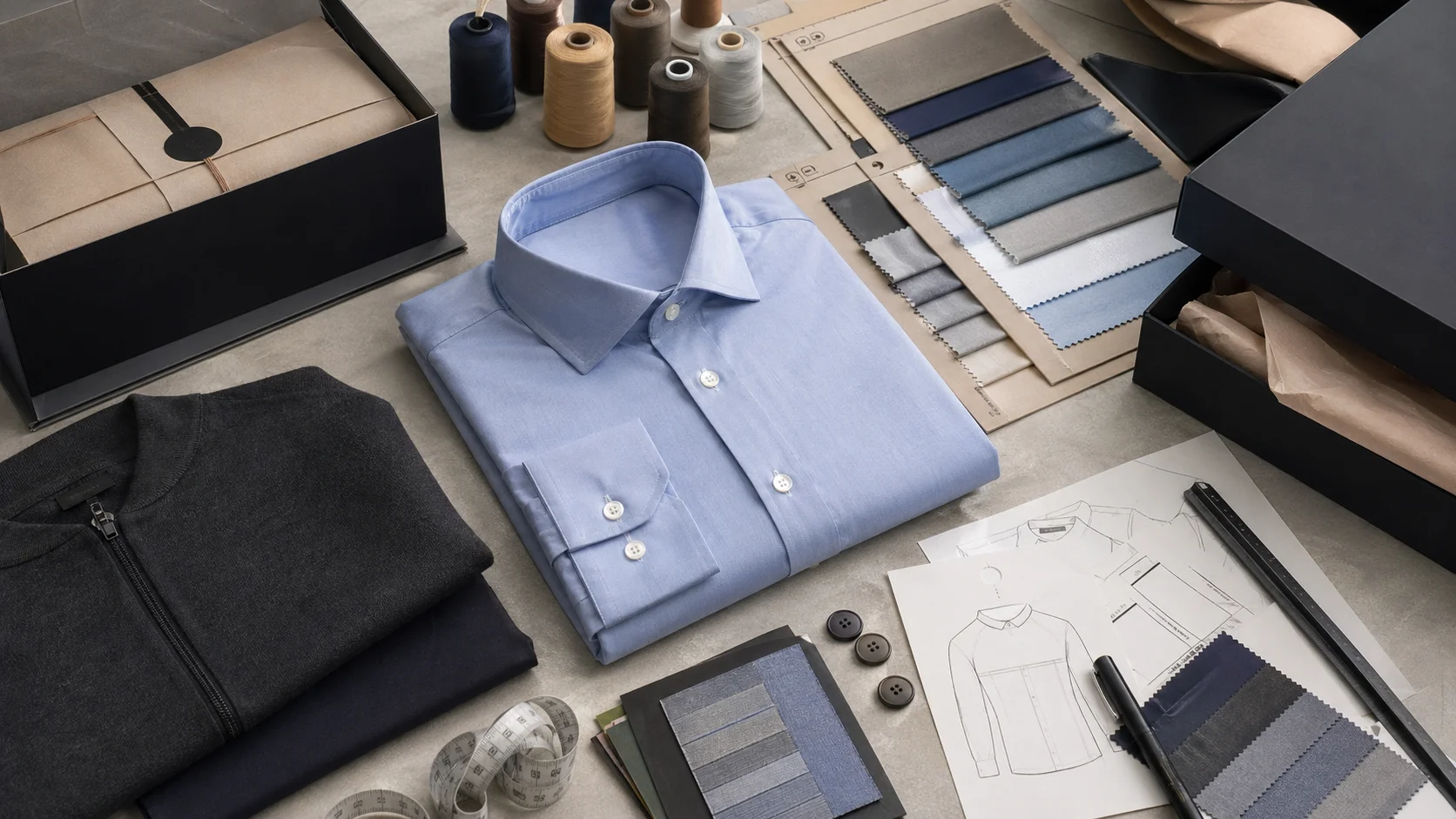
Sampling Cost for Custom Apparel compared by sample evidence, fabric or trim specs, MOQ, AQL terms, cost lines, delivery timing, and rework responsibility.
Fast answer: Sampling Cost for Custom Apparel: Tech Pack, Sample Gate, MOQ, and QC Terms should be judged by production evidence, not by a generic sourcing promise. The buyer needs sample proof, cost breakdowns, QC checkpoints, and delivery buffers in writing.
Ask for recent sample photos, measurement tolerances, fabric or print test assumptions, decoration test notes, packing examples, and a named inspection checkpoint. These details show whether the team can repeat an approved sample at bulk volume.
Separate garment cost, decoration, labels, packaging, sampling, testing, freight, and rush charges. Clear cost lines make it easier to reduce colorways, adjust size depth, or reserve more time for sampling.
The first sample always looks innocent; the invoice rarely does. The sampling cost for custom apparel can seem manageable until the revisions start piling up, the courier bills land, and someone decides the neck tape needs changing. I watched a plain $38 tee sample swell to $210 after two fit rounds, a rush shipment, extra rib trim, and a late spec change. Still one shirt. Just a much uglier invoice.
New buyers often treat sampling like a tiny production run. Not even close. Pattern making, fit development, cutting, sewing, labeling, technician time, and troubleshooting all sit inside that number. The manufacturer or factory does real work before volume exists. A single sample carries the weight of a future 500-piece order.
Cheaper countries do not automatically mean cheaper samples. Vietnam has quoted me $25 to $45 for a simple knit sample, while a more premium workshop in Portugal came in at $60 to $90 and finished the second round with fewer fixes and less wasted time. Labor is part of it. Speed is part of it. So is pattern skill and how many messages it takes to settle one sleeve opening.
Sample price and production price are different animals. Mixing them up wrecks the budget. Some supplier relationships use samples as loss leaders; others subsidize development when they want the bulk order. A hoodie sample might be billed at $30 while the technician burns three hours reshaping the hood and pocket placement. Someone has to absorb that work.
Here’s the part many buyers miss: a higher upfront quote can end up cheaper. A factory charging $55 with two corrections included may beat a $20 quote that bills every change at $8 to $12. I’ve seen that “cheap” option cross $140 before approval. For brands sourcing custom apparel wholesale, the sampling cost for custom apparel is often the first real test of how a supplier communicates under pressure.
According to ISO, process control cuts error rates by improving repeatability. Sampling is where that shows up first. A neat quote means very little if the next round arrives 10 days late and 2 cm off spec.
Fabric sourcing. Trim procurement. Pattern development. Tech packs. Sewing complexity. Finishing. Those are the levers, and every one of them moves the bill. A 100% cotton jersey tee with a rib neck is one thing. A tailored jacket with lining, fusible canvas, buttonholes, and sleeve head roll is another beast entirely. The price gap can run 4x to 8x before revisions even enter the room.
A basic cotton T-shirt sample may land in the $20 to $50 range if the factory already stocks the fabric. A sweatshirt in 320 GSM French terry usually climbs to $35 to $80, especially when the rib needs custom dyeing. Woven shirts with cuff plackets, collar stands, and stripe matching often sit around $60 to $120. Tailoring starts near $90 and can push past $180 once lining and structure come in. Outerwear sits at the top end. A padded jacket with zippers, snaps, and seam sealing can easily hit $150 to $300 per sample.
Specialty fabrics turn the dial fast. Small dye lots. Enzyme wash versus stone wash. Embroidery placement. Print strike-offs. A single embroidery strike-off can cost $15 to $40. Pigment print screen tests can add $25 to $60. Wash testing adds another line. When a brand wants shrinkage control locked down, factories may need 2 or 3 lab dips plus a wash test set before they approve the shade.
Exact-match components are their own tax. I’ve seen buyers ask for custom metal snaps in a brand-specific gunmetal finish and then discover the MOQ was 1,000 pieces at $0.28 each, plus an $80 to $150 mold fee. Brutal for one sample. Same story with zippers, branded labels, drawcord aglets, and custom hang tags. Even a single sample can require 3 to 5 extra components if the brand wants it to look like production.
According to AATCC, textile testing and color evaluation are formal processes, not casual add-ons. That is why a woven shirt or tailored garment sample takes longer than a tee. Precision costs money. Simple as that.
Pattern changes and grading matter too. A simple size M sample costs less than a 3-size fit set. If the production team at the factory has to adjust shoulder slope, armhole depth, and torso length, expect 2 to 4 hours of work per round. Add artwork approvals, screen placement, and stitch-density revisions, and suddenly the sample is a small project instead of a one-off.
Regional differences are real, but they are messy rather than neat. China still offers broad sample capability, with simple knits often quoted around $20 to $50 and more technical styles at $60 to $150. Vietnam can look similar on basics, while complex samples may take longer if trims need to come from abroad. India is often strong on cotton programs, with simpler pieces around $18 to $45, though approval cycles can stretch when multiple teams touch the file. Portugal usually runs higher, from $50 to $120 for many samples, but the technical support is often stronger and the back-and-forth faster for European buyers.
Labor is only one line. Shipping eats savings in a hurry. A sample courier from Asia to Europe may cost $25 to $60 per parcel and add 3 to 7 days. A local workshop in Portugal or Eastern Europe might charge more per hour, but you can get a revised mock-up in 2 to 4 days and skip two extra courier loops. That matters when a showroom deadline is breathing down your neck or the retail line review is next week.
Factory culture varies, too. In China, many sample rooms are built for speed and technical execution. Pattern teams can move fast, especially on knits, activewear, and denim. Vietnam often mirrors that pace on simpler programs, with solid consistency on T-shirts, fleece, and athleisure. India can be excellent on cotton wovens, especially when embellishment is involved, but buyers should expect more time for trims and repeat approvals. Portugal tends to be strong on fit development and communication, which cuts blind revisions.
Cheap sample quotes can hide a trap. I’ve visited budget factories that offered a tee sample for $15, then added $6 for the first pattern tweak, $8 for the second, $12 for color correction, and $18 for sourcing a better rib. By the end, the “cheap” sample cost $59 before freight. So much for the headline number.
Data from trade.gov shows apparel sourcing decisions usually balance labor, logistics, and lead time, not just unit cost. That’s exactly what happens on factory floors. A lower hourly wage does not guarantee a lower development bill if the sample room is slow, the trim market is fragmented, or the tech pack needs constant translation. I’ve paid more in Europe and saved time. I’ve also paid less in Asia and lost two weeks to revision churn. For buyers targeting China at scale, the sampling cost for custom apparel often comes down to how mature the supplier’s sample room is, not just the country rate.
For one style and one sample, a low-complexity tee may sit at $25 to $60, a mid-complexity sweatshirt at $40 to $90, and a high-complexity tailored garment at $100 to $250. That is the opening number, not the final bill. A brand asking for three revisions on one tee may end near $90 if the supplier keeps charges in check, while a brand building a line of 10 styles can see development spend climb to $800, $1,500, or more before bulk orders begin.
I like to think in sample types. Development samples are the rough first pass, often $20 to $70. Fit samples are cleaner and may cost $30 to $100. Salesman samples, which need to look polished for buyers, can run $50 to $150. Pre-production samples, made once the bulk specs are nearly locked, are often priced at $40 to $120, though complex outerwear can go beyond that.
With a bigger program, the factory can spread pattern and admin work across more styles, and the math changes. One sweater sample for a 500-piece order may cost $55. Put that same sample inside a 10-style program and the effective cost might drop to $35 if the factory sees the line as real bulk business. Private label clothing services often work this way; the first round is treated as development investment, not a standalone ticket. If you want to compare options, you can private label clothing services against cut-and-sew offers and see how revision policy changes the total.
Fast-track sampling is expensive. Standard sampling is slower, but usually cheaper. A normal round may take 7 to 14 days for a simple knit and 14 to 21 days for a woven or tailored piece. Rush work can compress that to 3 to 5 days, though rush fees often add 20% to 50%. I’ve watched a $40 sample become $60 because the buyer wanted it before a trade show. Speed has a price tag.
Budgeting also depends on how many styles launch together. One style, three revisions, and one fabric direction may cost far less than three styles with separate trims and graphics. Send a hooded sweatshirt, a jersey tee, and a tailored trouser into development at once, and the sample room may charge $180 to $400 just to get the first usable set on the table. For larger labels, that overhead is easier to absorb and more likely to be recovered in bulk. Buyers who want a development partner usually find cut and sew manufacturing handles multi-style programs more clearly than a basic sample-only workshop.
Factories usually price samples four ways: flat sample fee, refundable deposit, sample fee credited to bulk order, or hourly development billing. Flat fees are easy to read. Refundable deposits sound generous, but only when the terms are written clearly. Credit-based models can work if the factory believes production is coming. Hourly billing is the least friendly for buyers unless the brief is exceptionally tight.
Hidden extras show up in courier costs, fabric sourcing fees, strike-off fees, model fitting, and markup on trims. A courier label from Guangzhou to New York may cost $28 to $55. A small fabric hunt for matching French terry or stretch twill can add $12 to $40 in admin time before material is even purchased. If the factory buys trim on your behalf, expect markup. I’ve seen 10% to 25% on buttons, zippers, and labels.
Some factories separate sample labor from sample materials. Others bundle them. Separate billing can look cheaper at first glance, but comparison gets messy fast. If labor is $18 and materials are $22, the sample is already $40 before revisions. If the factory bundles it at $42, the number looks higher even when the economics are nearly identical. The quote should spell out fabric, trims, labor, courier, and revision policy in writing.
A fair quote should also list the number of revisions included, the turnaround window, and whether the sample fee applies to production. If a factory says “free sample” but needs a 1,000-piece order to recover the cost, that isn’t free. It’s deferred cost. If a factory says “$25 sample” but bills $7 for every pattern tweak and $10 for each color correction, the real cost can double quickly.
When a buyer asks to get a free quote, I always tell them to request a line-by-line breakdown before sending artwork. The quote should show whether the factory already owns the base pattern, whether the sample room has stock fabric, and whether the fit model charge is included. A quote without those details is just a guess with better formatting.
Data from Global Standard reminds us that material integrity and traceability have real value. Sampling is where that traceability starts. The cleanest quote is rarely the cheapest one. Usually, it’s the one that tells you how the factory behaves after the first mistake.
Standardize what can be standardized. Send a tight tech pack, measured points of measure, annotated artwork, and 2 or 3 fit references before the first sample leaves the cutting table. When I visited factories in India and Portugal, brands with cleaner packs cut development rounds from 4 to 2 more often than brands sending mood boards and hope. Not a coincidence.
Use digital mockups, lab dips, and paper patterns before you pay for repeated physical samples. A good flat sketch can settle placement questions in hours. A lab dip can prevent a $50 fabric mistake. A paper pattern can confirm proportion before a single yard is cut. I’ve seen brands save 15% to 30% on sampling spend by avoiding early fabric experiments that had no path to production.
Consolidate changes. Fit, trim, and artwork should be handled in the same revision whenever possible. Split them into separate rounds and courier fees plus technician time multiply. If the sleeve is wrong, the neck label is off, and the print needs moving, fix all three at once. That saves a week and often $20 to $60 per style.
Spend where precision matters. On a premium hoodie, don’t cheap out on the rib, the hood shape, or the garment wash. On a simple tee, don’t burn money on custom hardware nobody will notice. The cheapest move can turn expensive later if it creates production errors, higher return rates, or dead stock. I’ve seen one brand save $12 on sampling and lose $4,800 on unsold units because the neckline was 1.5 cm too tight across a 2,000-piece run.
Last move. If your brand spans knits, woven shirts, and outerwear, browse our product catalog before you lock the brief. Existing silhouettes make it easier to reuse patterns, trims, and construction details. That usually trims the development bill and shortens the learning curve.
Before approving a sample, ask for five things: fee breakdown, revision policy, turnaround time, sample ownership, and production credit terms. If a supplier can’t answer those in one email, expect confusion later. I also ask for courier estimates, fabric sourcing rules, and whether the sample will be made in the main factory or a separate sample room.
Compare quotes apples to apples. A $32 sample in China with $18 freight and 2 included revisions may be cheaper than a $45 sample in Portugal with no freight and one-day feedback cycles. Currency matters. So do revision rules. I set a sample budget per style before outreach, then rank suppliers by total development cost, not the headline price. That’s how false bargains get exposed.
The clearest quote and the fastest correction cycle should win. Not the lowest first number. Sampling is the insurance policy for bulk production. Buy it carefully, and you pay once. Buy it badly, and you pay twice, then again in returns and rework.
How much does sampling cost for custom apparel? Basic tees often run $20 to $50, sweatshirts $35 to $80, and tailored garments $90 to $250. Add courier, trims, and revisions, and the total can rise 25% to 100% above the first quote.
How long does sampling usually take? Simple knit samples often take 7 to 14 days. Wovens and technical pieces usually need 14 to 21 days, and rush orders can compress that to 3 to 5 days with a 20% to 50% fee.
What affects sampling cost for custom apparel the most? Fabric sourcing, pattern changes, embellishment, trims, and revision count drive the price most. A custom zipper or special wash can add $10 to $40 by itself.
Can I reduce sampling cost for custom apparel without hurting fit? Yes. Use a strong tech pack, combine revisions, and approve digital mockups before physical rounds. Many brands cut sample spend by 15% to 30% that way.
Do factories credit the sample fee toward production? Some do, especially on orders above 300 to 500 pieces. Get that in writing, because credit terms vary by supplier and by region.
A fair range is $20 to $50 for a standard cotton tee, excluding freight. If the sample needs custom rib, special prints, or multiple corrections, expect $60 to $100 total.
Two revisions is a practical minimum, and 3 is better for first-time programs. If the factory charges per correction, ask for the per-change rate before you proceed.
Some factories credit the sample fee on orders of 300 to 1,000 pieces, usually within the first bulk invoice. The credit should be written into the quote, not implied.
Request quotes from at least 2 factories in Asia and 1 in Europe, then compare total landed development cost. Include courier, revision charges, and material sourcing so the numbers are truly comparable.
Yes, but exact fabric often raises the price because mills may require minimum yardage or a small dye lot. For one sample, expect an extra $15 to $60 if the cloth is not already in stock.