
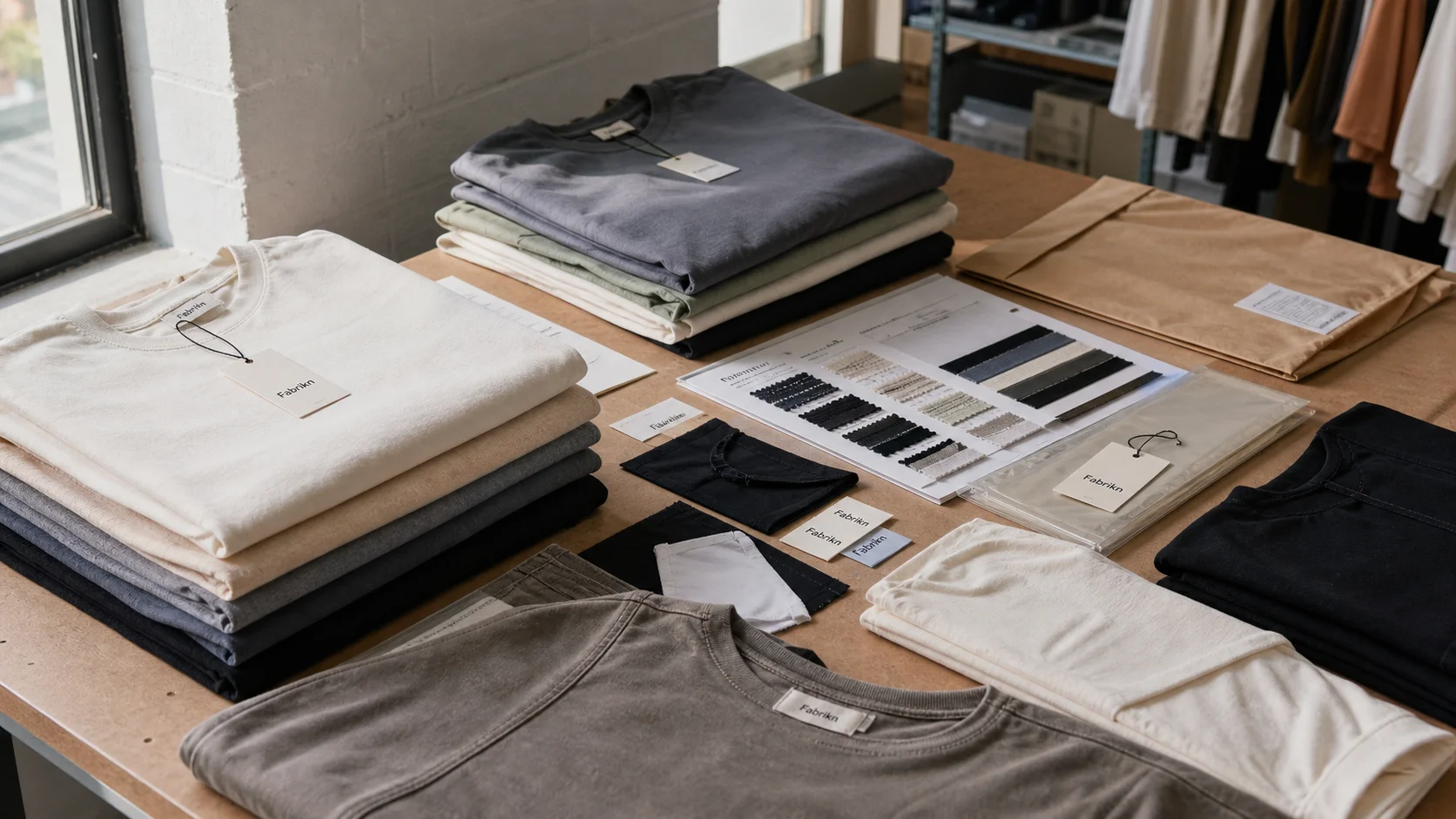
Spot UV Apparel Box Packaging with checks for samples, fit, MOQ, QC evidence, pricing terms, and delivery risk.
Fast answer: Spot UV Apparel Box Packaging: Finish Area, Cost, and Proof should be judged by production evidence, not by a generic sourcing promise. The buyer needs sample proof, cost breakdowns, QC checkpoints, and delivery buffers in writing.
Ask for recent sample photos, measurement tolerances, fabric or print test assumptions, decoration test notes, packing examples, and a named inspection checkpoint. These details show whether the team can repeat an approved sample at bulk volume.
Separate garment cost, decoration, labels, packaging, sampling, testing, freight, and rush charges. When every cost line is visible, it becomes easier to reduce colorways, adjust size depth, or reserve more time for sampling.
The box has about three seconds to earn its keep, and spot UV on apparel box packaging is built for that kind of pressure. Premium packaging can lift perceived value by 20% to 30% in consumer tests, while unboxing recall often lands 2 to 3 times higher when contrast and texture do the talking.
I have stood in factories where converters timed the first glance at shelf and on camera. Their verdict was blunt: if the lid catches light, the box gets picked up. If it reads flat, it gets passed over in under 2 seconds, especially in stores with 40 to 80 competing SKUs on a single fixture.
Spot UV works because it creates a visible break against matte coatings, kraft stocks, and soft-touch laminations. A logo glossed against a dull field looks sharper from 1 to 2 meters away. On dark navy cartons, it can feel almost embossed even when the surface is perfectly level. That matters more than people admit.
In boutique retail, the finish reads intimate and considered. In DTC parcels, it reads premium on camera, which matters when a brand expects 15 to 25 social posts for every 100 orders. In department stores, the same finish competes with heavier embellishment and louder visual noise, so spot UV on apparel box packaging has to work harder or share space with cleaner typography. I have seen a $28 tee box and a $180 knit box both use spot UV, yet the cheaper box often performs better because it is simpler and more direct.
That price-point mismatch surprises people. A $6.50 carton can feel more persuasive than a $14 rigid box if the print discipline is tighter and the logo placement is smarter. From the factory floor, the lesson stays the same: converters care less about fancy language and more about whether the coating hits cleanly on the first pass, with no blur, no ghosting, and no wasted sheets. For brands building custom clothing packaging solutions, spot UV on apparel box packaging is rarely decoration alone. It is merchandising.
The production sequence is straightforward on paper and unforgiving on press. Artwork is separated into print and varnish layers. The base sheet is printed first, usually on 350 to 450 gsm paperboard. Then a matte, satin, or uncoated surface receives the UV varnish in the selected areas, followed by curing under UV lamps. The whole run depends on registration staying within tight limits, often 0.2 to 0.5 mm on a decent line and less on premium work.
Spot UV on apparel box packaging behaves differently across stock types. On matte-coated paperboard, contrast is crisp because the gloss sits against a dull field. On satin stock, the effect is softer and can look more expensive if the brand wants restraint. On uncoated board, the UV usually appears more pronounced, but the paper can absorb unevenly, which means the coating edge sometimes looks less exact. If the sheet has too much tooth, the gloss can feel patchy rather than clean.
That is where file setup matters. I ask for vector varnish plates, not raster guesses. Small type under 6 pt often fails, and hairlines below 0.25 mm can break or fill in. Knockout spacing around 1 to 1.5 mm keeps the varnish from bleeding into adjacent artwork, especially when the press operator has to hold speed at 4,000 to 6,000 sheets per hour. Flood coats are possible, but they change the whole budget and often make the piece feel less deliberate.
Pack geometry also shapes the outcome. Rigid lids give you room for a hero panel. Sleeves add friction and can hide registration drift. Folding cartons are the cheapest path at 500 to 2,000 units, but their seams and dust flaps introduce extra alignment risk. Mailers can work too, though the crush factor during transit means the finish should be placed where hands and tape will not abrade it. Last year I worked with a brand that shifted from a lid-and-base rigid box to a folding carton with a UV logo panel. Unit cost dropped from $2.80 to $1.15, and the visual result barely changed.
Spot UV is rarely the most expensive embellishment, but it is often the smartest one. Against embossing and foil stamping, it usually wins on speed and on how much design space it gives back to the brand. A simple UV logo can add $0.08 to $0.25 per box at 3,000 to 10,000 units, while foil stamping often lands at $0.12 to $0.40 depending on die area, color, and whether the line needs a second pass. Embossing can be similar, though the tooling cost starts higher, often $150 to $350 for a die, and setup time stretches when the logo is large or detailed.
Durability tells another story. Foil can scuff. Embossing can flatten under stacking. Spot UV on apparel box packaging holds well on rigid board and matte lamination, but very heavy abrasion can dull it after repeated handling. For apparel brands shipping 1 to 3 pieces per carton, that is usually acceptable. For subscription mailers or store bags that get reopened constantly, foil or embossing may have a longer physical life. I have seen a luxury knitwear label choose UV over foil because the client wanted a quieter box that still flashed under boutique lighting; the box looked more editorial than promotional.
The cost and look shift sharply by tier. Entry-tier packaging at $0.75 to $1.50 per unit often uses one-color print with a single UV logo or pattern block. Mid-market boxes at $1.50 to $3.50 can combine matte lamination, spot UV on apparel box packaging, and a custom insert. Luxury packaging at $4.00 to $12.00 or more leans into rigid structures, multiple finishes, and thick board, but the finish can still be underwhelming if the design is overcrowded. That is the paradox. More spend does not guarantee more prestige.
Here is what most people miss: on a simple navy carton with 60% matte coverage, a 15% spot UV area can outperform a full foil panel in both shelf clarity and production efficiency. The reason is practical. UV has faster setup, fewer pass changes, and less risk of plate mismatch than metallic decoration. For a brand ordering 2,000 units, that can mean a 5 to 10 day lead-time advantage and a defect rate that stays under 2% rather than creeping toward 5% after multiple embellishment steps.
For private-label programs, especially those tied to private label clothing services, the finish should match the garment margin, not the mood board. A $24 t-shirt does not need a $5 box. A $180 jacket might justify it if the carton becomes part of the retail ritual. I have seen too many brands overspend on decoration and underinvest in structural integrity, which is the fastest way to make premium feel cheap.
Good artwork survives press reality. That means bold elements, clear separation, and a varnish layer that does not depend on tiny details behaving perfectly at speed. I ask designers to keep UV shapes at least 0.5 mm thick, with knockout spacing of 1 mm or more where possible. Logos with fine serifs, hairline borders, or dense decorative scripts are the first things to fail. They either disappear in proofing or trigger a second round of corrections.
Photographic art is tricky. It can work if the UV is limited to high-contrast zones, such as the outline of a model silhouette or a single geometric repeat. It usually fails when the varnish follows too many tonal gradients. Printers like artwork that reads from the file without interpretation. Once they suspect a grey area might misregister by 0.3 mm, they call for a reproof. That slows a run by 3 to 7 days and pushes up waste.
Placement matters as much as form. The box top is the safest real estate. Front panels are next. Side panels can work for repeat customers, but they are less visible on shelf. On folding cartons, keep the UV away from folds, glue zones, and score lines. I have watched a run of 8,000 cartons get rejected because the varnish sat 2 mm over a fold, which made the finish crack at the crease.
When I visit factories, the files that get approved fastest share the same traits: one clear focal point, strong contrast, and no guessing about opacity. There is a reason press crews breathe easier when they see a clean logo and a 12 mm safety margin. For any brand working with cut and sew manufacturing, packaging should echo the same discipline: precise, economical, and free of clutter.
UV coatings complicate recyclability, but the impact depends on the board system, coating coverage, and local mill infrastructure. A light spot varnish on FSC-certified paperboard is not the same as a plastic-heavy rigid box wrapped in laminated film, magnetic closures, and metalized foil. The first may still enter common paper recycling streams in many regions. The second often does not. According to Global Standard, certified material choices and chain-of-custody controls matter because paper claims are only as credible as the board and fiber behind them.
Standard coated cartons are easier to recycle than premium boxes built from multiple substrates. A typical folding carton at 400 gsm, printed with one varnish pass, can be sorted more easily than a 2 mm rigid board wrapped in printed paper and finished with foil, lamination, and magnets. FSC board does not solve everything, but it does make the fiber story stronger, especially when paired with low-coverage finishing and right-sized runs of 1,000 to 5,000 pieces rather than speculative over-ordering.
Waste reduction comes from production discipline. Shorter runs reduce dead stock. Smarter coverage lowers ink and coating usage. Fewer reprints reduce both material loss and freight. I have seen brands save 12% to 18% on packaging waste simply by tightening dielines, reducing SKUs from 6 to 4, and approving one pre-production sample instead of three. In apparel, where seasonal turnover is brutal, the greenest box is often the one that does not sit in a warehouse for 11 months.
The thing nobody tells you: spot UV on apparel box packaging can be greener than heavier decoration because it replaces multiple finishing steps. If a single UV hit removes the need for foil, embossing, and a second lamination pass, the total material and energy load can be lower even though the coating itself is not fully recyclable. That trade-off is real, and I have seen it on the production floor. Keep the finish restrained and match it to a board that still behaves well in recovery systems. Brands asking for greener custom packaging quotes should specify fiber content, coating coverage, and reprint tolerance at the brief stage, not after sampling.
For teams comparing certified fibers and responsible sourcing, it is also worth reviewing guidance from OEKO-TEX, Textile Exchange, and Trade.gov before locking a global packaging program.
Supplier selection starts with machinery, not promises. Ask whether the factory has in-line or offline UV coating equipment, what its registration control looks like, and how it documents sample-to-production consistency. A serious manufacturer can show you calibrated proofs, past apparel references, and a QC log that records sheet count, defect rate, and rework percentage. If they cannot, the quote is cheap for a reason.
I ask for three things before sampling: material specification, finish tolerance, and a reference run from a real brand. If the factory has produced 5,000 to 20,000 units for apparel, it should be able to show how the coating held up in transit and on shelf. I also want to know whether the supplier can hold color within Delta E 2 to 3 on repeat orders, because the finish means less if the base print drifts.
Domestic sourcing often wins on speed. Lead times of 7 to 14 days for sampling and 3 to 5 weeks for production are realistic in some markets. Overseas sourcing can bring lower unit costs, sometimes 10% to 25% less, but freight risk, customs delays, and defect handling can erase those savings fast. I have seen a 6,000-unit order from China arrive with 4% scuffing because the cartons were packed too tightly, while a regional supplier on a 1,500-unit run kept defects under 1% and replaced damage in 4 days.
Approve the factory using a simple checklist:
Brands with broader supply chains often benefit when packaging is coordinated with manufacturing. If garment production is already split across mills and trims, the box supplier needs to match that pace. That is where a partner familiar with wholesale clothing packaging solutions keeps the program from drifting into chaos.
Start with one SKU. Pick the box with the clearest margin story, a target unit cost of $1.25 to $2.50, and a retail role that justifies extra finish. Run one sample, one pilot batch of 500 to 1,000 units, then scale only if the finish survives handling and the unit economics stay inside the brief. Build your production brief with carton dimensions, substrate weight, varnish placement, safety margins, MOQ targets, and a QC target under 2% defect rate.
I tell teams to treat this like a three-gate process: sample, pilot, scale. If the sample fails registration or the cost climbs by more than 15%, stop. If the pilot looks good but slows packing by more than 10%, simplify the artwork. And if the final carton does not improve perceived value by at least one retail tier, do not force it. Spend the money where it counts.
If you are sourcing spot UV on apparel box packaging in bulk, ask for clear production timelines, quality checkpoints, and a custom approval sample before you commit to wholesale quantities. A good supplier should explain MOQ trade-offs, factory capacity, and how the finish performs across a full production run, not just on a single proof.
At 3,000 to 10,000 units, spot UV usually adds about $0.08 to $0.25 per box. Setup charges and plate prep can add $80 to $250, depending on the factory and how complex the varnish area is.
Sampling often takes 7 to 14 days, while production commonly runs 3 to 5 weeks after approval. Overseas orders can take longer once freight and customs are included, especially for runs above 5,000 units.
Often yes, if it is a light UV finish on paperboard and the box does not include plastic-heavy components. Recycling performance depends on the local mill system, the board grade, and how much coating coverage is used.
Small type, thin lines, poor register, and varnish placed too close to folds are the usual causes. Designs under 0.25 mm line weight or with less than 1 mm knockout spacing are much more likely to need a reproof.
Rigid lids, folding cartons, and sleeves all work, but rigid lids usually give the strongest shelf effect. Folding cartons are best for lower budgets, often starting around $0.75 to $1.50 per unit, while rigid boxes move into the $2.50 to $12 range.