
A sourcing-focused outline for resort uniform buyers evaluating wholesale team tracksuit fabrics, lab tests, wear trials, cost tradeoffs, MOQ planning, and production approvals before placing bulk orders.
Team Tracksuit Fabric Tests for Resort Buyers - MOQ, Cost & Sourcing manufacturing guide
Resort uniforms have to work harder than standard teamwear. A tracksuit used by a recreation team, transport crew, spa attendant, kids’ club staff, or event operations team must look coordinated in guest-facing spaces while surviving sweat, sun exposure, repeated laundering, luggage handling, and storage between seasons. Fabric testing is where many uniform sourcing projects either become predictable or start absorbing hidden cost.
This wholesale team tracksuit fabric testing guide for resort uniform buyers focuses on practical decisions: which tests matter, when to request them, what failures usually mean, and how testing affects MOQ, cost, and sourcing timelines. It is written for buyers comparing suppliers, approving samples, and placing bulk orders for resort staff uniforms, branded guest activity kits, or seasonal team apparel.
Tracksuits for resorts are often ordered in coordinated sets, which raises the risk level. If a jacket fabric fades differently from the pants, or if one production lot shrinks more than another, the entire uniform program looks inconsistent. In hospitality settings, the problem is visible immediately because staff members work in groups and often appear in guest photos, event areas, lobbies, marinas, sports courts, or shuttle zones.
Fabric testing gives buyers an early warning before bulk production. It does not remove every risk, but it helps identify weak dye lots, unstable stretch fabrics, poor finishing, excessive shrinkage, and unsuitable fabric weights. A low-cost tracksuit can become expensive if it pills after five washes or loses color on pale resort furniture.
For wholesale orders, the main objective is not to test everything possible. The objective is to test the right risks for the specific use case. A tropical beach resort needs strong sweat, washing, and light fastness controls. A mountain resort may care more about brushed fleece durability, warmth, and abrasion from radios, name badges, jackets, and bags. A wellness resort may need softer hand feel, low noise fabric, and better stretch recovery for movement-based roles.
Good fabric testing is a purchasing control. It protects the buyer from approving a tracksuit based only on appearance, hand feel, or a single showroom sample.
Before asking a manufacturer for tests, resort buyers should define the expected wear conditions. A tracksuit for a resort tennis academy does not need the same fabric as a back-of-house maintenance team uniform. Clear specifications reduce sampling rounds and make supplier quotations more comparable.
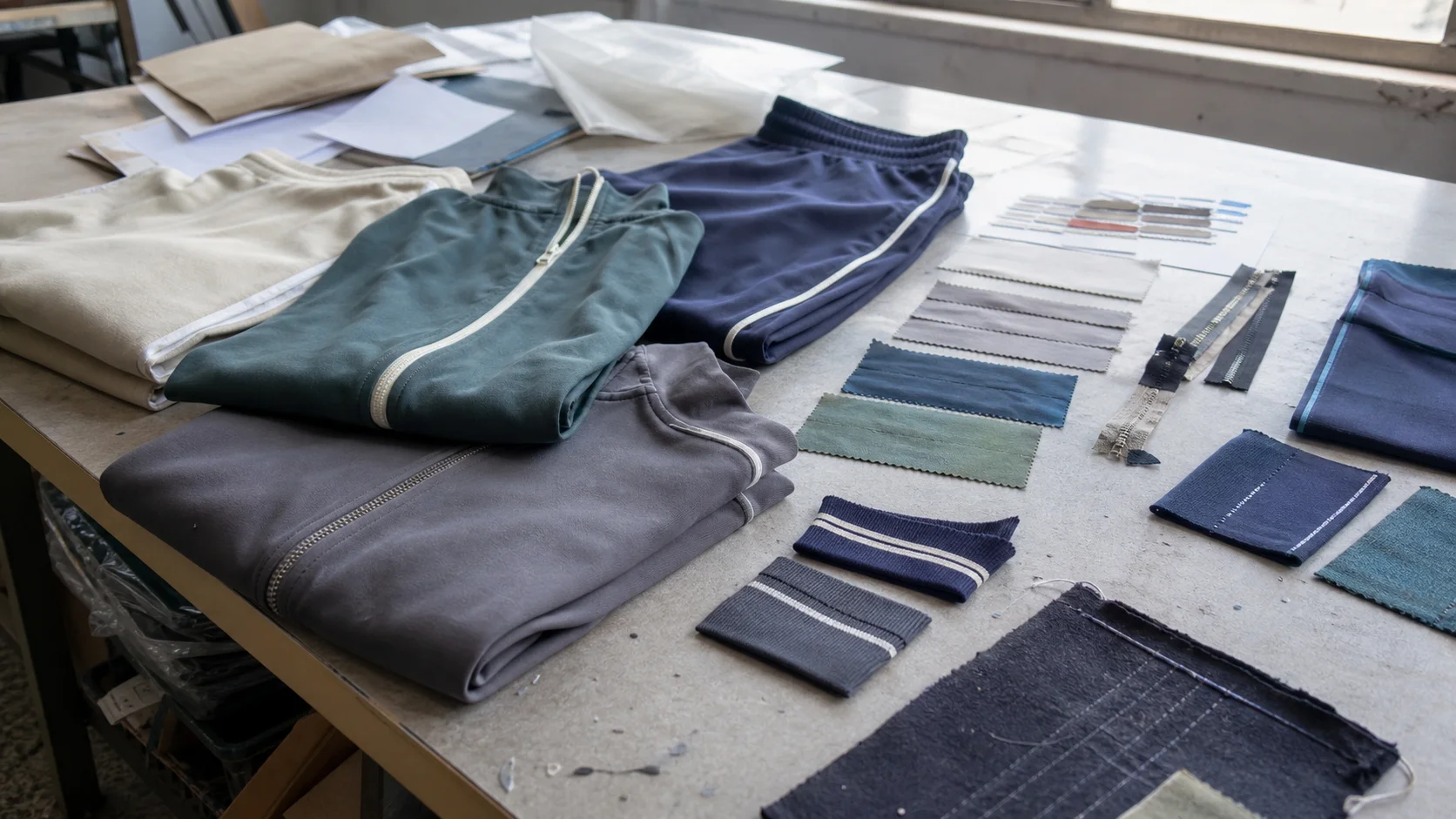
A practical fabric specification should include fiber content, fabric construction, weight, stretch direction, finish, color standard, shrinkage tolerance, and approved decoration method. If the tracksuit uses different fabrics for body panels, mesh lining, rib cuffs, pocket bags, or contrast piping, each component needs a basic compatibility check.
Most wholesale team tracksuits for resort uniform programs use polyester-based fabrics because they are durable, color-stable, and cost-efficient. Cotton-rich fabrics can feel more natural but may shrink more, fade faster, and dry slowly in humid environments. Nylon blends can perform well but often cost more and require more careful heat control during decoration and finishing.
Fabric Type Typical Use Advantages Risks to Test Polyester tricot Classic athletic tracksuits, activity teams, event staff Smooth surface, strong color options, good durability, moderate cost Snagging, shine, colorfastness to washing and rubbing Polyester interlock Premium casual uniforms, wellness teams, front-of-house sport staff Better hand feel, stable structure, clean appearance Pilling, shrinkage, seam recovery, weight consistency Poly-spandex knit Movement-heavy roles, fitness teams, yoga or spa staff Stretch comfort, modern fit, good mobility Stretch recovery, spirality, heat sensitivity, elastane damage Brushed fleece Cool weather resorts, alpine staff, evening operations Warmth, soft interior, casual comfort Pilling, lint shedding, shrinkage, bulk variation Woven polyester or nylon stretch Resort transport, outdoor operations, travel uniforms Crisp look, wind resistance, quick dry options Seam slippage, coating durability, noise, color shadingFor most resort buyers, polyester interlock or midweight poly-spandex knit gives the best balance between appearance, comfort, and durability. Tricot is cost-effective for large activity teams and promotional uniform programs, but it can look too athletic for premium guest-facing roles. Brushed fleece works well in cooler locations, yet it needs stricter pilling and shedding checks.
Fabric weight is another key decision. Lightweight tracksuit fabrics may sit around 160–220 gsm, midweight options often fall around 230–300 gsm, and heavier fleece or winter knits may exceed 300 gsm. These are typical commercial ranges, not fixed rules. The right weight depends on climate, role, silhouette, lining, and laundry method.
A resort buyer does not need a laboratory report for every small reorder, but the first bulk order should include basic fabric verification. If a supplier claims a fabric has been tested, ask whether the report applies to the current fabric lot, color, finish, and composition. Old reports can be useful references, but they do not replace current-lot checks for important uniform programs.
Test standards may vary by market and supplier. Common references include ISO, AATCC, ASTM, and GB methods. The buyer should focus on clear performance thresholds rather than collecting test names alone. A report with weak results is still a weak report.
Many resort uniform programs set colorfastness targets around grade 4 or above for washing and rubbing where possible. Dark and neon colors may require more cautious acceptance, especially for wet rubbing. Shrinkage targets often sit within 3% to 5% for knits after washing, while tighter tolerances may be requested for premium programs. Pilling targets are often grade 3.5 to 4 or better after a defined number of cycles.
These figures are common commercial expectations, not universal guarantees. Heavy brushing, pigment effects, recycled fiber blends, deep navy, black, red, and bright corporate shades can change achievable results. The buyer should ask the supplier what is realistic before locking a color palette that is difficult to reproduce at scale.
Colorfastness is one of the most important testing areas for resort tracksuits. Uniforms are worn in public and washed frequently. They may be exposed to perspiration, sunscreen, poolside moisture, rain, sea air, chlorine residue, and long hours of sunlight. A fabric that looks good in a sample room can fail quickly in actual resort conditions.
This test evaluates whether fabric color fades or stains other materials during laundering. For tracksuit sets, staining is especially important when the design uses contrast panels, white piping, light linings, or pale logo patches. Dark navy pants with white side stripes can look sharp in sampling and still create trouble if the dye bleeds.
Buyers should ask whether the washing test was performed on the actual approved color. Testing only a medium shade does not prove that a black, red, or fluorescent color will behave the same way. If the resort plans to use industrial laundry, the test conditions should be discussed because higher temperatures, stronger detergents, and tumble drying can increase damage.
Rubbing, also called crocking, checks whether color transfers when fabric is rubbed dry or wet. This matters for resort uniforms that may touch guest seating, golf carts, white towels, pale upholstery, luggage, and spa furniture. Dark shades usually carry the highest risk.
Wet rubbing results are often lower than dry rubbing results. A dark uniform used in humid weather or during active roles should be reviewed carefully. If the result is weak, a buyer can consider changing the shade, selecting another dyeing route, washing fabric before cutting, or accepting the risk only for non-guest-facing roles.
Perspiration testing is essential for tropical resorts, sports teams, entertainment crews, pool staff, and transport teams. Sweat can interact with dyes, finishes, and deodorants. The failure may appear as fading, yellowing, staining, or patchy discoloration near collars, underarms, waistbands, and back panels.
Light colors are not risk-free. White or pale tracksuits can yellow or stain if the finish is unstable, while dark colors can lose depth around sweat zones. If the resort’s uniform design uses a premium brand color, perspiration testing should be done before bulk approval.
Sun exposure can damage bright colors and some synthetic dyes. This is a frequent issue for beach resorts, island properties, outdoor adventure programs, marina staff, and pool teams. Light fastness testing is not always included in basic supplier reports, so buyers should request it when uniforms will be worn outdoors.
A shade that meets washing requirements can still fade in strong sunlight. Red, orange, turquoise, lime, and fluorescent colors need closer review. For long-term uniform programs, stable color is usually more valuable than an exact but fragile shade.
Stretch fabrics make tracksuits more comfortable, especially when staff bend, lift, walk, guide activities, or demonstrate sports movements. The buying risk is that stretch fabric can lose shape if elastane quality, knitting tension, heat setting, or laundering performance is poor.
Stretch testing checks how far the fabric extends. Recovery testing checks how well it returns. Both matter. A fabric with impressive stretch but poor recovery may feel comfortable during fitting and then bag out at knees, elbows, and seat after a few wears.
Elastane blends also need heat control. Excessive heat during dyeing, sublimation, pressing, bonding, or tumble drying can weaken stretch recovery. If the tracksuit includes heat-transfer logos, reflective prints, or silicone badges, decoration testing should be done on the actual fabric before bulk production.
A moderate elastane percentage can improve comfort, but more stretch is not always better. Higher elastane content often raises cost, complicates cutting and sewing, and may increase sensitivity to heat and chemical exposure. For many resort uniform tracksuits, a stable poly-spandex blend is more useful than a very stretchy performance fabric designed for compression wear.
Pilling is a common complaint in hospitality uniforms because it makes garments look old even when they are structurally intact. Tracksuits experience friction at cuffs, inner arms, underarms, pocket edges, inner thighs, seat, and backpack contact points. Brushed fleece and soft knits need closer control because a pleasant hand feel can come with reduced surface durability.
Pilling tests simulate rubbing to see how the surface changes. A higher grade means better resistance. Resort buyers should not rely only on hand feel. A very soft fabric may pill quickly after repeated washing and movement.
Pilling risk increases with loose yarns, low twist yarns, brushed finishes, recycled blends with inconsistent fiber lengths, and poor fabric finishing. Recycled polyester can work well for resort tracksuits, but it should still be tested rather than accepted only for sustainability messaging.
Abrasion testing matters when staff carry radios, keys, waist bags, clipboards, sports equipment, life vests, backpacks, or tool belts. It also matters for transport teams and activity guides who sit, move, and load equipment throughout the day.
If abrasion results are weak, the supplier may suggest a tighter knit, different yarn, reinforced panels, heavier gsm, or a woven overlay at high-wear zones. These changes may increase cost, but they can reduce replacement rates. A cheap fabric that fails at pocket edges and thighs is rarely the lowest-cost option over a full season.
MOQ affects fabric testing decisions because custom-dyed fabric, special trims, and branded tracksuit details usually require higher commitments. Typical wholesale tracksuit MOQs can range from 100 to 300 sets for simple stock-fabric styles, 300 to 800 sets for semi-custom designs, and 500 to 1,500 sets or more for custom fabric colors, yarn-dyed elements, special finishes, or fully customized trims. These ranges vary by supplier, fabric mill, color, size spread, and decoration method.
Small resort groups often want full customization at low quantities. The practical tradeoff is simple: lower MOQ usually means using available fabrics and trims, while higher MOQ gives more control over color, fabric weight, finish, and branding. Testing becomes more valuable as customization increases because the buyer is approving a production input that may not have broad market history.
Basic fabric tests may be quoted separately or built into the supplier’s development cost. Third-party laboratory testing adds cost but gives more neutral documentation. For a one-time small order, buyers may choose selected tests only. For a multi-property resort group or recurring uniform program, fabric testing is usually a reasonable upfront cost because failures multiply across locations and seasons.
Order Type Typical MOQ Range Testing Priority Buying Judgment Stock fabric with logo decoration 100–300 sets Wash, rubbing, shrinkage, decoration durability Good for smaller teams if color choice is flexible. Semi-custom color-block tracksuit 300–800 sets Colorfastness, shade matching, pilling, seam strength Best balance for many resort uniform programs. Custom-dyed fabric and trims 500–1,500+ sets Full fabric testing and lab dip approval Worth it when brand color consistency matters. Performance stretch tracksuit 300–1,000+ sets Stretch recovery, heat resistance, wash appearance Higher comfort, but more technical sourcing control required.Buyers should also account for sample charges, lab dip fees, courier cost, testing fees, pre-production sample cost, and possible resubmission. A quotation that ignores these items can look cheaper at the beginning and become less attractive once development starts.
For support with custom apparel development and sourcing structure, buyers can review the manufacturing options on Fabrikn’s services page. Early alignment on fabric, MOQ, and decoration method usually saves more time than negotiating unit price before specifications are clear.
A disciplined sample process is the best way to connect fabric testing with real garment performance. Many problems happen because the buyer approves a good-looking prototype without confirming whether the bulk fabric, trims, and decoration method are final.
The brief should state the wearer role, climate, season, expected wash method, branding requirements, color references, size range, gender fit needs, and estimated order quantity. Include whether the tracksuit is for daily staff wear, guest activity uniforms, seasonal events, or retail/resort merchandise.
Review fabric swatches by fiber content, construction, gsm, stretch, hand feel, and available colors. Ask the supplier which options are stock-supported and which require custom dyeing. A fabric that is available today may not be available for reorders unless the supplier confirms continuity.
For custom colors, approve lab dips under standard light conditions. Resort buyers should compare color under daylight and indoor lighting because uniforms are seen in both environments. Contrast fabrics, rib trims, zippers, drawcords, elastic, and logo materials should be checked together.
The first garment sample checks silhouette, construction, pocket placement, waistband comfort, sleeve length, pant taper, and decoration position. It may not use final bulk fabric. If fabric is substituted, mark the sample clearly and avoid using it for final performance judgment.
Once the fabric direction is close to final, request testing on the intended bulk fabric or a representative lot. For high-risk colors, test the actual color. For stretch fabrics, include recovery and laundering appearance. For outdoor teams, add light fastness.
The pre-production sample should use final fabric, trims, decoration, stitching details, labels, packaging method, and approved measurements. This sample becomes the control reference for bulk inspection. If the supplier changes fabric lot, zipper quality, rib composition, or print process after approval, the buyer should request written confirmation and possibly retesting.
Tracksuit fit can vary across sizes, especially in pants rise, thigh, shoulder width, and sleeve length. A size set helps catch grading problems before bulk cutting. For resort teams with international staff, broader size coverage may be needed.
Buyers who are ready to define a project brief can use Fabrikn’s contact page to discuss requirements, expected quantities, and sourcing constraints before locking specifications.
Fabric testing is only one part of tracksuit quality. Many bulk problems come from trims and components that were not specified tightly. A tracksuit set may include main fabric, contrast panels, mesh lining, pocket bags, rib cuffs, elastic, drawcords, zippers, zipper pullers, snaps, reflective tape, embroidery thread, heat-transfer film, labels, and packaging.
The care label should reflect the weakest component, not just the main fabric. If a tracksuit body can tolerate warm washing but the transfer logo cannot, the care instruction needs to protect the finished garment. This is a common source of dispute when buyers and suppliers only discuss fabric performance.
Inspection should compare bulk goods against the approved pre-production sample, test results, purchase order, and measurement chart. Resort buyers should not inspect only carton count and general appearance. Tracksuits are multi-component garments, so small mismatches become obvious when worn as a team.
A pre-shipment inspection can use AQL sampling, though acceptance levels should match the buyer’s risk tolerance. Guest-facing uniforms usually need stricter visual standards than basic back-of-house apparel. If the program is time-sensitive for a resort opening, event launch, or seasonal onboarding, the buyer should leave time for rework. Rushed inspections tend to turn quality issues into operational problems.
For larger orders, a simple garment wash check before shipment can be useful. Pull one or more sets from bulk production and wash according to the care label. Check shrinkage, twisting, color bleed, logo durability, zipper function, and surface appearance. This does not replace lab testing, but it often catches practical failures that reports may not show clearly.
Lead time for wholesale resort tracksuits depends on fabric availability, MOQ, customization level, testing, sample rounds, decoration, and shipping method. Stock-fabric logo tracksuits may move faster, often in a few weeks after sample approval if capacity is available. Custom-dyed or specially developed tracksuits can require several additional weeks for lab dips, fabric knitting or weaving, dyeing, finishing, testing, and production.
Typical development stages include fabric sourcing, lab dip approval, fit sample, revised sample if needed, test submission, pre-production sample, bulk material purchase, cutting, sewing, decoration, finishing, inspection, packing, and shipping. Any failed test can add time. A failed colorfastness or shrinkage result may require fabric reprocessing, new dyeing, or changing fabric quality altogether.
Buyers should avoid approving fabric and trims too close to the required delivery date. Resort uniform programs usually have fixed onboarding dates, training dates, photography schedules, or soft-opening timelines. A practical sourcing calendar should include buffer for testing and rework, not only production sewing time.
The right questions reveal whether a supplier understands uniform performance or is quoting a generic teamwear product. Resort buyers should ask for specific answers, not broad assurances.
A reliable answer may include tradeoffs. For example, a supplier may say that a specific bright color needs higher MOQ, longer dyeing time, or weaker light fastness than a standard navy. That answer is more useful than a blanket promise. Buyers should be cautious when every requirement is described as easy, fast, and low-cost.
Not every tracksuit program needs premium fabric. A short-term event team uniform can use a cost-efficient fabric if expectations are clear. A multi-season resort staff uniform should not be treated the same way. The cost of replacement, inconsistent appearance, and staff dissatisfaction can exceed the savings from a cheaper fabric.
The best purchasing decision is usually not the cheapest fabric or the most technical fabric. It is the fabric that matches the job, climate, care method, brand standard, and order quantity. A sourcing partner should help narrow those choices before sampling begins. Buyers can also review company background and sourcing focus on Fabrikn’s about page.
Fabric testing is not paperwork for its own sake. It is a way to make resort uniform buying more controlled. Tracksuits are visible, heavily worn, and often ordered in large size ranges. Testing helps buyers choose better fabrics, negotiate realistic costs, and reduce avoidable failures before the garments reach staff.
Get a free quote from Fabrikn — your trusted B2B clothing manufacturer with 10+ years of experience. MOQ as low as 200 pieces.
Get a Free Quote →Polyester interlock, polyester tricot, and poly-spandex knits are common choices. Polyester interlock often gives a good balance of comfort and appearance. Tricot is usually more cost-effective for larger athletic teams. Poly-spandex is better for movement but needs stretch recovery and heat testing.
Typical MOQs may range from 100–300 sets for stock-fabric styles, 300–800 sets for semi-custom designs, and 500–1,500 sets or more for custom-dyed fabrics or special trims. The exact MOQ depends on fabric availability, color, size range, decoration, and supplier capacity.
Shrinkage, colorfastness to washing, colorfastness to rubbing, colorfastness to perspiration, pilling resistance, and appearance after laundering are core tests. Light fastness is important for outdoor teams, while stretch recovery is essential for elastane fabrics.
Testing every color is ideal for high-value programs, but it may not be practical for every order. At minimum, test the highest-risk colors such as black, navy, red, bright shades, fluorescent colors, and any color used beside white or pale trims.
An old report can be a useful reference, but it may not represent the current fabric lot, dye batch, finish, or color. For important resort uniform orders, buyers should request current-lot testing or at least confirm that the tested fabric matches the bulk material.
Testing can add several days to several weeks depending on the test type, laboratory schedule, courier time, and whether results pass. Failed results can add more time if fabric needs to be changed, reprocessed, or retested.
Shade variation can happen when fabric panels are cut from different dye lots, when jacket and pant fabrics are dyed separately, or when trims do not match the main fabric. Buyers should require shade control and inspect tracksuits as complete sets.
Recycled polyester can be suitable if it meets performance requirements. Buyers should still test pilling, colorfastness, shrinkage, and hand feel. Sustainability claims do not replace fabric performance checks.
The most common risks are shade mismatch, poor logo placement, inconsistent measurements, pilling, seam puckering, and fabric performance that differs from the approved sample. A pre-production sample and pre-shipment inspection reduce these risks.
Buyers should contact a manufacturer before finalizing fabric, color, and decoration decisions. Early sourcing input helps align MOQ, testing, cost, and lead time before the project becomes locked into unrealistic specifications.