
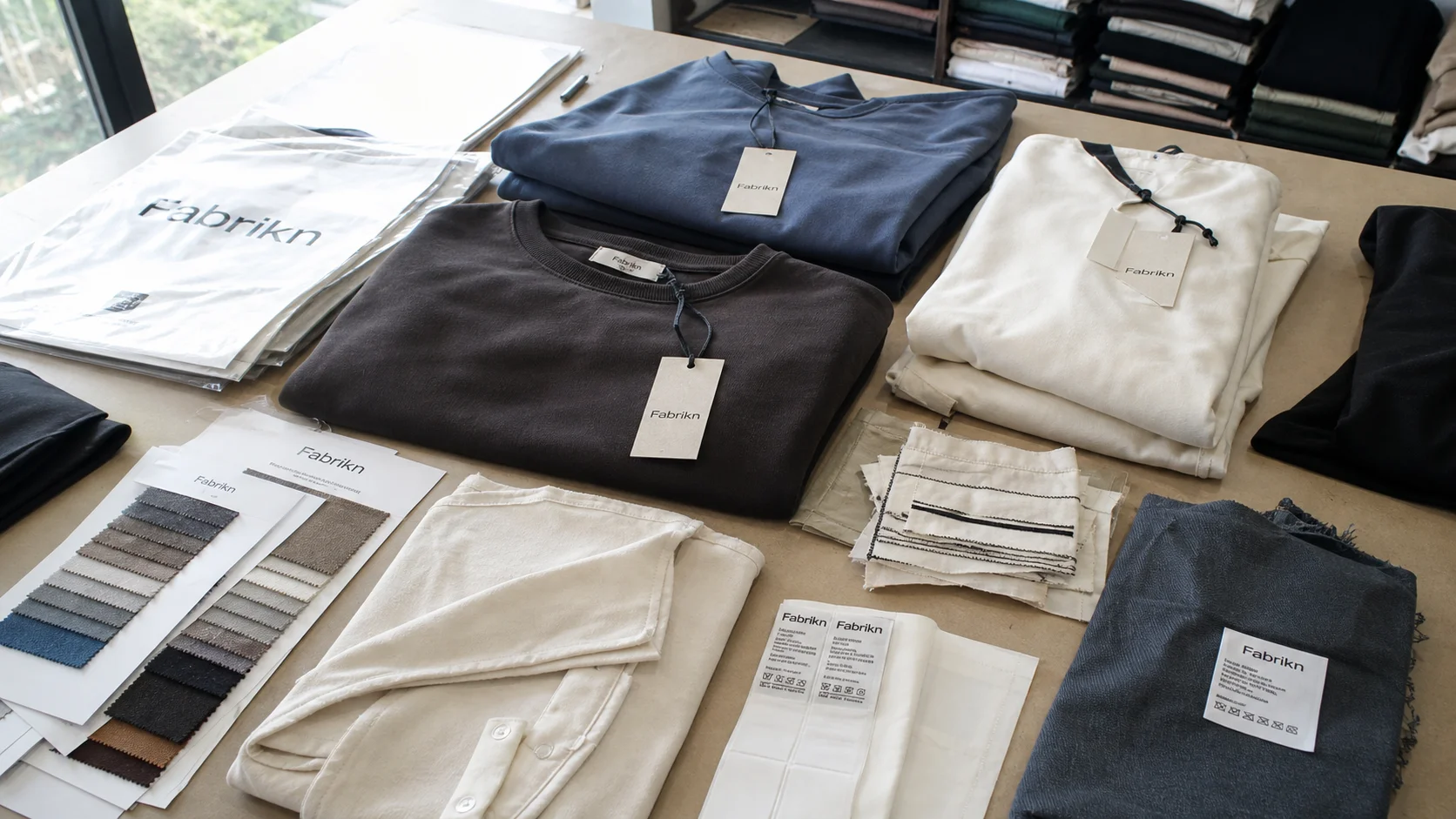
Audit cotton jersey T-shirt suppliers for catalog and retail reorders with checks for fabric consistency, trims, labeling, packing, and replenishment timing.
Use this page when the program is a repeatable cotton jersey T-shirt or similar knit basic, not a vague apparel-supplier search.
Decision pointWhat to confirm before productionProduct specFabric weight, fit block, size range, trims, and decoration method.Order economicsMOQ, sample cost, unit tiers, packaging, freight, and repeat-order terms.Quality controlPre-production sample, color approval, measurements, labeling, AQL, and carton marks.Choosing an apparel production supplier for catalog and retail programs is less about finding the cheapest quote and more about finding a partner that can hold quality, timing, labeling, and replenishment discipline across repeat orders. Catalog and retail work usually carries more structure than one-off promotional production. Styles need to stay consistent, colors need to match across runs, and packaging often needs to arrive in a format that is ready for distribution. In practice, a simple cotton jersey tee may price around $2.50-$4.00 per unit at a 500-unit MOQ, while a more construction-heavy woven or washed style can move into the $6.00-$12.00 range before freight, testing, and duties.
If the supplier will support your line for months rather than a single shipment, the vetting process needs to go beyond a sample photo and a price sheet. The real question is whether the factory can produce the same garment the same way at scale, with enough control over fabric, trims, testing, and inspection to protect margin and reduce chargebacks. A typical development cycle is 18-22 business days after full tech pack approval for simpler cut-and-sew styles, but that can stretch to 30-45 business days when you add lab dips, wash approvals, custom trims, or specialty fabrics.
For companies building a catalog assortment or retail program, the best suppliers tend to be the ones that communicate clearly, document their process, and give realistic lead times. If you are comparing capabilities across partners, start with the supplier’s services page, review the company background on about us, and use the contact us page to ask for process details before any order is placed. Common sourcing requests include a line-item quote, a sample calendar, current compliance certificates, and at least one recent third-party inspection or test report.
How to Vet an Apparel Supplier for Catalog and Retail - Clothing Manufacturer manufacturing guide
Catalog and retail programs are built on consistency. A buyer may expect a garment to be reordered after it performs well in the market. A merchandiser may need the same wash, the same fit, and the same label application six months later. A factory that can make a good one-off sample is not automatically equipped to support that kind of repeatability. For repeat programs, ask the supplier for measurement tolerance ranges, shade band control, and a sample of its final inspection report before you move forward.
The risk rises when a program involves several SKUs, multiple colorways, size runs, and a mix of fabrications. A weak supplier can create problems that are expensive to unwind: delayed deliveries, shade variation between lots, missed packaging instructions, labeling errors, and returns caused by fit or construction inconsistency. Common retail checkpoints include 4-point fabric inspection, in-line sewing audits, final AQL inspection at 2.5 or 4.0, and carton verification against the packing list.
For that reason, vetting should focus on control points. These include how the supplier sources fabric, how they approve trims, how they manage pre-production samples, what inspection systems they use, and how they react when something falls out of spec. A supplier that can explain those points in detail is usually a better candidate than one that relies on broad promises. Good answers usually mention specific tools and records, such as lab dips, strike-offs, shrinkage tests, colorfastness testing, and written corrective action when defects are found.
Catalog and retail lines usually require a higher degree of standardization than many fashion or limited-run programs. The products may look simple on the surface, but the commercial requirements are exacting. The most reliable programs define the fabric construction, garment measurements, labeling copy, fold standard, and carton pack-out before bulk production starts.
Repeat orders should match the original approved standard as closely as the materials allow. That means controlled shrinkage, reliable color matching, stable garment measurements, and consistent trim sourcing. Even small deviations can create problems when products are sold alongside existing inventory. A common benchmark is +/- 0.5 inch on key measurement points for knit tops and +/- 0.75 inch for some woven items, though the actual tolerance should be set in the spec sheet and signed off before cutting.
Retail and catalog programs often need folding standards, hangtags, barcode placement, polybag specifications, carton markings, and country-of-origin compliance. If a supplier treats packaging as an afterthought, the shipment may still pass sewing inspection but fail distribution requirements. Ask for a packaging mock-up, a label placement sample, and a carton-marking proof; common sourcing practice is to approve these before bulk to avoid relabeling or repacking charges.
Many catalog programs need replenishment, not just one release. That makes fabric availability, dye-lot planning, and trim continuity especially important. A factory should be able to discuss how it handles repeat production when mills have changed minimums, when color lots shift, or when trims are discontinued. If replenishment is likely, ask whether the supplier can reserve greige fabric, hold trim inventory, or commit to a repeat dye standard using the original lab dip as the master reference.
For catalog and retail work, the lowest quote is rarely the lowest-risk choice. A slightly higher unit cost can be easier to justify if it reduces rework, chargebacks, and late deliveries.
Before comparing price, confirm whether the supplier is structurally capable of producing your type of apparel. A vendor that excels at simple promotional tees may not be the right fit for woven shirts, cut-and-sew knits, structured outerwear, or multi-component garments. Ask what machines and processes they use in-house - for example, Juki single-needle lockstitch machines, Pegasus overlock machines, Kansai coverstitch machines, Bartack machines, Gerber or Lectra CAD/CAM cutting, and automatic spreading tables.
Ask which product categories the supplier produces regularly. For catalog and retail programs, useful experience usually includes tops, bottoms, active basics, sweaters, uniforms, outerwear, and private-label programs with stable repeat demand. Experience should be relevant to your item type, not just general apparel manufacturing. A factory that can show recent spec sheets, inline defect logs, and finished-goods inspection reports for the same garment category is usually a stronger fit than one that only has a lookbook.
Capacity matters when styles must ship on a schedule tied to catalog drops or retail floorset dates. Ask how many lines the supplier runs, how it schedules multiple styles, and how it protects production when a priority order arrives. A supplier that cannot explain line balancing, bottleneck management, or work-in-process tracking may struggle with larger programs. Common planning details include daily output by line, sewing efficiency targets, and whether they do in-house cutting or outsource it.
Minimum order quantities vary widely by garment type, fabric complexity, and decoration. As a practical guide, many suppliers quote around 300 to 1,000 units per style/color for simpler knit programs, while woven or more construction-heavy items can land in the 500 to 2,000 unit range or higher. For example, a basic jersey tee may be workable at 300 to 500 units per color, while a brushed fleece hoodie, lined jacket, or woven dress shirt often requires 500 to 1,500 units because of fabric yield, trim minimums, and setup time. Special fabrics, custom trims, or color-specific dyeing can push minimums upward.
Typical lead times depend on sample approval, fabric booking, trim sourcing, testing, and production queue. A sample round may take 7 to 21 days, though more complex styles can take longer. Pre-production approval and bulk preparation can require 2 to 6 weeks. Bulk production and shipment often fall somewhere in the 30 to 90 day range depending on fabric readiness and order complexity. For a straightforward cut-and-sew knit program, 18 to 22 business days after approved fabric and trims is a realistic target; for washed, dyed, or woven styles, 35 to 50 business days is more common. A supplier that quotes an unusually fast schedule without explaining dependencies deserves close scrutiny.
Material control is one of the biggest differentiators between a supplier that can support retail programs and one that cannot. Fabric is often where quality drift starts, especially on repeat orders. Common base materials for catalog and retail include combed cotton jersey, ring-spun cotton, CVC 60/40 cotton-poly blends, French terry, 3-end fleece, polyester interlock, poplin, twill, and woven rayon or viscose blends, depending on the product.
Ask where the fabric comes from, who owns the specification, and how the supplier confirms consistency between lots. A strong supplier should be able to identify the base composition, construction, weight, and finish of the fabric being used. If the style depends on a particular handfeel or performance feature, the supplier should be clear about what can change and what cannot. Useful sourcing documents include mill test reports, fabric composition certificates, 4-point inspection results, and shrinkage or spirality test records.
For most catalog and retail apparel, the specification package should define fiber content, yarn or knit structure, fabric weight, finish, shrinkage tolerance, color standard, and any functional requirements such as moisture management, pilling resistance, or stretch recovery. If those details are vague, the finished goods can vary more than the buyer expects. Common examples are 180-220 gsm combed cotton jersey for tees, 280-320 gsm French terry for sweatshirts, and 5-8 percent elastane in stretch knits when recovery matters.
Labels, zipper tape, snaps, buttons, elastics, drawcords, heat transfers, and hangtags all need continuity planning. A supplier should confirm whether trims are stock items, custom sourced, or customer supplied. The risk with custom trims is simple: if a component is discontinued or delayed, the whole style can be held up. Ask for trim cut sheets, finish specs, and a back-up component plan for items like YKK zippers, nickel-free snaps, or sewn-in labels with specific wash-care content.
Catalog and retail programs often expose color variation more quickly than one-time fashion drops. Ask how the supplier handles lab dips, strike-offs, dip-dye approvals, and shade banding. If the program will be reordered, ask whether future dye lots can be matched to the original approved standard and what tolerance the supplier considers acceptable. Common sourcing practice is to approve color under a D65 light box and, when needed, compare with a spectrophotometer so the buyer is not relying on visual judgment alone.
Sampling is not just a formality. It is where most hidden production problems become visible. A disciplined supplier should have a clear approval path and should not move into bulk without written signoff at each stage. For repeat programs, that paper trail usually includes tech pack approval, lab dip approval, fit approval, pre-production sample approval, and packing approval.
A practical workflow usually includes tech pack review, fabric and trim confirmation, first sample, fit or prototype review, revisions if needed, pre-production sample, and final bulk approval. Some programs also require wash testing, wear testing, or packaging approval before production begins. Typical timing is 5 to 10 business days for a proto sample, 7 to 14 business days for a fit sample, and another 7 to 10 business days for a pre-production sample once the final materials are on hand.
Catalog and retail buyers should pay close attention to fit standards. Ask whether the supplier can work from graded specs, how size sets are approved, and how tolerances are managed across sizes. The best suppliers use a size set, measurement sheet, and fit comments log so corrections are traceable, not verbal. If the item is intended for repeated replenishment, ask the supplier to retain the approved pattern, grading rule, and marker file for future runs.
Fit alone is not enough. Review seam type, stitch density, seam allowance, topstitch spacing, neck binding recovery, armhole symmetry, and hem quality. Common construction details include 301 lockstitch, 504 overlock, 406 coverstitch, bartacks at stress points, and flatlock seams on activewear. A sample should also be checked for thread trimming, label orientation, puckering, twisting, and needle damage before it is approved.
Catalog and retail customers are sensitive to defects because returns, chargebacks, and rework quickly erode margin. Quality control should be built into the supplier's operating process, not added after problems appear. Ask for their inspection plan, test list, and corrective-action process before you issue a purchase order.
A solid factory usually checks materials on receipt, in-line during sewing, after finishing or washing, and again before packing. Common checkpoints include fabric shade approval, cut panel verification, first-piece approval, in-line seam audit, final measurement audit, carton count, and barcode scan. For higher-risk styles, ask whether they use metal detection or needle detection before shipment, especially if the product includes snaps, zippers, or other hard components.
Ask for current certifications and their scope. For social compliance, WRAP and BSCI are widely recognized references. For textile chemistry and organic claims, GOTS and OEKO-TEX Standard 100 are common proof points. A strong supplier should be able to share certificate numbers, issue dates, and the exact product scope covered, not just a logo on a website. Common test requests also include colorfastness to washing and rubbing, dimensional stability after wash, seam slippage, pH, and azo dye screening where relevant.
A trustworthy supplier should explain how they quarantine nonconforming goods, rework defected units, and document root cause. Ask what happens if a shade band appears, if measurements drift outside tolerance, or if a trim lot fails. The answer should include a written corrective-action report, a revised inspection step, and a clear decision on whether the lot is reworked, sorted, or rejected.
Price matters, but the quote only makes sense when the commercial terms are clear. A lower unit price can be offset by expensive sampling, high freight exposure, hidden packaging charges, or poor repeat-order control. The most useful quotes break out fabric, cutting, sewing, washing or finishing, trims, labels, testing, packaging, and any special handling.
Ask for a line-item quote with separate pricing for materials, labor, decoration, packaging, and testing. If the style uses custom dyeing, print, embroidery, or washing, those should be itemized as well. As a practical benchmark, sample fees often run $50-$150 per proto, while lab dips, strike-offs, or wash development can add $25-$100 per iteration depending on the fabric and process.
Many suppliers require a 30 percent deposit and 70 percent balance before shipment, though terms vary by relationship and order size. If you need replenishment, ask whether the supplier can hold fabric or trims for a fixed window, and whether the pricing changes if the order is repeated from the same approved materials. That detail is especially important when a custom color, custom label, or branded packaging must be recreated exactly.
Lead time and cost both move when the program depends on specialty fabric, custom hardware, post-production wash, or outside testing. A garment that needs enzyme wash, silicone softener, garment dye, or pre-shrinking may cost more and take longer than a standard cut-and-sew piece. Freight mode, carton size, and labeling requirements can also change landed cost in ways that are easy to miss if the quote is too simple.
A simple scorecard makes it easier to compare factories on the same basis. Good suppliers usually score well on communication, sampling discipline, material control, inspection records, and realistic capacity planning. Ask each candidate for the same documents so the comparison is fair: sample photos, spec sheets, inspection reports, certifications, and a production timeline tied to your target delivery date.
Useful scorecard items include response speed, clarity of technical answers, consistency between sample and bulk, on-time delivery history, and willingness to document the process. Many buyers also track whether the factory can maintain at least 95 percent on-time delivery, keep key measurements within tolerance, and resolve defects without repeated follow-up. If the supplier cannot provide those basics, the relationship is likely to become expensive.
The best supplier is not always the cheapest or the biggest. It is the one that can prove repeatability with documented materials, approved samples, inspection data, and a production schedule that matches the business plan. For catalog and retail, that often means choosing the supplier that can explain its fabric sourcing, trim continuity, AQL process, and replenishment strategy in plain language.
Several warning signs should slow the process down. A supplier that refuses to itemize pricing, cannot explain where fabric comes from, or will not share recent inspection or test records is hard to trust for a repeat program. The same applies if the factory cannot name its sewing machines, does not use written sample approvals, or changes the delivery date every time you ask a technical question.
Another red flag is vague compliance language. If a supplier claims certification, ask for the actual document. If it mentions GOTS, OEKO-TEX, WRAP, or BSCI, verify the current scope and expiration date. If it promises retail-grade quality but has no mention of AQL, measurement tolerances, or pre-production approval, that is a sign the process is not mature enough for catalog work.
Finally, be cautious when a supplier quotes a lead time that ignores fabric booking, lab dip approval, or wash development. Those dependencies are not optional. A realistic production plan should show where the time goes and what can slow it down.
Get a free quote from Fabrikn — your trusted B2B clothing manufacturer with 10+ years of experience. MOQ as low as 200 pieces.
Get a Free Quote →What is the most important thing to verify first? Confirm that the supplier can repeatedly match the approved sample through fabric control, trim continuity, and final inspection. Ask for recent records, not just a promise.
How do I know if the price is competitive? Compare line-item quotes at the same MOQ, fabric weight, construction, and packaging standard. A quote at $2.50-$4.00 per unit for a basic tee is not comparable to a fully packaged, tested, and labeled program with custom trims.
Which certifications matter most? For apparel programs, common credentials to ask about include GOTS for organic textiles, OEKO-TEX Standard 100 for restricted substances, and WRAP or BSCI for social compliance. Always verify the current certificate scope and date.
What inspection process should a supplier use? At minimum, ask for incoming fabric inspection, in-line sewing checks, final random inspection using AQL, and pre-ship carton verification. For higher-risk items, needle detection or metal detection may also be appropriate.
How long should production take? For simple cut-and-sew knits, 18-22 business days after approvals is a reasonable benchmark. More complex woven, washed, or trim-heavy styles often need 35-50 business days or more, depending on fabric readiness and testing.