
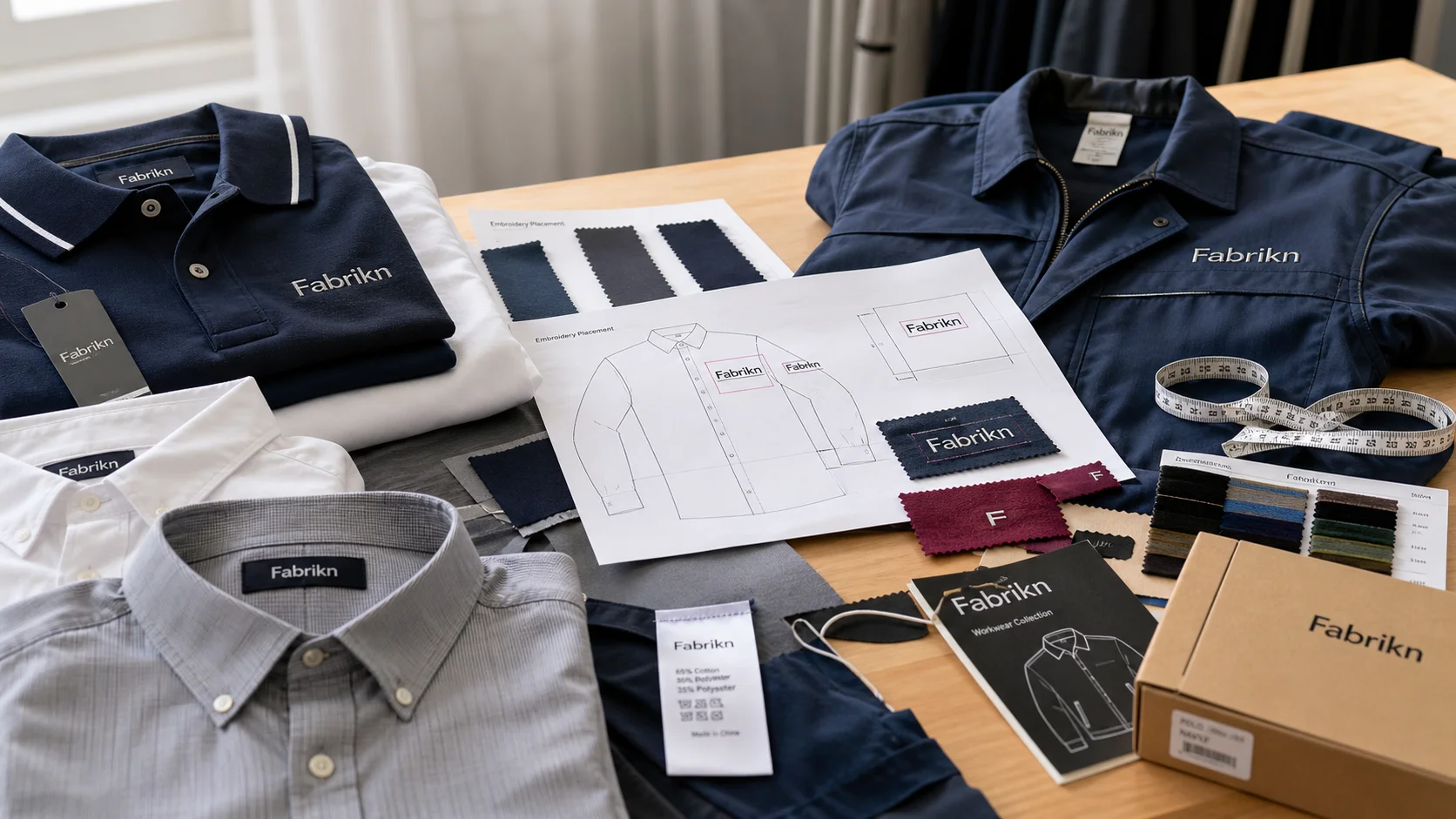
The Materials for Clothing Boxes compared by sample evidence, fabric or trim specs, MOQ, AQL terms, cost lines, delivery timing, and rework responsibility.
Fast answer: The Materials for Clothing Boxes: Tech Pack, Sample Gate, MOQ, and QC Terms should be judged by production evidence, not by a generic sourcing promise. The buyer needs sample proof, cost breakdowns, QC checkpoints, and delivery buffers in writing.
Ask for recent sample photos, measurement tolerances, fabric or print test assumptions, decoration test notes, packing examples, and a named inspection checkpoint. These details show whether the team can repeat an approved sample at bulk volume.
Separate garment cost, decoration, labels, packaging, sampling, testing, freight, and rush charges. Clear cost lines make it easier to reduce colorways, adjust size depth, or reserve more time for sampling.
I’ve watched a premium shirt lose half its perceived value in ten seconds. It arrived in a crushed poly mailer with a bent collar board, then in a rigid box with sharp edges, a crisp closure, and a 2.5 mm wall that held its shape after a 1.2-meter drop test. Same product. Different reaction. That is why what are the best materials for clothing boxes starts with psychology, not carton catalogs.
At factories in Vietnam and Poland, the numbers kept lining up with the same ugly truth. Boxes made from 350-400 gsm SBS paperboard showed visible edge wear after about 4-6 transit touches, while 1.5-2.0 mm rigid chipboard cut damage complaints by 18-27% for premium apparel shipped cross-border. Stronger board also reduced replacement orders, especially for folded shirts, knits, and gift sets that need a clean reveal. Heavy stock is not only about luxury. It cuts the odds of a refund email from a buyer who reads dents as cheap product.
Fast-fashion labels usually ask for the lowest-cost foldable pack, often 250-300 gsm paperboard or corrugated mailers with simple flexo print, because their garment margin may be $3-8 and the box has to stay under $0.40-0.80. DTC basics tend to land in the middle: one-piece mailer boxes, modest print, shipping-friendly structures. Luxury labels push in the other direction, even for a $45 shirt or a $220 silk blouse. The garment price changes the material brief far more than the fabric content does.
The box is part of the product. In store, on camera, and on the doorstep, it has to balance protection, shelf impact, and print fidelity. A beautiful matte navy box printed on weak board can scuff in a week. A plain kraft corrugated box can outlast it in transit and still look intentional if the typography is disciplined. I’ve seen brands spend $1.20 on foil stamping and save $0.18 on board, then pay twice that in reprints after corner crushes. Bad trade.
No universal winner exists. Only the right material for the job. The main families are rigid chipboard, corrugated kraft board, SBS paperboard, recycled paperboard, and specialty cellulose-based options. Rigid board is built for premium gifting and high-touch retail moments. Corrugated kraft board handles rough freight, stacking, and the abuse of parcel networks. SBS paperboard gives a sharp print surface for lightweight folded apparel. Recycled board works well for eco-led brands that want a visible fiber story without a luxury price tag. Specialty cellulose-based boards can be useful where fiber traceability or compostable positioning matters, though they often cost more and have tighter supplier options.
In Europe, I’ve seen boutique fashion brands choose rigid boxes at a much higher rate than in North America. In Italy and France, a rigid setup is often treated as part of garment architecture. In the United States and Canada, DTC fulfillment pushes brands toward corrugated mailers because parcels move through more hubs, and the box must survive 2-5 scanning and handling points before arrival. That regional split changes sourcing decisions quickly. The same dress can be packed in a €1.80 rigid box in Milan or a $0.72 corrugated mailer in Chicago.
Some premium brands hide a corrugated structure under a laminated wrap. I saw this in a Turkish factory producing for export to the Gulf and North America. The outer finish looked like rigid board, but the inner structure was corrugated, which survived cross-border freight better than rigid board alone. The boxes carried 12-15 kg stacked loads for 48 hours without edge collapse. Not cheap vanity. Engineering dressed up as luxury.
If your brand sits between mass and premium, the board choice should mirror your customer promise. For a $28 sweatshirt, a 300-350 gsm paperboard box or corrugated mailer is usually enough. For a $180 knit set, 1.5 mm rigid board or reinforced corrugated with a wrap can protect the value story. I’ve linked packaging decisions to product categories in the same way I do garment sourcing: a cap from custom hat manufacturing may ship well in a simple structure, but a tailored coat in a collection box needs much more stiffness and visual control.
When sustainability is the brief, I start with measurable inputs, not brand language. Recycled fiber percentage, FSC or PEFC sourcing, recyclability after printing, and coating chemistry matter far more than a green icon on a sales deck. According to FSC and PEFC, chain-of-custody systems help verify responsible sourcing, but they do not automatically make a box recyclable or low-impact. A 70% recycled board with water-based inks and an aqueous coating can be a better practical choice than a heavily laminated 100% recycled board that fails in transit and gets replaced.
There’s a trade-off buyers ignore. A 100% recycled board can look beautifully matte and natural, but virgin fiber often improves strength at lower caliper. That matters if the box is large, if the shipment travels 1,500-6,000 km, or if the product inside is heavy, such as denim or outerwear. I have seen a 28% recycled-content increase force a thicker board spec just to hit the same compression number, which raised weight by 9-14%. In a carton that ships 50,000 units a season, that is not a small change.
Plastic-free coatings help end-of-life recovery. Aqueous coatings, soy-based inks, and minimal lamination keep the box closer to curbside recyclability, while foil, metallic film, and heavy soft-touch laminates complicate separation. The printing side matters too. Water-based coatings usually dry faster than solvent-heavy systems, and they behave better on paperboard than on highly coated rigid wraps. For brands building clean fiber stories, those details matter as much as the recycled percentage on the spec sheet.
Emissions move with weight. A lighter box can reduce transport emissions per order, especially in air freight or last-mile parcel shipping. I’ve seen switching from a 1.8 mm rigid box to a lighter recycled paperboard structure cut outbound pack weight by 18-26 grams per unit and reduce void fill by 30-40%. Small on paper. Huge at 80,000 orders. Sustainability is not a mood. It is a set of material choices that survive a warehouse, a truck, and a customer’s recycling bin.
When a brand wants sustainability without guesswork, I ask for certification documents and production proof, then I compare them to garment programs like custom baby clothing manufacturing, where safety, traceability, and low-odor materials are already non-negotiable. The box should meet the same level of evidence.
Buying on unit price alone is how brands pay twice. A $0.32 corrugated mailer can be cheaper than a $1.10 rigid box, but if the lighter option causes 4% more damage, the replacement cost can wipe out the savings fast. I always push buyers to calculate total landed cost: factory quote, freight, packing time, damage rate, and reprint risk. The cheapest board is not always the cheapest program.
Here is a practical comparison I use with sourcing teams:
Print compatibility shifts with material. Litho lamination performs well on rigid board and premium corrugated wraps because it delivers rich color and fine type. Digital print is faster on paperboard and short-run corrugated, especially at MOQ 300-1,000 pieces. Flexo is efficient for plain kraft boxes and larger volume runs, though it can look flatter. Embossing and foil stamping look strongest on rigid board, but they add cost and can slow lead time by 3-7 days. A box with a 2-color logo does not need the same process stack as one with a full-bleed photographic campaign.
Speed matters. Corrugated and digital paperboard can move faster than rigid boxes because converting is simpler and drying times are shorter. I’ve seen factories in Shenzhen quote 7 days for a digital paperboard mailer at MOQ 500 pieces, while a rigid set with magnetic closure took 21-28 days and needed extra QC for corner alignment. That is a meaningful gap for seasonal launches or reorders. For brands also running private label clothing services, packaging lead time can become the last bottleneck before goods ship.
Luxury apparel and gift sets usually belong in rigid board, especially when the customer pays for ceremony as much as for fabric. A magnetic-closure rigid box with 1.5-2.5 mm board and wrapped paper stock can justify a higher unboxing value for a $150 scarf or a $600 coat. A foldable mailer box cannot create the same tactile experience, even if the print is immaculate. The structure has to match the price point.
Subscription basics and DTC apparel do better with corrugated mailer-style boxes or sturdy paperboard mailers. They need compression resistance, repeatable pack-out, and lower freight costs. A $14 tee or a 3-pack of socks does not need a luxury hinge. It needs clean folding, low scuffing, and a box that survives the trip. Retail brands on a tighter margin often use recycled paperboard for value-led presentation, then reserve rigid components for seasonal gift packs or limited drops.
Sustainability-led brands should prioritize FSC-certified board, recycled content, and minimal laminations, but they should not sacrifice structure so much that the box arrives crushed. I have watched founders spend $1.50 on embossed logos and only $0.12 on the board itself. Backwards. A crushed corner makes a recycled story look careless. A well-formed recyclable box does more for brand trust than a glossy promise printed in silver foil.
For factory economics, the spread is large. A premium box can cost 3x to 6x as much as a standard corrugated mailer, yet the customer often sees that box as part of the garment’s value. I’ve seen this especially with occasionwear, bridal accessories, and premium childrenswear, where packaging becomes a keepsake. That is why the structural brief matters. A magnetic lid, a tuck-end flap, and a foldable mailer each demand different board density and different tolerances. The same rule applies in garment production; a structured collection for cut and sew manufacturing needs materials that support the product, not distract from it.
Ask for board caliper, burst strength, ECT or compression data, coating type, recycled content proof, and sample pack-out testing before you approve anything. I also want the supplier to state whether the quoted sample matches the mass-production mill, because a beautiful hand sample can hide a weak production board. In one factory in Guangdong, the sample board measured 1.8 mm, but the production run landed at 1.55 mm. Enough to collapse corners on a 20-box stack test.
Request side-by-side prototypes with the same artwork across 2-3 materials. Use one graphic system, not three different designs, so your team can judge color shift, scuffing, and edge crush fairly. Test with real garments, inserts, tissue, and any hang tags or cards that will ship in the box. A folded sweater, a silk shirt, and a denim overshirt behave differently under compression. A box that works for one may fail for the other in 2-3 days of warehouse handling.
Supplier red flags are usually obvious once you know where to look. Vague sustainability claims without documentation. Missing test data. Board thickness that changes from quote to quote. Samples that look luxurious but use a different coating or liner than the production version. If the factory will not tell you the MOQ, the curing time, or the exact board grade, treat that as a warning. Good suppliers can explain the trade-offs in minutes, not marketing slogans.
Packaging decisions also affect adjacent product lines. A brand that sources seasonal accessories alongside apparel may want packaging consistency across categories, while teams handling custom baby clothing manufacturing often need softer, safer materials with cleaner inks and lower odor. The point is simple: test the box in the same shipping conditions your apparel will face, not in a studio under perfect light.
When evaluating a manufacturer or factory in China or elsewhere, ask for the same documentation you would request from any supplier in wholesale or bulk production. If a vendor is unwilling to share spec sheets, quality checks, or process notes, keep looking. The best packaging partner should be able to support custom programs, explain lead times, and show how the material performs in real production.
For broader material and compliance guidance, review the textile standards and sourcing references from Textile Exchange, U.S. Trade and sourcing guidance, and OEKO-TEX. These resources can help brands compare fiber claims, supplier transparency, and quality expectations before placing an order.
Start with five decisions: protection needs, shipping method, brand position, budget ceiling, and recycling target. Then score each material on three axes only: protection, presentation, and end-of-life impact. If one option wins on appearance but fails on transit, it is not the right option. If another wins on sustainability but causes reprints, it is not the right option either. Buyers should optimize the whole order, not a single line on the invoice.
The fastest pilot is simple. Test 2 materials, ship 50-100 units, and review damage, unboxing feedback, and pack-out time. If the box adds 12 seconds per unit at fulfillment scale, that can matter more than a 5% unit savings. Keep the sample loop tight: one artwork file, one garment type, one shipping route. Use real customers if possible, because their reactions are clearer than internal opinions.
My recommendation is blunt. Choose rigid board for premium presentation, corrugated for shipping resilience, paperboard for lightweight retail, recycled board for value-led sustainability, and specialty eco boards only when the story justifies the cost and lead time. Do not default to the cheapest board. Decide the role of the box, test it against actual freight, and lock the spec only after the box proves itself under pressure. That is the practical answer to what are the best materials for clothing boxes when you need performance, not theory.
Rigid chipboard is usually the strongest choice for premium apparel because it delivers crisp edges, better stack resistance, and a luxury unboxing feel. For many brands, 1.5-2.5 mm board with laminated wrap is the most reliable spec.
Corrugated kraft board is the best fit for most mail-shipped clothing orders because it handles compression and transit damage better than thin paperboard. In many fulfillment programs, ECT 32-44 is a practical starting range.
Paperboard can run about $0.18-0.65 per box, corrugated about $0.22-0.85, and rigid board about $0.90-2.80, depending on size and print. Freight, packing labor, and damage rates can change the real cost more than the factory quote.
Corrugated and digital paperboard boxes can often be produced in 5-14 days, while rigid boxes usually take 10-28 days because of wrapping, drying, and extra QC. MOQ also affects timing, with 500-1,000 pieces typically moving faster than larger runs.
Recycled paperboard or FSC-certified board with aqueous coating is often the best balance. It can deliver a clean print surface, lower weight, and better recyclability while still giving a polished retail appearance.