
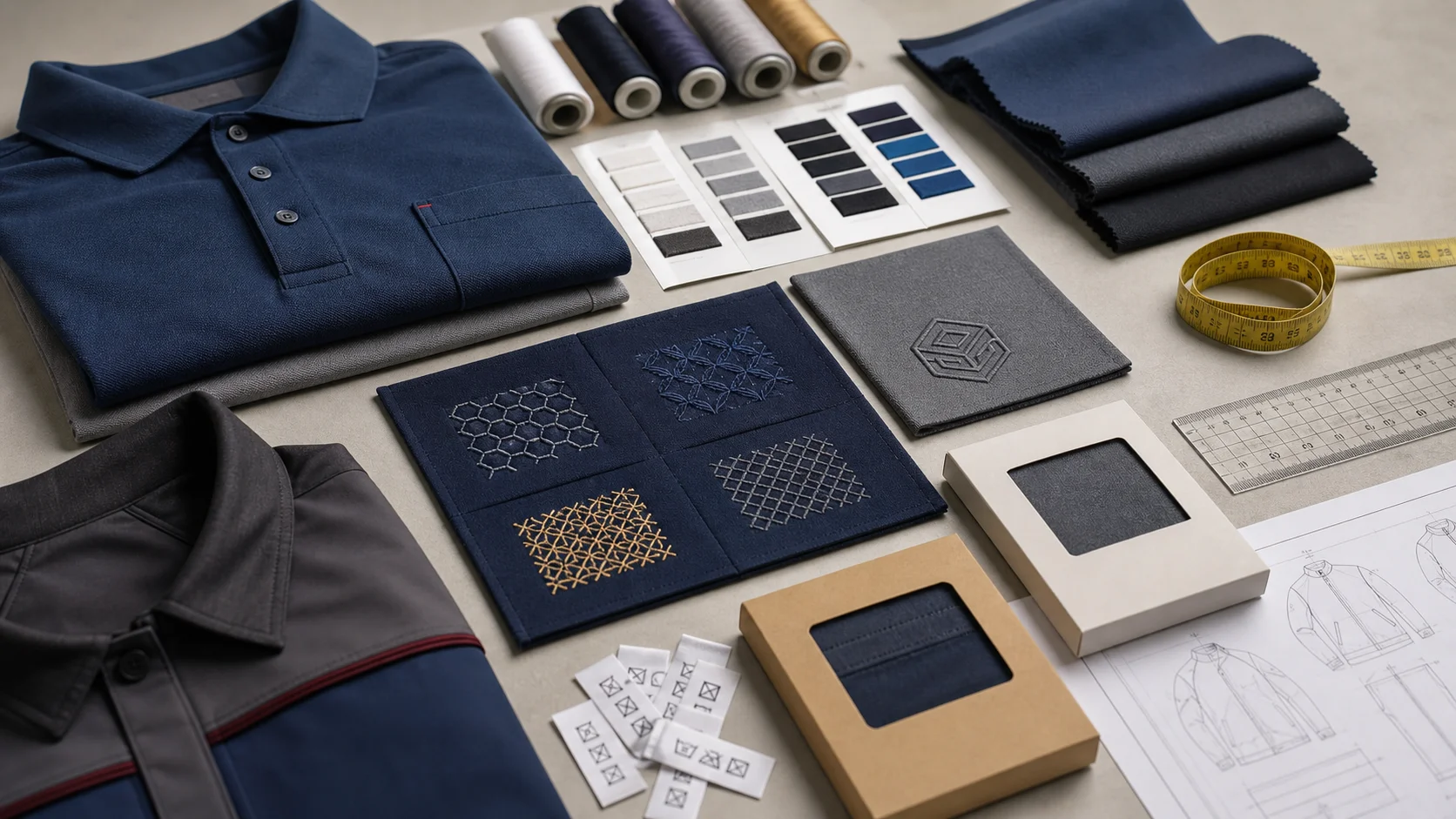
Materials for Clothing Hang Tags By Budget with checks for samples, fit, MOQ, QC evidence, pricing terms, and delivery risk.
Fast answer: Materials for Clothing Hang Tags By Budget: Deposits, Cost Lines, QC, and Rework Risk should be judged by production evidence, not by a generic sourcing promise. The buyer needs sample proof, cost breakdowns, QC checkpoints, and delivery buffers in writing.
Ask for recent sample photos, measurement tolerances, fabric or print test assumptions, decoration test notes, packing examples, and a named inspection checkpoint. These details show whether the team can repeat an approved sample at bulk volume.
Separate garment cost, decoration, labels, packaging, sampling, testing, freight, and rush charges. When every cost line is visible, it becomes easier to reduce colorways, adjust size depth, or reserve more time for sampling.
A hang tag can make a tee feel sharper, a jacket feel pricier, and a brand feel like it has its act together before the garment is even touched. A $12 tee and a $120 jacket often leave the factory with nearly identical tag construction: 300 to 400 gsm board, a 3 mm hole, black offset print, and a cotton or polyester string. What changes is the impression in the shopper’s hand.
I’ve watched shoppers turn over a tag for less than 2 seconds, then decide a brand feels “cheap” or “considered” before they ever touch the garment. That tiny ritual matters. Hang tags shape perceived quality, sustainability claims, and conversion rates both on shelf and in unboxing videos, where a clean edge or a warped coating can show up in high resolution.
Retailers notice scuffing first; direct-to-consumer brands notice how the tag photographs against matte packaging. For labels investing in clothing packaging solutions, the hang tag is not decoration. It is part of the proof set.
When I visited factories in Portugal, Vietnam, and South China, the same contradiction kept appearing. Low-cost tags can look expensive with the right stock, especially a dense uncoated board with crisp typography and 1-color print. A premium coating can make a poor paper choice harder to recycle and more likely to crack at the fold line.
One luxury sample book used soft-touch lamination over a mixed-fiber board. It felt lovely. It also failed a basic tear test after 6 bends. The point is simpler than many sourcing decks suggest: the best materials for clothing hang tags depend on brand position, print method, turnaround, and end-of-life goals.
A recycled kraft tag with soy ink can be the right answer for a startup shipping 1,500 units a month. A coated SBS board may be smarter for a retailer needing 25,000 tags in 10 days with barcodes, sizing icons, and a color-critical logo. Material choice is strategy, not garnish.
The main material families are easy to list and easy to misunderstand. Paper stock, board, recycled fibers, and synthetics each solve a different problem. I judge them by feel, print behavior, durability, and how much they cost once you add die cutting, stringing, and packing. The paper itself is often only 20% to 35% of the final tag cost.
Uncoated paper is the workhorse and one of the best materials for clothing hang tags when a natural, understated look matters. It suits brands that want pencil-like typography, soft blacks, and tactile embossing without glare. A 350 gsm uncoated stock can look richer than a 450 gsm coated sheet if the design is restrained.
Coated board sharpens color and photograph reproduction, which helps labels running lifestyle imagery, but it can also read more commercial than premium if overprinted. Textured cotton or felt-like papers sit at the premium end. They work well for luxury cues, especially with blind debossing, foil, or edge painting. They are not always the most sustainable choice, because specialty coatings and adhesives can complicate recycling.
Recycled paper is more varied than buyers expect. Good recycled board can run cleanly at 300 to 400 gsm, but fiber quality, ink holdout, and die-cut behavior vary by mill. Recycled content is not a synonym for weak quality. Polypropylene, PET, and PVC show up for activewear, swimwear, outdoor apparel, and kids’ goods because they resist moisture and tearing. PP is lighter and often cheaper than PET. PET is stiffer and can feel more premium.
PVC still appears in some legacy supply chains, though many brands avoid it for environmental and compliance reasons. In price terms, entry-level paper tags can land around $0.03 to $0.08 per piece at volume, mid-market stocks around $0.08 to $0.20, premium textured papers from $0.20 to $0.45, and ultra-premium synthetics or specialty finishes can pass $0.60 once MOQ, tooling, and finishing are added.
For brands building private label clothing services, the material decision should match the garment and the sales channel. A clean 300 gsm recycled board may be enough for a 500-piece custom drop from a factory or manufacturer. A 32 pt coated sheet may be better for a 10,000-piece wholesale run from a supplier in China that needs bright seasonal color and exact barcode density. The right stock is rarely the fanciest one. It is the one that survives your actual use case.
Sustainability claims are easy to print and harder to verify. According to Textile Exchange, buyers are under more pressure than ever to document material inputs, and packaging suppliers feel that pressure in every certificate request. For hang tags, I look for FSC-certified paper, recycled kraft, post-consumer waste content, and inks that do not introduce avoidable waste. Soy and water-based inks are common, but they are not magic. The substrate still matters most.
Here’s what most people miss: some “eco” tags use a heavy lamination layer that blocks recycling even when the board itself is recycled. I’ve handled tags that were marketed as sustainable yet carried a 25 to 30 micron film over a mixed-fiber sheet. They looked polished. They were harder to reclaim than a plain 350 gsm uncoated stock printed with one dark color.
Another counterintuitive finding from factory visits: a simple uncoated tag often outperforms a specialty paper in waste reduction because it needs fewer reprints, fewer coatings, and less transport complexity. Local sourcing matters too. A paper mill 200 km away with a 5-day lead time can be greener in practice than a low-carbon claim built on a 6-week import route, especially when freight consolidation is poor.
In Europe, I’ve seen brands buy from mills in Italy or Germany to cut replenishment time to 7 to 10 days. In the US, brands often trade a longer supply radius for better availability of FSC and post-consumer stock. For product teams working with custom baby clothing manufacturing, that speed matters because kids’ collections often change by season and by safety compliance.
Recycled fibers do create trade-offs. Fine typography can fill in, barcodes can lose contrast, and dark brand colors may shift warmer than expected. If your logo relies on a deep navy or rich charcoal, ask for a press proof, not just a PDF. I have seen recycled kraft tags pass a sustainability audit and still fail brand approval because the barcode scanned at 92% instead of the required 99% on retail checkout systems.
For brands comparing the best materials for clothing hang tags, sustainability should be measured alongside quality, not instead of it. A tag that looks responsible but fails at production proof adds waste, delays, and extra cost. That is why packaging teams should review certifications, recyclability, and print performance together.
I test hang tags the same way I test trim in factories: bend, rub, scuff, moisture exposure, and edge fray. A tag that survives a sample room can still fail in a shipping carton if the grain direction is wrong or the stock is too brittle. That failure is expensive. One bad carton can mean 500 to 2,000 reworks, and the tag is usually the first item buyers blame.
Paper and board handle finishes differently. Foil stamping looks sharp on smooth coated stock and can hold clean edges on 300 to 400 gsm board. Spot UV creates contrast, but it may crack on heavy folding or on stocks with too much fiber movement. Debossing works beautifully on cotton papers and thick uncoated boards.
Edge painting can elevate a tag, yet it adds another setup step and another place for color mismatch. Print constraints vary by substrate. Coated board supports sharper photo reproduction and richer saturation, which helps brands printing lifestyle imagery or tonal gradients. Uncoated stock softens images and can blur tiny type if the ink gain is not controlled.
Barcodes need special attention. I ask for a scannability test on every production proof, because a nice-looking tag that fails on the floor is a compliance problem, not a design choice. Material should match garment category. Denim labels often need thick board, 400 gsm or higher, plus a hang loop that survives abrasion.
Knitwear can work with softer uncoated stock and clean typography. Luxury apparel usually benefits from textured papers, blind embossing, or restrained foil. Kidswear needs rounded corners, tear resistance, and durable strings. Athleisure and outdoor apparel often justify PP or PET because moisture and friction are real, not theoretical. For brands using cut and sew manufacturing, aligning tag durability with garment performance is part of the product brief, not a late-stage packaging fix.
Buyers often price hang tags as if paper equals cost. It doesn’t. Material, finishing, freight, conversion, and packing each pull the number in a different direction. A plain digital-printed tag can be one of the lowest-cost line items in a collection, while a specialty tag with foil, embossing, and custom stringing can cost more than the packaging insert it sits beside.
Here is the practical range I see most often. Standard paper tags on stocked board usually sit around $0.03 to $0.10 per piece at 5,000 to 20,000 units. Recycled specialty stocks tend to run $0.08 to $0.18 because fiber availability, production, and waste rates are less predictable. Premium textured papers and heavy-board luxury tags often land at $0.18 to $0.40 before finishing.
Synthetics such as PP or PET can start near $0.10 and move past $0.35 once lamination, die cutting, and custom hole reinforcement are added. MOQ is where plans change. Standard paper tags can often be ordered at 1,000 to 3,000 pieces if the printer has a stock sheet size and digital setup. Recycled or custom-sized boards often need 3,000 to 5,000 because mills and converters want efficient press runs.
Synthetic tags usually start at 5,000, sometimes 10,000, due to tooling and print setup. Hot-foil luxury tags can require 2 to 4 weeks of lead time just for tooling, and another 7 to 14 days for production. Simple digital tags may ship in 3 to 5 days. Offset runs generally take 10 to 15 days. Specialty die-cut or laminated options can stretch to 3 to 6 weeks.
The hidden cost drivers are rarely listed on a quote. Extra proofing, color matching, custom stringing, retail packaging, and insert packing can add 10% to 25% before freight. I have seen brands save $0.04 on paper and lose $0.12 in labor because they chose a tag that required manual assembly. That is not savings. That is a deferred bill.
When sourcing the best materials for clothing hang tags at wholesale or bulk volume, ask every supplier for a full landed-cost estimate. That should include tooling, packing, and any special finishing needed to maintain quality across the run. A clear quote from a factory or supplier is usually more useful than a low unit price with hidden add-ons.
The best material changes with brand positioning, not just budget. Fast fashion needs speed, consistency, and low waste at scale, often favoring 300 to 350 gsm paper board with digital or offset print and quick replenishment. Premium basics usually benefit from heavier uncoated stock, subtle embossing, and cleaner typography. Luxury houses can justify textured cotton papers, foil, and edge painting, but they still need disciplined material choice or the tag becomes theatrical without credibility.
I’ve seen European premium brands favor restrained paper textures and lower-gloss print, while many Asian export factories optimize for speed, repeatability, and a narrow cost band. US brands often sit between the two, balancing retailer compliance, barcode demands, and a wide range of pack-out rules. That is why the same tag spec can feel elegant in Milan, ordinary in Los Angeles, and too expensive in Shenzhen.
A high-end garment can lose credibility if the hang tag feels flimsy. A modest product can feel more considered with a well-chosen uncoated stock and sharp typography. That contrast shows up sharply in sustainability-led assortments, where a 400 gsm recycled tag with one-color print often signals more discipline than a glossy “eco” card with multiple coatings.
For a label running clothing packaging solutions across multiple regions, I would rather see one coherent material standard than three different premium effects fighting for attention. If you are comparing the best materials for clothing hang tags across channels, start with the garment, then the compliance rules, then the expected retail environment. That order produces better custom outcomes and fewer reworks in production.
Start with 3 to 5 samples, not 20. Ask for the exact stock, exact finish, and the intended string or fastener. Then test print quality, barcode scannability, scuff resistance, and corner durability under real packing conditions. A tag that looks perfect under showroom light can reveal edge fray after 50 rubs against kraft mailers.
Send suppliers a short but serious checklist: composition sheet, certification proof, lead time, MOQ, waste rate, color tolerance, and whether the finish can be recycled or separated. Ask for a side-by-side matrix with cost, feel, durability, recyclability, and shelf impact. If a supplier cannot tell you the difference between a 1-color digital proof and a 4-color offset run, keep looking.
My approval sequence is simple. Sample review. Internal signoff. Retail compliance check. Final production proof. Then production. I have watched brands skip one of those steps and pay for it in reprints, delays, or wasted cartons. The cheapest tag can become the most expensive mistake if it damages perception or creates avoidable waste.
If you are comparing the best materials for clothing hang tags for a new collection, use a structured sourcing process with your manufacturer, factory, or supplier before placing a bulk order. That is the fastest way to protect quality while keeping MOQ and lead time under control. For broader sourcing guidance, trade references from trade.gov and certification standards from OEKO-TEX can help your team verify claims and align production choices with compliance expectations.
For mid-market brands, 300 to 350 gsm uncoated or lightly coated board is usually the best balance of cost and finish. Expect roughly $0.06 to $0.15 per tag at 5,000 to 10,000 pieces, depending on print and die cutting.
Most paper hang tags fall between $0.03 and $0.20 per piece at volume. Premium textured or foil-finished tags often reach $0.25 to $0.45, while synthetic tags can go higher once lamination and special tooling are included.
Simple digital paper tags can ship in 3 to 5 days. Offset runs usually take 10 to 15 days, while foil, embossing, or specialty die cuts can require 3 to 6 weeks depending on supplier capacity and proof approvals.
Yes. Good recycled board can perform well at 300 to 400 gsm, especially for clean typography and single-color logos. The key checks are fiber quality, barcode contrast, and whether the finish stays recyclable or separable.
Source close to your production center when lead times matter. Local mills or converters can cut replenishment to 7 to 10 days, while overseas sourcing may take 4 to 8 weeks after freight and customs. Ask for certification, MOQ, and waste-rate data before quoting.