
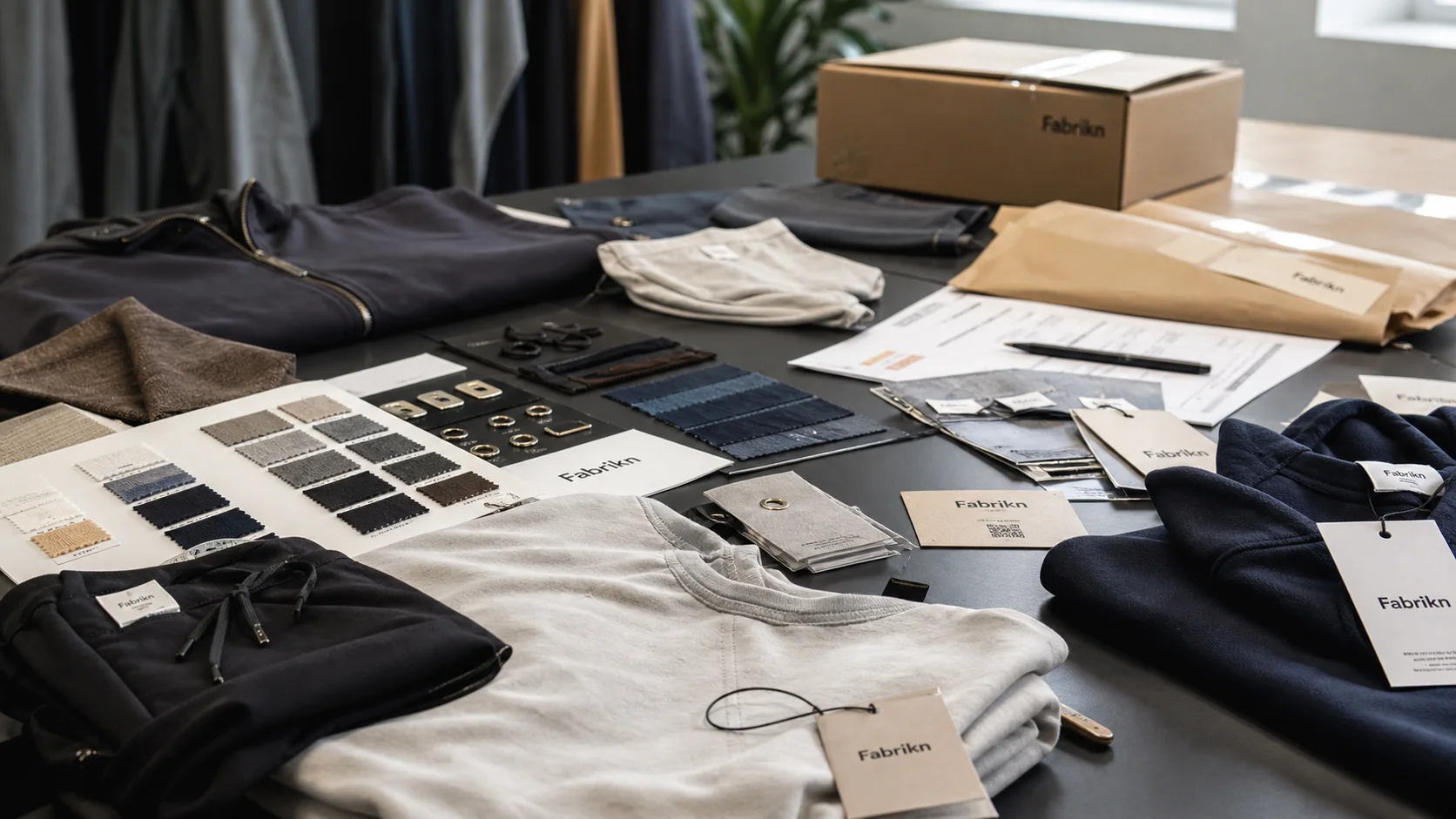
Does OEM Mean in Clothing Manufacturing compared by sample evidence, fabric or trim specs, MOQ, AQL terms, cost lines, delivery timing, and rework...
Fast answer: Does OEM Mean in Clothing Manufacturing: Tech Pack, Sample Gate, MOQ, and QC Terms should be judged by production evidence, not by a generic sourcing promise. The buyer needs sample proof, cost breakdowns, QC checkpoints, and delivery buffers in writing.
Ask for recent sample photos, measurement tolerances, fabric or print test assumptions, decoration test notes, packing examples, and a named inspection checkpoint. These details show whether the team can repeat an approved sample at bulk volume.
Separate garment cost, decoration, labels, packaging, sampling, testing, freight, and rush charges. Clear cost lines make it easier to reduce colorways, adjust size depth, or reserve more time for sampling.
If you are trying to pin down what does oem mean in clothing manufacturing, think of it this way: a brand hires a manufacturer to make garments to its exact specifications, and the factory builds what the brand has already defined. I’ve stood on sewing floors where one OEM order was 500 pieces and walked export plants turning out 50,000-plus units a month. That spread tells you the first truth about OEM: it is not a generic label, but a production model built around a brand’s specs, not the factory’s stock catalog.
In practice, OEM means the brand owns the concept and usually the tech pack, while the supplier executes production. The brand defines fabric weight, stitch type, label placement, and wash standard. If those details are vague, the order slows down fast.
White-label gets mixed up with OEM all the time, but they are not the same thing. White-label usually starts with ready-made goods, often with the same body shape sold to multiple buyers. OEM asks for more control, more responsibility, and more decisions.
Why does the label matter for brand owners? Because it determines who carries the burden when something goes wrong. In an OEM order, I’ve seen brands approve a 320 GSM French terry sample, then later reject bulk because the shrinkage was 6% instead of the agreed 3%. That gap is expensive. It means re-cutting, re-washing, or sometimes redoing the entire run.
Lead times, minimum order quantities, and defect rates vary sharply by region and factory tier. A mid-tier factory in Vietnam may quote 30-45 days for bulk on a simple T-shirt, while a small workshop in Portugal might need 6-8 weeks but offer tighter finishing. Do you want to own the design, or only the finished product? That answer changes sampling, quality control, and the amount of back-and-forth before production starts.
OEM is brand-led manufacturing. The buyer brings the design direction, and the factory makes it happen. ODM is factory-led development. The factory already has styles, blocks, or full garments in motion, and the buyer selects from that library. Private label sits even closer to the shelf-ready end: the goods are made by someone else, then branded and sold under your name.
The ownership split matters. In OEM, the brand usually owns the design intent, specifies the materials, and signs off on fit. The factory may source fabric from approved mills, but the buyer often controls the bill of materials, the grading rules, and the artwork files. In ODM, the factory may own the base design and even the sampling history. In private label, much of that legwork is already done, which is why private label clothing services can move faster for launch-heavy brands.
Here’s how the three models differ in the real order room. OEM asks for a tech pack, measurement chart, and sample approvals. ODM asks for a model selection and light customization, such as logo placement or a color change. Private label often skips much of the development cycle and focuses on branding, packaging, and size label changes. Fewer decisions mean less control over the final garment.
Premium brands tend to prefer OEM because fit, handfeel, and fabric behavior drive loyalty. A knit polo in 220 GSM mercerized cotton lives or dies on collar recovery and placket stability. Lower-price sellers often prefer ODM because speed matters more than originality. I’ve seen launches move from concept to bulk in 3-4 weeks under ODM, while a clean OEM development cycle took 8-10 weeks before a single carton shipped.
The trade-off is not subtle. More control in OEM usually means more sampling, more approvals, and more time before bulk production starts. That extra time buys precision. It also creates more chances to catch mistakes before 5,000 pieces are cut. For brands serious about fit, sizing, and material story, OEM is often the better tool.
I map OEM production in ten steps because the order usually breaks at one of them. Concept comes first. Then the tech pack. Then fabric and trim sourcing, proto sample, fit sample, size set, pre-production sample, bulk cut-and-sew, finishing, inspection, and packing. Miss one stage, and the whole schedule starts slipping by days, sometimes weeks.
The documents matter more than many buyers expect. A proper tech pack should include flat sketches, construction notes, artwork files, measurement charts, and tolerance ranges. The bill of materials should list each fabric and trim by composition, color code, supplier, and unit cost. For children's products, compliance requirements tighten fast. I’ve reviewed orders where a missing drawcord note delayed release by 12 days.
Sampling is where discipline shows. A proto sample checks concept and construction. A fit sample checks how the garment wears on body. A size set checks grading across multiple sizes. A pre-production sample confirms the exact bulk recipe before sewing starts. Sampling can take 2 to 8 weeks, depending on fabric availability and how fast the brand replies.
Bulk production is its own clock. For simple knits, 30 to 45 days is common once fabric is ready. For outerwear, bonded styles, or washed denim, 60 to 90 days is not unusual. Factories often wait longer than buyers realize because the fabric mill is late, the strike-off is rejected, or the zipper shade is off by one tone.
Small brands often lose more time on approval cycles than on sewing, even when the line itself runs efficiently. A 15-minute sewing task can sit for 3 days if the buyer has not signed off a neckline width or accepted a revised label placement. I once saw a hoodie order delayed by 9 days because the brand kept changing pouch pocket depth. The sewing team was ready. The approvals were not. That is exactly why cut and sew manufacturing rewards clear decision-making from day one.
OEM pricing is built from more than labor. A garment cost usually includes fabric, trims, labor, sampling amortization, packaging, freight, duties, and quality control. When a buyer sees one quote at $4.80 and another at $7.20 for the same hoodie, the difference usually sits in fabric weight, stitching density, wash process, and compliance testing.
Regional pricing can be startling. Factories in Bangladesh may quote a basic jersey T-shirt at $2.50-4.00 per piece, while Vietnam may sit closer to $3.20-5.50 for a similar build. China often prices higher in some coastal hubs because wages and overhead are higher, but the speed and supply chain depth can offset delays. Portugal and Turkey often land much higher on labor, sometimes $8-15 per tee depending on finish and order size.
Order volume changes everything. A 300-piece run will almost always carry a higher per-unit cost than a 3,000-piece run because setup costs are spread over fewer units. Screen setup, pattern grading, marker making, and machine calibration all cost the same whether you make 300 or 3,000. MOQ 500 is often where pricing starts to soften, though category and factory size can push that higher.
Complexity adds hidden cost fast. Embroidery with 12,000 stitches, enzyme wash, stone wash, custom snaps, bonded seams, or printed neck labels each adds minutes and rejects. Children’s apparel and performancewear can require stricter testing for colorfastness, seam strength, and chemical content, which pushes up both factory fees and lab charges. A baby hoodie is rarely “just a smaller hoodie.”
I’ve seen the cheapest quote become the most expensive one. A brand chose a low bid for a 2,000-piece sweatshirt run, then paid again for rework, air freight, and 7% defect replacement. The original quote saved $1.10 per piece. The failure added nearly $3.40 per piece once returns and rush freight were counted. Cheap production is expensive when the defect rate climbs.
Quality control in OEM is shared, but not evenly. The brand defines the spec. The manufacturer must build to it consistently. If the buyer sends a sloppy measurement chart or ignores tolerance ranges, the factory cannot read minds. If the factory substitutes yarn count or moves stitching without approval, it breaks trust and usually the order.
Inspection happens in layers. Inline checks catch problems while sewing is still active. Final random inspection checks the finished batch before packing. Lab testing covers colorfastness, shrinkage, seam strength, pilling, and safety compliance. For many programs, brands ask for AQL inspection levels before shipment, especially if the order is 1,000 pieces or more.
Compliance changes by market. EU buyers may need REACH-related chemical documentation, fiber content labeling, and product traceability. US orders often require specific labeling, flammability standards for certain categories, and strong records for children’s products. UK buyers can face similar demands, but the paperwork routing and importer responsibility can differ. According to Global Organic Textile Standard guidance, documentation is only meaningful when the chain of custody is traceable from fiber to final garment.
For broader sustainability and responsible sourcing context, it is also worth reviewing Textile Exchange materials on preferred fibers, OEKO-TEX product safety standards, and trade.gov export resources.
Risk also shifts by price point. Budget orders with high volume often face more variation because factories run faster and margins are thin. Premium orders may carry tighter tolerances, but the material risk is heavier: a luxe wool blend, coated nylon, or brushed fleece can fail in ways a cheap jersey never would. A $9.50 jacket can create a bigger headache than a $3.20 tee if the fabric delaminates after wash.
Before bulk, I ask for test reports, approved sample records, and the factory’s AQL target. I also want a clear sign-off trail for every revision. One misplaced approval can trigger 500 returns later, and chargebacks are rarely kind to a young brand.
The right factory is not the one that says yes fastest. It is the one that understands your category, your volume, and your tolerance for mistakes. I look at MOQ, sample speed, communication quality, compliance record, and whether the plant can actually handle the volume the brand plans to repeat. A factory quoting 200 pieces may be perfect for a test run and wrong for a 20,000-piece season.
Specialization matters. Knitwear, denim, outerwear, sportswear, and underwear each demand different machinery and different people. A plant that produces 100,000 basic tees a month may still struggle with tailored jackets, taped seams, or bonded activewear. When a factory can handle custom hat manufacturing alongside apparel, that tells me it likely understands embroidery tension, brim shaping, and the discipline needed for small detail work. It does not guarantee fit expertise in garments. That still needs proof.
Credibility shows up in paper and in samples. I ask for audit reports, third-party certifications, client references, and repeat-order consistency. Then I compare the first sample with the third sample from the same style. If the measurements drift by 1 cm to 1.5 cm without explanation, I worry. If the seam finish improves on the second run, I relax a little. Stable production beats enthusiastic promises.
Last year I worked with a brand that received two quotes for a sports hoodie. One factory was excellent at 100,000 basic tees and struggled with zipper guards and bonded panels. The other quoted 18% more, but had better performancewear references and cleaner QA records. The second factory won. The defect rate was under 2% versus nearly 7% on the first sample run.
Watch the red flags. Vague quotations are trouble. So are factories that refuse to explain process steps, hide subcontracting, or promise a 10-day turnaround on a complex order. If a supplier cannot tell you where fabric is sourced, what inspection stage they use, or how they handle substitutions, I keep looking. A clear factory can describe its work in numbers: MOQ 500, sample lead time 7-14 days, bulk 35-60 days, inspection at 100% and final random check.
The fastest way to move from idea to production is to show up prepared. Build a tech pack before you contact factories. Define target cost, expected MOQ, size range, and compliance standards. If your target is a baby line, your testing and labeling needs are different from a men’s fleece program, and the factory should know that immediately. For babies, I would never skip custom baby clothing manufacturing experience, because safety, softness, and closure design matter from the first sample.
Your first email should include sketches, fabric ideas, target market, quantities, deadline, and whether you need development support or only production. If you know the handfeel you want, say so. If you want 280 GSM cotton French terry with enzyme wash, say that too. If you do not know the exact fabric, give a benchmark garment instead of a vague mood board.
Choose the production model that fits the business stage. OEM works best when the brand has design direction and wants control over fit, fabric, and branding. ODM works when speed matters more than originality. Private label is faster still, and for some launches, that speed is the entire point. If your priority is entering market in 4-6 weeks, OEM may be too slow unless the factory already has a close block.
I advise a pilot order first. Test one style or one colorway before you scale. A 300-piece pilot can reveal fit issues, wash shrinkage, print cracking, or label mistakes without tying up cash in a 3,000-piece run. If the sell-through is strong and the defect rate stays below 3%, then expand. If not, fix the pattern or fabric before the next round.
Request 3 comparable quotes and compare more than price. Look at sampling time, minimums, test support, and the quality of the factory’s replies. I read response quality as carefully as I read the quotation. Fast, specific answers usually signal a disciplined team. Slow, vague answers usually cost money later.
OEM means a manufacturer produces garments to your specifications, usually from your tech pack, patterns, fabrics, and trims. It gives you more control than private label, but it also requires more product development work and clearer approvals.
Costs vary by fabric, country, and order size. A basic tee might land around $2.50-5.50 per piece, while a hoodie can range from $6 to $15 or more depending on fabric weight, wash, and trims. Small orders usually cost more per unit because setup fees are spread across fewer pieces.
Sampling often takes 2 to 8 weeks, and bulk production can run 30 to 90 days. Simple knitwear is faster, while outerwear, denim, and heavily washed styles usually take longer. Fabric readiness is often the main delay, not sewing speed.
OEM means the buyer owns the design direction and the factory manufactures to spec. ODM means the factory offers pre-developed styles that the buyer can customize. OEM gives more control over fit and materials, while ODM usually gets to market faster.
Yes, but not every factory will accept it. Many OEM plants prefer 500 to 1,000 pieces per style because smaller runs raise setup costs. A 300-piece pilot can work if the style is simple and the supplier is used to small-batch production.