
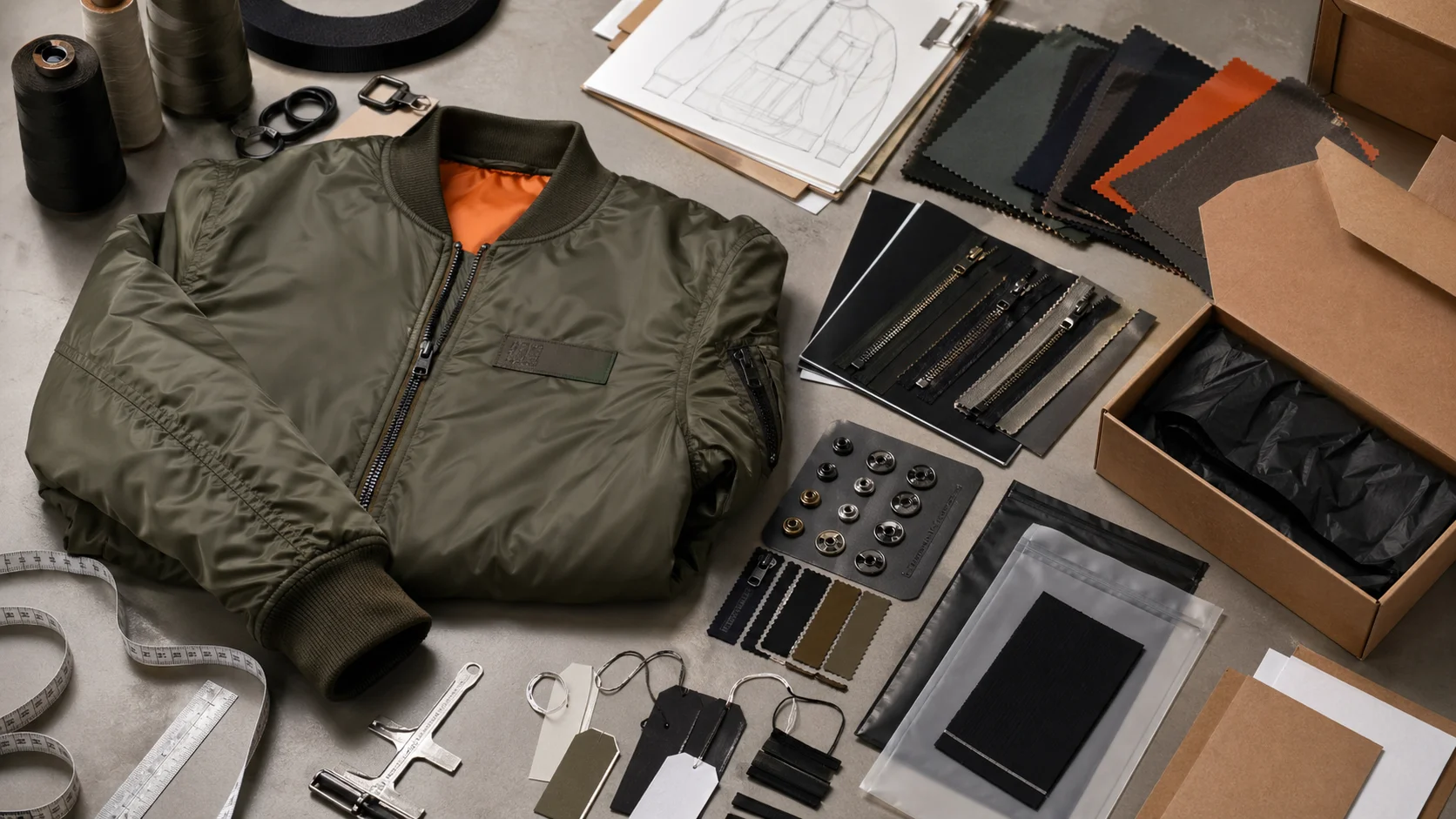
Information Goes on Care Labels compared by sample evidence, fabric or trim specs, MOQ, AQL terms, cost lines, delivery timing, and rework responsibility.
Fast answer: Information Goes on Care Labels: Material, Print, MOQ, and QC Terms should be judged by production evidence, not by a generic sourcing promise. The buyer needs sample proof, cost breakdowns, QC checkpoints, and delivery buffers in writing.
Ask for recent sample photos, measurement tolerances, fabric or print test assumptions, decoration test notes, packing examples, and a named inspection checkpoint. These details show whether the team can repeat an approved sample at bulk volume.
Separate garment cost, decoration, labels, packaging, sampling, testing, freight, and rush charges. Clear cost lines make it easier to reduce colorways, adjust size depth, or reserve more time for sampling.
A scratchy neck seam can sink a sweater faster than a bad hemline ever will. And a wrong wash symbol or a missing fiber breakdown suddenly sends that $28 knit back to the rack—or the return pile. I’ve seen it happen, and the fallout rarely stays small. In Guangzhou, Dhaka, Ho Chi Minh City, and Istanbul, even the night shift line leaders know that a misprinted icon can halt a full carton just as fast as a loose seam. what information goes on care labels isn’t decorative. It’s compliance, quality control, and a quiet guardrail on margin. I’ve been inside factories where a single misprinted symbol sets off a midnight scramble (yes, even the interns end up memorizing the symbol set), which is why it feels like playing manufacturing whac-a-mole—except the mole keeps wearing new fibers and refuses to stay down.
Retail teams usually spot label problems after the money is already gone. And the bill arrives in pieces: refunds, relabeling labor, warehouse reroutes, customs holds. In one Guangzhou dye house with an automated Stenter line, a label error that cost about $0.03 per piece to print still created a $1.80 relabeling cost per unit once the goods were unpacked, checked, and reworked using reactive dyeing and enzyme wash stations. On a 12,000-piece order, that gap is brutal. And catching the issue at bulk sampling keeps the rework cost on the spreadsheet instead of stapled to a customs hold. No one enjoys that Friday status meeting.
Missing or wrong labels also drive shrinkage. And stores cannot resell returned goods as new if the label is damaged, incorrect, or removed for cleaning. Mid-market denim feels that pain hard, with returns running 18% to 24% in some e-commerce channels, especially on 13.5-ounce selvedge that ships from Ho Chi Minh City or Dhaka. Premium knitwear feels it differently: one compliance miss can stall 2,000 to 5,000 pieces at once, particularly when the garment is GOTS-certified ring-spun cotton with OEKO-TEX Standard 100 trim and a woven label meant to show the GRS recycled content seal. Customers also remember the sweater that shrank after one cold cycle. I’ve found that brands margin-checking returns against label accuracy get a clearer sense of how much the paperwork is bleeding into their sell-through (and yes, the finance team notices those 2% hits).
I’ve watched brands spend weeks perfecting sleeve shape and neckline rib, then approve care labels in five minutes during sampling. Bad habit. During factory visits across eight countries, label accuracy was one of the most rushed items in tech pack review, even though it touches legal exposure in the US, UK, EU, and much of Asia. According to U.S. trade compliance guidance, textile and apparel compliance is routinely tied to market access and documentation quality, not just product quality. It’s maddening when the label file gets the five-minute nod while the hemline gets a week of debate, yet we still have to explain the same gap every season.
Factories feel the cost fast. A missing country-of-origin line can mean stop-ship status. And a symbol printed too small can fail readability checks. A wrong language version can force a second print run with a 7- to 14-day delay and often 18-22 business days before the new woven label arrives from a WRAP- and BSCI-compliant supplier. I’ve watched a $0.03 mistake snowball into freight holds, overtime, and a full carton rework. Double payment, basically. Sometimes it feels like explaining the same story to three supply chain managers in a row (so much for the 'single source of truth').
The core answer to what information goes on care labels is straightforward, though the details vary by market. Most buyers need a handful of essentials: a fiber breakdown that matches the lab report, clear care instructions, the country of origin, the declared size, and the manufacturer or brand identification. In many production lanes, that list also includes a symbol set, a language version for the target market, and sometimes a reseller or RN-style identifier for traceability—particularly when the mill is certified to standards such as GOTS, OEKO-TEX Standard 100, WRAP, BSCI, or GRS. I’ve noticed that factories treating label approvals like a quality gate have smoother launches because nobody has to renegotiate compliance with the customs team three days before shipment.
Fiber content is the first line buyers scrutinize. And a label that says 100% cotton has to match the test report, the trim mapping, and the actual bulk order. If a garment includes 92% cotton and 8% elastane, the ratio matters. I’ve seen factories caught by a 3% swing after a buyer changed rib content from 95/5 to 92/8 without updating the label file, and the laser-cut samples already in the Stoll flatbed knitting line had to be reissued. Not a typo. A claim error. It just works better to align the label data with the lab test report before the strike-off so the buyer can’t blame “communication” later (and that excuse ages poorly).
Country of origin is another frequent tripwire. For a shirt assembled in Honduras from fabric made in Taiwan, the legal wording must match the market’s origin rules, not the marketing team’s preference. Brand identity belongs on the label too, because customs officers and retailers use it to trace accountability. Size may seem obvious, but it belongs there because returns teams need it, and because size can vary by market. A UK medium is not always a US medium. I’ve found that aligning the wording early avoids the “but the marketing team wants...” argument later.
Care instructions need both text and symbols in many markets. A symbol might be technically correct yet still fail if the line weight is too faint or the print sits too close to the seam. I’ve rejected strike-offs for that exact reason. The data was right. The label was still unusable because nobody could read it after the first wash, even though the printhead on the Brother digital heat-transfer machine was calibrated to 0.8 mm.
Here’s what most people miss: luxury brands often use simpler care labels than mid-market brands because they standardize globally. One premium label might carry just 3 care icons and 2 lines of text, while a mid-market brand stacks fiber percentages, multiple language lines, and distributor details across 4 zones. Simple isn’t lazy (and the product team usually loves that the label doesn't fight the boutique hanger). Simple is often the result of a tighter global spec.
Legal requirements vary. The US may tolerate a different ordering of information than the UK or EU, while Asia-based production lanes often require local language or local-market symbol sets for domestic sales. That means a label can be technically correct in content and still be rejected for placement, readability, or font size. The label may be mandatory, but it is only accepted if the buyer can read it at arm’s length without squinting. Feels a bit like revising a visa application for clothing.
Product type changes the label. And a cotton tee needs a simpler spec than a coated shell jacket, while a beaded dress needs more caution than either. A 180 GSM jersey top may require only basic wash and dry guidance, while a bonded outerwear style can add dry clean restrictions, temperature limits, and trim warnings. Denim often needs extra language about color transfer, especially on raw or enzyme-washed finishes. Lingerie can require softer handling language because heat and agitation destroy elastane recovery fast. In my experience, smaller brands that split label approvals between product and compliance rarely get blind spots caught before the freight window closes.
A strong brief makes the supplier's job narrower and the quote more reliable. For what information goes on care labels, include the target customer, sales channel, expected order quantity, size range, decoration needs, packaging requirements, and delivery market. Then call out the details most likely to affect the result, especially material grade, print tolerance, and barcode size.
The brief should also explain what cannot change. Some brands care most about hand feel, some about price, some about launch timing, and some about retail compliance. When those priorities are not written down, suppliers tend to optimize for whatever is easiest to quote. Clear priorities help the factory make better tradeoffs before the first sample is cut or printed.
Ask the supplier to respond with assumptions, not just a price. A useful reply states MOQ, sample route, production capacity, inspection plan, packing method, and freight handoff. If the answer is vague, the project may still work, but it needs a tighter pre-production stage before money and calendar pressure build up.
The best time to catch problems is before the pre-production sample is approved. Check measurements, color, placement, material behavior, shrinkage, construction, labels, and packaging in the same review instead of approving each item in isolation. Many bulk issues are not caused by one dramatic mistake; they come from several small unchecked assumptions.
For what information goes on care labels, pay special attention to folding method, pack-out sequence, and retail compliance. These details often look minor in an email but become expensive once cutting, printing, sewing, packing, or shipping begins. A simple checklist with owner, due date, and approval status keeps the brand team and factory aligned.
Bulk production should not start until the supplier can explain how the approved sample becomes a repeatable production standard. That means reference sample storage, line instructions, inline checks, final inspection, and defect handling. A factory that can describe this process clearly is usually safer than one that only promises speed.
Price differences are useful only when the quotes cover the same work. Compare sample cost, material source, trims, decoration, packaging, testing, inspection, and freight assumptions. A low unit price can become expensive if it excludes items the brand needs before launch.
Timeline promises deserve the same scrutiny. Ask what happens if the first sample needs revision, whether materials are in stock, when the production slot is reserved, and how export packing is handled. The most reliable supplier is often the one that gives a realistic calendar instead of the fastest optimistic answer.
Before making the final decision, write down the specification, approval owner, delivery expectation, and the one or two risks that would cause the most trouble if missed. For what information goes on care labels, this usually means checking material grade, print tolerance, barcode size, and the support process after the order is placed.
This last review does not need to be complicated. It simply makes the decision easier to repeat, easier to explain, and easier to verify when the finished product or jewelry arrives.
One useful way to pressure-test the decision is to ask what would happen if the order had to be repeated in six months. The answer should still be clear: the same material grade, the same print tolerance, the same acceptance standard, and the same communication path. If a second order would depend on memory or guesswork, the first order is not documented well enough yet.
Another useful check is to separate preference from requirement. Preference is the look, wording, or finish the brand likes. Requirement is the measurement, tolerance, certificate, material, or delivery condition that cannot fail. Good buying decisions keep both visible, so the final choice is not pushed around by the last email, the cheapest quote, or the prettiest sample photo.
Finally, ask who owns each approval. A project with one accountable owner for sample review, one owner for final content or artwork, and one owner for delivery sign-off usually moves faster than a project where every decision is shared loosely across a team. Clear ownership reduces delays and makes the finished result easier to judge.