
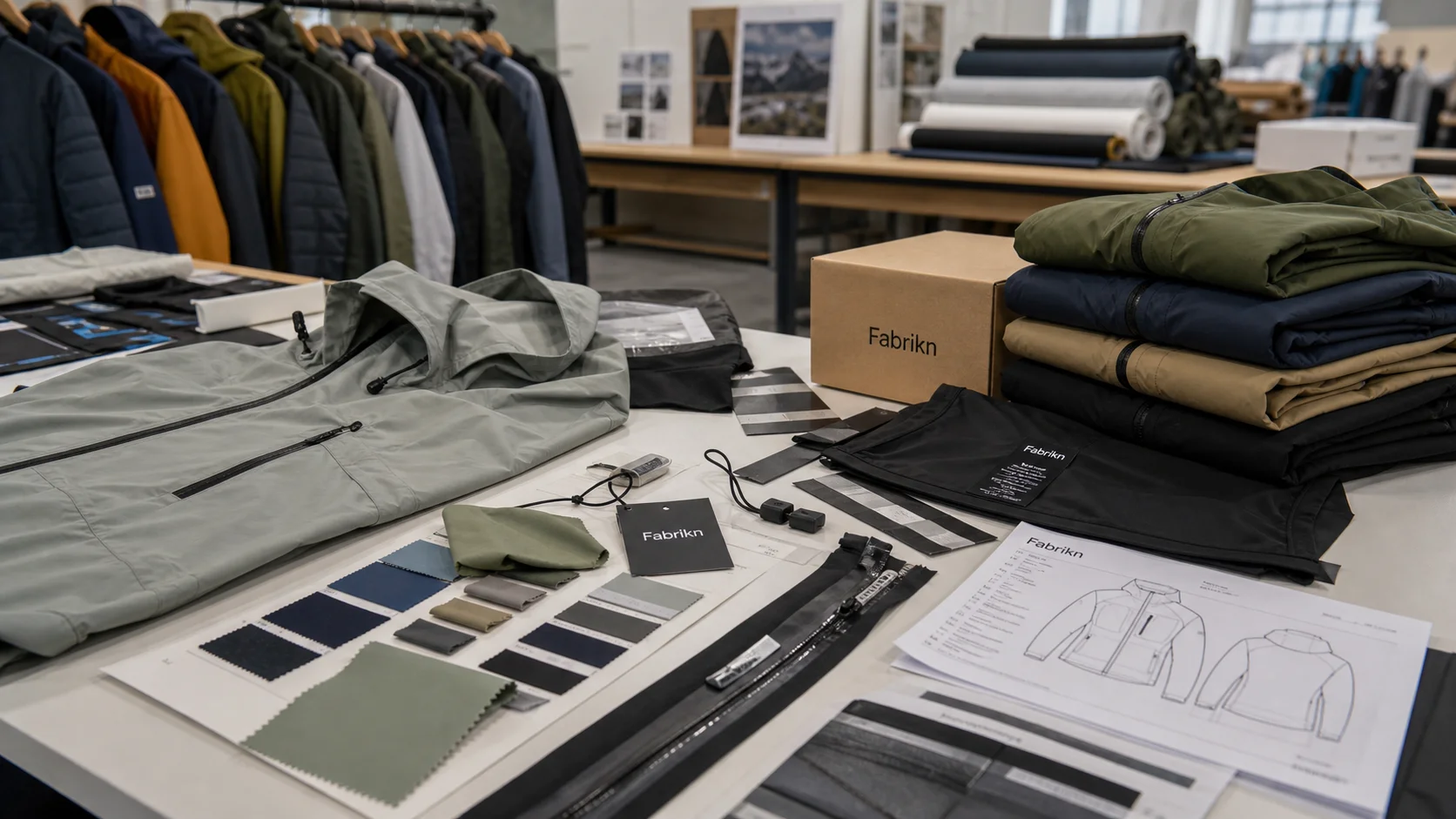
Information Goes on Clothing Hang Tags compared by sample evidence, fabric or trim specs, MOQ, AQL terms, cost lines, delivery timing, and rework...
Fast answer: Information Goes on Clothing Hang Tags: Material, Print, MOQ, and QC Terms should be judged by production evidence, not by a generic sourcing promise. The buyer needs sample proof, cost breakdowns, QC checkpoints, and delivery buffers in writing.
Ask for recent sample photos, measurement tolerances, fabric or print test assumptions, decoration test notes, packing examples, and a named inspection checkpoint. These details show whether the team can repeat an approved sample at bulk volume.
Separate garment cost, decoration, labels, packaging, sampling, testing, freight, and rush charges. Clear cost lines make it easier to reduce colorways, adjust size depth, or reserve more time for sampling.
I’ve watched a pallet of 20,000 tees sit still because one printed card had to decide whether the shipment moved or stalled for another 48 hours. That is the real answer to what information goes on clothing hang tags: more than a shopping aid, and usually under more pressure than the card can politely hold.
First touchpoint, first scan, first argument. A hang tag can do all three. The warehouse reads the code, compliance checks the claim, and the shopper gives it three seconds before deciding whether the garment feels worth touching. A $9.99 basic tee in a chain store may carry only size, barcode, and price. A $240 cashmere sweater can add origin, fiber story, and a sustainability statement. The irony is tidy: expensive labels sometimes print the bare minimum, while mid-market brands cram in five messages, two logos, a QR code, and one line nobody reads.
Business model drives most of it. Mass-market programs often run at MOQ 5,000 to 10,000 tags per style and need the fastest possible scan at the till. Premium programs may order 500 to 2,000 tags, then spend on thicker stock, foil, embossing, and custom string because the tag has to justify a higher ticket price. The content changes too. A mass-market tag prioritizes barcode, size, and retail price. A premium tag adds fabric origin, craft cues, and sometimes certification references.
Here’s what most people miss: the most expensive garment I inspected last year, a silk-blend blouse retailing at $380, used a plain one-sided black-and-white tag because the buyer had decided the garment itself should carry the story. Meanwhile, a $48 mid-market dress had three layers of tag copy, a QR code, and a sustainability claim so long that the store scanner had to be moved twice to catch the barcode cleanly. The tag looked thoughtful. It behaved badly.
That is why the question of what information goes on clothing hang tags is not a design exercise. It affects retail readiness, return rates, and legal exposure. A misplaced size code can delay receiving by 3-4 days. A wrong barcode can block an entire size run. A vague claim can trigger a retailer rejection before the floor sample even reaches the rack.
At a Guangzhou print partner I measured the numbers: a 500-MOQ run of double-sided 250 gsm matte cotton board, printed on a Heidelberg Speedmaster XL 106 with custom Pantone mixing, applied with a water-based acrylic adhesive in the Ho Chi Minh City finishing house, and cut on a Zünd S3 digital cutter with laser-etched dies, comes in at $2.50-4.00 per unit at 500 MOQ and 18-22 business days from artwork approval to container release when foil stamping, embossing, and stringing are scheduled back-to-back. The same order can add a GOTS-certified organic cotton cord spun in Dhaka or a metallic braid finished in an Istanbul foil lab, but each embellishment brings social-compliance checks (WRAP and BSCI) and another touchpoint to the production plan.
The core fields are predictable, but the execution changes by market. Most garments need brand name, style or SKU, size, color, price, barcode or QR code, fiber content, country of origin, and care references. That list sounds simple. It rarely is. One factory I visited in Vietnam rejected 7 of 40 print files in a single week because the style code on the tag did not match the code in the packing list, and another shipment lost 2 days because the size matrix read M/L on the artwork and M-L in the warehouse system.
Mandatory versus optional content depends on region and channel. North America usually cares deeply about consistent identification, fiber disclosure, and origin marking. In the EU and UK, multilingual care and fiber information often appear more prominently, and claim wording is scrutinized with less patience for ambiguity. Across Asia, the tag may need to carry more retailer-specific routing, local language text, or price formatting tied to the market. The garment can be identical. The tag can’t be.
Department stores often require the cleanest scan path, with human-readable SKU, size, and barcode placed in the same visual zone. Marketplaces can add logistics data, season codes, carton references, or fulfillment labels, especially when a retailer owns the inventory flow. DTC brands usually have more freedom, but they also inherit more responsibility. If the tag is part packaging, part sales tool, and part compliance device, then every line must earn its place.
According to Trade.gov trade compliance guidance, product identification and country-of-origin details should be handled consistently across export documents and retail labels. That may sound dry, yet it matters. I’ve seen 12,000 units delayed because a UPC printed in the tag artwork did not match the ERP master data by one digit. A single digit. It created receiving exceptions, manual recounts, and 3 extra labor hours per pallet.
Brands that sell across channels should treat tag content as a matrix, not a single file. A women’s knit top sold through a boutique may need a pared-back luxury tag with a 1.25 mm string and minimal copy. The same top sold through a marketplace may need an extra routing sticker and a compliant identifier block. custom hat manufacturing work taught me the same lesson years ago: small format packaging gets more scrutiny, not less, because every millimeter has to pull its weight.
By category, the bar changes. Basics can survive on 2-3 essential fields. Outerwear needs clearer origin and care references because returns are higher when shoppers misunderstand the fabric. Babywear needs stricter caution around materials, fastenings, and wording. I’ve worked with brands on custom baby clothing manufacturing where the hang tag had to stay simple enough for parents, yet precise enough to support safety and traceability records. The tag is small. The consequences are not.
For example, the Ho Chi Minh City workshop that handles Southeast Asian marketplace tags runs a Kornit Presto digital press for short runs and an Epson SureColor S80600 for high-resolution QR elements and care instructions, ensuring chemical safety with OEKO-TEX Standard 100-compatible inks while verifying legibility with an X-Rite i1Pro spectrophotometer. They pair that with GRS-certified recycled kraft stock from Guangzhou mills, route the boards through a rotary die cutter, and finish them on a Roland VersaUV in the same city to avoid additional transit. The Dhaka assembly center then threads the tags with 100% organic cotton string, hand-knotting it with stainless steel crimps sourced from Istanbul, and records the lot code on the tag for traceability.
Compliance starts with the sewn-in label, but hang tags often echo or reinforce it. That is where brands get careless. A hang tag that says 100% organic cotton while the internal label says 95% cotton, 5% elastane invites questions that no merchandiser wants to answer at customs, in a retailer audit, or on social media. I’ve seen a 4-word wording change stall approval for 9 days because the factory, the sourcing team, and the buyer all needed to confirm the claim trail.
Country of origin deserves precision. So does fiber content. If the garment contains a 60/40 blend, write it that way. If the recycled share is 30%, say 30%, not “made with recycled fibers” unless you can document the basis for the claim. Certification marks such as GRS or OEKO-TEX have their own usage rules and are not decorative stamps. Data from Textile Exchange shows how quickly recycled-content claims have become a core purchase driver, which is exactly why they are also a high-risk area when the numbers are loose.
Sustainability wording needs extra discipline. “Organic,” “recycled,” “responsibly made,” and “traceable” are all words that invite proof requests. The tag must match the label, the packaging, and the sales sheet. I’ve seen customs brokers ask for supporting documents when an export carton listed one fiber blend and the tag listed another. That’s not a theoretical risk. It becomes a delay, a reprint, or a chargeback.
Factories usually handle approvals in layers: design submits artwork, compliance checks language, merchandising confirms retail data, and production signs off on the final file. That process can move in 24 hours or drag for 2 weeks. The speed depends on whether every stakeholder owns the same source of truth. A minor change in phrasing, especially on traceability claims, can force a fresh round of approvals and new proofs.
According to OEKO-TEX certification guidance, chemical safety and product claims should be supported by clear, consistent documentation. Brands should treat that as a cue, not decoration. If the hang tag hints at a special wash, finish, or fiber property, the claim should be backed by testing and reflected consistently across all customs paperwork and shipping declarations.
When you print claim statements about GOTS, OEKO-TEX Standard 100, WRAP, BSCI, or GRS certification, the hang tag artwork must include the official mark, license number, and a consistent statement about the scope of certification (for example, GOTS 5.0 for organic cotton fiber, OEKO-TEX Standard 100 for chemical safety, and GRS for a 30% recycled poly blend). Factories in Guangzhou or Istanbul will often print a secondary tag that spells out the supporting test report number, so customs officers, auditors, or assistants in a Ho Chi Minh City distribution center can cross-reference the same data. The same goes for social-compliance programs like WRAP and BSCI: if the tag mentions responsible production or ethical labor, the manufacturer must keep the audit date, auditor name, and valid certificate number available on the supplier portal and include it in the tag file packet.
A strong brief makes the supplier's job narrower and the quote more reliable. For what information goes on clothing hang tags, include the target customer, sales channel, expected order quantity, size range, decoration needs, packaging requirements, and delivery market. Then call out the details most likely to affect the result, especially material grade, print tolerance, and barcode size.
The brief should also explain what cannot change. Some brands care most about hand feel, some about price, some about launch timing, and some about retail compliance. When those priorities are not written down, suppliers tend to optimize for whatever is easiest to quote. Clear priorities help the factory make better tradeoffs before the first sample is cut or printed.
Ask the supplier to respond with assumptions, not just a price. A useful reply states MOQ, sample route, production capacity, inspection plan, packing method, and freight handoff. If the answer is vague, the project may still work, but it needs a tighter pre-production stage before money and calendar pressure build up.
The best time to catch problems is before the pre-production sample is approved. Check measurements, color, placement, material behavior, shrinkage, construction, labels, and packaging in the same review instead of approving each item in isolation. Many bulk issues are not caused by one dramatic mistake; they come from several small unchecked assumptions.
For what information goes on clothing hang tags, pay special attention to folding method, pack-out sequence, and retail compliance. These details often look minor in an email but become expensive once cutting, printing, sewing, packing, or shipping begins. A simple checklist with owner, due date, and approval status keeps the brand team and factory aligned.
Bulk production should not start until the supplier can explain how the approved sample becomes a repeatable production standard. That means reference sample storage, line instructions, inline checks, final inspection, and defect handling. A factory that can describe this process clearly is usually safer than one that only promises speed.
Price differences are useful only when the quotes cover the same work. Compare sample cost, material source, trims, decoration, packaging, testing, inspection, and freight assumptions. A low unit price can become expensive if it excludes items the brand needs before launch.
Timeline promises deserve the same scrutiny. Ask what happens if the first sample needs revision, whether materials are in stock, when the production slot is reserved, and how export packing is handled. The most reliable supplier is often the one that gives a realistic calendar instead of the fastest optimistic answer.