
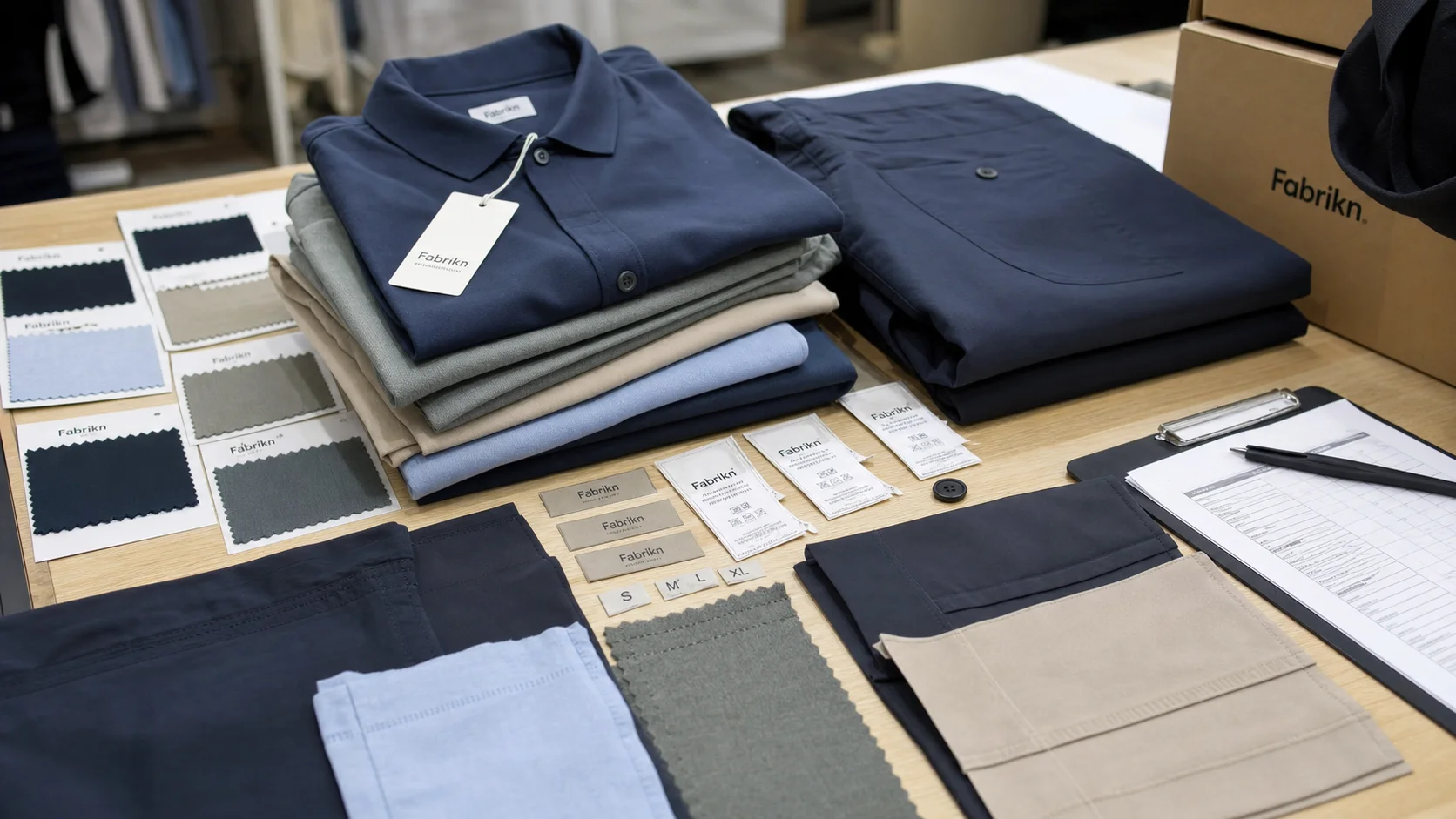
Information Is Required on Care Labels compared by sample evidence, fabric or trim specs, MOQ, AQL terms, cost lines, delivery timing, and rework...
Fast answer: Information Is Required on Care Labels: Spec Files, Packing Method, and Landed Cost should be judged by production evidence, not by a generic sourcing promise. The buyer needs sample proof, cost breakdowns, QC checkpoints, and delivery buffers in writing.
Ask for recent sample photos, measurement tolerances, fabric or print test assumptions, decoration test notes, packing examples, and a named inspection checkpoint. These details show whether the team can repeat an approved sample at bulk volume.
Separate garment cost, decoration, labels, packaging, sampling, testing, freight, and rush charges. Clear cost lines make it easier to reduce colorways, adjust size depth, or reserve more time for sampling.
Care labels may look small, but they play a major role in product compliance, customer satisfaction, and brand credibility. If you are manufacturing, sourcing, or selling apparel, understanding what information is required on care labels is essential. These labels tell consumers how to wash, dry, iron, bleach, and dry clean a garment so it lasts longer and maintains its quality.
For clothing brands and B2B buyers, care labels are also part of a broader packaging and product information strategy. They help reduce returns, prevent damage caused by incorrect laundering, and ensure your products meet legal and industry expectations. In this guide, we will explain exactly what information belongs on care labels, why it matters, and how to create labels that are both compliant and practical.
Care labels are informational tags sewn into garments that explain how to properly clean and maintain the item. They are commonly placed inside clothing near the neckline, side seam, or waistband. The goal is simple: provide clear laundering guidance that helps consumers protect the fabric, preserve color, and extend the life of the garment.
Unlike brand labels or size tags, care labels are functional. Their content is focused on maintenance rather than marketing. Depending on the market, care labels may include written instructions, standardized symbols, fiber content, country of origin, or manufacturer details.
Care labels do more than instruct customers. They support the entire product lifecycle. For brands, they are a key part of packaging and product communication. For consumers, they reduce confusion. For manufacturers, they help lower complaint rates and improve product performance.
If you are building a scalable clothing line, care labels should be part of your standard product development process. To learn more about how Fabrikn supports apparel brands, visit our services page.
The exact requirements for care labels vary by country, product type, and target market. However, most care labels contain a core set of information that answers the same basic question: how should this garment be cleaned and maintained?
In general, a care label should include the following:
For many apparel brands, the core “required” information is the care instruction set. However, packaging and labeling regulations may also require fiber content, origin, and business identification. Because of this, it is important to treat care labels as part of a larger compliance system rather than a standalone tag.
Washing instructions are the most important part of a care label. These tell the user whether the garment can be machine washed, hand washed, or should be professionally cleaned only.
Typical washing guidance includes:
When writing washing instructions, be specific enough to avoid confusion but not so detailed that the label becomes difficult to read. For example, “Machine wash cold on gentle cycle” is often clearer than a vague “machine wash only.” Manufacturers often verify these instructions on their on-site labs in Guangzhou, Ho Chi Minh City, or Dhaka using a 25-drawer Launder-O-Matic washer to confirm shrinkage and colorfastness.
Water temperature affects shrinkage, fading, and fiber damage. Labels usually specify cold, warm, or hot water. In some cases, a numerical temperature may also be included, depending on the market or garment type.
For delicate fabrics, lower temperatures are typically safer. For cotton or durable blends, warmer conditions may be acceptable. Always ensure the instruction matches the actual fabric testing results performed with calibrated thermometers in the lab or via digital sensor packs tied to the line in Istanbul or other production hubs.
Not all fabrics can tolerate bleach. Labels should clearly state whether bleaching is allowed and, if so, what type. Common language includes:
This section is especially important for colored garments and performance fabrics, which may be damaged by harsh chemicals. Brands working with suppliers in Istanbul and Dhaka typically restrict bleach on inkjet-dyed recycled polyester blends to preserve print vibrancy.
Drying is another area where customers often make mistakes. The label should indicate whether the item can be tumble dried or whether air drying is recommended.
Drying instructions help prevent shrinkage, warping, and fabric stress. Knitwear, activewear, and embellished garments often require more careful guidance here. Production facilities in Guangzhou often use dual-chamber tumble dryers with adjustable air humidity on the finishing line to test how garments hold shape at different heat levels.
Ironing instructions should clearly indicate whether the garment can be ironed and at what temperature. Since heat can damage synthetic fibers, prints, coatings, and embellishments, this information is essential.
For garments with heat-sensitive components such as screen prints, vinyl transfers, or waterproof coatings, the label should warn users accordingly. Factories often rely on Corghi heat presses or steam presses to replicate consumer ironing conditions before finalizing instructions.
Some garments should be dry cleaned only, while others can be dry cleaned but do not require it. Care labels should make the distinction clear.
This instruction is common for tailored clothing, wool suits, structured outerwear, and premium garments made from delicate materials. Audits in Istanbul, Dhaka, and Guangzhou often verify the solvent exposure limits for these items before they hit retail floors.
Fiber content identifies the textile composition of the garment. While this is not always part of the care instruction itself, it is often required on the same label or a closely related one. It helps consumers understand fabric behavior and supports transparency.
Examples include:
Accurate fiber content matters because it influences how the garment should be washed, dried, and ironed. It also helps retailers and importers comply with textile labeling rules, especially when reporting under OEKO-TEX Standard 100 or WRAP accreditation.
Many markets require the garment’s country of origin to be disclosed. This tells the customer where the product was manufactured or assembled. In some cases, this may be printed on the care label itself or on a separate label attached to the garment.
For global brands, country of origin labeling is especially important for customs, retail compliance, and consumer trust.
Regulations in the U.S., EU, and other regions often require a manufacturer or importer name, RN number, or company contact information on the care label or the adjacent hangtag. That information helps trace garments back to their source if a recall or quality concern arises.
Labels printed with a Roland VersaStudio on recycled nylon or satin tape allow precise placement of company details, while heat-activated adhesives from the label supplier ensure consistent attachment to the garment in production lines across Guangzhou, Ho Chi Minh City, Dhaka, and Istanbul.
The five main categories—washing, bleaching, drying, ironing, and dry cleaning—cover nearly all consumer laundering scenarios. Some labels go further by adding professional symbols, warnings about trims like sequins or adhesives, and recycling information for the garment.
Brands that rely on recycled or hemp-blend materials often call out additional care steps, such as “rinse twice to remove natural oils” or “reshape while damp.” Those details help avoid complaints related to shrinkage or stiffness.
The most common care label placement is the side seam, neck, or waistband, but other placements are valid depending on garment design. The priority is visibility without interfering with comfort. Inspectors from WRAP or BSCI audits typically confirm label durability after 25 wash cycles on sample garments.
Tagless heat transfers are also possible, especially in workout tops, but the transfer must display all required information legibly and withstand at least 18-22 business days between the last production run and the first retail shipment, if the supplier is handling the logistics.
Good label design balances readability with brand personality. Common considerations include:
Some brands use UV-resistant inks and laser-cut edges made on a Tri-Roll cutter to prevent fraying even after repeated laundering.
Care labels must meet the rules of the target market. In the U.S., the FTC enforces care labeling; Europe's REACH and textile labeling regulations add further requirements. Certifications such as GOTS, OEKO-TEX Standard 100, WRAP, BSCI, and GRS are often required by retailers to prove ethical sourcing and chemical safety.
Working with suppliers who maintain these certifications helps streamline compliance because auditors already monitor processes like wastewater treatment, chemical storage, and worker safety. Label suppliers in Guangzhou, Dhaka, Ho Chi Minh City, and Istanbul often keep these certifications on file for buyers to review.
Some recurring pitfalls include:
Testing labels on actual washing and ironing equipment—including industrial steamers and ultrasonic seam sealing machines—helps brands avoid costly revisions.
Care labels are typically applied during the finishing stage. A reputable manufacturer should be able to deliver complete garments with labels sewn in using automatic overlock machines such as Juki or Brother 5-needle coverstitch units, finish them with ultrasonic cutting tools, and pack them in poly bags with printed care instructions on the exterior.
Every production partner should offer transparent communication about pricing, lead times, certification status, and quality control inspections. For example, some suppliers in Guangzhou or Ho Chi Minh City quote $2.50-4.00 per unit at 500 MOQ for a complete woven label package (including synthetic twill, OEKO-TEX Standard 100 ink, and sewing) and confirm final delivery in 18-22 business days once the label proofs are approved. Pricing may be slightly higher in Istanbul when using specific trims for European markets, while Dhaka partners may add value with hand-finishing crews familiar with BSCI audit requirements.
Material-wise, consider specifying organic cotton poplin or GRS-certified recycled polyester for the label itself, then pair it with heat-activated adhesives that bond during the finishing iron pass. Yarn suppliers should provide test certificates showing compliance with GOTS or OEKO-TEX. Machines like Stahls' CAD-CUT Plotters or Roland digital printers can handle short-run label production with precise color matching.
When in doubt, request a pilot run to see how the label holds up through washing, abrasion, and folding tests. This is especially important for garments destined for temperate climates where consumers might misinterpret care instructions.
Use these adjacent sourcing guides to compare supplier capability, costing, and production planning before you brief a factory.
For production planning, review Fabrikn services or contact the team through the sourcing brief form.
Q: What happens if a care label is missing? A: In many markets, missing care labels can result in fines, rejected shipments, or costly returns. Always verify label placement before bulk shipping.
Q: Can I use printed hangtags instead of sewn labels? A: Hangtags can supplement but not replace required care symbols in most regions. If you are using tagless heat transfers, ensure the instructions remain legible for the life of the garment.
Q: Do I need different care labels for different regions? A: Yes, because symbols and language preferences vary. Work with your manufacturer to tailor labels by region, especially if you are selling in the EU, UK, or Brazil, where additional declarations may be needed.