
Premium Spot Uv Labels Boost Garment Packaging compared by sample evidence, fabric or trim specs, MOQ, AQL terms, cost lines, delivery timing, and rework...
Fast answer: Premium Spot Uv Labels Boost Garment Packaging: Material, Print, MOQ, and QC Terms should be judged by production evidence, not by a generic sourcing promise. The buyer needs sample proof, cost breakdowns, QC checkpoints, and delivery buffers in writing.
Ask for recent sample photos, measurement tolerances, fabric or print test assumptions, decoration test notes, packing examples, and a named inspection checkpoint. These details show whether the team can repeat an approved sample at bulk volume.
Separate garment cost, decoration, labels, packaging, sampling, testing, freight, and rush charges. Clear cost lines make it easier to reduce colorways, adjust size depth, or reserve more time for sampling.
How Premium Spot UV Labels Boost Garment Packaging - Packaging manufacturing guide
Premium spot UV labels for garment packaging do more than sit on a box, pouch, hang tag, or mailer. They change the first impression. In fashion, that first touch matters. I have seen buyers judge a brand in three seconds just by the packaging feel, and the difference between "nice" and "high-end" is often a very small production detail, not a massive budget. On a 500 MOQ run, that premium finish can add only $0.08-$0.18 per piece on a paper label, or roughly $2.50-$4.00 per unit on a fully finished rigid presentation box, depending on board, lamination, and whether the plant is in Guangzhou, Dhaka, or Ho Chi Minh City.
Spot UV gives you that detail. It adds a selective gloss over a matte or soft-touch base, so certain parts of the label catch the light while the rest stays calm and tactile. That contrast is what makes a logo pop, a monogram feel expensive, and a garment package look intentionally designed instead of simply printed. In production, the coating is usually applied only after the base sheet has cured and laminated, then flashed under UV lamps so the gloss lands cleanly on the registration marks instead of bleeding into the surrounding print.
For brands selling apparel, accessories, activewear, premium basics, or boutique collections, spot UV labels can quietly lift perceived value without completely redesigning the packaging system. That matters when you want stronger shelf appeal, better unboxing content, and a cleaner brand story. It also matters when you are trying to keep lead times within a 18-22 business day window after proof approval, which is the range many export factories can hit once dielines, spot layers, and material specs are locked.
Spot UV labels are printed labels or stickers finished with a clear UV varnish on selected areas only. The "spot" part means the coating is applied to specific design elements, such as a logo, border, pattern, or product name. The "UV" part refers to the curing process under ultraviolet light, which hardens the coating quickly and locks in the gloss effect. On most commercial lines, the varnish is applied at about 30-50 microns wet film thickness and then cured immediately, often on a screen coater or inline flexo unit.
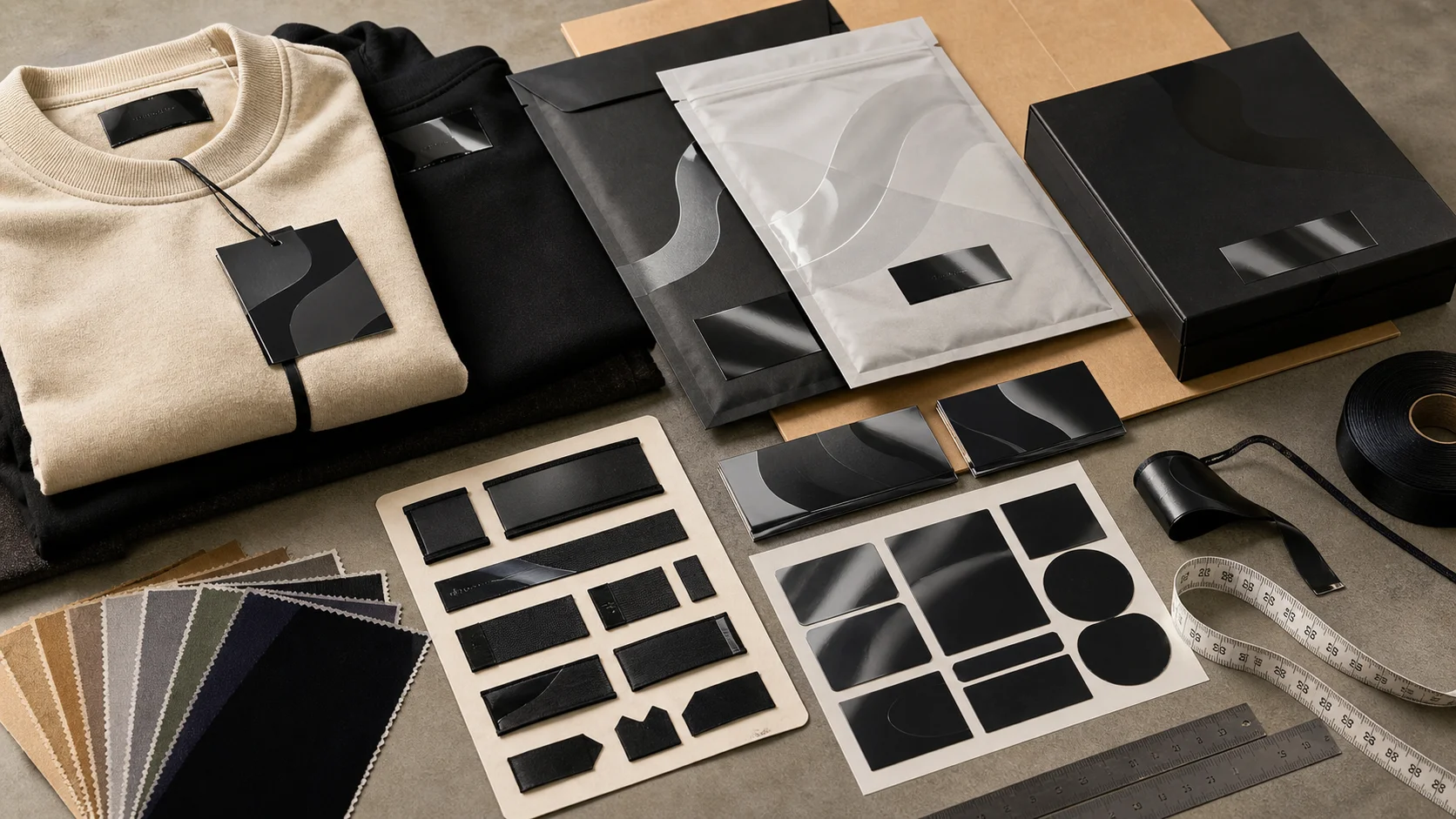
In garment packaging, these labels are often used on rigid boxes, folding cartons, tissue wraps, envelope seals, swing tags, thank-you cards, garment bags, and shipping mailers. The base surface is usually matte, uncoated, or soft-touch laminated. Common substrates include 157 gsm C2S art paper for cartons, 350 gsm to 450 gsm card for hang tags, and 60-80 micron BOPP or PET for pressure-sensitive stickers. That contrast is the whole point. A matte background keeps the piece elegant, while the glossy spot UV highlights the brand mark and adds visual movement.
Not all spot UV is created equal. On a well-run factory line, the alignment is sharp, the gloss level is even, and the edges of the UV layer stay crisp. On a sloppy line, you get blur, ghosting, or a patchy finish that looks cheap. I have seen more than one "premium" package ruined by poor plate setup and rushed curing. That is a hard lesson, and an expensive one. A 0.3 mm registration drift can be invisible on a bold block logo, but it becomes obvious on a thin serif wordmark or a 6 pt legal line.
Fashion packaging is emotional. Buyers do not just want a product. They want a feeling. Premium spot UV labels create that feeling because they play with light, texture, and contrast in a very controlled way. In showrooms, that effect is especially strong under 3000K to 4000K LED lighting, where the gloss catches the eye before the carton is even opened.
For garment packaging, that last point is critical. A lot of apparel brands want a clean, elevated look. They do not want glitter, heavy metallics, or loud graphics everywhere. Spot UV gives a subtle premium effect without breaking the visual language of the brand. On a black soft-touch carton, for example, spot UV on the logo or monogram often performs better than a full foil stamp because it keeps the piece quiet while still showing contrast at an angle.
In my experience, the strongest packaging is rarely the most decorated. It is the one where the finish supports the brand story instead of shouting over it.
There is also a practical side. Spot UV labels can be paired with other finishes like embossing, foil stamping, textured paper, or soft-touch lamination. When combined carefully, these elements create layered value. That layered value is what premium packaging is really about. A common high-end stack is 157 gsm C2S printed sheet, matte lamination, spot UV on the logo, and a 1.5 mm greyboard insert for rigidity, which is enough to move a package from basic retail to gift-ready.
Premium spot UV labels for garment packaging are flexible, which is one reason fashion buyers keep asking for them. They are not limited to one format or one type of product.
Rigid boxes for shirts, dresses, sweaters, and premium knitwear often use a matte black, white, or deep neutral base with spot UV on the logo. This works especially well for direct-to-consumer brands that want their delivery box to feel like a retail purchase, not just a shipping container. A typical premium setup is 1200 gsm to 1500 gsm greyboard wrapped with 157 gsm art paper, then finished with spot UV on a single focal mark.
Spot UV labels on hang tags can make a small item feel much more considered. A flat tag with a glossy logo or size mark looks polished and photographs well. For denim, jackets, premium tees, and boutique collections, this detail often matters more than people expect. On tags, the sweet spot is usually 350 gsm to 450 gsm cardstock with a 3 mm or 5 mm round hole, paired with a UV mask that keeps the varnish at least 0.5 mm away from the edge so it does not chip during finishing.
A seal sticker with spot UV gives the unboxing a clear moment of reveal. It is a modest cost, but the result is strong. If a customer sees a clean branded seal before opening the package, the product feels protected and curated. For tissue seals, plants often use 40-60 gsm tissue with a 25 mm to 50 mm adhesive seal, and the spot UV is usually restricted to the icon or wordmark so the sticker still tears cleanly by hand.
Soft mailers and fold-over shipping packs can also benefit from spot UV branding. It is a good option when a brand wants to keep shipping costs controlled while still elevating the outer packaging. A lot of factories in Ho Chi Minh City and Guangzhou will suggest a 60-80 micron coex mailer with a printed front panel and spot UV only on the brand name, because full-area gloss can look uneven on flexible film.
Some brands extend the same finish to insert cards, care labels, and brand story cards. That consistency makes the whole package feel designed as one system instead of a collection of separate items. For premium apparel, it is common to print inserts on 300 gsm coated paper with a matte film and keep the UV to a small line of text, QR code frame, or monogram.
Spot UV looks best when the design is disciplined. That sounds obvious, yet a lot of packaging mistakes come from trying to show too much at once. The best factories will ask for a separate spot layer in pure black, with overprint enabled and vector edges kept clean, because raster-heavy UV masks tend to show stair-stepping on the press.
The mild criticism I always give clients is this: spot UV is not a rescue tool. It cannot fix a weak layout, bad typography, or a cluttered brand identity. If the design is already busy, the gloss only makes the noise more obvious. In practice, most experienced prepress teams will recommend at least 0.25 mm line weight for UV details and a 0.2 mm choke or spread to protect against misregistration on the curing line.
For garment packaging, the safest and strongest approach is often a restrained matte base with a single glossy brand element. That could be a logo in the center, a monogram at the corner, a subtle repeat pattern, or a small line of text. Simple wins. Nearly every time. If you are printing in a 4-color process on coated stock, it also helps to keep the UV area away from heavy ink coverage, since dense solids can cause gloss to read differently under different angles.
Color choice also matters. Black on black can be dramatic, but it can also disappear under low light. White on white can feel elegant, but the contrast may be too subtle for retail photography. A dark matte base with clear UV usually gives the strongest result because the shine is visible from multiple angles. Many factories will test this with a drawdown and a quick light-box inspection before approving the main run.
When people ask how spot UV labels are made, I usually explain it in plain language. It is a controlled finishing process, and the quality depends on the printing setup, the coating application, and the curing accuracy. In a serious packaging factory, the job might move from a Heidelberg Speedmaster or Komori Lithrone press to a screen UV coater, then to a Bobst die-cutter or similar finishing line, with each stage checked before the next one starts.
Here is the typical workflow in a garment packaging factory:
On a professional line, the operator checks alignment carefully because even a 0.5 mm shift can be visible on a logo edge. That is why good suppliers pay close attention to prepress setup. It saves time, waste, and arguments later. For press operators, the real tell is whether the UV sits cleanly on the same axis as the trim line after the sheet is fed through the coater, because the finishing defect often appears only after die-cutting.
Factories handling premium garment packaging usually run proofing first. A sample takes around 5 to 7 business days if the artwork is ready, sometimes a bit longer if the finish combination is complex. Full production often runs 18 to 22 business days depending on quantity, material availability, and finishing queue. For urgent fashion launches, I have seen teams compress that schedule, but the trade-off is usually a higher cost or reduced flexibility. In Guangzhou, a short-run UV label line may turn around faster; in Dhaka, a vertically integrated garment supplier may be stronger on fabric and trim coordination; in Ho Chi Minh City, export factories often balance speed with careful carton finishing.
The base material affects both the look and the price. For premium spot UV labels, common choices include coated paper, art paper, synthetic paper, PET film, and premium adhesive stocks. Each one behaves differently under UV coating and each one suits a different packaging use. If the brand needs an organic or sustainable claim, the supplier may also need GOTS for cotton components, FSC for paper sourcing, or OEKO-TEX Standard 100 for inks, adhesives, and textiles that touch the product directly.
Material Best For Typical MOQ Estimated Price Range Lead Time Coated paper Hang tags, inserts, stickers 1,000 - 3,000 pcs $0.03 - $0.08 per label 7 - 12 business days Art paper with matte lamination Luxury boxes, brand cards 1,000 - 5,000 pcs $0.05 - $0.12 per label 8 - 14 business days Synthetic paper (PP or PET) Durable stickers, mailers, shipping packs 1,000 - 5,000 pcs $0.08 - $0.18 per label 10 - 15 business days Soft-touch laminated cardstock Premium hang tags, inserts, thank-you cards 1,000 - 3,000 pcs $0.06 - $0.15 per label 8 - 13 business days Pressure-sensitive PET adhesive stock Clear seals, high-durability packaging labels 2,000 - 10,000 pcs $0.09 - $0.22 per label 10 - 18 business daysFor fully finished rigid presentation boxes with spot UV, matte lamination, and custom inserts, pricing usually starts around $2.50-$4.00 per unit at 500 MOQ, then drops materially at 1,000 to 3,000 units depending on board thickness and insert complexity. If the job uses a 1200 gsm or 1500 gsm board, magnetic closure, or foil plus UV together, the cost can move up fast. Most experienced buyers get the best value by locking the structure first, then adding one premium finish instead of stacking three at once.
Production timelines also depend on where the job is made. A Guangzhou factory with in-house offset, lamination, UV, and die-cutting can often keep the cycle tight. A Dhaka supplier with garment and trim integration may need a little more coordination but can be strong on repeat seasonal work. Ho Chi Minh City plants often offer a good middle ground for export packaging with consistent QC. In all three locations, a solid proof-to-shipment plan typically lands between 18 and 22 business days after final approval.
The real value of spot UV labels is not only visual. It is commercial. When the packaging feels premium, it supports the price story. A brand selling a $60 tee or a $240 jacket does not need packaging that screams, but it does need packaging that feels intentional. Spot UV helps the product sit in that higher bracket without adding much physical weight or shipping cost.
The most common mistake is overusing the finish. If every surface has gloss, nothing feels special. Another mistake is applying spot UV to weak artwork. Thin script fonts, tiny icons, and crowded pattern fills usually do not survive production well. A third mistake is ignoring the substrate. On uncoated stock, gloss contrast can disappear; on heavily textured paper, the UV can break across the grain and look uneven. Most factories will flag this during sample review if the operator has real finishing experience.
There is also a supply-chain mistake that shows up a lot in fashion packaging: brands choose a supplier without checking compliance. For organic apparel lines, a GOTS-certified partner matters if the packaging includes cotton ribbons or textile components. For general apparel export, OEKO-TEX Standard 100 gives more confidence around ink and adhesive safety, while WRAP and BSCI are often used to demonstrate responsible labor and factory auditing. If a supplier in Guangzhou, Dhaka, or Ho Chi Minh City cannot explain which part of the job is certified, they probably do not control the process as tightly as they claim.
A packaging partner is useful because premium spot UV is as much about process control as it is about printing. The right supplier can advise on board weight, adhesive type, lamination finish, and whether the design should use a screen UV build or a more restrained inline varnish. That guidance saves rounds of rework and keeps the piece within budget.
It also helps when the partner has factory depth across multiple locations. A Guangzhou plant may be ideal for short-run branded cartons and precision spot UV. A Dhaka factory can be strong when the packaging has to align with garment production, cut-and-sew scheduling, and export packing. A Ho Chi Minh City supplier may be especially useful for fast-moving seasonal lines and mixed packaging formats. The best partners can quote all three sides of the equation: structure, finish, and timeline.
What I look for first is simple. Can they show a clean sample with matched registration, a visible spot UV edge, and a realistic production schedule? Can they explain whether the job is using Heidelberg, Komori, or digital short-run equipment? Do they have real certification documents, not just logos on a website? If they can answer those questions clearly, they are usually the kind of factory that can handle premium garment packaging without drama.
Get a free quote from Fabrikn — your trusted B2B clothing manufacturer with 10+ years of experience. MOQ as low as 200 pieces.
Get a Free Quote →For standard paper labels, pricing often sits around $0.03-$0.18 per piece depending on material, size, and MOQ. For rigid garment boxes with spot UV, matte lamination, and custom inserts, a realistic starting point is $2.50-$4.00 per unit at 500 MOQ.
Sample approval usually takes 5 to 7 business days if artwork and dielines are final. Full production typically lands in 18-22 business days, though simple label runs can move faster if the factory has open press time.
For fashion packaging, the most commonly requested certifications are GOTS, OEKO-TEX Standard 100, WRAP, and BSCI. The right one depends on whether you are using textile components, paper sourcing claims, or labor-compliance requirements for export.
Matte laminated art paper, coated cardstock, synthetic paper, and PET film are the most common. If the piece needs durability, PET or PP works well. If it needs a luxury tactile feel, soft-touch laminated paper is usually the better choice.
Yes. The most common premium stack is matte lamination plus spot UV, and then embossing or foil only on the logo. Keeping the design focused usually gives a better result than combining every finish at once.
Premium spot UV labels are one of those details that seem small until you see them on a finished garment package. Then the value is obvious. The finish is subtle, but the effect is immediate, and in fashion that is often exactly what you want.
Use these related guides to compare specs, costs, quality checks, and buyer decisions before making the final call.