
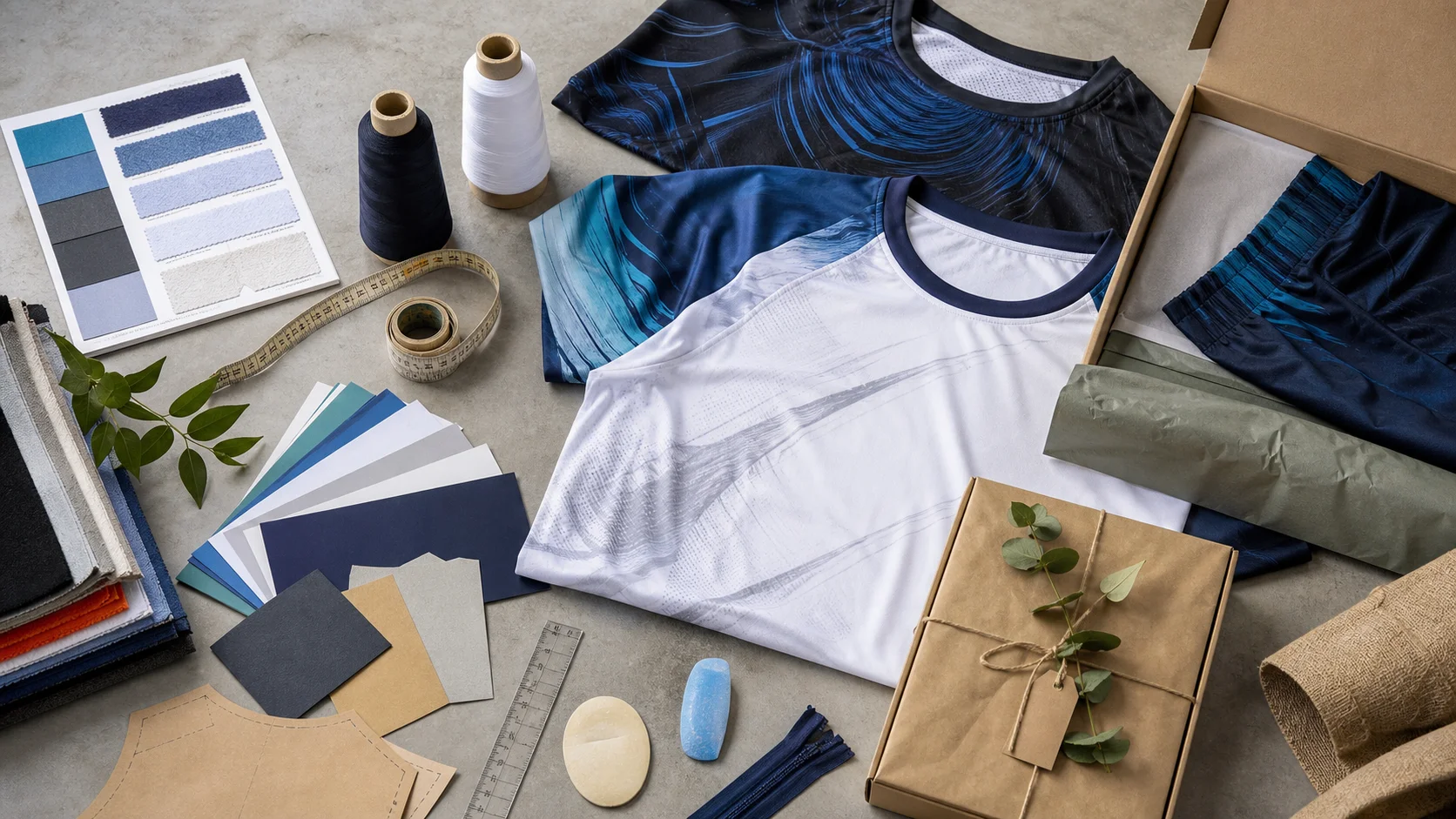
Clothing Box Print Content with checks for samples, fit, MOQ, QC evidence, pricing terms, and delivery risk.
Fast answer: Clothing Box Print Content: Logo, Size, Care, and Retail Notes should be judged by production evidence, not by a generic sourcing promise. The buyer needs sample proof, cost breakdowns, QC checkpoints, and delivery buffers in writing.
Ask for recent sample photos, measurement tolerances, fabric or print test assumptions, decoration test notes, packing examples, and a named inspection checkpoint. These details show whether the team can repeat an approved sample at bulk volume.
Separate garment cost, decoration, labels, packaging, sampling, testing, freight, and rush charges. When every cost line is visible, it becomes easier to reduce colorways, adjust size depth, or reserve more time for sampling.
I’ve watched customers judge a package in under 3 seconds, and I’ve watched brands lose trust in the same window. If you're deciding what should be printed on clothing boxes, start with this: the box is not decoration. It is evidence. The box is often the first physical brand touchpoint after checkout, and in e-commerce it arrives carrying a lot more than a T-shirt or a hoodie. During a late-night audit in Guangzhou’s Huangpu District, I saw a bespoke box move from unnoticed to unforgettable because the OEKO-TEX Standard 100 reference and steel-threaded adhesive flange aligned perfectly before the courier peeled the tape.
On factory floor audits across Ho Chi Minh City, Dhaka, and Istanbul, weak packaging is obvious before the shipment leaves the line. A 450 gsm SBS board may be printed on a Heidelberg Speedmaster XL 106, die cut on a Bobst MasterCut 106, and scored with a Komori ProScorer, yet if the Nordson ProBlue 10-10 water-based adhesive streaks or the matte aqueous coating is misregistered, the box leaves the factory with peeling seams. Compliance certifications such as WRAP and BSCI are checked during these walk-throughs, and any misprint often signals the same attention gap that cost them a BSCI re-audit in Dhaka.
I’ve seen premium printing underperform for one simple reason: the information architecture was wrong. A $1.40 box with perfect registration can fail harder than a $3.80 box if the logo is tiny, the item description is missing, or the size sticker is hidden under the flap. A 4-color flexo run with a matte soft-touch lamination on 350 gsm SBS board typically sits at $2.50-4.00 per unit at 500 MOQ, while adding sealed gold foil stamping or tactile blind embossing can nudge the price toward $5.20 if the tool path crosses a second die. Customers do not inspect ink coverage the way printers do. They ask, silently, whether the brand has its act together.
That matters across price points. Basics bought for $18 to $35 need clarity because repeat purchase depends on confidence. Luxury goods at $150 to $600 need restraint, but not emptiness. Sustainable apparel sits in a more demanding middle: buyers want proof, not poetry. Packaging influences returns too. When a customer receives the wrong size, a vague box adds friction. When gifting is involved, a box that looks under-thought can drag down the perceived value of the garment inside by 20% or more, even if the product itself is excellent. Brands that plan their supply chain in Guangzhou, Ho Chi Minh City, and Istanbul rarely forget to reserve 18-22 business days for the full production, inspection, and export window, especially when materials such as GRS-certified recycled liners and OEKO-TEX Standard 100 inks are specified.
The core answer to what should be printed on clothing boxes is less glamorous than most brand decks suggest. Print the brand name, logo, product category, size information, SKU or barcode, and a handling cue if the item needs it. For garments produced under GOTS or OEKO-TEX Standard 100 certifications in Dhaka, include the accreditation badge, fiber content, and GRS batch code so customs and consumers can confirm the provenance before the box is unsealed.
There is a real difference between consumer-facing print and warehouse-facing print. Consumer-facing print should help the shopper identify the item in 2 seconds and understand why it is priced at $32, $68, or $180. Warehouse-facing print should help pickers, packers, and returns staff move fast: barcode, color code, size code, SKU, and even the Nordson ProBlue adhesive type used to seal the flap so the warehouse knows which glue machine to match. When those two systems are collapsed into one muddy panel, errors rise. In one audit, a brand with 500-piece MOQ box runs had a 7.8% mis-sort rate because the barcode was printed in low contrast beside decorative graphics.
Wholesale boxes need more information density than direct-to-consumer boxes. Gift packaging often needs the least visible logistics data, but still needs hidden identifiers. That hidden layer matters. For custom baby clothing manufacturing, for example, I always want size, fiber content reference, and care direction to be easy for staff to verify because product swaps are costly and parents do not forgive confusion. A baby box missing a size cue can delay dispatch by 24 to 48 hours on a busy Dhaka line.
Regional rules complicate the picture. The U.S. and EU do not require identical markings, and importers often get caught by that gap. Missing origin statements can trigger hold-ups, and incorrect barcode formats can create chargebacks that cost $50 to $250 per case, depending on the retailer. According to ISO barcode and data-structure standards, automated systems punish sloppy labeling. Clear labeling is cheaper than rework, and documenting the adhesive specification—often a water-based EVA approved for WRAP audits—can stop inspectors from demanding new samples.
Price point changes the print strategy more than most founders admit. Luxury packaging can survive with minimal copy because the product, the venue, and the price do part of the talking. A black rigid box with one-color foil, an embossed logo, and a 300 gsm inset board can feel appropriate for a $220 knitwear piece, particularly when the foil is applied through a Heidelberg Speedmaster XL run and trimmed on a Bobst MasterCut to avoid edge cracking. Mid-market brands sit in the middle: they need a balanced panel with logo, product name, size, barcode, and one short brand line, often printed on a flexo press with a UV varnish to protect the ink. Value brands, by contrast, need clarity first. A $24 sweatshirt box with poor instructions can produce returns that wipe out the margin.
What gets cut first is usually the very thing that prevents confusion. Founders trim the product category, then the SKU, then the size marker, because they want the box to “look premium.” I’ve seen that mistake in Italy, Istanbul, and Bangladesh, and the result is predictable: a prettier box that slows operations. On a 10,000-unit run, upgrading from one-color flexo to full-color digital may add $0.18 to $0.55 per box, while foil stamping can add another $0.30 to $0.90 depending on area coverage and tool complexity. Matte soft-touch lamination raises perceived value, but it also raises scrap rates if the board is recycled and the coating cracks on fold lines.
For brands that span categories, the packaging logic should change by collection. A sports capsule with sublimation printing services often needs bold color references, wash-care cues, and a contrast ratio that survives 2,000-lux retail lighting, while a tailored line may need cleaner copy, structured labeling, and foil-printed size bands applied at the hand-glued stage. The wrong finish also sends the wrong signal: foil on a value box can look aspirational, but if the corrugate dents in transit, the whole effect collapses. Design for three conditions: retail shelf, courier abuse, and a customer holding the box under kitchen light at 9 p.m.
Sustainability copy belongs on-pack only when it can survive scrutiny. The safest claims are material-based and verifiable: FSC paper, 100% recycled content percentage, plastic-free packaging, and repair or reuse instructions. Use FSC-certified 300 gsm paperboard sourced from Guangzhou mills, print it with OEKO-TEX Standard 100 compatible inks on a Heidelberg Speedmaster, and seal it with water-based adhesives that have WRAP approval. A QR code can point to proof, but only if the landing page contains real data, not branding fluff. I’ve visited small-batch factories where the carton was marketed as “recycled,” yet the inner coating made the box non-recyclable in most municipal systems. That gap is common. It is also avoidable.
Avoid vague claims like eco-friendly, planet positive, or responsible packaging unless you have documentation that ties the statement to a standard or a measurable outcome. Claims enforcement is tightening in the EU, the U.K., and parts of North America, and buyers are less forgiving than lawyers would like to think. Data from Textile Exchange shows how quickly material sourcing language can be challenged when brands cannot show chain-of-custody records. Packaging claims face the same scrutiny, just with less press coverage.
Factory visits reveal the gap between the story and the substrate. I’ve handled boxes printed with “100% recycled” on a 500-piece run where the supplier had only verified 30% recycled content for the outer layer, and the inner layer was virgin SBS. That is not a branding issue. It is a liability issue—especially when the printed QR code references a GRS certificate that auditors from Dhaka or Ho Chi Minh City expect to see. If the adhesive used to close the box is not approved for recycling, the entire claim collapses.
If you are working with private-label apparel, packaging needs the same rigor as the fabric. Print the sustainability claim alongside the certificate number, the ink formula, and the adhesive spec so that importers, retail partners, and customs officials can verify it at a glance. When the board is sourced from Istanbul, for example, call out the mill lot and note that the liner passed WRAP and GRS audits before the first carton ships.
Start every layout by plotting the 2-second glance: brand, size, and SKU must appear above the fold, printed with a minimum 70% contrast in Pantone 425C ink and aligned to the die line. Place handling cues such as “Fragile Trim” or “Wash Inside Out” adjacent to the barcode so that warehouse staff can spot them on the same panel. If you are printing on a Heidelberg Speedmaster and then finishing on a Bobst folder-gluer, plan the die line to include thumb notches, adhesive-tabs (sealed with Nordson ProBlue glue), and a dedicated bleed that keeps pantone-to-Pantone registration within ±0.25 mm.
Consumer-facing copy should flow left-to-right, but your compliance layer—things like fiber content, certifications (GOTS, OEKO-TEX Standard 100, WRAP), and country-of-origin—can live in a secondary panel on the box bottom. The panel should be readable in natural light and saturated enough to pass the ISO 12647 press check in Ho Chi Minh City. Reserve a faint grid on the panel for traceability, so that the factory can stamp the production date and adhesive batch number during final inspection.
Finally, document the print plan in a control sheet. Include the press (Heidelberg Speedmaster XL 106 or Komori Lithrone), ink set (soy-based or UV), surface finish (matte soft-touch or high-sheen aqueous), and process steps (flexo pre-press, die cutting, flame scoring). That sheet becomes your compliance artifact in case an EU auditor asks why a box shipped from Guangzhou lacks the right origin statement. With that hierarchy, buyers see the message they need first, and compliance teams find the proof they need second.
Start with a short sample run of 50 to 100 units on a Heidelberg Speedmaster or Komori Lithrone press that mirrors the full production process. Print both the consumer-facing and warehouse-facing panels, then laminate and die-cut using the actual tool that the final run will use. This test confirms that the size indicator aligns with the SKU window, that the adhesive glues the flap without bleeding through, and that the foil stamping (if applicable) can survive four drops from 1 meter.
Next, conduct a “scan-and-read” test: have warehouse staff in Ho Chi Minh City and Istanbul scan the barcode, read the handling icons, and verify that the adhesive batch listed on the print matches the glue used on the folder-gluer. Any discrepancy should trigger a pre-production correction before the 500-piece MOQ is committed, otherwise you risk 7.8% mis-sort rates or worse.
Finally, run the sustainability proof: check that the QR code resolves to the Textile Exchange or GRS certificate, that the adhesive is WRAP-approved, and that the ink passes the OEKO-TEX Standard 100 rub test. Only after these tests pass should you release the 10,000-unit run for a campaign launch.
With a 500 MOQ flexo run on 450 gsm SBS board, adding explicit certification badges (GOTS, OEKO-TEX Standard 100, GRS) and a secondary compliance panel typically keeps the price in the $2.50-4.00 per unit range. Additional processes such as foil stamping, embossing, or soft-touch lamination nudge the cost toward $5.00, and you should also budget time for a 18-22 business day window from Guangzhou or Ho Chi Minh City when you add those specs.
Yes, if you are claiming GOTS, GRS, OEKO-TEX Standard 100, WRAP, or BSCI compliance. Include the certification name, license number, and a QR code that links to the current audit report. That level of detail lets customs officers confirm the claim in seconds and prevents chargebacks that range from $50 to $250 per case.
Use a two-panel system: a visible consumer panel with brand cues, product name, and styling, and a bottom or side panel with warehouse data such as barcode, handling icons, adhesive batch, and compliance statements. This approach allows you to keep the visual field clean for retail while still supplying the detail needed for fulfillment centers in Istanbul, Dhaka, or anywhere else the boxes travel.