
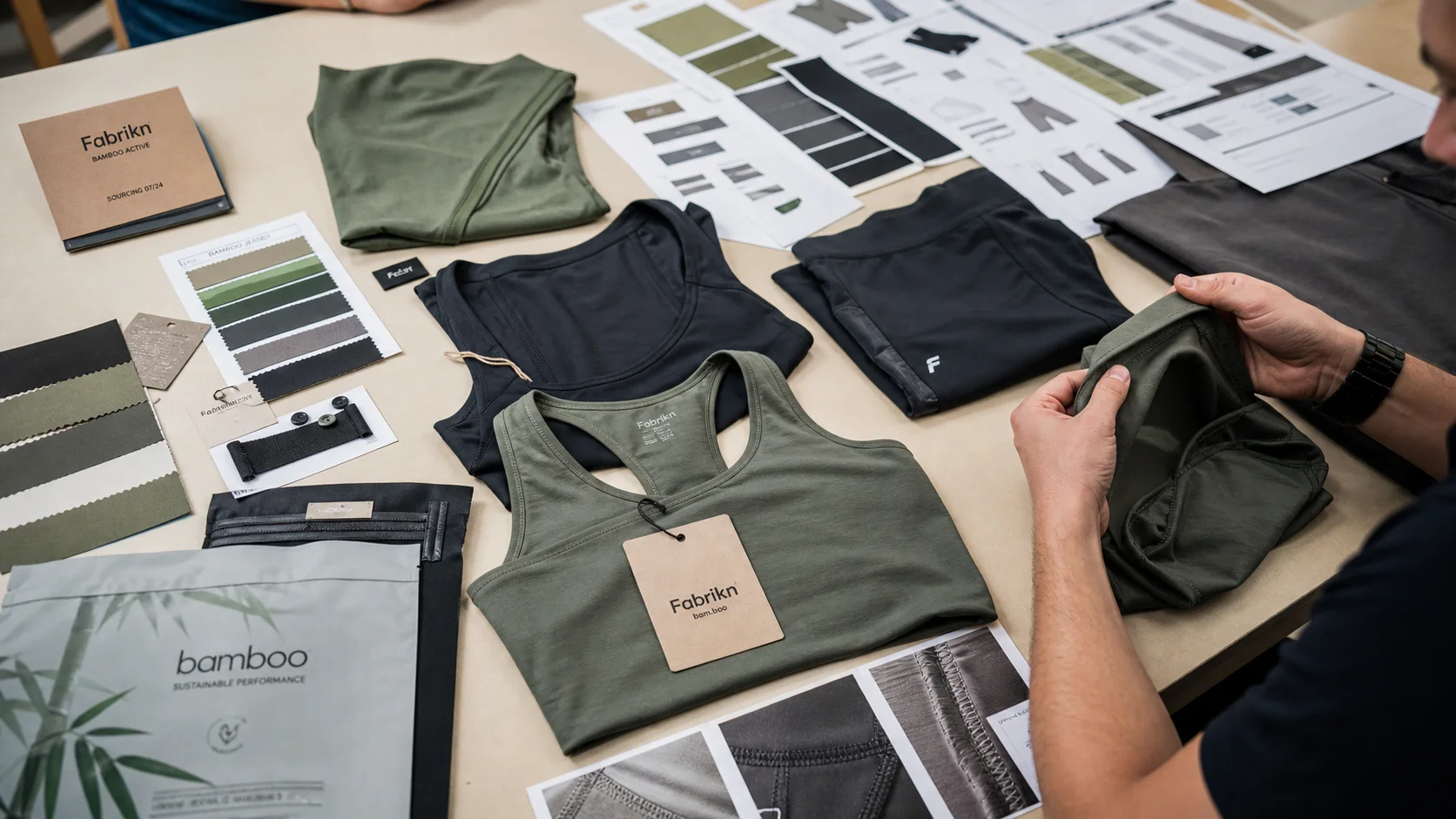
A product-specific outline for sports distributors sourcing wholesale activewear sets backed by compliance documentation, with a focus on sustainable materials, testing records, and program-ready production paperwork.
Wholesale Activewear Sets with Compliance Docs - Fabrikn production reference
Wholesale activewear sets are no longer judged only on fit, color, and price. For sports distributor programs, the paperwork behind the product now carries almost equal weight. Buyers want leggings, sports bras, training tops, joggers, and coordinated sets that are commercially viable, but they also need clear compliance documentation that can move through internal procurement, retailer onboarding, customs checks, and risk review without delays.
That shift is especially visible in sustainable fashion. A distributor may be targeting gyms, sporting goods chains, teamwear resellers, e-commerce partners, or corporate wellness channels. Each route has different product expectations, yet they all tend to ask the same core question: can the supplier support the order with reliable documents on material composition, chemical compliance, labeling, and social or environmental claims?
That is where many sourcing projects become difficult. A supplier may offer attractive prices on activewear sets, but if the compliance file is incomplete, the buyer inherits risk. Missing test reports, unclear fiber declarations, inconsistent care labels, or unsupported recycled-content claims can delay launches or trigger rejected shipments. In distributor programs where the same style is sold across multiple accounts, that risk multiplies quickly.
From a purchasing standpoint, compliance documentation is not a side task. It is part of the product itself. If a supplier can make a clean compression set but cannot organize supporting files in a timely way, the sourcing value is weaker than it first appears. Buyers comparing wholesale activewear partners should weigh document readiness almost as heavily as sewing quality and cost.
Companies building sustainable product lines often start by reviewing a supplier’s production and documentation capabilities together. Fabrikn’s services page is a useful starting point for teams that need development, manufacturing coordination, and sourcing support in one process rather than treating compliance as an afterthought.
In this market, “activewear sets” usually refers to coordinated tops and bottoms sold as matching units or as mix-and-match programs built from the same fabric family and color standard. Common combinations include:
For sports distributor programs, sets are often planned with merchandising efficiency in mind. Distributors prefer fewer fabric platforms, fewer shade variances, and strong repeatability across seasons. That usually means selecting core constructions such as recycled polyester-spandex interlock, nylon-spandex jersey, or brushed performance knits that can support multiple silhouettes without fragmenting the supply chain.
The practical advantage of sets is clear. They lift average order value, simplify visual merchandising, and allow sales teams to offer coordinated collections to retail partners. The challenge is that matching pieces also magnify quality-control issues. If the sports bra and leggings use fabric from different lots, a small dye variation becomes far more obvious. If one piece passes stretch recovery and the other does not, the whole set feels inconsistent.
Buyers should also distinguish between fashion-active sets and performance-active sets. Fashion-active programs may tolerate lighter compression, more trend-driven silhouettes, and lower abrasion requirements. Performance-focused programs usually need tighter controls on opacity, moisture management, recovery, seam security, and pilling. The documentation burden rises with performance claims.
Compliance documentation can look different by market, but most sports distributors ask for a standard package before approving bulk production or shipment. The exact list depends on destination country, customer account, claim language, and product category. Still, the following documents appear frequently in wholesale activewear sourcing:
Buyers in sustainable fashion should be cautious with broad marketing language. A hangtag that says “eco-friendly” has little sourcing value if it is not supported by traceable material evidence or recognized certification pathways. The safer approach is precise language tied to documents, such as verified recycled fiber content, tested fabric performance, or documented chemical compliance.
It is also worth separating three categories of paperwork that often get mixed together:
That distinction matters because some suppliers are strong in production records but weak in claim substantiation. Others can provide certificates at fabric level but not keep style-level spec sheets aligned with final trims and labels. In practice, buyers need both.
Direct purchasing judgment: if a supplier says compliance files will be “arranged after production,” treat that as a warning sign. The better suppliers lock documents into the development timeline, not the post-shipment stage.
Sustainable activewear sourcing usually starts with fiber selection, but the correct commercial decision goes beyond choosing recycled yarns. Buyers need to assess whether the material can perform in production, hold color consistently, and support the compliance claims required by distributor accounts.
Common fabric directions include recycled polyester-spandex blends, recycled nylon-elastane constructions, organic cotton blends for lower-impact lounge-active hybrids, and performance knits engineered for breathability or compression. Typical activewear set fabrics fall in the 220 to 320 GSM range for leggings and shorts, while bras, tops, and lightweight layers may sit lower or use power mesh panels, brushed interiors, or double-layer front constructions.
Useful fabric and trim specifications often include:
A sustainable claim should also be checked at trim level. Brands sometimes focus on the shell fabric while ignoring conventional elastics, virgin-poly trims, or non-compliant print applications. That may not block a sale, but it weakens the integrity of the program and can create inconsistency in customer-facing claims.
There is also a cost tradeoff. Recycled nylon can be attractive for hand feel and premium positioning, but it often lands at a higher price point than recycled polyester alternatives. If the distributor program targets volume accounts and price-sensitive retail channels, a well-developed recycled polyester-spandex platform may offer the cleaner balance between performance, margin, and scalability.
For buyers planning a sustainable collection, it helps to align material choices early with the broader sourcing brief. Fabrikn’s about us page gives context on how a sourcing-focused manufacturing partner may fit brands that want a more structured product-development approach rather than piecing together vendors independently.
Activewear sets with compliance documentation need a disciplined development process. Skipping steps to save time often leads to inconsistent fit, claim mismatches, and preventable rework in bulk production. A standard approval path usually includes several stages.
The buyer provides silhouette sketches, size specs, construction notes, artwork files, fabric targets, and trim requirements. This is also the best time to define compliance needs, including testing expectations, labeling rules, packaging requirements, and any recycled-content claims that must be documented.
For dyed activewear programs, lab dips are reviewed against brand standards or Pantone references. Fabric submissions should include hand feel, stretch behavior, opacity, and recovery comments. If the set includes multiple pieces, all matching components should be evaluated together.
The proto stage checks overall design execution. Buyers review fit balance, seam placement, paneling, waistband construction, bra support level, and general workmanship. At this point, commercial buyers should already flag any details likely to create bulk issues, such as unstable bonded edges, overcomplicated mesh insertions, or trims with weak replenishment potential.
The fit sample refines measurements and wearing comfort. Activewear requires movement-based evaluation, not just static measurement checks. Squat opacity, arm mobility, bust support, waistband rolling, and inseam comfort all need review.
The PPS stage is critical. This sample should reflect approved bulk fabric, approved trims, finalized labeling, packaging format, and production construction. Compliance reviewers often need this stage to confirm that the product being shipped matches the documents being prepared.
For distributor programs, size consistency matters because reorders are common and inventory spreads across multiple accounts. A size set helps expose grading problems early. After approval, the buyer should issue clear written bulk authorization tied to the final spec pack and document checklist.
Typical sample timelines vary widely. A first proto may take 7 to 21 days depending on fabric availability and complexity. Fit revisions can add one or more rounds. If custom knitting, printing, or branded trims are involved, development extends further. The practical takeaway is simple: compliance-heavy activewear should not be scheduled like a basic blank-garment program.
Minimum order quantity is one of the first commercial filters in wholesale activewear sourcing. Typical MOQ ranges depend on fabric sourcing method, customization level, and the supplier’s production model. For standard dyed activewear sets, buyers often see MOQs around 200 to 500 pieces per style or color. Some suppliers quote by set, while others quote each piece separately. Cut-and-sew programs with custom fabrics or complex printing may require higher commitments, often 500 to 1,000 pieces per colorway or more.
Low MOQ options can be useful for testing a distributor program, but they usually come with tradeoffs:
Buyers should also ask how the supplier defines a “set.” Some vendors treat a bra and legging bundle as one commercial unit while still requiring separate MOQ thresholds by component. That matters because size ratios for tops and bottoms rarely match perfectly. A distributor may sell more medium leggings than medium bras, which can create inventory friction if the program is too rigid.
From a sourcing perspective, the most efficient distributor programs usually begin with a narrow platform: one or two core fabrics, a few proven silhouettes, and a balanced color palette. That reduces fabric liability, helps document control, and improves reorder viability. An overbuilt first launch with six fabrics, eight colors, and too many trim stories tends to create compliance and inventory noise.
Program Type Typical MOQ Range Commercial Advantage Main Tradeoff Stock fabric activewear set 200–500 pieces per style/color Faster launch and lower development cost Less exclusivity Custom dyed set 300–800 pieces per style/color Better brand control Longer lead time and dye risk Custom knit or performance-engineered set 500–1,000+ pieces per style/color Stronger differentiation Higher complexity and document burdenLead time in activewear production depends on more than sewing capacity. Fabric mill timing, trim development, testing queues, color approval speed, and shipping method all affect the calendar. Wholesale buyers often underestimate how much compliance requirements can stretch timelines, especially when third-party testing or claim verification is part of the order flow.
A common planning range for bulk production is 45 to 90 days after final approvals, but that can move in either direction. Stock fabrics and simple trims shorten timelines. Custom dyeing, specialty finishes, printed waistbands, molded bra components, or peak-season congestion can extend them.
Several lead-time dependencies deserve early discussion:
The key sourcing judgment is to avoid compressing the approval stage to protect the ship date. That decision often backfires. If documents, labels, and testing are rushed, the shipment may still leave late after failing a final review. It is safer to build realistic buffers into the launch calendar than to treat compliance as recoverable at the end.
Activewear is one of the easier categories to underestimate from a quality perspective. The garments may look simple, but stretch fabrics expose technical weaknesses quickly. For coordinated sets, the inspection focus should go beyond visual appearance and include performance-related defects that affect sell-through and returns.
Common inspection risks include:
Inspection planning should include inline checks during sewing, not only final random inspection. Waiting until packed goods are complete is expensive when defects involve fabric shading, seam construction, or label errors across the full lot. Activewear sets also benefit from wear-testing logic during development, particularly for products making compression, support, or squat-proof claims.
Buyers should insist that bulk production follows the approved construction spec exactly. Substituting elastic width, changing seam type, or swapping label material without written approval can create both quality and compliance issues. In sustainable programs, even a small trim substitution may undermine the claim structure if the original documentation no longer matches the shipped garment.
Sports distributor programs work best when the product line is built for repeat ordering, account flexibility, and manageable compliance control. That usually means resisting the temptation to launch too many SKUs at once. Distributors need collections they can explain and replenish, not just photograph well in a catalog.
A strong starter structure often includes:
This approach keeps materials concentrated and documentation easier to manage. If the same fabric family supports multiple silhouettes, testing and spec alignment become more efficient. Reorders also become simpler because the distributor is not rebuilding the supply chain every time a customer account wants a repeat buy.
Another smart move is separating “always-on” styles from seasonal capsules. Always-on styles carry the stable compliance file and support core revenue. Seasonal styles can take more design risk in smaller volumes. Mixing the two without a plan often strains production and creates document inconsistency.
Distributors that need support aligning product, documentation, and sourcing communication may benefit from an early consultation through contact us before locking in the assortment. That is often more efficient than revising a complex range after sampling has already started.
Choosing a wholesale activewear supplier for a distributor program should involve more than checking catalog styles and initial pricing. The right evaluation process tests whether the supplier can support repeat orders, document accuracy, and commercial problem-solving under deadline.
Key questions to ask include:
Suppliers should also be evaluated for communication discipline. Fast replies are useful, but complete replies are better. A sourcing partner that answers only the easiest questions and leaves document details vague can create hidden delays later. Clear reporting on approvals, material status, and testing is usually a stronger predictor of program success than the lowest quoted price.
In commercial terms, a slightly higher unit cost from a more organized supplier may be the better buy if it reduces rework, claim exposure, and missed launch windows. This is especially true for sustainable fashion programs, where unsupported claims can damage both margin and brand credibility.
For brands and distributors looking at wholesale activewear sets with compliance documentation, the priority is usually not just finding a factory that can sew stretch garments. The larger need is a sourcing setup that can coordinate product development, material selection, approvals, and commercial communication in a more structured way.
That is where an integrated partner can offer practical value. A well-managed process helps align tech packs, samples, trim choices, documentation requests, and production planning before the bulk order becomes vulnerable to delay. In sustainable fashion, this coordination matters even more because the product claim, the material file, and the final shipped garment all need to stay consistent.
The strongest purchasing approach is to treat compliance as part of supplier capability from day one. Buyers who do that usually build cleaner distributor programs, with fewer avoidable revisions and stronger reorder performance over time.
Get a free quote from Fabrikn — your trusted B2B clothing manufacturer with 10+ years of experience. MOQ as low as 200 pieces.
Get a Free Quote →Most buyers ask for specification sheets, labeling approvals, commercial shipping documents, and relevant testing or declaration files. If recycled-content or sustainability claims are used, supporting certificates or traceability records are often requested as well.
Typical MOQs often start around 200 to 500 pieces per style or color for simpler programs using stock or standard fabrics. More customized developments, specialty fabrics, or engineered performance features may push MOQs higher, often into the 500 to 1,000 piece range or above.
Bulk lead times commonly fall in the 45 to 90 day range after final approvals, but actual timing depends on fabric availability, trim sourcing, testing requirements, sample revisions, and shipping method. Custom dyeing and claim-related documentation can extend the calendar.
Recycled polyester-spandex and recycled nylon-elastane blends are common choices because they balance stretch, recovery, and commercial scalability. The right option depends on target price, hand feel, performance level, and what documentation is available to support any sustainability claims.
The main risks include color mismatch between pieces, poor opacity, seam failure, inconsistent compression, measurement drift, and weak logo or print durability. These problems are easier to control when the supplier uses strong inline inspection and follows approved bulk specs closely.
Distributor programs often serve multiple sales channels, each with its own onboarding and compliance expectations. Reliable documentation reduces shipment delays, supports claim accuracy, and makes repeat ordering more manageable across a wider account base.