
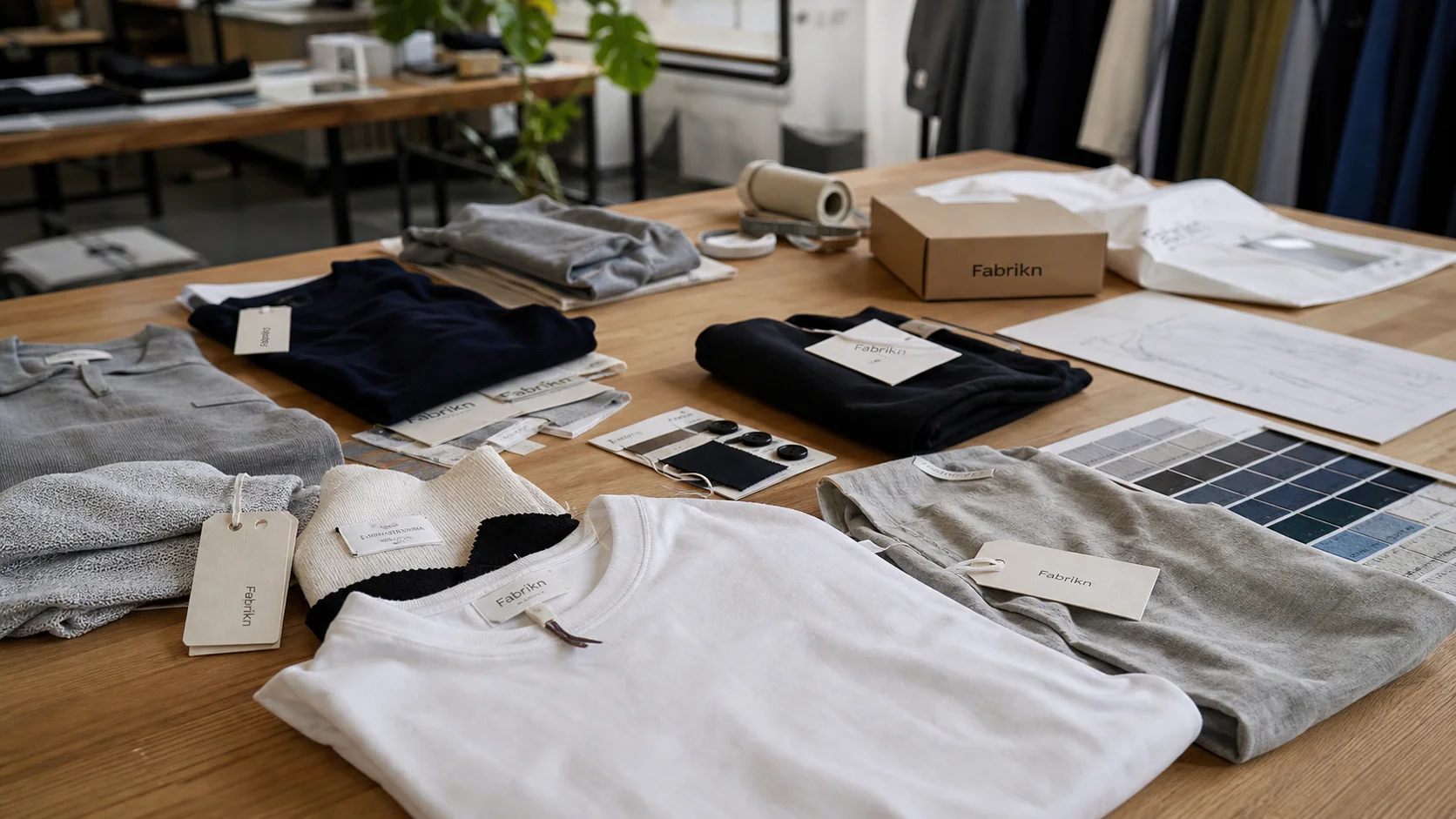
China Garment Production Sourcing with checks for samples, fit, MOQ, QC evidence, pricing terms, and delivery risk.
Fast answer: China Garment Production Sourcing: Cost Lines, Risk Signals, and Wins should be judged by production evidence, not by a generic sourcing promise. The buyer needs sample proof, cost breakdowns, QC checkpoints, and delivery buffers in writing.
Ask for recent sample photos, measurement tolerances, fabric or print test assumptions, decoration test notes, packing examples, and a named inspection checkpoint. These details show whether the team can repeat an approved sample at bulk volume.
Separate garment cost, decoration, labels, packaging, sampling, testing, freight, and rush charges. When every cost line is visible, it becomes easier to reduce colorways, adjust size depth, or reserve more time for sampling.
The quote is never the whole bill. A 10% unit-price gap can disappear once freight, duties, trims, and rework land on the sheet, and apparel factory sourcing in china has a way of teaching that lesson fast. I once watched a $4.20 FOB sweatshirt land at $7.96 after carton upgrades, customs fees, and an unglamorous afternoon sorting 312 mis-sewn cuffs. First lesson from 200+ factory visits across 8 countries: price the whole chain, not the quote sheet.
Sample rooms always look reassuring. Clean tables. Fresh samples. A technician binding a neckline in four minutes and talking stitch classes like a professor. Then the floor starts telling the truth. One line with 18 machines and two missing operators. Another with thread cones piled on the floor. A third claiming 1,200 pieces a day on paper, but only 760 when I asked for the last three production records.
Coastal China and inland China do not behave the same way. Guangdong often runs high labor turnover, yet trim access is fast and the supply chain is dense. Inland provinces may run 12% to 20% lower on wages, but a simple zipper delay can add five to seven days if the factory depends on trucks from another province. I have seen factories near Shenzhen handle urgent reorders in 10 to 14 days, while inland sites with lower hourly labor costs needed 20 to 28 days because fabric and accessories arrived in separate waves.
Glossy showrooms hide weak process control. I have visited factories with marble reception desks and terrible seam consistency, and others with no polish at all but disciplined QC and defect logs tracking needle breaks, shade variation, and shrinkage by style. Cheap quotes are easy. Reliable bulk execution is not.
The hidden gap between quote sheets and final cost is usually boring, not dramatic. Packaging changes. Carton testing. Embroidery digitizing. Fabric overage. A missing label that strands the shipment in a warehouse for two extra days. If you need a starting point for structured sourcing, I often recommend reviewing private label clothing services before requesting quotes, because a factory that understands private-label expectations usually prices more honestly from day one.
Guangdong is still the speed king. Fast trim sourcing. Strong export routines. Enough subcontractors to rescue a last-minute order. That same flexibility can hide weak traceability. Zhejiang fits private-label runs of 500 to 3,000 pieces, especially knitwear and woven tops, because many factories there are built for agile repeat business rather than giant seasonal programs. Jiangsu often handles higher-spec work better: tighter seam tolerances, cleaner finishing, more consistent fabric handling on technical polos or premium shirts. Inland provinces usually win on wage rates, but they can lose time at every handoff.
Factory size matters just as much as geography. Cut-and-sew specialists usually accept lower MOQs, often 300 to 800 pieces, and they communicate faster because one merchandiser can sit beside production. Full-package factories can source fabric, trims, labeling, and packing, which cuts down vendor sprawl, but they usually want 1,000 to 5,000 pieces per style. Trader-led operations can be useful for speed, yet they often add 8% to 15% margin and blur accountability when defects appear. If your brand depends on consistent grading and repeat orders, a direct production partner or a real cut and sew manufacturing setup is easier to manage than an anonymous middle layer.
Product type changes the math. A French terry 320 GSM hoodie behaves nothing like a satin blouse or a bonded shell jacket. Denim needs wash control, abrasion checks, and shrinkage management. Activewear needs stretch recovery, flatlock execution, and colorfastness under sweat conditions. Outerwear demands more labor in seam sealing, padding, and hardware placement. I have seen the same hoodie quoted at $6.10 in one province and $7.90 in another once enzyme wash, brushed fleece sourcing, and rib trim matching were added. That 15% to 30% spread is real.
The cheapest labor region is not always the cheapest final source. A factory with lower wages but weak fabric access can burn savings through extra trucking, slower approvals, and more rework. In sourcing, distance has a price. So does silence.
A $4 FOB quote can become a $7.80 landed cost without bad intent from the factory. FOB covers the goods up to the port. EXW starts at the factory gate. Landed cost includes freight, duty, customs brokerage, domestic trucking, insurance, testing, cartons, and the fixes nobody budgeted for. I have built enough sourcing models to know the error usually sits in the middle: small brands undercount chargeable weight by 12% to 18%, then act surprised when air freight doubles the math.
MOQ is where price discipline gets tested. A factory may quote $3.40 for 3,000 tees, then $4.25 for 500 tees, and $5.10 for 300 tees because setup costs are spread across fewer units. That same pattern hits woven shirts, denim, and technical outerwear even harder. A basic cotton jersey tee can land near $2.20 to $3.80 FOB at scale. A woven button-down might sit at $5.50 to $9.00 depending on collar construction, button count, and wash. Denim often jumps to $8.00 to $16.00 once enzyme wash, hardware, and pocketing are included. Technical outerwear can start around $18 and move well past $45 with seam sealing and taped construction.
Here is the way I model it. For 300 units, sampling, lab dips, and testing usually add $0.60 to $1.20 per piece. Packaging can add $0.25 to $0.90. Inspection may add $250 to $450 per style. Domestic freight to port can be another $80 to $220, depending on province and carton count. Those are not edge cases. Those are standard line items.
By 1,000 units, the per-piece burden falls, but only if the order is repeatable and the tech pack is complete. If the spec is vague, the factory will price in risk. Wider tolerances. Extra rework allowance. Higher trim wastage. A brand that asks for “premium quality” without a graded BOM and target fabric shrinkage can lose 8% to 12% in avoidable cost. If you need a quote benchmark for a smaller run, you can request a custom quote for apparel production and compare it against your own landed-cost model before committing.
Compare at least three scenarios: EXW, FOB, and true landed cost. The cheapest FOB can still be the worst total buy if testing fails or a carton spec gets rejected at the warehouse. Price only tells half the story.
Brochures tell you what a factory wants to be. Documents tell you what it can prove. Before I send a deposit, I ask for the business license, export records, recent audit reports, client references, machine list, and photos of the actual production floor. A real manufacturer will usually share them within 24 to 48 hours. A trader will stall, send generic PDFs, or use inconsistent names across documents.
On the first call, I ask for line capacity, absentee rates, QC staffing, and the last three order references in the same product category. A factory claiming 20,000 units per month should know how many operators it has per line, how many are on second shift, and what defect rate they ran last quarter. If the answer is vague, the capacity is probably inflated. I also ask which processes are in-house and which are outsourced. That answer matters more than the showroom.
Production photos prove little. I have seen recycled images from two years earlier, stitched together from multiple suppliers. Ask for a live video walk-through, then request machine counts by category: overlock, flatlock, coverstitch, bartack, and pressing stations. Ask about compliance audits too. Depending on your market, that may mean WRAP, OEKO-TEX, or chemical testing aligned with OEKO-TEX standards for textile safety. If the factory sells into higher-control markets, they should know exactly how they handle azo dyes, formaldehyde, and nickel release.
Red flags are rarely dramatic. They are small and persistent. Vague MOQ answers. Refusal to share defect rates. Inconsistent factory names on invoices and licenses. A salesman who says “no problem” to every change. I have watched those phrases turn into delayed shipments and disputed claims six weeks later. Social audits matter too, especially if you sell into major retail channels. For context on compliance expectations and labor checks, WRAP factory compliance standards remains a useful benchmark for buyers who want structure, not slogans.
Most quality failures begin before the first seam is sewn. They start with incomplete tech packs, missing grade rules, or a buyer who approves a fit sample too quickly because the calendar is tight. I have seen brands rush from prototype to bulk in five days and then lose three weeks correcting measurement drift after production started. That is not factory laziness. That is weak process control on both sides.
The approval chain should be predictable: prototype, fit sample, pre-production sample, inline inspection, and final audit. Each stage should answer a different question. Does the design work? Does the fit match the block? Are fabric, trims, and labeling consistent? Is the line making the garment correctly? Is the shipment clean enough to release? Skip one stage, and the next one inherits the mess.
Defect patterns vary by category. On T-shirts and hoodies, I watch for stitching slippage, twist, shade variation, and shrinkage after wash. On woven shirts, collar symmetry, placket alignment, and button spacing usually fail first. On prints, cracking and misregistration become obvious after two to three wash cycles. On denim, the problems are often measurement drift, wash inconsistency, and broken hardware. On activewear, stretch recovery and seam puckering can ruin a garment even when it looks fine on the hanger.
Factory visits taught me something uncomfortable. Faster approvals often produce slower deliveries later. When a buyer waves through a pre-production sample without confirming fabric shrinkage at 3% to 5% or allowing time for a 24-hour wash test, the factory scrambles in bulk. Rework climbs. Overtime climbs. Deadlines slip. A disciplined AQL plan makes more sense than heroic last-minute fixes. I usually want measurable targets: critical defects at 0, major defects under 2.5%, and a clear sampling plan by lot size.
For brands building assortments, it helps to browse a realistic range first. You can browse our product catalog for apparel styles and finishes to see how specs, fabrics, and finishing choices shift the QC burden before you choose your next style.
I use a simple matrix with four columns: turnaround time, MOQ, communication quality, and compliance depth. Coastal factories usually win on speed, often two to four weeks faster for repeat styles because they sit closer to fabric mills, trims, and ports. Inland sites can save 5% to 12% on labor, but lead times often stretch by one to two weeks once materials move farther. Premium manufacturers usually charge more, yet they can reduce defect rates enough to offset the premium.
For startup brands, I favor factories with lower MOQ, responsive merchandisers, and clear sample revision rules. DTC labels need speed, but they also need consistent photo samples and repeatability for color. Larger retailers care more about compliance depth, documented testing, and audit trails. If you are launching a 300-piece capsule, a small cut-and-sew unit may be better than a giant factory with a 5,000-piece minimum. If you are scaling a 20,000-piece reorder, the larger partner often wins on efficiency.
Here is the counterintuitive part. The most expensive factory can still deliver the lowest total cost if defect rates are lower. I have seen a $9.20 FOB sweater factory beat a $7.80 quote because the cheaper plant failed 11% of the inspection, forcing sorting, replacement, and a missed delivery window that cost the brand retail placement. Price is only useful after quality is modeled.
Practical matrix:
Start with a 30-day sourcing plan, not a vague search. In week one, shortlist eight to 12 factories by product type, province, and MOQ. In week two, send the same tech pack to each one so you can compare apples to apples. In week three, order samples, review measurements, and ask for fabric photos under daylight. In week four, inspect the best candidate, negotiate terms, and place a pilot order. Skip the pilot, and you are not sourcing. You are gambling.
Before outreach, prepare a complete package: BOM, graded specs, target price, target delivery window, care label text, packaging requirements, and compliance needs. Add fabric composition, GSM, wash method, and stitch type. If the item is a French terry hoodie, say whether you want 320 GSM brushed fleece, an enzyme wash, or a stone wash finish. Small details change the quote by 4% to 18%, and they also change who is willing to quote at all.
Negotiate the terms that actually matter. Payment terms should protect cash flow, usually 30/70 or 20/80 depending on order size. Defect allowances should be written down, not discussed casually. Late penalties matter if the style is seasonal. Carton standards matter if the goods will ship long distances. IP protection matters if you have proprietary prints, blocks, or trims. I also insist on documented replacement rules for major defects and clear wording on who pays for rework if the fault sits with the factory.
Then test one production run before you scale. A pilot order of 300 to 1,000 units will tell you more than 12 polished emails. It reveals stitch quality, wash response, packing discipline, and how the factory behaves under pressure. That first run is your real audit, your real price check, and your clearest answer to whether the partner is built for repeat business.
Basic tees can start around $2.20 to $3.80 FOB at scale, while woven shirts often land at $5.50 to $9.00. Denim usually sits near $8.00 to $16.00, and technical outerwear can move above $18 depending on seam sealing and trims. Add 15% to 30% for smaller MOQs, plus testing, cartons, and freight.
For straightforward styles, sampling may take seven to 14 days and bulk production another 14 to 35 days. Complex items like outerwear or washed denim often need three to six additional days for approvals and finishing. Inland factories can add one to two weeks because trims and freight move more slowly.
The biggest risk is not finding a factory. It is approving a partner with weak process control and incomplete documentation. That usually leads to rework, delayed shipping, and quality claims after payment. A pilot order and a clear inspection plan reduce that risk sharply.
Yes, but your per-unit price will usually rise by 10% to 35% because setup costs are spread across fewer units. Some cut-and-sew factories accept 300 to 500 pieces if the style is simple and the tech pack is complete. Expect tighter limits on fabric choice and fewer custom finishing options.
Start with eight to 12 factories that match your product type, province preference, and MOQ. Send one complete tech pack, compare three to five serious quotes, then sample and inspect before placing a pilot order. If a supplier will not share license details, capacity, and recent references, move on.