
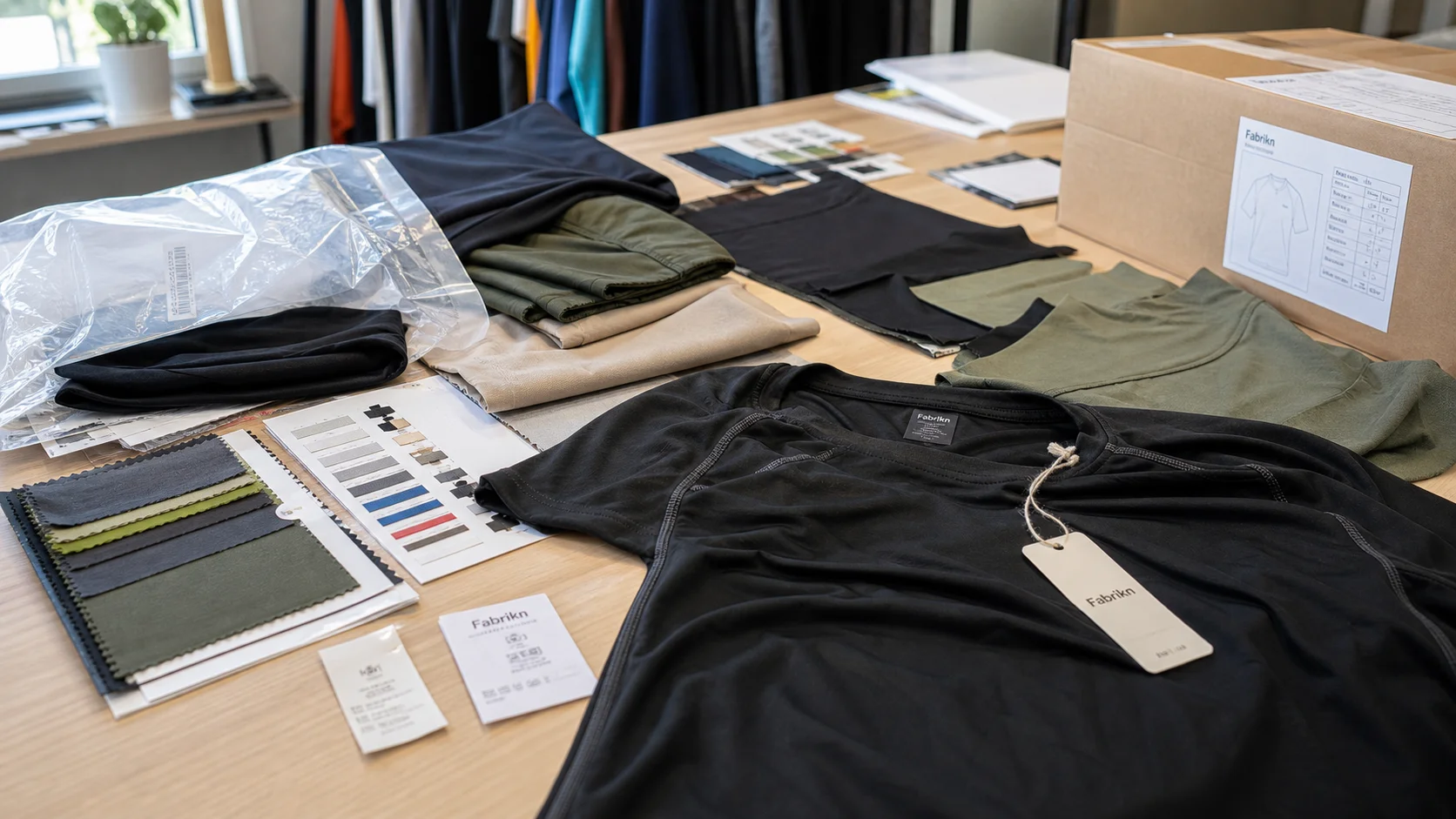
Clothing Brand Pricing Strategy with checks for samples, fit, MOQ, QC evidence, pricing terms, and delivery risk.
Fast answer: Clothing Brand Pricing Strategy: Deposits, Cost Lines, QC, and Rework Risk should be judged by production evidence, not by a generic sourcing promise. The buyer needs sample proof, cost breakdowns, QC checkpoints, and delivery buffers in writing.
Ask for recent sample photos, measurement tolerances, fabric or print test assumptions, decoration test notes, packing examples, and a named inspection checkpoint. These details show whether the team can repeat an approved sample at bulk volume.
Separate garment cost, decoration, labels, packaging, sampling, testing, freight, and rush charges. When every cost line is visible, it becomes easier to reduce colorways, adjust size depth, or reserve more time for sampling.
Pricing matters. A lot.
Set prices too low, and you may struggle to cover production, marketing, shipping, returns, and overhead. Set them too high without a clear value proposition, and you may lose customers before they ever try your products. What good is a margin if the market never buys in?
The best clothing brand pricing strategy is not just about making a margin on each item. It is about building a pricing structure that supports profitability, positions your brand in the market, and leaves room to grow.
Apparel pricing gets tricky fast. Garments involve multiple cost components, varying order quantities, seasonal demand shifts, and different consumer expectations depending on the category. A T-shirt brand, for example, may rely on high-volume sales and thinner margins, while a premium outerwear label may focus on fewer units and higher perceived value. The right strategy depends on your audience, your brand identity, your production model, and your business goals.
Production geography can change pricing quickly: a cut-and-sew tee made in Guangzhou at a 500 MOQ might land around $2.50-4.00 per unit for a basic 180-200 GSM cotton style, while a similar item in Dhaka may be closer to $1.80-3.20 depending on fabric, print complexity, and wash. A knit polo in Ho Chi Minh City or a sweater program in Istanbul may price differently again because of labor rates, yarn cost, and finishing requirements. Lead times also matter; many factories quote 18-22 business days for repeat orders, but 30-45 days is more common for development-heavy first runs with new patterns and fabric sourcing.
In this guide, we’ll break down how to create the best clothing brand pricing strategy for your business.
You’ll learn how to calculate costs, choose the right pricing model, understand market positioning, and protect your profit margins without pricing yourself out of the market.
A clothing brand pricing strategy is the framework you use to decide how much to charge for each product. It includes your cost structure, profit goals, target customer, competition, brand positioning, and sales channels. Effective pricing is not random. It is intentional and aligned with your overall business model.
For example, a brand selling direct-to-consumer through an eCommerce website may price differently than a brand selling wholesale to boutiques. A direct-to-consumer brand often needs to account for paid ads, fulfillment, and returns, while a wholesale brand may need to leave room for retailer margins. Understanding these distinctions is essential if you want your prices to support growth rather than create cash flow pressure.
The best clothing brand pricing strategy should answer three questions:
Pricing affects nearly every part of your business. It determines your gross margin, influences customer perception, shapes your marketing strategy, and affects how much inventory risk you can absorb. In fashion, where trends can shift quickly and inventory often involves upfront commitments, pricing can make the difference between sustainable growth and constant financial strain.
Strong pricing matters because it helps you:
If your pricing strategy is weak, you may end up relying on constant discounts just to move product. That can train customers to wait for sales and erode brand value over time. On the other hand, if your pricing is well-structured, you can create a healthier business model that supports both profitability and brand credibility.
Before setting any retail price, you need a clear picture of your true cost per unit. Many new clothing brands make the mistake of focusing only on the factory cost. In reality, the total cost of getting a garment ready for sale is much broader.
This includes fabric, trim, labor, stitching, dyeing, finishing, and any special treatments. If you work with a manufacturer, this is usually your base unit cost. For example, a 100% combed cotton jersey tee may use 180 GSM fabric, 1x1 rib neck binding, four-needle coverstitch hems, and reactive dyeing. A fleece hoodie might add brushed-back French terry, kangaroo pocket bartacks, rib cuffs, and enzyme or silicone softening to the final cost.
Pattern making, prototypes, fit samples, revisions, and testing all add to your overall product cost. Even if these are one-time costs, they should still be built into your pricing model. A first sample set may require CAD pattern grading, laser-cut markers, and 2-4 rounds of fit approvals before bulk production begins.
Tags, poly bags, tissue paper, boxes, stickers, and inserts all cost money. Premium packaging can improve perceived value, but it must be priced accordingly. A basic folded tee in a polybag may add only $0.15-0.35 per unit, while a rigid mailer box with branded tissue, hang tags, and a QR-code insert can add $1.25-3.50 per unit.
Transportation from factory to warehouse, customs duties, and inbound freight should not be ignored. These can be significant, especially for international production. Ocean freight is usually cheaper than air freight, but air can be worth it for a 500-piece launch when you need speed. Always include destination charges, local trucking, and customs brokerage in your landed cost.
Storage, pick-and-pack fees, and shipping labor often become major expenses as volume increases. Fulfillment rates commonly range from $2.50-5.00 per order for pick-and-pack, plus postage, depending on parcel size, zone, and carrier.
If you sell online, you may spend heavily on social media ads, influencer campaigns, content creation, or affiliate commissions. These are not product costs, but they directly affect your profitability. Many DTC apparel brands plan for a 20-35% customer acquisition cost as a share of revenue, especially during launch periods.
Apparel is a category with high return risk. Sizing issues, color expectations, and quality concerns can reduce your effective revenue. A pricing strategy should leave room for this. A 5-12% return allowance is common for some categories, while fit-sensitive products can run higher.
Rent, software, salaries, bookkeeping, and administrative costs need to be covered by product margins.
Need help mapping production choices to pricing? Fabrikn’s services page shows how manufacturing support can shape your cost structure. Fabrikn can also help source factories in Guangzhou, Dhaka, Ho Chi Minh City, and Istanbul depending on MOQ, fabric type, and target landed cost.
There is no single best pricing model for all apparel brands, but there are several common approaches. The right one depends on your market and business model.
Cost-plus pricing means taking your unit cost and adding a markup percentage. This is one of the simplest methods and is widely used in apparel. For example, if a shirt costs $12 to produce and you apply a 2.5x markup, your wholesale or retail price may be built from that base. In many factories, a basic cotton tee at 500 MOQ may quote at $2.50-4.00 per unit in bulk, then rise to $4.50-7.50 when you add premium dyeing, embroidery, garment washing, or specialty trims.
Pros:
Cons:
This model sets prices based on what competitors charge and what customers expect in your category. It is useful when entering a crowded market, but you should not copy competitors blindly. Your product quality, branding, and service levels may justify a higher price. A premium hoodie with brushed French terry, double-layer hood, and YKK zippers may support a retail price far above a basic fleece style, even if the factory cost differs by only $6-10 per unit.
Value-based pricing starts with what the customer believes the product is worth. That can be powerful when your brand has a strong story, unique design language, or a loyal audience willing to pay for more than just fabric and stitching. A limited-edition drop, a collaboration, or a fit that solves a real problem can all support this approach.
Not every product should be priced the same way. Sometimes a brand needs a mix of models: cost-plus for basics, value-based for hero pieces, and market-based checks to stay grounded.
A simple retail pricing formula can help you get started:
Retail Price = Total Landed Cost ÷ Desired Margin
Let’s say your landed cost for a hoodie is $18 and you want a 70% gross margin.
Retail Price = $18 ÷ 0.30 = $60
That gives you a retail price of $60.
If you also sell wholesale, you need a separate structure. Many apparel brands use keystone pricing or another wholesale markup that leaves enough room for retailers to make money too. If your retail price is $60, your wholesale price might need to fall around $30, depending on your category and channel strategy.
When setting prices, test several scenarios:
That kind of pressure test is boring, maybe. Still worth doing.
Pricing is also a positioning tool. Customers often read price as a signal of quality, exclusivity, and brand identity. If your prices are too low, people may assume your product is cheap or unremarkable. If your prices are too high for the category, they may hesitate unless the value is obvious.
Think about where your brand fits:
Your pricing should match the experience you are promising. A brand built on minimalist basics, for example, may need clean execution and fair pricing more than fancy packaging. A fashion-forward label may justify higher prices through design, scarcity, and storytelling.
Different apparel categories behave differently, so your strategy should change with the product.
These often compete on volume, fit, softness, and color range. Margins can be tighter, especially in crowded markets, so efficient production matters.
These usually carry higher price points because of fabric weight, construction, and perceived value. Brushed fleece, heavy GSM, and premium trims can justify stronger margins.
Denim pricing depends heavily on wash treatments, hardware, and fit development. A great fit can support a much higher price than the base material alone would suggest.
Stretch performance, technical fabric, seam quality, and function influence pricing here. Customers expect more from the product, so returns and testing should be built into your model.
Coats, jackets, and technical layers often require more complex construction and stronger margin planning. Small errors get expensive fast.
The sweet spot is not always the lowest price or the highest margin. It is the price people will pay while still leaving enough room for the business to function well.
Ask yourself:
You may need to test prices across collections, channels, or seasons. A launch collection can be priced differently from a repeat core line. A limited drop may carry more margin than a staple item. And if a product consistently sells out, that is usually a sign you may have room to raise the price.
Many apparel brands run into the same pricing mistakes:
One more: chasing “affordable” at the expense of survival. Cheap prices are not a strategy if the business cannot sustain them.
Raising prices is never fun, but sometimes it is necessary. Costs go up. Demand changes. The brand gets stronger. Any of those can justify a price increase.
You might consider raising prices when:
Be careful with timing. If you raise prices, make sure the product and the presentation support it. Better photos, better fit, better packaging, better story. Sometimes that’s the whole difference.
Pricing apparel well is easier when your supply chain is organized from the start. Fabrikn helps clothing brands connect manufacturing decisions to real unit economics, from factory sourcing and sampling to production planning and cost control. If you need help building a pricing structure around actual production data, Fabrikn’s services can help you get there.
What is the best markup for clothing? There is no universal markup. Many brands use different markups for basics, premium items, wholesale, and direct-to-consumer sales.
Should apparel brands use cost-plus pricing? Cost-plus is a useful starting point, but it should be checked against market demand, brand position, and channel economics.
How do I price a new clothing line? Start with landed cost, add overhead, account for returns and marketing, then test the number against your target market and competitors.
Can I charge more if my clothing is made overseas? Yes, if the quality, fit, branding, or overall experience supports the price. Production location alone does not determine value.
When should I review my prices? Review them whenever costs change, you launch a new collection, or your brand position shifts in a meaningful way.