
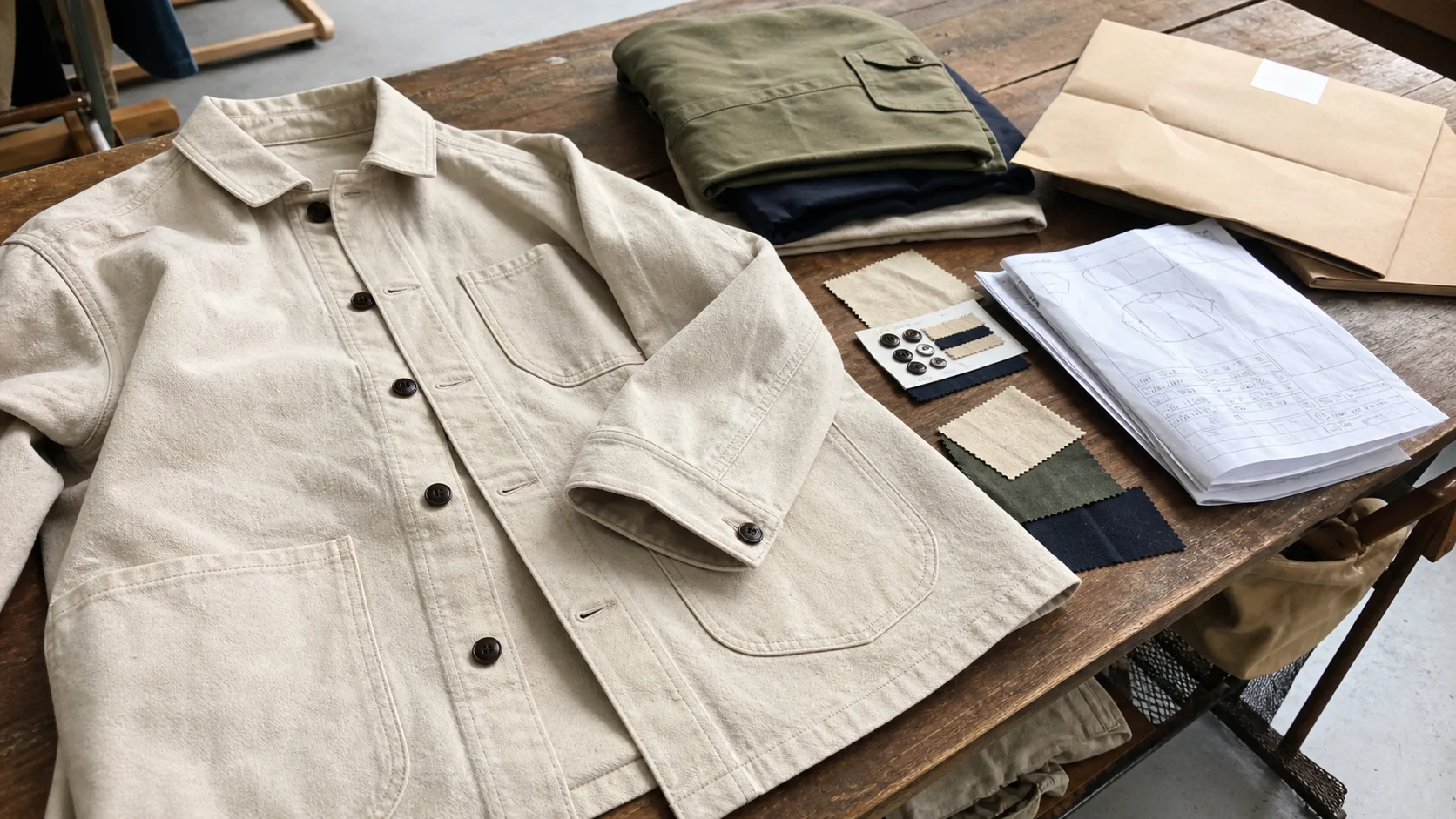
A focused review of MOQ pricing factors for organic cotton work jackets for cleaning crews, including fabric choices, decoration options, and production considerations that affect cost and order planning.
Cleaning crews need work jackets that hold up to repeated laundering, carry a professional look, and still make sense on price. Organic cotton is often appealing because it supports a cleaner material story, feels familiar to wear, and can fit sustainability claims more cleanly than blended workwear when the product is positioned carefully. The sourcing question is less about whether the fabric is good and more about where the cost lands once you add minimum order quantity, trims, embroidery, wash testing, and quality control.
This review looks at organic cotton work jacket MOQ pricing for cleaning crews from a sourcing point of view. The goal is simple: understand what usually drives price, which specs are worth paying for, where suppliers often quote low and recover cost later, and how to judge whether an offer is actually usable for a uniform program.
If you are building a private-label or uniform program, it helps to compare factory capability early. Pages like services, about us, and contact us are useful starting points when you are narrowing down suppliers and need to discuss sampling, production, or fabric development.
Organic Cotton Work Jacket MOQ Pricing Review - Fabrikn production reference
A cleaning crew jacket is not fashion outerwear. It is a utility layer that has to be easy to move in, easy to wash, and easy to identify on site. The design brief usually includes a neat appearance, pockets for small tools, enough room for layering, and construction that survives frequent laundering without twisting out of shape.
For this category, the jacket is judged by practical performance first. Cleaning crews often work in variable indoor environments, move between temperatures, and need clothing that does not feel bulky while bending, reaching, or carrying supplies. That means the pattern, fabric weight, and closure choice matter more than decorative detail.
For this use case, organic cotton is often chosen for brand positioning and wearer comfort. It is less about luxury and more about aligning the uniform with a sustainability story while keeping the garment practical.
Organic cotton does not automatically make the jacket better. It changes the sourcing profile, the price floor, and the documentation burden. If the fabric is certified, the supplier may need transaction certificates, fiber traceability, and a documented chain of custody depending on the claim standard being used. That adds work for both the mill and the garment factory.
From a cost perspective, the premium can come from several points in the chain. Organic cotton fiber can be more expensive than conventional cotton. Certified yarn and fabric may carry an additional compliance charge. Smaller mills sometimes need longer production windows for certified lots. If the order is not large enough to fill a fabric run efficiently, the quoted price rises quickly.
For cleaning crews, the right question is not “Is organic cotton worth it?” The better question is “Does the jacket need to support a sustainability claim strong enough to justify the fabric premium and the tighter sourcing controls?”
The answer depends on the buyer’s priorities. If the jacket is a visible part of a corporate sustainability program, organic cotton can be justified. If the main requirement is low-cost uniform replacement, the premium may be hard to defend unless the team values the handfeel and brand message.
MOQ for an organic cotton work jacket varies widely by factory, fabric source, and level of customization. A basic stock-pattern jacket with minimal branding can sometimes start around 300 to 500 pieces per color, but that is not a universal number. For custom patterns, multiple sizes, and certified fabric, the practical MOQ is often higher.
Typical sourcing ranges for this category look more like this:
Order Type Typical MOQ Notes Basic unlined jacket, standard fabric 300-500 pcs/style/color More realistic with a factory that already has suitable fabric access. Custom pattern, organic certification, custom trims 500-1,000 pcs/style/color Better pricing usually appears once fabric and trim usage are efficient. Small pilot program for crews 100-300 pcs total Possible, but unit cost often rises and sample charges are less likely to be absorbed.MOQ is not only about the factory’s willingness to sew the garment. Fabric minimums can be the real constraint. A mill may require a minimum dye lot or weaving run, and the garment maker may not want to hold excess certified fabric inventory for a small order. That is why a low garment MOQ can still produce a high final price.
For cleaning crews, sizing dispersion matters as well. A company may need a broad size curve, and each size can affect cut efficiency. If the order has many sizes but low total volume, the price per piece usually climbs because fabric utilization falls.
Organic cotton work jacket pricing is built from a handful of predictable components. The biggest mistake buyers make is comparing only the sewing quote and ignoring the cost stack beneath it.
A cautious price range for a simple organic cotton work jacket, excluding freight and duties, might land somewhere around $18 to $35 at relatively modest volume, with higher figures when the fabric is heavier, the construction is more complex, or the order is small. For smaller programs, price can move above that quickly. The exact number depends heavily on fabric GSM, certification status, country of manufacture, and how many features are included.
Two jackets that look similar on a tech pack can price very differently. A 260 GSM organic cotton twill jacket with basic buttons is not the same as a garment-washed, 320 GSM jacket with reinforced elbows, custom labels, and lined pockets. Buyers should ask suppliers to quote on identical spec assumptions, not broad descriptions.
A practical quote request should include fabric composition, fabric weight, weave type, color target, trim list, construction notes, size breakdown, labeling requirements, and packing instructions. Without that, comparisons are weak and the lowest quote may just be the least complete quote.
Sampling is where many uniform programs lose time. A clean process reduces surprises later in bulk production, especially when the jacket is being made for staff who wear it every day and expect consistency.
For organic cotton, the pre-production sample matters more than usual. A factory can show a clean prototype in substitute fabric, but that does not prove the final jacket will wash or hang the same way. If certification claims are involved, confirm the exact fabric batch and documentation before approving bulk.
Sampling fees are common on custom workwear. Some suppliers credit part of the charge back against bulk production, while others treat it as non-refundable development cost. That is normal. What matters is clarity. If a supplier is vague about sample charges, the hidden cost often reappears later in the production quote.
Cleaning crews are sensitive to fit and function. A jacket that is too tight across the shoulders or too short in the back may be rejected by the end user, even if it technically meets the spec sheet. Fit approval should include movement testing, not just a static measurement check.
The right fabric specification depends on the work environment, but a few settings are common. Many buyers lean toward woven organic cotton twill, canvas, or a cotton-rich drill because these fabrics balance structure with comfort. A midweight range often works well for cleaning teams because it is strong enough for daily use without feeling heavy indoors.
Trim selection can affect both price and durability. Plastic buttons are cheaper than metal snaps, but snaps can be easier for staff wearing gloves. Zippers add cost and can become a failure point if the quality is poor. Pocket reinforcement is worth paying for if the crew carries cloths, keys, or small tools.
Labels and branding should be reviewed carefully. Heat transfers can be lower cost in some cases, but they may not hold up as well under repeated laundering. Woven labels usually signal better durability, though they increase cost slightly. For a uniform program, durability should win over decorative savings.
Lead time is shaped by more than sewing capacity. Organic cotton sourcing depends on fabric availability, certification handling, dyeing schedules, sample revisions, and whether trims need to be developed from scratch. A straightforward order can move quickly if the factory already has the right fabric in stock. A custom order with certified fabric and new trims can take much longer.
Typical lead times for this type of jacket often fall into a 45 to 90 day production window after sample approval, but that window can stretch if fabric is not ready or if the buyer changes the spec late. Busy production calendars, holiday shutdowns, and port congestion can add further delay.
Three factors usually push cost higher:
Buyers should also ask whether the quoted price assumes duty, freight, and packaging. These items can turn a reasonable ex-factory number into a weak landed cost. Uniform programs often care more about landed cost than the factory quote, especially when jackets are being distributed to multiple sites.
Inspection for work jackets should focus on function and repeatability, not just appearance. A jacket can look good on a hanger and still fail in use. Cleaning crews notice poor seam alignment, twisted sleeves, weak bartacks, and inconsistent sizing very quickly.
Common risks include:
Pre-shipment inspection is not optional on a workwear program. For small and medium orders, the buyer should still expect measurement checks, visual defect limits, wash handling review, and carton verification. The inspection scope should match the risk level of the order. A simple jacket can still fail a program if the size spread is unreliable.
Frequent laundering creates its own risk profile. If the fabric is too light, the jacket may thin out early. If the construction is too rigid, the seams may break under repeated movement. If the dye is unstable, the garment can lose its professional appearance long before the end of its useful life. In workwear, replacement cost often matters more than the first purchase price.
The best place to spend is usually fabric quality and construction at stress points. That is the part of the jacket the crew will feel every day. A slightly better fabric weight, stronger pocket reinforcement, and more stable shrinkage control often return more value than decorative upgrades.
Places where savings are more realistic:
Places where cutting cost can backfire:
A practical sourcing editor would treat organic cotton as a strategic choice, not an automatic upgrade. If the crew is visible to clients or works under a sustainability policy, the material story may justify the premium. If the jacket is mainly an internal utility garment, the buyer should calculate whether the claim value is worth the additional complexity.
For cleaning crews, the right jacket is the one that survives the laundry cycle, keeps its shape, and stays within a cost ceiling that makes replacement possible when the uniforms wear out.
When comparing suppliers, use the same checklist for every quote. This keeps the conversation focused on real differences instead of price theater.
Area What to Confirm Why It Matters Fabric Organic content, GSM, weave, certification status Drives cost, handfeel, and claim integrity. MOQ Per style, color, fabric lot, and size breakdown Prevents hidden minimums from distorting the quote. Sampling Sample fee, sample timeline, approval stages Controls development cost and launch timing. Trim package Buttons, zippers, labels, thread, packaging Small changes here can alter both quality and price. Testing Shrinkage, colorfastness, seam strength, wash durability Critical for laundering-heavy use. Lead time Fabric ready date, production window, shipping terms Determines whether the program can launch on schedule. Inspection Pre-shipment inspection scope and defect limits Reduces rejection risk and post-delivery disputes.If you are still shortlisting partners, ask them how they handle development, reporting, and production communication. A clear process matters more than a polished sales pitch. For supplier conversations around custom workwear and sustainable materials, the contact pages on fabrikn.com/contact-us and the capability overview on fabrikn.com/services can be useful reference points.
Organic cotton work jacket MOQ pricing for cleaning crews sits at the intersection of uniform utility and sustainability positioning. The right price is not the lowest quote. It is the quote that aligns fabric quality, certification needs, construction standards, and production volume with the way the jacket will actually be used.
For smaller programs, MOQ can be the main obstacle. For larger programs, the challenge is usually spec control and consistency across sizes and color lots. Buyers who define fabric weight, trim quality, sample approval steps, and inspection requirements early are in a much better position to protect both budget and garment performance.
When the brief is clear, organic cotton work jackets can work well for cleaning crews. When the brief is vague, the order tends to drift into avoidable cost and quality risk. The better buying decision is usually the one that looks plain on paper and performs reliably in the field.
Get a free quote from Fabrikn — your trusted B2B clothing manufacturer with 10+ years of experience. MOQ as low as 200 pieces.
Get a Free Quote →Many suppliers start around 300 to 500 pieces per style and color for a straightforward jacket. Custom patterns, certified fabric, and multiple trim options can move the practical MOQ closer to 500 to 1,000 pieces.
The premium often comes from certified fiber sourcing, limited fabric availability, compliance handling, and smaller production runs. The final cost can also rise if the order is too small to use fabric efficiently.
Midweight fabrics in roughly the 220 to 320 GSM range are common because they balance durability and comfort. The final choice should reflect the climate, laundering frequency, and whether the jacket is worn indoors or outdoors.
At minimum, the buyer should approve the fabric, trims, fit sample, measurements, branding placement, packaging, and any certification paperwork tied to the organic claim. A pre-production sample is the safest checkpoint before bulk cutting.
Common problems include shrinkage, dye variation, weak pocket seams, uneven stitching, and inconsistent sizing. Frequent laundering makes these defects more visible over time, so wash performance should be reviewed early.
It is possible, but the unit price will usually be higher than a larger order. Small programs can reduce risk by simplifying the pattern, limiting color options, and keeping trims standard.
Yes. For cleaning crews, wash durability is one of the most important checks. Shrinkage, seam integrity, and colorfastness should be reviewed before bulk approval whenever possible.