
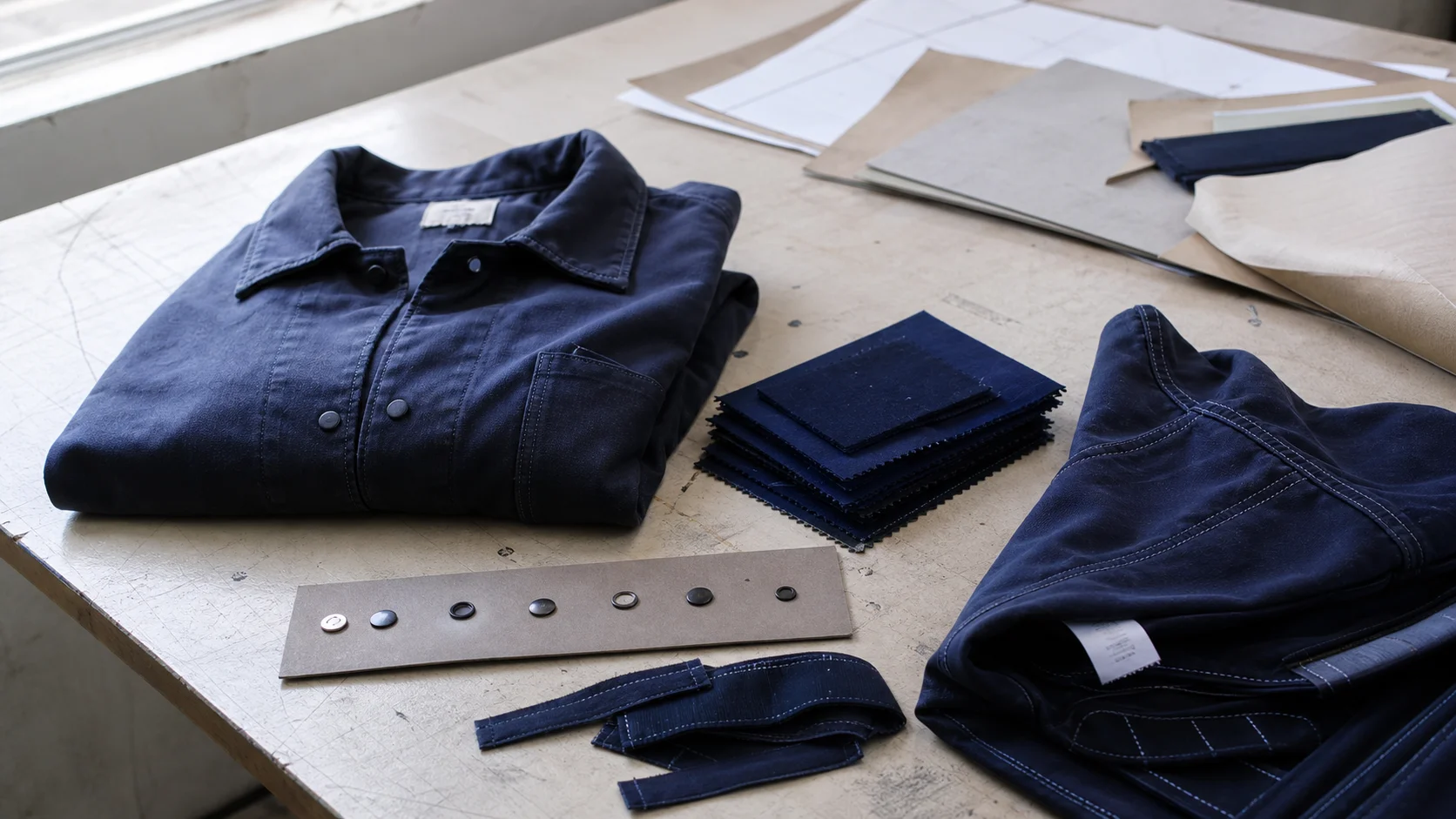
A practical audit framework for corporate uniform buyers evaluating mono-material workwear for wash durability, rub resistance, light stability, and dye performance across real uniform use cases.
Corporate uniform buyers are under pressure to choose workwear that is easier to recycle, simpler to track, and less likely to become waste after a short service life. Mono-material construction helps on the sustainability side, but it does not solve the day-to-day wear problem on its own. If a garment fades, bleeds, or patches unevenly after a few wash cycles, the uniform program starts to look cheap long before the fabric fails.
A mono-material workwear colorfastness audit is the practical way to check whether a fabric system can survive real use. It looks at how a garment holds color through washing, rubbing, perspiration, light exposure, and finishing processes, then asks a more commercial question: does the result still meet brand, durability, and replenishment expectations at scale?
For buyers managing corporate uniform programs, the audit should sit alongside sourcing, pattern approval, and wash testing. The goal is not to chase the highest lab score in isolation. The goal is to avoid avoidable color variation, customer complaints, and replacement orders caused by weak dye selection or unstable fabric construction. For buyers who need supplier support across sampling, development, and production control, the most useful starting point is usually a structured manufacturing partner such as Fabrikn services or a sourcing conversation through contact.
Mono-Material Workwear Colorfastness Audit - Fabrikn production reference
Mono-material workwear is designed so the main garment body uses one fiber family, usually polyester, cotton, or a recycled version of one of those. The simplest reason for doing this is end-of-life sorting. A garment made from one dominant fiber is easier to process than a multi-fiber blend with complex trim combinations.
The colorfastness audit checks whether that cleaner material story creates a garment that still performs. In sourcing terms, the audit should answer four questions:
The last point is easy to miss. A mono-material shell can still fail the practical test if contrast thread, zipper tape, heat-transfer labels, or reflective trims behave differently. Buyers often approve the fabric and then discover that the full garment system creates color variation after wash testing. That is a sourcing failure, not a fabric-only issue.
For a corporate uniform program, the audit should also check repeatability. The first production lot matters, but the replenishment lots matter more. Uniform programs live or die on consistency across seasons, sizes, and reorder cycles.
There is a common assumption that a mono-material garment is automatically easier to control. That is only partly true. A single fiber type simplifies recycling logic, but colorfastness depends on dye class, fabric construction, finishing chemistry, and how the garment is washed in the field.
Polyester workwear can show different risks than cotton workwear. Polyester often has better dimensional stability and can perform well in wash durability, but low-grade disperse dyes or poor heat-setting can produce shade shift, crocking, or press-marking. Cotton can take reactive dyes well, yet poor wash-off or unstable finishing can lead to staining, fading, or high shrinkage that changes the way color appears after laundering.
Recycled fibers introduce another layer. Recycled polyester, for example, can be an excellent sustainability choice, but feedstock variation and dye uptake differences can create lot-to-lot shade drift. Buyers should not assume recycled content weakens color performance, but they should expect tighter testing and more careful pre-production approval.
Uniform buyers also need to account for use case. A hospitality shirt and a logistics jacket are both workwear, yet they experience different exposure. A garment worn indoors under controlled lighting may only need solid wash and rub performance. A garment exposed to direct sun, chemical cleaners, sweat, and repeated industrial laundering needs a broader audit.
A mono-material strategy improves end-of-life logic, but colorfastness determines whether the uniform looks acceptable during its useful life. Sustainability loses value if the garment fails early and gets replaced sooner than planned.
Most buyers do not need to design test methods from scratch. They need to ask suppliers for the right lab reports, then interpret them in the context of the uniform’s actual use. The exact standard depends on the market and fabric type, but the test categories below are the minimum useful set.
This is the central test for most corporate uniforms. It checks whether the garment retains its shade after repeated laundering and whether adjacent fabrics are stained by released dye. For workwear, buyers should pay attention to both shade change and staining. A fabric can hold its own color reasonably well yet still bleed onto collars, pocket linings, or base layers.
Practical buying judgment: ask for results after multiple wash cycles, not just one wash. A one-cycle result can hide gradual failure that appears after five to ten washes. For program buys, that is not enough.
Rubbing tests measure color transfer from the fabric surface to another material under dry and wet conditions. This matters when uniforms touch light-colored shirts, chairs, car seats, work surfaces, or the wearer’s skin. Dark shades, saturated dyes, and brushed surfaces usually need more careful checking.
Practical buying judgment: wet crocking often reveals problems that dry crocking misses. If the garment will be worn in hot environments or by staff with active physical movement, wet rubbing should be treated as a real risk, not a secondary detail.
Light fastness checks how well the color resists fading under exposure to daylight or artificial light. This is especially important for uniforms used in retail, outdoor service, transport, and facilities management. A brand can approve a deep corporate navy, then discover that collars, shoulders, or sleeve tops fade unevenly after long exposure.
Practical buying judgment: if the garment will be worn in direct sunlight, light fastness should be part of the main approval gate. Shade drift across panels is a common complaint in service uniforms.
Perspiration exposure can trigger color change or staining where sweat accumulation is highest, especially at underarms, collars, cuffs, and waistbands. This test matters for uniforms worn in warm climates, active roles, or long shifts.
Practical buying judgment: perspiration testing is often ignored in low-risk officewear programs. It should not be ignored in hospitality, logistics, maintenance, or industrial settings.
Heat can alter dye behavior, crease appearance, and surface gloss. This is relevant after ironing, heat-sealing logos, industrial drying, and garment finishing. Some fabrics look fine when freshly dyed, then change shade after post-dye heat exposure or pressing.
Practical buying judgment: ask whether the fabric was tested after the final finishing route, not before it. A pre-finishing lab result does not always predict the final garment outcome.
Colorfastness should not be treated separately from shrinkage and visual consistency. If one panel shrinks more than another, the garment can look faded or distorted even when the dye performance is technically acceptable. This matters in mono-material programs because the buyer usually expects a clean, uniform appearance across the entire item.
Practical buying judgment: measure shade alongside shrinkage and seam appearance. A visually stable garment is more valuable than a perfect isolated test score.
A strong audit starts before the first sample arrives. If the purchase order or development brief is vague, the supplier will make assumptions, and those assumptions tend to surface as avoidable defects later.
At minimum, the buyer should specify the following:
Specification quality is one of the most underrated cost controls in uniform sourcing. Clear technical direction lowers the chance of late-stage revision, but it also narrows the number of mills and factories that can participate. That tradeoff is usually worth it when color consistency matters.
Buyers should also state whether the program prioritizes sustainability metrics, performance durability, or lowest landed cost. Those goals are not always aligned. A more recyclable mono-material garment may have fewer trim options or narrower styling flexibility. A more economical fabric may pass basic tests but show visible wear faster. The sourcing team should decide which constraint wins before approving development.
Sample approval is where most colorfastness failures can be detected cheaply. The process should not be treated as a formality or a styling exercise.
The first step is color approval on a small lab sample. This is where the buyer checks the target shade, undertone, brightness, and consistency against brand requirements. A good lab dip process also reveals whether the color can be repeated reliably across lots.
Practical buying judgment: approve the lab sample only after viewing it under multiple light sources. Warehouse light, office light, and daylight can each shift perception. A color that looks acceptable in one setting may fail in another.
Color alone is not enough. Buyers should review drape, surface texture, stretch recovery, pilling tendency, and stitch appearance. Some finishing choices improve dye clarity but make the fabric more vulnerable to abrasion. Others improve durability but slightly mute the shade.
Practical buying judgment: a slightly less vivid color that survives washing is often preferable to a richer shade that breaks down quickly. Uniform programs are judged over months, not on day one.
The fabric should be cut and sewn into a complete sample, then washed in the way the end user is expected to care for it. This reveals panel distortion, seam puckering, shade variation, label behavior, and accessory performance. The garment sample is a better predictor of field performance than fabric yardage alone.
Practical buying judgment: ask for at least one wash trial on the assembled garment before bulk approval. Fabric-only approval is not enough for a production release.
If the program is large enough, a short wear trial helps confirm real-world behavior. The point is not to run a scientific research program. The point is to identify obvious mismatch between test results and field use, especially around perspiration, friction, and daily laundering.
Practical buying judgment: wear trials are most useful when the target environment is demanding. They are less useful when the uniform is lightly worn and carefully laundered.
Before bulk cutting begins, the supplier should re-confirm the approved shade, fabric roll consistency, trim lots, and production route. This is the last practical checkpoint before scale risk increases.
Practical buying judgment: a pre-production seal that references the approved standard, not just a verbal sign-off, reduces disputes later.
Corporate uniform buyers often underestimate how much the colorfastness brief affects minimum order quantity and lead time. Tight technical requirements usually raise the barrier to entry for suppliers, especially when the program needs custom dyeing, specialty finishing, or controlled trim sourcing.
Typical MOQ ranges vary by fabric type and garment complexity, but broad planning assumptions are useful. For a standard uniform program, fabric MOQs may start around 300 to 500 meters per color for some mills, while finished garment MOQs may range from 300 to 1,000 pieces per style and color depending on the factory’s setup. Technical fabrics, custom trims, and recycled content often push those numbers higher.
Lead time depends on the slowest part of the chain. A buyer should expect the following dependencies:
A colorfastness program that asks for tighter shade tolerance, more wash tests, or a specific recycled input can add time at several points. That is normal. What causes trouble is when the timeline is compressed without adjusting the technical brief. The result is rushed approvals and a higher risk of inconsistency.
One practical rule: if the uniforms must be launched on a fixed date, color approval should start early enough to allow at least one corrective sampling round. Skipping that buffer usually costs more than the time it saves.
Bulk production is where a good sample can become an inconsistent shipment. The main inspection risk is not always catastrophic defect rate. More often it is small shade drift that accumulates across panels, sizes, and batches until the uniform program looks uneven.
Key risks include:
Inspection plans should include both visual checks and technical measurements. Visual inspection catches obvious shade mismatch. Instrumental checks, where available, help reduce subjectivity. A good buyer also asks how the supplier manages roll mapping, shade bands, and cut-ticket controls. Those controls matter more than presentation slides.
If the uniform is part of a large corporate rollout, buyers should insist on a bulk shade approval procedure before cutting the whole order. That can prevent a warehouse full of garments that technically match the fabric order but not the brand expectation.
Sustainable fashion is often discussed through material sourcing, recycled content, and end-of-life recyclability. Those are important, but durability is equally important. A garment that fails early creates more waste than a garment that survives a full intended service life.
Mono-material workwear supports circular thinking only if it also performs in use. Colorfastness is part of that performance equation. Poor dye stability can shorten the usable life of a garment, increase return rates, and force replacement orders. That creates additional freight, more finishing waste, and more pressure on inventory.
The most defensible sustainable choice is not always the purest material story. It is the garment that balances recyclability, durability, care burden, and appearance over time. In some programs, that means choosing a slightly heavier fabric, a better dye system, or a more controlled finishing route. In others, it means limiting the color range to shades that are easier to keep stable.
Corporate buyers should treat colorfastness as a sustainability metric in its own right. If a garment keeps its appearance after repeated laundering, it stays in service longer and supports the original material investment.
The cheapest garment is not the cheapest program if it fades early, drives complaints, and forces replacement. Uniform sourcing should measure cost per usable wear, not only unit price.
A supplier that is serious about mono-material workwear should be able to show more than a price sheet. The buying team should look for evidence of process control, not just confidence.
Useful signs include:
Suppliers that overpromise on speed while dismissing testing are usually weak on consistency. Suppliers that discuss tradeoffs plainly are usually easier to manage. For a buyer, that difference matters more than a polished presentation deck.
When technical support is needed across development, production coordination, and sampling, a supplier relationship should be built around the full program rather than a single garment quote. A practical starting point is to review the supplier’s broader manufacturing capability on the company page and then confirm whether the service model fits the uniform program on services.
A mono-material workwear colorfastness audit is not a niche technical exercise. It is a practical buying tool for corporate uniform programs that need durability, consistency, and a cleaner end-of-life story. The audit helps separate garments that merely look sustainable from garments that hold up in service.
For buyers, the main discipline is to connect sustainability goals with performance requirements early. Define the fiber system, specify the test expectations, approve samples in the assembled garment state, and make room for production realism in MOQ and lead time planning. That approach costs less than solving color failure after rollout.
When managed properly, mono-material workwear can support both branding and sustainability. When managed casually, it becomes another replacement cycle. The difference usually comes down to how seriously colorfastness is audited before bulk production begins.
Get a free quote from Fabrikn — your trusted B2B clothing manufacturer with 10+ years of experience. MOQ as low as 200 pieces.
Get a Free Quote →It is a structured check of how a single-fiber or single-dominant-fiber workwear garment holds color through washing, rubbing, light exposure, perspiration, heat, and bulk production. The audit looks at both lab results and real garment behavior.
Mono-material construction can make recycling and end-of-life sorting simpler. It also reduces complexity in sourcing, provided the fabric, trims, and finishing are controlled carefully.
Wash fastness, rubbing fastness, light fastness, perspiration fastness, and heat stability are the key tests. Shrinkage and visual uniformity should be checked at the same time because they affect the final appearance.
There is no single standard, but fabric MOQs often begin around 300 to 500 meters per color, while finished garment MOQs may range from 300 to 1,000 pieces depending on the style, fabric, and factory setup. Technical fabrics and custom trims can increase those numbers.
At least one lab dip round and one assembled garment wash trial are common. Technical programs often need more than one approval cycle if the shade target is tight or the fabric is highly specified.
Shade variation between rolls or reorders is one of the most common risks. It can produce a uniform that technically meets spec but looks inconsistent across the program.
Not automatically. Recycled content can perform well, but it may need tighter control over feedstock consistency, dyeing, and shade approval. Testing should be done on the actual production fabric, not assumed from the fiber claim.
Start with the supplier’s technical service scope, manufacturing capability, and sample approval process. For a structured review, use the service overview at /services/, then confirm fit through /contact-us/ if the uniform program has specific technical targets.