
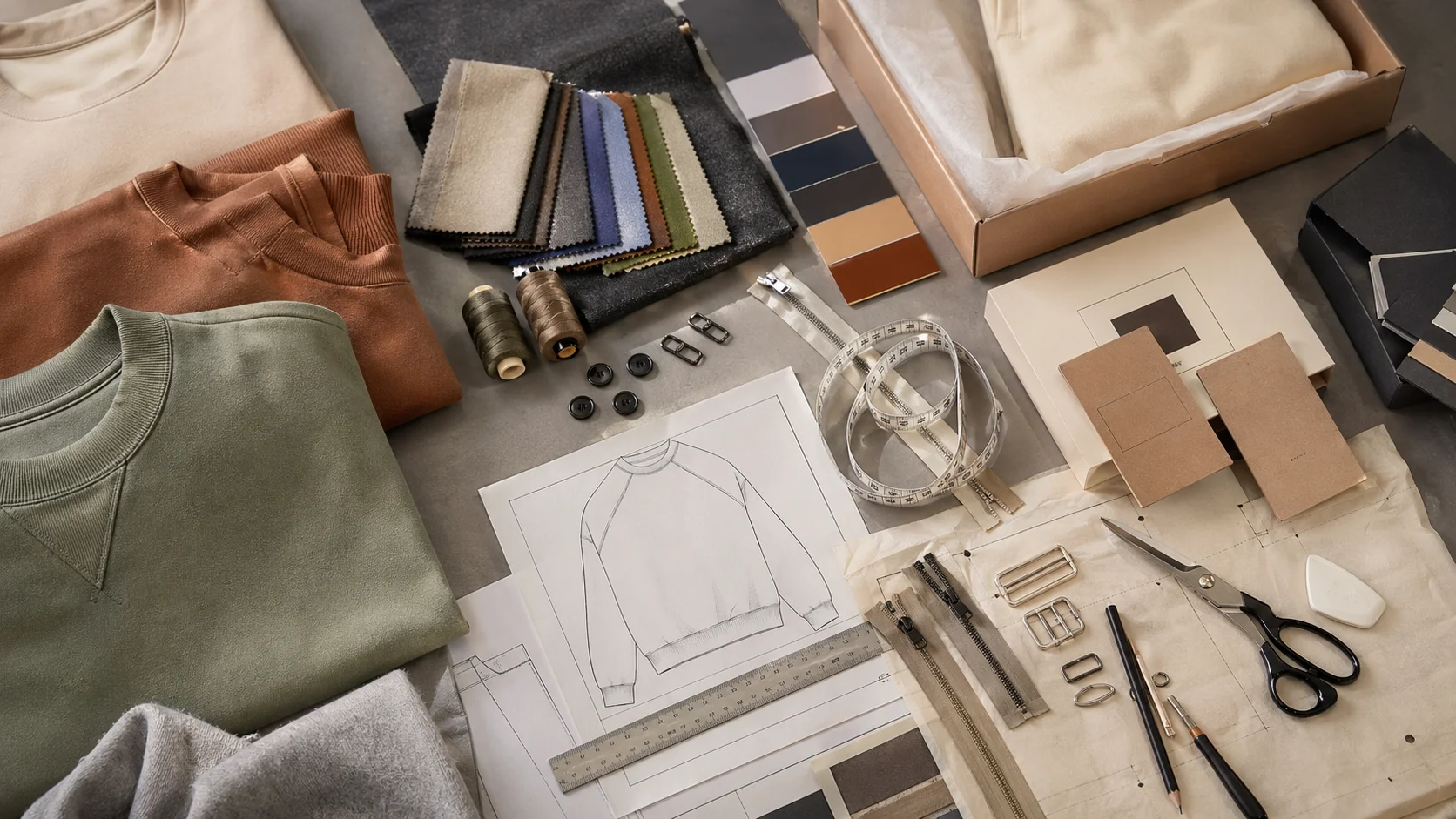
Clothing Manufacturer for Small Brands with checks for samples, fit, MOQ, QC evidence, pricing terms, and delivery risk.
Fast answer: Clothing Manufacturer for Small Brands: Samples, MOQ, QC, and Lead Time should be judged by production evidence, not by a generic sourcing promise. The buyer needs sample proof, cost breakdowns, QC checkpoints, and delivery buffers in writing.
Ask for recent sample photos, measurement tolerances, fabric or print test assumptions, decoration test notes, packing examples, and a named inspection checkpoint. These details show whether the team can repeat an approved sample at bulk volume.
Separate garment cost, decoration, labels, packaging, sampling, testing, freight, and rush charges. When every cost line is visible, it becomes easier to reduce colorways, adjust size depth, or reserve more time for sampling.
A brilliant design can still die on the factory floor. I have watched strong concepts, clear customer targeting, and polished launch plans collapse the moment a supplier could not handle small runs, pattern corrections, or consistent quality. That is why finding the best clothing manufacturer for small brands matters so much. I have seen factories where their “small order” claims suddenly mean you need to reserve a $15,000 production slot just to get an actual sample. Across 200+ factory visits in 8 countries, I have seen the same story repeat: creativity survives, factory fit does not. And the wrong fit can turn a $9 sampling mistake into a $90,000 inventory problem.
Small brands live or die by the first order. If a factory wants 1,000 pieces per color, needs four sample rounds to approve a sleeve, or demands 70% upfront, your cash gets trapped before the product ever reaches a hanger. In dense apparel hubs like Guangzhou, Dhaka, Ho Chi Minh City, and Istanbul, I found more mills, more trims, and faster sample corrections. In thinner regions, brands often faced 300 to 500 units per style and longer approvals, sometimes three to four weeks just for a corrected proto. That delay matters. In my experience, the moment a corrected proto sits in review for more than a week your entire launch calendar starts to look like a hostage situation (and finance gets twitchy).
The cheapest quote often becomes the most expensive one. I watched a $4.80 tee quote turn into a $7.90 landed cost after re-sampling, air freight, carton rework, and an 8% defect allowance. The brand could have paid $5.60 elsewhere and saved money. Honestly, this approach works better because once you accept a realistic landed cost, you stop chasing the lowest number that never materializes. Low sticker price can hide expensive chaos. It feels like watching a slow-motion train wreck when a $4.80 tee arrives needing rework and the factory blames the thread. For founders producing 50 to 5,000 units, the real question is not who is cheapest. It is who can make the same shirt twice, the same way.
That is why this buyer’s guide exists. I wrote it for brands that need a serious production partner, not a giant factory that only cares about 20,000 units. I have seen how private label clothing can work beautifully for small labels when the factory understands speed, label placement, and controlled color runs. I have also seen it fail when a supplier treats small orders like an inconvenience. The best clothing manufacturer for small brands earns trust by making the hard parts look boring. In my experience, nothing keeps a founder sane quite like a partner who owns the tech pack updates (and yes, I have received midnight texts about label placement).
The best clothing manufacturer for small brands does more than sew. It reduces decision fatigue. It reads a tech pack, flags a bad seam allowance, suggests a more stable rib knit, and warns you when your dyed viscose will bleed under a harsh wash test. That sounds basic. Many factories still miss it. A real partner protects you from learning every lesson the hard way.
Here is the service stack I expect to see: pattern making with Gerber AccuMark templates, grading tracked on Lectra cutting tables, sourcing of materials with OEKO-TEX Standard 100 and GOTS certification, sampling, bulk production, quality control with inline fabric inspections, labeling, and packing. For specialist categories, the same rule applies. A bra factory that understands cup construction and elastic recovery is not the same as a tee shop. I have seen founders move from unstable first fit to repeatable production only after choosing custom bra manufacturing teams that could handle underwire placement, strap tension, and five-point fit feedback without wasting three months.
Small brands need factories that accept editing. A good partner will revise a neckline 2 mm, swap a button from 18L to 20L, or explain why your chosen interfacing will fail after 10 washes. They should also own the learning curve of the first collection. The wrong factory expects you to arrive perfect. The right one helps you get there.
Sample house or production partner? Not the same thing. (In my experience, sample houses love the creative stage but bail when you need 500 pieces with consistent tension.) A sample house may love tiny test runs and one-off prototypes, but cannot repeat 500 pieces with stable tension, trim control, or packing discipline. A production partner may look less glamorous, but it knows how to keep fabric shrinkage within 3% and defects under 2% across bulk. That quiet competence cuts sample rounds from four to two, shortens approvals from six weeks to three, and protects cash flow when every dollar matters.
I have also seen how the right factory handles category differences. custom baby clothing manufacturing needs softer trims, safer labels, and stricter compliance than adult basics. A factory that can serve both categories usually has better discipline on testing, documentation, and consistency. That is exactly what you want from the best clothing manufacturer for small brands.
Region changes everything when you are choosing the best clothing manufacturer for small brands. China often gives the widest fabric access, especially for jersey, fleece, and trim libraries, with sample turnaround as fast as 5 to 7 days in strong hubs. India can be excellent for cotton knits and artisan finishes, but communication and specification discipline vary more by factory. Portugal tends to deliver cleaner construction and tighter QA, with production often starting at 100 to 300 units per color for select programs. Turkey sits between speed and specialization, with 2 to 4 week bulk windows if fabric is ready. Vietnam is strong on cut-and-sew basics and stable bulk repeatability. The United States offers the fastest feedback loop, but labor costs can push a simple tee above $12 before freight. Honestly, this approach works better because you align technical requirements with a factory’s regional strengths instead of randomly chasing the lowest quote.
For a basic cotton tee, I have seen factory quotes of $3.20 in India, $4.10 in Vietnam, $5.50 in Turkey, and $7.00 in the United States, before freight and duties. Once you add packaging, wastage, and import costs, that $7 tee can land near $12 or more in some markets. Premium cut-and-sew, like French terry 320 GSM hoodies or enzyme-washed sweatshirts, widens the gap even further because labor and finishing matter more than raw fabric cost. The fabric itself may be only $2.80 to $4.50, but construction can double the final unit cost.
MOQ is the trap hidden inside “affordable” pricing. Some facilities talk about small brands but only accept 50-piece samples, not true repeat production. Real production MOQs often sit at 100 to 300 units per color in flexible factories and 500 to 1,000 in more rigid ones. Specialty items are worse. Structured outerwear, corsetry, and technical items can require 300 to 500 units per style just to justify setup. That is why cut and sew manufacturing matters for small brands: it gives more control, but only if the factory actually respects lower runs. The best clothing manufacturer for small brands will state those numbers plainly, not hide behind vague optimism.
Timeline tradeoffs are just as real. A local supplier may get you a sample in 7 days and bulk in 2 to 3 weeks. Offshore production can stretch to 4 to 8 weeks for samples and 30 to 60 days for bulk, depending on fabric lead times and shipment slots. A factory in Guangzhou that runs computerized Lectra cut tables, Juki AMS-210EN automatic seamers, and Brother 2-needle chain stitchers can hit 18-22 business days from approved sample to first bulk shipment when all materials are staged. In Dhaka, I have seen $2.50-4.00 per unit at 500 MOQ for organic cotton tees using GOTS-certified yarn and OEKO-TEX Standard 100 dyeing, but you still need to lock the slot 8 weeks in advance because the dye house and finishing mills schedule in blocks. Ho Chi Minh City excels with laser-guided rotary cutting and ultrasonic welding for seamless athleisure, yet these investments only pay off when the brand confirms fabric in one colorway early.
Look closely at the quoting structure. Some factories give a low labor rate but hide a high trim fee or rush charge. Ask for the Excel breakdown that shows fabric, labor, trims, washing, and packing, and verify each line against your tech pack and materials list. A good partner will also include a buffer for dyes that require pre-treatment or finishes that trigger WRAP or BSCI audits.
Vetting starts with documentation. Request copies of ISO audits, BSCI compliance reports, WRAP certificates, and any site qualifications like GRS for recycled polyester usage. If the factory claims to use GOTS-certified cotton, ask to see the spinner’s certificate and the dye house’s OEKO-TEX Standard 100 marks. Many factories in Ho Chi Minh City and Istanbul run accredited labs on-site with spectrophotometers and tensile testers; seeing the lab log makes the difference between trust and hope.
Next, walk the floor—physically or virtually. Look for computerized pattern storage, automated buttonholing, and modular sewing lines that use smart feeders. A factory that tolerates static-charge on cut bundles or lets fabric pile up untagged is simply not ready for a 500-unit run. Ask for recent tech pack edits and the number of fit iterations they accommodated without extra charges. If they cannot produce a photo diary of the sample journey, move on.
Finally, request a balanced reference list. Legitimate small brand partners will share contacts from similar projects—think indie swimwear labels or boutique athleisure lines that ordered 800 pieces per SKU and stayed within a 2% defect tolerance. Follow up with those references to confirm shipping timelines, payment terms, and responsiveness.
Beware factories that use vague MOQs like “negotiable” without naming a floor, or that push you to pay 50% before they even confirm fabric availability. If a supplier cannot spell out whether the fabric is 100% Supima cotton, 280 GSM single jersey, or recycled polyester with a GRS certificate, they probably cannot support traceability later. Beware of machines left idle—if the line workers are not using overlock machines with automatic tension control or the pressing area lacks a steam tunnel, the final crosshatch won’t meet your specification.
Another red flag is labs that only test colorfastness but skip dimensional stability or pilling. The best factories run a complete suite of AATCC tests, track every wash cycle, and keep a digital log. If they cannot provide a wash test report with instructions used (e.g., 40-degree rinse, enzyme treatment, tumble dry low, etc.), question whether they know how your product will behave after 10 wears.
Finally, if a factory resists third-party inspections (SGS, Intertek, or QIMA), or tries to replace documented checkpoints with verbal assurances, that is a warning. The best clothing manufacturer for small brands embraces visibility because they know good documentation prevents issues.
Start by building a shortlist of three to five suppliers and mapping their strengths—Guangzhou for trim-heavy streetwear, Dhaka for organic cotton basics, Istanbul for tailored pieces with BSCI compliance, and Ho Chi Minh City for athleisure with ultrasonic seam sealing. Then compare them against three criteria: MOQ commitment, documented quality control (MRP/PPS, inline inspection), and certification stack (WRAP, OEKO-TEX Standard 100, GOTS, GRS).
Next, run a pilot order with clear KPIs: 18-22 business days for the first 200-unit run, defect rate at or below 2%, and tertiary packing per your spec (tissue wrap, hangtags, polybags). Use that learning to refine your tech pack, confirm trims, and lock in pricing for future runs.
Finally, document every iteration. Keep a shared folder with color codes, hardware specs, grading charts, and final fit videos. When the second order hits 500 units, the factory should already know your preferences—meaning less rework and faster shipping.
Sustainability is not a checkbox; it is a supply chain decision. Choose fabrics with OEKO-TEX Standard 100 certification for skin contact, GOTS certification for organic fibers, and GRS marking for recycled blends. Prefer mills that use water-saving reactive dyes, closed-loop washing, and energy recovery boilers, especially in dye houses around Ho Chi Minh City and Guangzhou that report on effluent quality monthly.
Machine choices matter too. Factories with laser-guided cutting tables reduce waste, while ultrasonic welding and temperature-controlled pressing optimize adhesives and coatings without solvents. Ensure your partner can run enzyme washes or stone washes safely and still meet WRAP labor standards.
Finally, track every yard through the supply chain. Transparent factories share batch numbers, test results, and transportation documents so you can claim compliance with BSCI and WRAP audits without digging.
What is a reasonable MOQ for a small brand? Look for flexible arrangements—500 units per color is reasonable in China, Dhaka, or Istanbul when the factory uses computerized prep tables and modular sewing cells; 100-300 units is possible in Portugal or Turkey when you pre-prep fabric. Always confirm whether that MOQ applies per style, per color, or per size run.
How long does it take to get a bulk order? Expect 30-60 days from sample approval to bulk shipment offshore, depending on the fabric and finishing you select. Locally, the timeline shrinks to 18-22 business days if the factory already stocks your trims and the machines (Juki overlockers, Brother flatbed, or Brother 4-needle coverstitchers) are calibrated.
Do certifications matter for small orders? Yes. Certifications like GOTS, OEKO-TEX Standard 100, WRAP, BSCI, and GRS prove that the factory adheres to environmental, quality, and labor standards—and they can tip the scales when you attract wholesale or retail partners.
Can I source sustainably without breaking the bank? You can, but you must plan. Choose regenerative cotton or recycled polyester blends certified by GRS, negotiate fixed dye lots, and ask for digital inspection reports. That way, your cost per unit may rise to $6.50 or $7.50 for a premium tee, but the repeatability saves you money over time.