
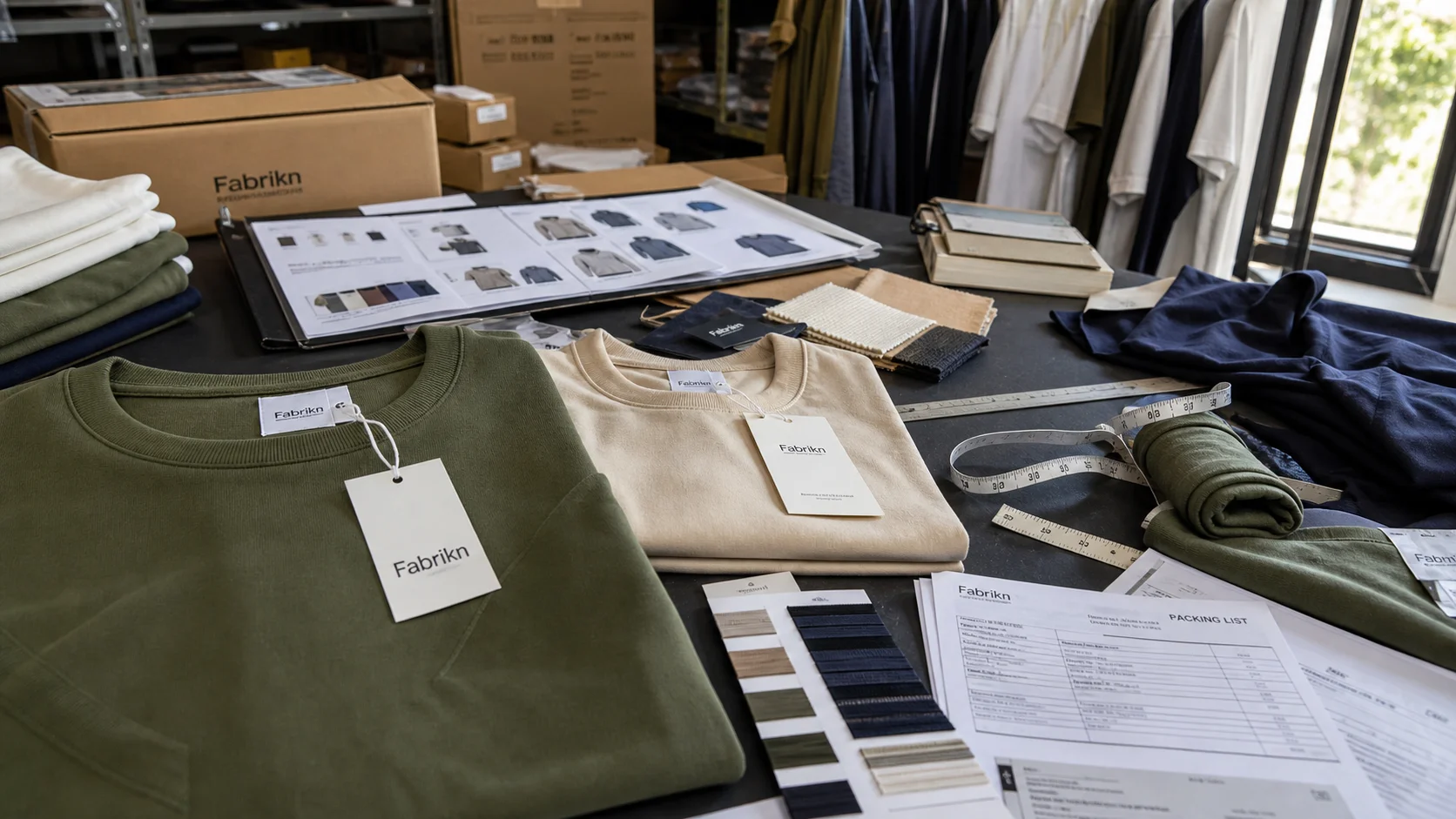
Low-MOQ Clothing Manufacturer with checks for samples, fit, MOQ, QC evidence, pricing terms, and delivery risk.
Fast answer: Low-MOQ Clothing Manufacturer: Size Runs, Color Limits, Sampling, and Cash Flow should be judged by production evidence, not by a generic sourcing promise. The buyer needs sample proof, cost breakdowns, QC checkpoints, and delivery buffers in writing.
Ask for recent sample photos, measurement tolerances, fabric or print test assumptions, decoration test notes, packing examples, and a named inspection checkpoint. These details show whether the team can repeat an approved sample at bulk volume.
Separate garment cost, decoration, labels, packaging, sampling, testing, freight, and rush charges. When every cost line is visible, it becomes easier to reduce colorways, adjust size depth, or reserve more time for sampling.
Factory floors have a way of telling the truth quickly. During audits across Vietnam, Portugal, Turkey, India, and Los Angeles, I kept seeing the same thing: many factories will happily take a 50-unit order and still price it 20-40% higher than a 300-unit run. That is not greed. It is risk pricing. A low MOQ clothing manufacturer for fashion brands is selling machine time, operator attention, and schedule flexibility, not just garments.
Small orders move for practical reasons. I have watched them slip through lines that usually want 1,000-piece commitments because a plant had a two-day gap to fill, wanted to test a new fabric account, or was backing a label that could reorder in 60 days. Idle capacity, lower inventory risk, and access to production systems young brands could not otherwise fund are the usual reasons.
Regional behavior splits fast. In Southeast Asia, flexibility is often part of the pitch; factories in Vietnam and parts of Indonesia will quote 100-200 units if the style is simple, the fabric is stocked, and the trim package is standard. In Europe, some workshops go lower still, sometimes 30-80 pieces, but labor can push unit prices into the $18-$45 range for a basic woven shirt or knit top.
A similar style from a mass supplier might land at $7-$14, though anything under 300 pieces gets rejected. Premium factories can be easier to work with on small orders than mid-market suppliers because short, frequent cycles keep their teams busy. A clean 120-piece order beats a 1,200-piece knot in the schedule every time.
Bottom line: small orders are not cheap by default, but they can be smart if they buy speed, cut inventory risk, and keep cash free for the styles that actually move. According to World Trade Organization apparel trade overview, apparel trade remains highly fragmented, which is why factories still price around capacity and risk instead of a flat cost per unit.
The wrong factory turns a 100-piece launch into a 10,000-piece headache. I have seen brands choose a supplier because the website said “low minimums,” then discover the shop only understood T-shirts, not structured trousers, bonded activewear, or engineered knits. Product type decides almost everything: knitwear often runs at 100-300 units because knitting and sewing are flexible; woven apparel usually needs 150-500 units because cutting and pressing are stricter; denim can demand 300-800 units because wash consistency and hardware setup cost more; activewear may start around 150-400 units, but compression fabrics and bonded seams raise the stakes.
Before you ask for a quote, ask five blunt questions. Can the factory source fabric, or must you supply it? Will they develop the pattern in-house, or do they expect a finished tech pack? What are the grading fees for sizes XS to XL, or XS to 3XL? What are the trim minimums for labels, zippers, and buttons? Can they handle repeating colors across 2-3 drops without redoing lab dips every time? If they cannot answer clearly, your first sample will probably expose gaps that should have been obvious on day one.
Factory specialization shows up in the sample room long before it shows up in a sales pitch. I look at stitch density, seam consistency, label placement, and how they handle difficult materials such as 320 GSM French terry, cupro, or recycled nylon. Machine lists matter too. Flatlock, coverstitch, and bartack equipment open up more activewear options than a shop with only basic overlock and lockstitch lines. Production photos help. Sample quality matters more. If the sample comes back with puckering, skipped stitches, or crooked plackets, the bulk order will not suddenly improve.
My checklist shifts with brand stage. Startups should keep it simple: 1-2 styles, stocked fabrics, 50-150 units, one fit model. Pre-launch brands need stronger development support, including at least 2 sample rounds and a clear costing sheet. DTC scale-ups should care about repeatability, because 300 stable units beat 3 separate 100-unit emergencies. Niche premium labels can accept higher unit costs if the factory gives better handfeel, better finishing, and private label clothing options that protect margin.
For bras and intimates, the bar rises even higher; I have seen brands save months by sourcing from a specialist in custom bra manufacturing instead of forcing a generalist to improvise. Same logic, different category, for newborn lines, where custom baby clothing manufacturing demands stricter safety, softer trims, and tighter compliance than a standard jersey tee.
Pricing a small run takes two numbers, not one. Unit price gets the attention. Total landed cost decides whether the style survives. I recently compared three common scenarios for a simple women’s knit top: 50 units, 100 units, and 300 units. At 50 units, a low MOQ clothing manufacturer for fashion brands might quote $14-$22 per piece before freight because setup time gets spread over very few garments.
At 100 units, that could drop to $11-$17. At 300 units, it may fall to $7-$12, assuming the fabric is available and the color is standard. The math improves quickly, but only if the style stays put.
Then the hidden costs show up. Pattern making can run $80-$300 per style. Tech packs may cost nothing if you build them yourself, or $150-$500 if a consultant prepares them. Fabric dye minimums can force you to buy 50-100 meters more than planned. Lab dips, wash tests, freight, customs duties, and inspection fees add another layer. Choose enzyme wash instead of stone wash and the cost and handfeel can shift enough to move margin by 2-5 percentage points.
On a 300-piece order, that matters. On a 50-piece order, it can decide whether every unit loses money. Regional pricing bands help if you compare honestly. China often sits in the middle: efficient on fabric access and trims, but not always the cheapest for true low MOQ. Vietnam can look similar, sometimes stronger on knit and casual basics. India often offers competitive fabric costs and flexible sourcing, though communication and sampling speed vary widely.
Turkey usually prices higher than South Asia but can win on shorter lead times to Europe and stronger knit or denim expertise. Portugal sits in the premium band for small runs, with reliable workmanship and higher labor costs. Los Angeles tends to be the most expensive for small batches, yet its speed and domestic responsiveness can save a launch that cannot wait 12 weeks for a container.
The upside is cash protection. A 100-piece run at $12 costs $1,200 before freight, while a 300-piece run at $8 costs $2,400. The larger order is cheaper per piece, yet it ties up twice the cash and triples inventory risk. For a new brand, that is not a small distinction.
I have seen founders save themselves by paying more per unit in year one, then reordering only after sell-through data proved the style could carry volume. According to Textile Exchange standards and materials guidance, recycled fiber adoption keeps rising, but recycled content often carries different minimums and supplier sourcing constraints.
If your order includes recycled polyester or organic cotton, ask early about certification paperwork and whether the mill can support your quantity without substitution. For trade and import planning, the U.S. International Trade Administration is also a useful reference for customs and market-entry basics.
Small runs do not automatically mean fast runs. I have seen founders assume 75 pieces will move in 2 weeks, only to wait 5 weeks for fabric approval and another 3 weeks for sampling. A realistic timeline starts with inquiry and costing, which can take 2-5 days if the tech pack is clean.
First sample development often takes 7-21 days. Fit corrections add another 5-10 days. Bulk production for a low MOQ clothing manufacturer for fashion brands can then take 3-6 weeks, depending on fabric availability and factory workload.
Domestic production shortens shipping, not always development. A Los Angeles factory may finish a small jersey program in 3-4 weeks, while a Turkey or Portugal workshop can deliver in 4-8 weeks plus transit. Offshore production can still be competitive for simple knit tops, especially when the fabric is stocked.
Heavy knits, denim, and activewear with bonded seams take longer because more steps need testing before bulk approval. The main bottlenecks are boring, not glamorous. Fabric mills often control the schedule. Trims can be delayed by 1-3 weeks if labels, zippers, or elastic are not standard.
Fit revisions burn time if the brand keeps changing measurements after the first sample. Internal approval delays hurt just as much. I have watched a 12-day sample turn into a 40-day delay because the brand took 9 days to approve a seam change. Low MOQ reduces inventory risk, but it does not erase development time.
If anything, the small run forces discipline. A cleaner tech pack, clearer grading, and faster response to comments can shave days off every stage. Brands that move quickly usually treat the first sample as a data point, not a mood board.
Small batches make quality failures easier to see and harder to absorb. If a 2% defect rate hits a 50-piece order, that is one broken seam, one bad print, or one mislabeled carton. If the same defect rate hits 300 pieces, you can still rework and recover. That is why I push small-brand buyers to inspect early, not only at the end.
Ask for documents before you pay a deposit. You need material composition details, test reports for colorfastness and shrinkage, workmanship standards, and social compliance audits where relevant. For fiber claims, request traceability on recycled content and confirmation of chemical restrictions such as restricted azo dyes or formaldehyde thresholds.
Standards matter. According to OEKO-TEX chemical safety standards, chemical safety testing is not a decorative extra; it is a baseline for credible claims. I use three inspection points. Pre-production checks confirm fabric, trims, and measurements before cutting starts. Inline inspection catches issues while 20-30% of the order is still on the line, when correction is still cheap.
Final random inspection checks packed goods against the approved sample. If a factory refuses all three, I treat that refusal as data, not inconvenience. Sustainability claims need paperwork even on 80-piece orders. If a supplier says organic, recycled, or low-impact, ask for the certificate number, the transaction record, and the lot identification.
A small run still touches raw material sourcing, dye houses, finishing chemicals, and packaging. Claims without documents travel well on social media. They fail in audits.
The first 100 units are not the finish line. They are a test. I have seen brands use low MOQ runs to measure sell-through, collect fit feedback, and watch reorder speed before committing to 500 or 1,000 units. If a style sells 70% within 30-60 days, returns stay below 8-12%, and customers reorder within 6-8 weeks, that style has earned a larger production conversation.
Once demand is proven, negotiate on the parts that matter. Ask for better fabric pricing at 300-500 units, lower sampling fees on repeat styles, and shorter approval windows. Move from one-off development to a repeat calendar with clear drop dates, such as February, May, August, and October. That rhythm gives the factory planning visibility and helps your brand avoid emergency production.
Scaling does not mean losing flexibility. It means using the same pattern block, the same trim library, and the same factory notes across multiple runs. Brands that work with private label clothing programs often scale faster because the factory already understands their fit and finishing requirements.
If your line depends on detailed panels, complex topstitching, or technical construction, a specialist in cut and sew manufacturing can keep quality consistent while volume rises. The best scaling signal is not hype. It is repeat purchase. If customers buy the same style twice, you have evidence. If they only buy once, the next order should stay conservative, even if the first batch sold out.
Start with the product, not the supplier list. Define the style, fabric, size range, and target quantity. Build a tech pack with measurements, construction notes, and trim callouts. Request MOQ tiers in writing, compare sample quality on the same spec sheet, and confirm lead times before any deposit leaves your account. I would shortlist 3 factories, not 12.
Audit each factory on four points: response speed within 24-48 hours, access to materials, payment terms such as 30/70 or 50/50, and production transparency through photos or line updates. Score the samples on fit, stitch quality, labeling, and consistency. Then choose the supplier that can repeat the result, not the one that promises the lowest number.
If you need to move from research to first order within 30 days, make the first week about documentation, the second about sampling, the third about revisions, and the fourth about production booking. Speed comes from clarity. Clarity comes from numbers.
It is a factory that accepts smaller production runs, often 50-300 pieces instead of 500-1,000. The trade-off is usually a higher unit price, often 20-40% above a larger order, because setup costs are spread across fewer garments.
For a simple knit top, I have seen 50-piece runs price at $14-$22 per unit, 100-piece runs at $11-$17, and 300-piece runs at $7-$12, before freight and duties. Pattern making, sampling, labeling, and inspection can add another $200-$1,000 depending on complexity.
Sampling usually takes 7-21 days, fit revisions another 5-10 days, and bulk production 3-6 weeks. Domestic factories can be faster on shipping, while offshore factories may add 1-4 weeks of transit depending on region and freight method.
Yes, but minimums are often higher than for basic knits. Denim commonly starts around 300-800 pieces because wash consistency and hardware setup raise costs, while activewear often starts around 150-400 pieces due to technical fabrics and specialized sewing equipment.
If speed is the priority, domestic production in places like Los Angeles can reduce shipping time and simplify communication. Turkey and Portugal can also be fast for European buyers, especially when fabric is already in stock and the style is technically simple.