
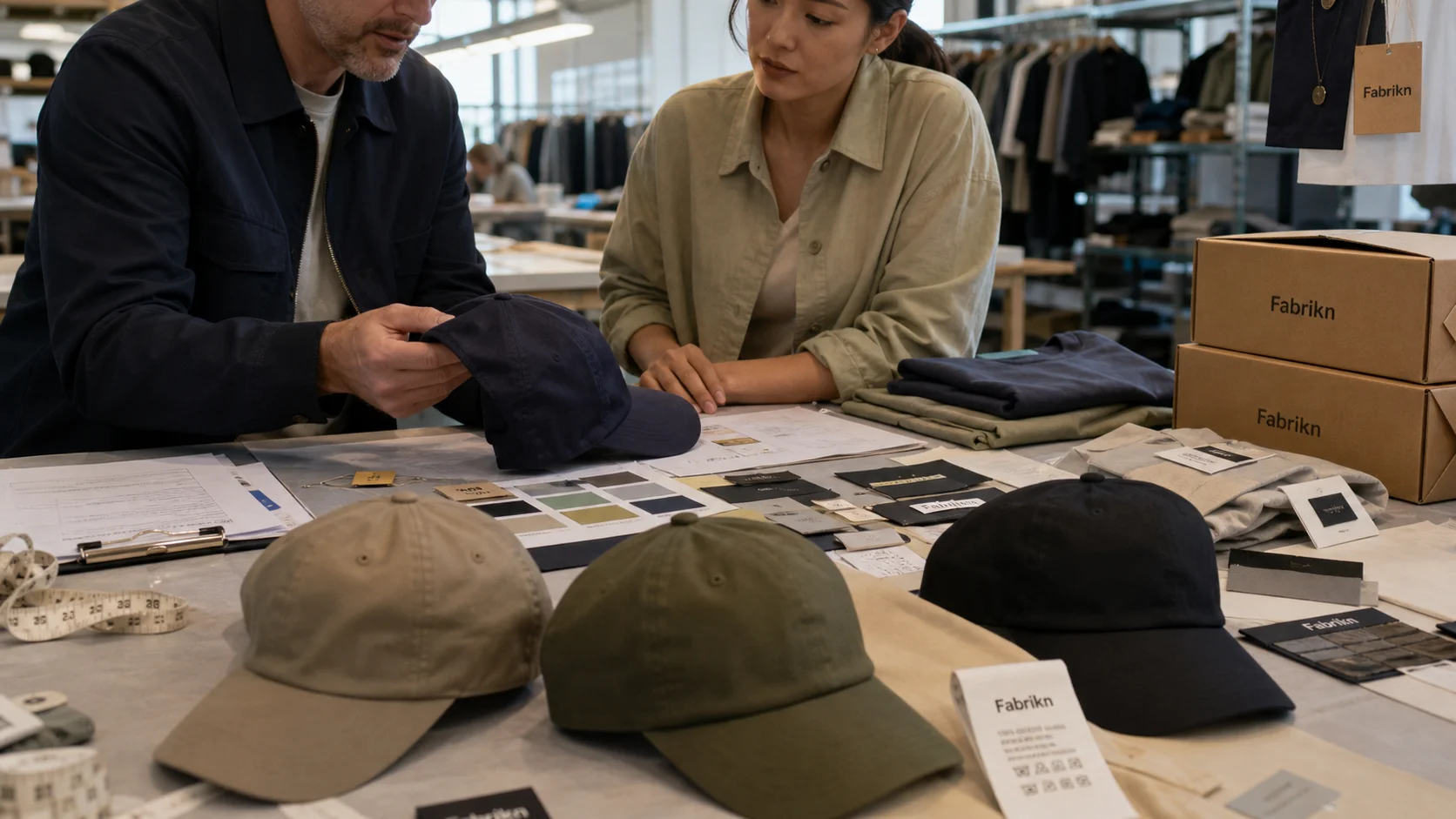
ODM Clothing Manufacturer for Fashion Brands with checks for samples, fit, MOQ, QC evidence, pricing terms, and delivery risk.
Fast answer: ODM Clothing Manufacturer for Fashion Brands: Range Development, MOQ, and IP Control should be judged by production evidence, not by a generic sourcing promise. The buyer needs sample proof, cost breakdowns, QC checkpoints, and delivery buffers in writing.
Ask for recent sample photos, measurement tolerances, fabric or print test assumptions, decoration test notes, packing examples, and a named inspection checkpoint. These details show whether the team can repeat an approved sample at bulk volume.
Separate garment cost, decoration, labels, packaging, sampling, testing, freight, and rush charges. When every cost line is visible, it becomes easier to reduce colorways, adjust size depth, or reserve more time for sampling.
Three sample revisions can burn through 6-10 weeks and drive development costs up by 15-25%. I have watched that happen in Shenzhen, Ho Chi Minh City, and Braga, usually after a brand tried to build a collection from scratch with no clear fit target and no reliable block. When that happens, an ODM clothing manufacturer for fashion brands can be the smarter route because it starts from a proven base instead of a blank page. First sample looks promising. Second sample exposes sleeve drag. Third sample arrives with a neckline that still twists after washing. The calendar bleeds. So does cash.
That is why an ODM clothing manufacturer for fashion brands becomes attractive once a label moves past the romantic idea of a blank-page design process. ODM shifts the work toward proven base styles, pre-tested patterns, and materials that already behave on the line. For a new brand, that can cut technical risk fast. In factories I visited, especially knitwear and casual wear units, ODM programs often moved 2-4 weeks faster than fully custom programs because the pattern base already existed and the sewing sequence had been solved before.
Across China, Vietnam, and Portugal, I saw a pattern. China offered the broadest range of ready blocks and the quickest turn on repeatable styles, often with 300-500 piece MOQ for simple tees or joggers. Vietnam was strong on clean sewn construction and steady workmanship, though timelines could stretch by 1-2 weeks if fabric sourcing was split across mills. Portugal impressed me on premium smaller runs, usually 150-400 pieces, but the price per unit could run 25-40% higher than comparable Asian sourcing. Speed mattered, yes. Clarity mattered more. When the tech pack was vague, even the fastest factory slowed to a crawl.
The thing nobody tells you: a higher unit price can still lower total launch cost. I have seen brands pay $3.40 instead of $2.70 per piece and save $4,000-8,000 overall because they needed one fewer sample round, avoided two air-freight corrections, and did not sit on 600 dead units that no retailer wanted. That trade-off is especially sharp for small labels trying to test a category before scale. An ODM path is not a shortcut for lazy sourcing. It is a way to buy time, reduce technical risk, and keep identity intact when the first season has to land on schedule.
ODM means the factory offers a ready-made or semi-developed product that a brand can adapt. The manufacturer owns the base pattern, initial construction logic, and often the material library. The brand comes in with a brief, then customizes the offer. That is different from starting with a blank sheet and asking a factory to engineer every seam from zero.
Here is the cleanest way to separate the models. In OEM, you bring the design, the tech pack, and the product direction, and the factory executes. In private label, you often buy a stock style with limited changes such as logo, color, or packaging. ODM sits between those two. You can usually change fabric, trim, color, fit, logo placement, labeling, and packaging, but the core silhouette stays anchored to a proven base. That boundary matters because it shapes who owns what and how much room you have to move.
I have seen brands use ODM for fashion tops, outer layers, loungewear, and even niche categories like sleepwear. For custom bra manufacturing, the line is narrower because fit engineering and support structure are more sensitive. For basics, ODM is often enough. For highly engineered pieces, you need to know exactly where the factory’s design starts and where your brand’s control ends.
The business trade-off is clear. You give up some design freedom, but you gain speed and fewer technical errors. Sample development may drop from 3 rounds to 1-2 rounds, and a launch calendar that once needed 12-16 weeks can sometimes compress to 8-10 weeks if fabric is available. Contracts should spell out design transfer rights, exclusivity by market, and ownership of modified patterns and artwork. If the factory keeps a version of your adapted block, that should be stated. If your print is unique, that should be protected. I have seen brands lose leverage because they assumed “customized” meant “owned.” It does not.
Factory specialization matters more than a glossy sales deck. A T-shirt ODM and a tailored blazer ODM are not interchangeable, even if both claim 20 years of experience and show beautiful showroom rails. I learned that the hard way in 2019, when a factory that excelled at jersey tops quoted me on a structured jacket. The sample looked fine from five feet away. Then I checked the armhole balance, and the whole jacket pulled. The wrong expertise costs money.
Knitwear factories usually have stronger sample speed because the construction is simpler, the blocks are repeatable, and the machines are tuned for stretch behavior. Outerwear plants need better seam engineering, more testing, and tighter control over zippers, lining, and waterproofing. Denim sits somewhere in between, with wash development adding time and cost. MOQ can swing wildly: 300-500 units for a simple jersey style, 1,000-2,000 units for complex outerwear with bonded seams, and often 600-800 units for denim if multiple washes are involved.
From my factory visits, China often led in breadth and speed. Vietnam was strong in sewn categories with disciplined operators and good line balance. Portugal stood out for smaller premium runs, especially for brands that wanted closer communication and shorter replenishment distances into Europe. I have also seen plenty of mismatches. A factory that ships perfect French terry hoodies at 320 GSM may struggle with tailored trousers because the skill set is different. That is why product strategy must match factory capability, not just the quoted FOB. The wrong fit of factory to category can add 2-3 weeks, 2 extra revisions, and a lot of frustration.
If your assortment mixes knit basics with structured pieces, split the sourcing. I would rather place tees through one specialized line and woven pants through another than force one plant to do both badly. For brands building around private label clothing, that separation becomes even more useful because the winning move is often category focus, not supplier sprawl.
On paper, custom development looks more ambitious. In practice, it often costs more before the first carton ships. Sample fees can run $50-$150 per style for ODM, while fully custom programs may start at $120 and climb well above $300 once grading, pattern revisions, and fabric development enter the picture. Development fees, when charged separately, can add another $200-$1,000 per style depending on complexity. I have seen brands underestimate the number because the factory quoted only the sample and not the work behind it.
An ODM program can reduce upfront development spend by 20-40% in some categories because the factory is reusing proven blocks and tested sewing routes. A custom cut-and-sew program, by contrast, often carries more risk in fit, more fabric waste, and a longer calendar. If a brand needs 3 sample rounds instead of 1 or 2, the hidden cost is not just the fee. It is freight, lost sales timing, and the opportunity cost of missing a retailer buy window by 4-6 weeks. If the retailer seasons do not wait, neither does your margin.
Hidden extras matter. Fabric upcharges can add 8-15% if your chosen mill minimum is below the factory’s normal purchase volume. Revision fees may appear once you change pocket shape or waistband width. Packaging, testing, courier runs, and QC inspections can easily add $300-$1,500 per style before bulk production begins. For categories like sweaters, cut and sew manufacturing can become expensive quickly if the factory has to source specialty yarns, test shrinkage, and rework the grading after wash.
I compare landed cost, not just FOB. A style at $6.20 FOB from one ODM supplier may beat a $5.70 quote if the cheaper factory has a 12% defect rate, forces 2 air shipments, or causes 5% returns because the fit is inconsistent. A premium source at $7.10 can win if it delivers 97% on-time, keeps defects under 2%, and cuts rework. That is the math I use. Price matters. Total cost matters more.
I do not trust sustainability language until I see documents, dates, and line-floor evidence. Factories can show certificates without proving that production follows them daily. According to OEKO-TEX, chemical safety claims depend on verified testing and traceability, not just a logo on a brochure. That is exactly how I assess suppliers: proof first, pitch second.
The most useful checks are audited social compliance, chemical management, fabric traceability, wastewater controls, and recent testing reports. If a factory claims organic cotton, ask for transaction certificates and mill invoices. If it claims low-impact dyeing, ask where effluent is treated and how often. Data from Textile Exchange shows that fiber sourcing claims only matter if they can be traced through the chain. A certificate from 3 years ago tells you very little about current bulk production.
I have seen higher-cost factories with excellent documentation and budget factories that outperformed them on waste control. Price does not determine discipline. In one plant in Vietnam, a $3.90 tee program had tighter cutting-room waste than a Portuguese factory charging four times that, because the operators tracked lay efficiency every shift and reused offcuts for trim samples. That kind of rigor is rare, but it exists.
Here is the factory-visit insight that saves headaches. Clean sample rooms do not guarantee better bulk production, and polished showrooms can hide weak finishing lines. I have walked through immaculate reception areas, then found skipped bartacks, uneven topstitching, and thread tails on the real floor 40 meters away. Ask for 12 months of test reports, recent audit dates, and evidence of corrective action plans. If a factory cannot show what changed after a nonconformance, its sustainability claim is just marketing ink. For audit frameworks, I also check WRAP because the corrective-action trail is often more revealing than the badge.
Vague specs are a warning sign. So is a factory that refuses to write down MOQ, fabric substitutions, or lead time milestones. I get nervous when a supplier pushes for a deposit before sample approval, because that shifts risk onto the brand before the product is even proven. If the MOQ is “flexible” but never documented, it is not flexible. It is undefined.
Exclusivity has to be precise. It can be by market, by channel, or by SKU, and each version needs a paper trail. If you want a silhouette reserved for Europe, say Europe. If you want the fabric locked for 12 months, state the exact mill code, weight, and color range. Modified patterns, trims, and prints should have clear IP language, especially if the ODM also sells to competing brands. I have seen a brand lose a core sweatshirt shape because the pattern file was never assigned back to them.
Timeline protections matter too. If fabric is late by 10 days, what happens to the production slot? If approvals slip by 5 days, does the factory automatically move your order behind the next client? Put that in writing. Include penalties, inspection rights, defect thresholds, and replacement terms. A fair contract is not hostile. It is a map. Brands that skip this step often pay for it later with emergency freight, missed launches, or product they cannot sell. I would rather negotiate now than explain a dead stock pile later.
Start with numbers, not mood boards. Define target margin, order size, category, delivery window, and sustainability rules before you email a supplier. If your launch needs 800 units of French terry hoodies at 320 GSM, say that. If your margin target is 65% and your retail price is $48, work backward before anyone samples a stitch. You will save time by being specific on day one.
My sourcing checklist is simple. Check factory specialization, sample speed, MOQ, testing capability, communication quality, payment terms, and references. Ask how many styles they run per month, what their defect rate is, and whether they can show you three recent buyer references in your category. Also ask for response time. A supplier that takes 4 days to answer a fabric question in sampling will not become faster in bulk. A strong ODM clothing manufacturer for fashion brands should be able to explain production planning, quality checkpoints, and bulk capacity without hesitation.
Run a pilot order of 100-300 units before you commit to a season. That is enough to test fit, defect rate, packing accuracy, and delivery reliability without locking the entire budget. I have watched brands use a pilot to catch a 7 mm collar issue, a labeling error, and a shrinkage problem that would have cost them 1,200 units later. Small test, big savings.
Use a scorecard to compare factories on cost, lead time, quality, flexibility, and compliance. I score each category from 1 to 5, then weight quality and compliance more heavily if the product will touch skin or sit in a premium price band. If you sell babywear, the standards should be stricter; a line like custom baby clothing manufacturing demands tighter testing and lower tolerance for finishing defects than a fashion tee does. Close the process with a controlled first order, a written inspection plan, and a clear exit if the sample-to-bulk gap widens. That is how I buy: shortlist, pilot, verify, then scale.
If you want a practical next step, compare the factory’s bulk calendar, sample turnaround, and QC checklist against your launch date. A reliable ODM clothing manufacturer for fashion brands should make those numbers easy to review, especially when you are buying wholesale or scaling in bulk for a seasonal drop. The right partner does not just say yes; it shows you exactly how the season will land.
An ODM clothing manufacturer offers pre-developed or semi-developed styles that a brand can customize. Typical changes include fabric, color, trims, fit adjustments, labeling, and packaging. This often cuts sample rounds from 3 to 1-2 and can shorten development by 2-4 weeks.
Sample fees often range from $50-$150 per style, while custom development can start around $120 and rise above $300 depending on complexity. Bulk FOB prices vary by category, but ODM can reduce upfront development spend by 20-40% in some cases.
For simple knit styles, ODM sampling can take 7-14 days if materials are available. More complex woven or outerwear styles may take 2-4 weeks, especially if fit corrections or fabric sourcing are still in progress.
Yes, but only if exclusivity is written into the contract. You should define whether exclusivity applies by market, channel, SKU, or fabric, and specify who owns modified patterns, prints, and artwork. If it is not written down, it is hard to enforce.
China often offers the broadest ODM selection for small runs, especially for knits, while Portugal is strong for premium smaller orders and Vietnam performs well in sewn categories. For simple knits, MOQs can start around 300-500 pieces; outerwear often needs 1,000+ units.