
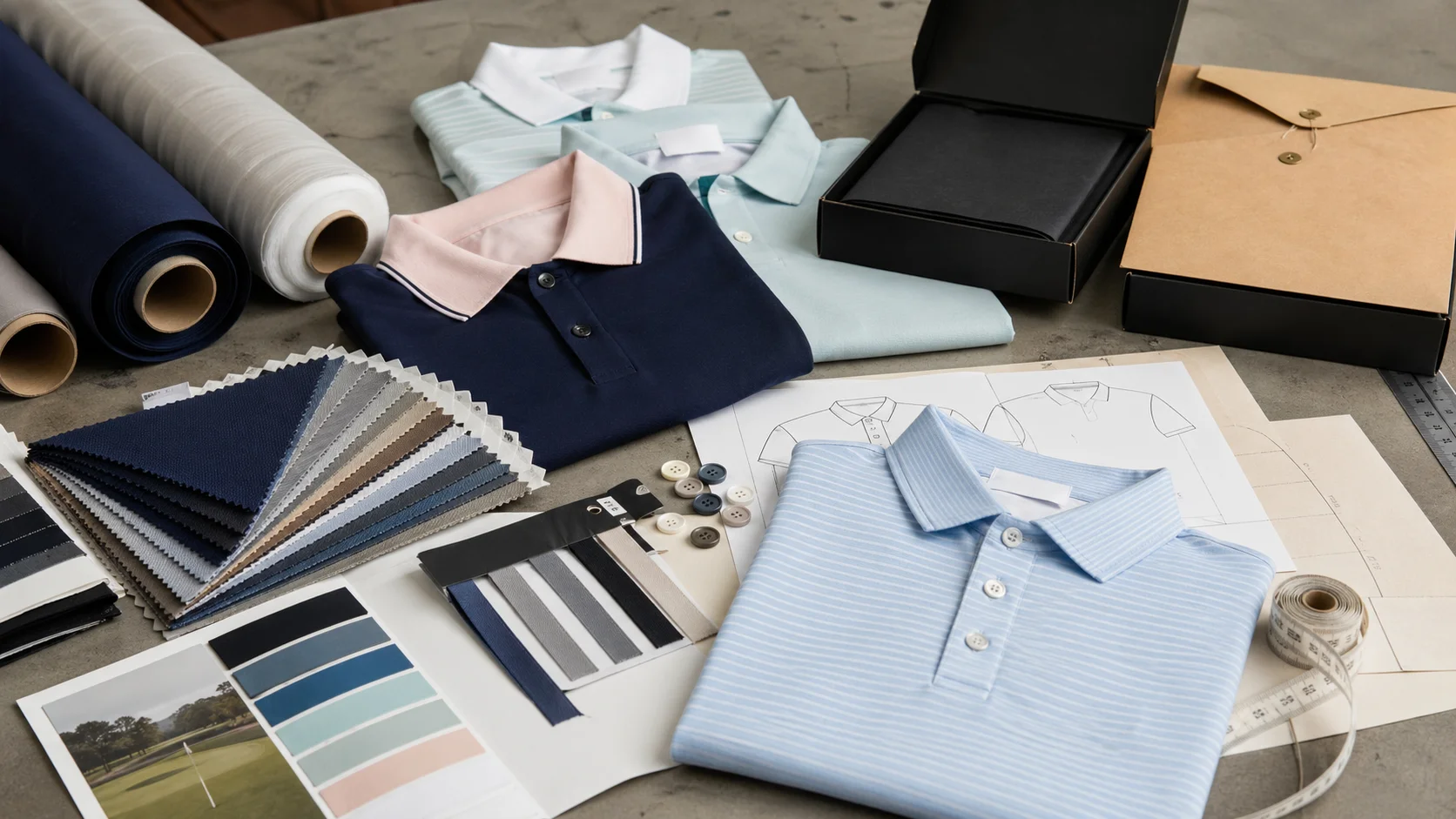
Branded Packaging Inserts for Clothing Launches with checks for samples, fit, MOQ, QC evidence, pricing terms, and delivery risk.
Fast answer: Branded Packaging Inserts for Clothing Launches: Costs, ROI should be judged by production evidence, not by a generic sourcing promise. The buyer needs sample proof, cost breakdowns, QC checkpoints, and delivery buffers in writing.
Ask for recent sample photos, measurement tolerances, fabric or print test assumptions, decoration test notes, packing examples, and a named inspection checkpoint. These details show whether the team can repeat an approved sample at bulk volume.
Separate garment cost, decoration, labels, packaging, sampling, testing, freight, and rush charges. When every cost line is visible, it becomes easier to reduce colorways, adjust size depth, or reserve more time for sampling.
A launch can turn on a card no bigger than your palm. I once watched a DTC knitwear drop almost miss its window because the garments were finished, the cartons were printed, and the hang tags sat in customs for four extra days. So the team slipped branded packaging inserts for clothing launches into each polybag before the tags arrived, and the campaign still went out on time. Tiny card. Big job. The insert carried the launch story, a care note, and a 15% code.
QR scans landed at 9.4%, redemptions at 6.8%, and repeat purchase rose 14% versus the prior drop. That is the bit founders miss. The garment is not the only message. While the item is still folded, the insert gets read before fit disappointment or return regret can kick in.
In premium launches, a textured 350 gsm card with sharp typography can make a $68 piece feel earned instead of guessed. In mass-market launches, a flimsy insert drags perceived value down even when the hoodie itself is solid. Outer cartons get all the attention. Fine. Yet factory visits across Vietnam, Portugal, and Turkey taught me something blunt: the insert often carries more emotional weight because it sits at eye level for 20 to 40 seconds.
According to trade.gov apparel market insights, apparel margins stay tight across major sourcing regions, which is why retention matters so much. A 4% lift in repeat purchase can beat shaving 8 cents off a mailer. Here is the part nobody says plainly: branded packaging inserts for clothing launches can outperform rigid packaging if the message is tighter and the offer is clearer.
I have seen a $0.18 folded card beat a $1.40 magnetic box because the card answered three things fast: what the brand stood for, how the piece should be cared for, and why the buyer should come back within 21 days. Not romance. Retention math.
Unboxing is a timing problem. The buyer opens the parcel, scans the insert, and makes a judgment before checking seam finish or GSM. For a launch that starts at 500 units, a single-card insert can produce a 3% to 8% post-purchase click-through if the QR lands on a clear next step.
Vague message? Scan rates collapse. I have watched 100% organic traffic from social posts turn into 0.7% email sign-ups because the insert buried the offer in paragraph three.
At factories in Portugal and Guangdong, packaging teams treated inserts as merchandising, not decoration. That matters. An insert should move the buyer from curiosity to action, not wander into a 180-word brand history.
Outer packaging is protected in transit. Inserts are protected only by the product itself, so they survive handling, folding, and warehouse friction far better than rigid formats. For a 10,000-unit run, that difference can shave 2 to 3 days off pack-out because workers can place a flat insert faster than assembling a box or sleeve.
In a warehouse paying $18 to $26 per labor hour, speed matters. So does waste: rigid boxes have landed with 4% dent rates in my experience, while a simple card insert shipped with less than 1% spoilage.
If your launch leans on custom clothing packaging solutions, the insert should mirror the same visual language. Otherwise the experience breaks apart. I have seen a $120 cashmere sweater arrive in a beautiful mailer with a generic insert that looked borrowed from a discount cosmetics brand. The customer noticed. She wrote it in a review.
Strong branded packaging inserts for clothing launches do five jobs in under 90 words. Thank the buyer. Explain care. Reinforce the brand mission. Invite a social action. Point to the next purchase. Simple on paper, messy in practice, because brands waste space on fluffy manifesto language.
A launch insert should read like it came from a sharp merchandiser with a CRM strategist looking over the shoulder. For premium capsules, I keep copy sparse: 45 to 70 words, one clear CTA, one discreet QR code, and no more than two typefaces. Streetwear drops can go louder, with 80 to 110 words and a code tied to the next release window.
Sustainable basics need proof, not poetry: fiber content, washing instructions, and a line on why the fabric was chosen. Children’s wear is even simpler. Parents want fiber details, wash temp, sizing reassurance, fast. Brands offering custom baby clothing manufacturing tend to convert better when inserts stay calm, factual, and easy to keep in the drawer.
I have seen return rates fall by 7% to 11% when inserts explain care in plain language. That matters with delicate jersey, brushed fleece, and enzyme-washed cotton, where one missed wash instruction can ruin fit or feel after the first cycle. Strong inserts sell the next purchase without sounding like an ad. They act like a receipt for trust.
The best insert hierarchy is blunt. Line one: thank you. Line two: care or sizing note. Line three: brand point of view. Line four: offer or QR. If the card is 100 mm by 150 mm, the main message should sit in the top 60% of the visible space, because most readers scan from the upper left and stop before the second paragraph.
That is why a 16-word headline can beat a 60-word statement. For brands building a tighter label architecture, especially those working through private label clothing services, inserts also help standardize the post-purchase voice across 3 or 4 collections. One note for the whole launch family. One offer logic. One measurable response path.
Material choice changes perception faster than copy does. Paper stock feels honest. Recycled board signals restraint. Seed paper gets attention, then often disappoints because buyers do not plant it. Tissue is cheap and light, but it tears in humid warehouses.
Card inserts land in the middle: stable, printable, easy to tuck into a folded tee, a bra set, or a newborn sleeper. For an intimate apparel launch, I have seen teams choose a matte 300 gsm card because it slid neatly into the cup of the garment without creasing. That same spec would feel thin for a $180 wool coat.
Finish matters, though it can slide into vanity if the product does not justify it. Matte lamination feels calm and premium. Soft-touch looks luxurious but can interfere with recycling streams when mixed adhesives are involved. Foil adds drama, and in European audits I have seen it complicate recovery if it is used too heavily.
Spot UV works best on a simple field of color, not a busy collage. Glossy laminates often fail sustainability checks in markets that push for easy fiber recovery, and they can make a small card look pricier than the actual garment. Risky mismatch.
According to Textile Exchange, material sourcing claims face much closer scrutiny now, especially when brands market recycled content. The claim has to match the paper path, the adhesive, and the finish. I have seen a recycled board insert rejected in a U.K. audit because a metallic coating made the card non-recyclable in local curbside systems.
The brand had spent $3,200 on print and ended up pulping the whole batch.
The thing nobody tells you: recycled board can cost more than virgin stock in short runs. At 500 to 2,000 units, I have seen recycled 350 gsm cost 12% to 28% more because mills charge more for small allocations, while virgin sheet sits ready in standard sizes.
That surprises people because sustainability is assumed to get cheaper once goodwill is counted. Not always. In a 2,000-unit run, a recycled board insert might land at $0.29 to $0.41 each, while virgin stock comes in at $0.23 to $0.33 depending on region.
If the garment price point is $28, the insert should feel efficient and intentional, not precious. If the garment is $220, the same card can justify a heavier 400 gsm stock, a blind emboss, or a restrained foil stamp. For premium knitwear, French terry at 320 GSM, or a structured bra set, the insert should echo the tactile value of the product.
For lower-price basics, spend on clarity rather than finish. The buyer remembers whether the note was useful. They rarely remember whether the corner had a soft-touch coat.
Pricing changes sharply with scale. A 500-unit run behaves like a custom project. A 10,000-unit run behaves more like manufacturing. For branded packaging inserts for clothing launches, I usually see three bands: small batch, mid-run, and volume.
At 500 units, a digitally printed 4 by 6 inch insert on 350 gsm recycled card may cost $0.55 to $1.10 each, depending on finish and shipping. At 2,000 units, that same piece often drops to $0.22 to $0.48. At 10,000 units, it can fall to $0.08 to $0.19 if the artwork is stable and the supplier is working on offset.
Unit price alone will fool you. Add setup fees, and the picture shifts. Digital print usually carries low or no plate costs, with setup in the $25 to $120 range. Offset print can add $180 to $650 for plates and press setup, especially if there are two-sided colors or special coatings.
Die cuts, if you need a custom shape, can add $90 to $350. Inserting labor may cost another $0.03 to $0.11 per piece in a fulfillment center, while freight can swing by 18% to 40% depending on carton density and whether the inserts are packed flat or nested with garments.
Regional sourcing changes the math again. Local digital print in the U.S. or U.K. is faster for 500 to 2,000 units, but at 10,000 units offshore offset can cut unit cost by 20% to 35%. Hybrid sourcing often wins: design and proofs handled locally, bulk print offshore, then pack-out near the fulfillment site.
I have seen brands save $1,400 on print only to lose $2,100 through air freight and rework. Cheap is not cheap if it arrives late.
For 500 pieces, the question is not “What is the lowest unit cost?” It is “What is the cheapest path to a correct launch?” If a reprint would take 10 days and cost $380, a slightly higher initial quote may be the safer choice. At 2,000 units, spoilage becomes more visible.
A 4% waste rate means 80 lost inserts before pack-out even starts. At 10,000 units, reprints get expensive enough to hurt cash flow and shipping schedules.
Simple ROI frame: total insert cost divided by expected orders influenced. If a $740 insert spend drives 44 repeat orders with an average gross margin of $31, the return is visible in the first 60 days. Add coupon redemption, and the case gets stronger.
The hidden extras are where buyers get cut. Color matching can add a proof round. Language changes for EU markets can add another. The binder rule in some fulfillment centers requires inserts to be packed in batches of 250, which may add a manual step.
If you are printing multiple versions, expect a changeover charge of $45 to $150 per version. I have seen a launch budget blow out by 19% because nobody priced the alternate French copy. For higher-AOV products, the insert can justify more spend.
For a $90 blazer set or a $120 underwear bundle, I would rather spend $0.38 on a sharp insert than $1.20 on packaging theater. The buyer sees the note. They barely remember the box.
Plan on 3 to 6 weeks for standard digital print and 5 to 8 weeks for offset with specialty finishes. That is the honest range I give brands after watching schedules slip for all the usual reasons: late copy, color disputes, and a last-minute sustainability review.
A tight digital job can move from brief to proof in 48 hours, then to print in 5 to 7 business days. Offset often needs 7 to 10 days just for plate work, then another week for finishing and pack-out.
Where launches slip is rarely the press slot. It is approval. One team took 9 days to approve a QR destination because the homepage and the offer page had different return policies. Another lost 4 days waiting for a fiber claim sign-off after the legal team asked for proof of recycled content.
Domestic suppliers are not always faster once three revision cycles are counted. A nearby printer can be slower than a disciplined offshore partner if the spec is messy. For influencer mailers, I schedule inserts 7 to 10 days before garments if the carton pack-out is happening at the warehouse.
If you are coordinating with sampling, set the insert proof before the final fit approval. That protects the launch date. For brands handling technical categories like bras or fitted intimates, the copy needs to match the product reality, which is why some teams coordinate packaging language alongside custom bra manufacturing milestones rather than leaving it for the last week.
Rush orders are possible. They are not painless. A 72-hour digital turnaround may be available for 500 units, but only if the artwork is final and the paper is in stock. Specialty embossing, foil, and lamination usually add 2 to 5 days.
Color approval can stall the whole chain if you demand an exact Pantone and the substrate shifts the ink slightly. Factories in Spain and India showed the same bottleneck: not machine time, admin. A missing dieline or an untranslated care line can hold the order longer than a press queue.
Build the insert around the launch calendar, not around hope.
Send one clean brief. Not six loose files. The first email should include final size in millimeters, print sides, Pantone references, stock weight, finish, delivery window, pack-out method, and whether the insert ships flat or pre-collated.
Add the exact copy, a dieline, a mockup, and one contact who can approve within 24 hours. I have seen jobs stall for a week because nobody knew who owned the final barcode text. Ask for a sample before you approve full production. Not a photo. A physical sample.
If the supplier cannot provide one, ask why. Revisions should be capped early, ideally before the first proof. Every late-stage edit adds cost and risk. If you need multilingual copy, specify it up front, including French, German, Spanish, or Japanese, and make sure the translations fit the live area without shrinking the type to 5 pt.
Compliance needs are not optional. Fiber claims must match the garment label. Recycling marks must be valid in your target market. Care labeling should align with ISO or local consumer guidance. For reference, standards bodies such as ISO and testing organizations like AATCC publish methods that can help you align claims and durability language before print goes out.
If you are working with infant products, the bar is even tighter; inserts for custom baby clothing manufacturing need extra care around safety wording and fabric content.
Ask three questions that expose weak vendors fast: What is your minimum order quantity? What is your spoilage rate? How long is your changeover time between versions? A good printer can answer in numbers, not vague promises.
For QC, inspect trim accuracy to within 1 mm, color consistency across at least 3 samples, and count accuracy by bundle. If the order is 2,000 units, I want a count tolerance of no more than 0.5% missing pieces.
One more practical check: confirm whether the inserts will be inserted by the factory, the warehouse, or your 3PL. The answer affects carton sizes, labor charges, and timing more than most brands expect. When comparing a manufacturer, factory, or supplier, ask for production photos and a quality checklist before you commit to wholesale or bulk quantities, especially if the work is being sourced from China.
Start with the goal. Do you want repeat orders, lower returns, social sharing, or email capture? Pick one primary goal and one secondary goal. Then set the format: card, folded leaf, tissue wrap, or hang-tag insert.
Budget next. For a 2,000-unit launch, I would usually set aside 3% to 6% of total packaging spend for the insert itself, not counting fulfillment labor. Approve the copy, then sample it on the actual garment, not on a desk.
Measure in the first 30 days. Track QR scans, coupon redemption, repeat order rate, social mentions, and return reduction. If one variable is underperforming, change only that variable. Test message against message, or paper stock against paper stock, but not both at once.
The moment you alter too many parts, the data turns to mush. I have seen a 7% redemption lift disappear simply because the QR code was moved 14 mm lower on the card. Scale the winner carefully.
If a $0.26 recycled insert outperforms a $0.74 soft-touch card, keep the lower-cost version and invest the savings in better copy or better fulfillment timing. That is how strong launches stay profitable. For brands building a longer shelf life around retention, branded packaging inserts for clothing launches are not garnish.
They are a low-waste revenue tool, especially when the garment already carries the brand story but the buyer needs one more reason to come back. If you are tightening your whole launch system, review your private label clothing services workflow at the same time so the packaging and product story match from first open to second order.
For 500 units, expect roughly $0.55 to $1.10 each for digital print. At 2,000 units, many inserts fall to $0.22 to $0.48, while 10,000-unit offset runs can reach $0.08 to $0.19. Finishes, paper weight, and freight can move those numbers by 15% to 40%.
Standard digital jobs usually take 3 to 6 weeks from brief to carton pack-out. Offset jobs with foil, emboss, or lamination often take 5 to 8 weeks. If copy, color, or compliance approvals drag, add 3 to 7 extra days.
Use five essentials: a thank-you note, care instructions, a short brand statement, a social prompt, and one clear offer or QR code. Keep the main message under 90 words for most apparel launches. For children’s wear and basics, clarity on fabric and washing often matters more than brand storytelling.
Yes. Inserts can reduce returns by clarifying fit, fabric care, and sizing expectations before the buyer wears the item. I have seen return rates fall by 7% to 11% when inserts explain wash temperature, shrinkage risk, or when to size up. That works best on delicate knits, bras, and babywear.
Choose the supplier based on your run size and timeline. Local digital printers suit 500 to 2,000 units and tight revisions. Offshore offset is better for 5,000 units and up. Hybrid sourcing can cut cost, but only if you allow time for proofing, freight, and fulfillment coordination.