
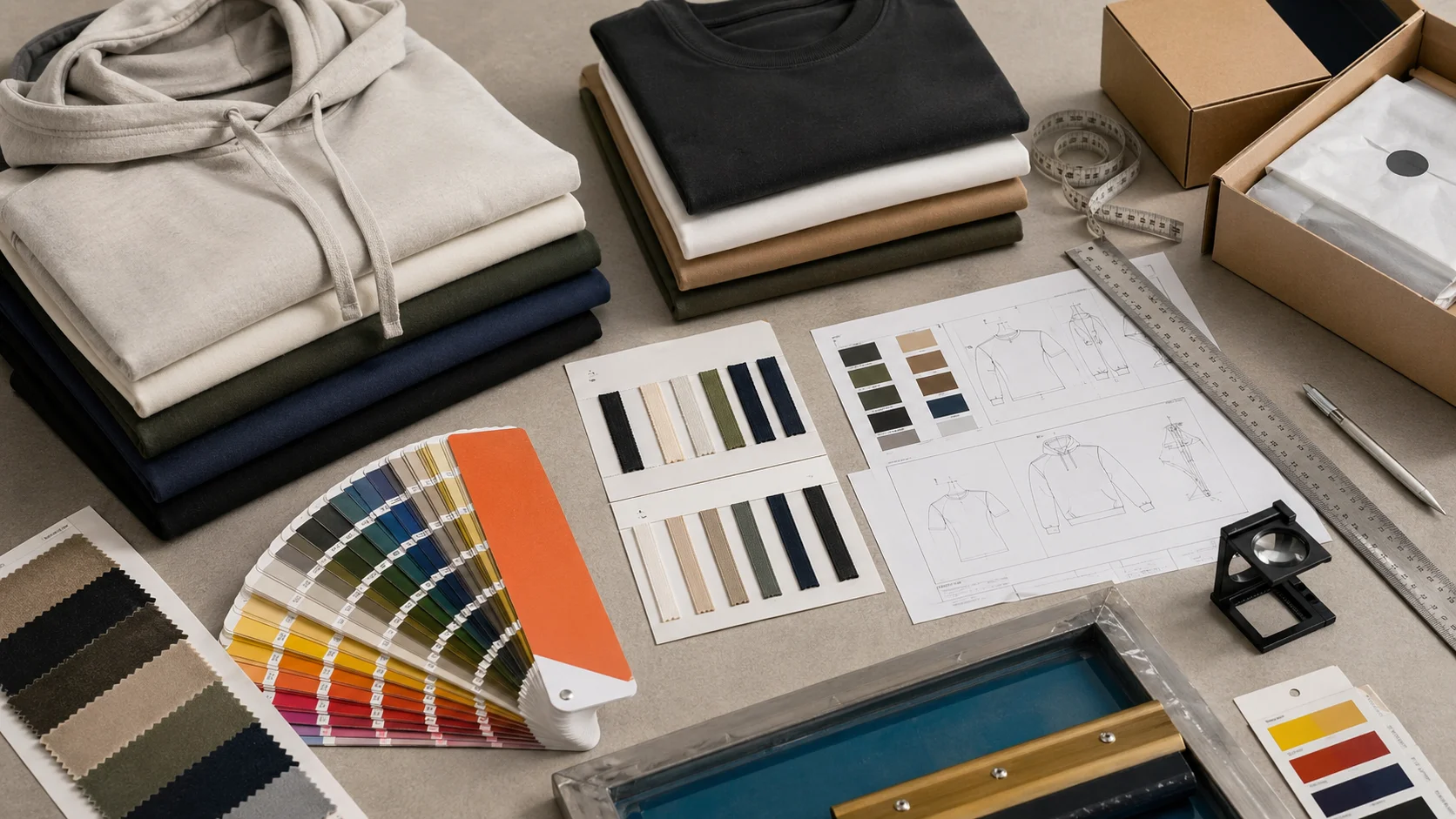
Branded Lookbook Inserts with checks for samples, fit, MOQ, QC evidence, pricing terms, and delivery risk.
Fast answer: Branded Lookbook Inserts: Page Count, Paper, Print, and Box Fit should be judged by production evidence, not by a generic sourcing promise. The buyer needs sample proof, cost breakdowns, QC checkpoints, and delivery buffers in writing.
Ask for recent sample photos, measurement tolerances, fabric or print test assumptions, decoration test notes, packing examples, and a named inspection checkpoint. These details show whether the team can repeat an approved sample at bulk volume.
Separate garment cost, decoration, labels, packaging, sampling, testing, freight, and rush charges. When every cost line is visible, it becomes easier to reduce colorways, adjust size depth, or reserve more time for sampling.
Some of the most profitable packaging in fashion is also the smallest. Branded lookbook inserts for clothing boxes can cost pennies, yet they often do more to spark repeat buying than the box the garments came in. A single insert may cost $0.08-$0.45 at scale, while a rigid box can run $1.20-$3.50 before freight. That gap matters.
Decoration? Not the job. The insert has to sell the next purchase. During visits to mills and packing lines in Portugal, Vietnam, and Turkey, the brands getting the best response were rarely the ones with the flashiest packaging. They were using a 4-page card or slim booklet to show styling ideas, care instructions, and a clear cross-sell path that customers kept on the dresser for 2-3 weeks instead of tossing with the tissue.
Luxury labels usually spend more on paper weight and finish. I have seen 350-400 GSM stock with soft-touch coating, foil, and a heavy editorial image. Mid-market brands often do better with discipline: 250-300 GSM, sharper photography, and a cleaner call to action. The insert feels more useful, less theatrical. That difference shows up in retention. A QR-coded insert can deliver a 6%-12% response rate on post-purchase traffic, while broad paid social for retention often sits below 2% click-through and fades fast after the first week.
What factory visits reveal is that the insert only works when it fits the box format, the shipping weight limit, and the brand story. A children’s label sending 12 garments per carton cannot bury a 12-page booklet under the products. A premium sleepwear line can. I once worked with a brand moving silk sets through a 0.6 kg postal cap; the insert had to stay under 18 grams, so every page earned its place. Tight constraint. Better sales message.
For brands built around categories like custom bra manufacturing or elevated basics, inserts become the bridge between fit education and repeat order behavior. For more complex programs, such as custom baby clothing manufacturing, the insert can cut returns by clarifying wash cycles, size drift, and fabric handling in the first shipment. Working with the right manufacturer, factory, or supplier also helps keep branded lookbook inserts for clothing boxes aligned with production realities, MOQ targets, and quality expectations.
A strong insert reads like a curated edit, not a catalog dump. I want the first panel to earn a second look within 2 seconds, which usually means a hero image, one sharp headline, and a visual hierarchy that says, “Here is what to wear next.” Three to five looks maximum. Any more and the page starts competing with the box itself.
The core components are straightforward. A hero image. One styled outfit set. Product callouts with fabric, fit, and SKU references. Size guidance. Care notes. A short brand story. And a CTA that points somewhere measurable, usually a QR code or campaign URL. The best-performing branded lookbook inserts for clothing boxes link to SKU-specific landing pages, not the homepage. That simple choice can lift conversion by 15%-20% because the customer lands on the exact item she just saw.
Page count should match the box and the garment. A folded 4-page card works well for tees, intimates, and socks. I have seen it perform best in boxes under 300 grams of contents. An 8-page mini-lookbook suits premium capsules, denim drops, and seasonal collections where the brand wants to show 3 outfits, not 12 separate SKUs. For private label programs, the insert often becomes the first branded touchpoint, especially when paired with private label clothing that needs context to feel premium.
Design matters because retention is visual, but the language matters because buyers are busy. Use merchandising language, not brochure language. Say “Layer with the rib tank” instead of “Our collection offers versatility.” Keep the edit tight. Better to show 4 compelling combinations than 9 weak ones. In my experience, the inserts that get saved are the ones that teach an outfit formula in one glance.
Sustainability does not require a limp-looking insert. Recycled stock, vegetable-based inks, and fewer pages can still feel rich if the photography and layout do their work. A 2-page card on 100% recycled 300 GSM board often beats a glossy 12-page booklet because it is easier to keep, easier to scan, and less likely to be binned with the mailer.
I have watched brands overbuy paper and underbuy clarity. The smartest buying decision starts with format. Single-sheet inserts are cheap, fast, and useful for simple assortments. Folded lookbooks give you space to tell a tighter story. Saddle-stitched booklets feel editorial. Postcard-plus-QR hybrids sit between utility and promotion, especially for refill or repeat-purchase categories. The right choice depends on basket size, product complexity, and how much weight you can afford in the parcel.
Here is the practical comparison I use with clients:
Paper stock changes the feel immediately. Uncoated stocks feel tactile and less synthetic, which works for sustainability-led brands. Coated stocks sharpen fashion photography and keep blacks deep, especially for dark denim or satin. Recycled stocks support the message, though they can mute saturation by 5%-10% if the printer does not calibrate well. On the factory floors I visited in Spain and India, color drift showed up most often on recycled fibers with uneven moisture content.
Finishes should earn their keep. Soft-touch coating can make a mid-price insert feel more expensive, but it adds cost and can scuff in transit. Aqueous coating is a practical middle ground. Spot UV helps if one logo or fabric close-up needs emphasis, yet it becomes wasteful decoration when used on every panel. Embossing sends a premium signal at a unit cost that often makes sense only above 5,000 pieces. I prefer finishes that support the message, not compete with it.
Regional production realities matter. China and Vietnam often handle larger volumes with lower setup costs, while some European hubs deliver tighter color control at the expense of higher unit pricing. MOQ can swing from 500 to 3,000 pieces depending on format, and waste rates of 2%-7% are common if folds or trim lines are off. If the insert is part of a garment system built through cut and sew manufacturing, the print plan should be set at the same time as the sampling calendar, not after the final fabric approvals. For branded lookbook inserts for clothing boxes, choosing the right production path is just as important as choosing the design.
Pricing changes fast with volume. At 500 units, setup fees can be the biggest line item. At 50,000 units, paper and finish dominate. For buyers, the trick is to price the insert as a sales tool, not a stationery purchase. I have seen brands reject a $0.22 insert and then spend $14.00 to win back the same customer through ads.
At 500 pieces, a simple one-color recycled card may land around $0.35-$0.85 each once design setup, proofing, and packing are included. A full-color folded lookbook with custom die-cut can sit between $1.10 and $2.40. At 2,500 units, those numbers often fall to $0.14-$0.42 and $0.55-$1.20. By 10,000 units, simple cards can dip under $0.10, while premium booklet formats usually settle around $0.28-$0.75. At 50,000 units, the savings are dramatic, but the risk is overcommitting to an edit that may be stale by the time it lands.
Hidden costs catch teams off guard. Artwork adaptation for multiple sizes can add $150-$800. Plate charges for offset runs might run $80-$300 per color. Freight on a 10,000-unit booklet order can add $0.03-$0.18 per piece depending on origin and carton count. Language localization for a 3-market campaign often costs another $120-$500, and waste allowance of 3%-5% should be baked in. If your supplier cannot quote these lines clearly, the sticker price is not real.
There is also a channel difference. DTC brands buy inserts to improve repeat order rate, recovery, and customer education. Wholesale-heavy brands need broader consistency, so they often accept a lower response rate in exchange for one message across 2-3 channels. I have seen DTC brands justify inserts on a cost-per-saved-customer basis of $1.80-$4.50, while wholesale teams look more at brand consistency across 20-100 stockists.
The buyer-friendly ROI formula is simple: cost per insert, cost per saved customer, and cost per incremental order. If an insert costs $0.24 and nudges even 1 in 50 customers to buy again, the return can beat paid media by a wide margin. That is not theory. I have tracked it in post-purchase flows for brands selling everything from jerseys to intimate basics. Branded lookbook inserts for clothing boxes work best when the economics are evaluated against repeat revenue, not print cost alone.
A realistic timeline starts with the brief and copy approval, usually 2-5 days. Design and layout take another 3-7 days. Prepress and proofing need 2-4 days. Print may take 2-10 days depending on digital or offset. Finishing, packing, and final QC add 2-6 days. So a basic run can move in 10-20 days, while a premium booklet with specialty finish often needs 3-4 weeks.
Digital print is faster for short runs and seasonal tests. Offset becomes more efficient at 2,500 units and up, especially if you want stable color across 8 pages or more. Specialty finishing extends the schedule because foil, embossing, or soft-touch lamination adds extra steps and more chances for rework. A good supplier plans around the print method, not around optimism.
The delays I see most are late art changes, image licensing issues, paper shortages, and mismatched box dimensions. A one-millimeter error can matter. If the insert needs to sit beside a folded knit in a 28 x 22 x 6 cm carton, the pack-out sequence has to be checked before print approval. On the floor, the best suppliers inspect bleed, fold accuracy, ink rub, trim variance, and how the piece behaves when packed with garments and tissue.
Build buffer time for launches and seasonal drops. I like a 7-day cushion for digital runs and a 14-day cushion for offset. That buffer keeps the insert from becoming the bottleneck in the whole box program, which is exactly what happens when the packaging team is still changing copy while the garments are already on the truck. This is where quality control, production planning, and supplier communication make or break branded lookbook inserts for clothing boxes.
Environmental impact should be judged by material weight, recyclability, and print coverage, not by the word “eco” on a spec sheet. A 12-page insert printed on heavy coated stock can carry a bigger footprint than a smaller card, even if both use recycled fiber. Data from Textile Exchange keeps reminding brands that material choices matter most when volume scales.
My default recommendation is recycled or FSC-certified paper, water-based or soy inks, and minimal lamination. If you need sheen, use a restrained aqueous coat rather than a plastic-heavy film. A 2-page insert on 100% recycled stock can feel more thoughtful than a thick booklet because customers hold onto it longer and discard less. That is the counterintuitive bit. Smaller often performs better.
The thing nobody tells you: a lean insert with better photography and tighter copy often survives 2-3 times longer in the home than a larger booklet with filler pages.
Regional sourcing changes the footprint. Some factories in Europe can source recycled stocks quickly with low waste. Other hubs face higher scrap because local mill options are limited, which pushes up transport and offcut loss. For standards and certification language, I rely on OEKO-TEX for chemical safety claims and ISO references when clients need process discipline in procurement. For brands sourcing from China or other export hubs, it also helps to align claims with practical production realities and supplier documentation.
If sustainability is part of the brand story, the insert should look like a design choice, not a concession. Clean layout, fewer pages, and honest material notes work. Customers notice. They may not read every line, but they feel the difference when the piece is easy to keep and easy to recycle. That is why branded lookbook inserts for clothing boxes can support both brand equity and lower-impact production when specified correctly.
A useful brief starts with eight things: audience, objective, box size, garment category, print volume, budget ceiling, sustainability targets, and success metric. If you cannot state those in one page, the supplier will make assumptions, and assumptions are expensive. I ask for the same clarity whether the client is selling underwear, outerwear, or occasion pieces.
Then I want four supplier answers in writing. What is your minimum order? Can you match brand colors to within Delta E 2-3? What proofing method do you use? How do you pack inserts with garments and tissue so the edges do not curl? Ask for three physical samples. Compare paper feel, image sharpness, trim quality, and folding precision side by side.
Track conversion with a QR code, discount code, or dedicated landing page. That way, each batch tells you something. I prefer a pilot run of 500-1,000 units before committing to 10,000, especially for a new market or a new category. Good briefs save time. Bad ones just create prettier problems. A strong supplier should also explain factory-side production constraints, MOQ bands, and quality checkpoints before you approve the custom run. Branded lookbook inserts for clothing boxes convert best when the brief is specific enough to keep both sides honest.
They are used to increase repeat purchases, show styling ideas, and give care or size guidance inside the parcel. In my experience, the best inserts keep customers engaged for 2-3 weeks and can support a 6%-12% QR response when the offer is specific.
At 500 units, a simple insert can cost $0.35-$0.85 each, while premium booklet formats may run $1.10-$2.40. At 10,000 units, many brands land closer to $0.10-$0.75 depending on finish, page count, and freight.
Digital runs can be completed in 10-14 days if artwork is approved quickly. Offset runs with specialty finishing usually need 3-4 weeks, and I always advise a 7-14 day buffer for proofing, shipping, and pack-out checks.
Yes, and it is often the smarter choice. Recycled or FSC-certified paper works well for 2-page cards and folded 4-page inserts, though color can dull slightly unless the printer calibrates carefully. Water-based inks and minimal lamination improve recyclability.
Match format to garment type and box weight. A single-sheet or folded insert works for basics and small orders, while an 8-page booklet fits premium capsules and higher-margin launches. If the pack is under 300 grams, keep the insert light and highly focused.
MOQ depends on the manufacturer and format, but many suppliers start around 500 to 3,000 pieces. Digital production usually supports lower MOQ, while offset and specialty finishing are more economical at higher bulk quantities.