
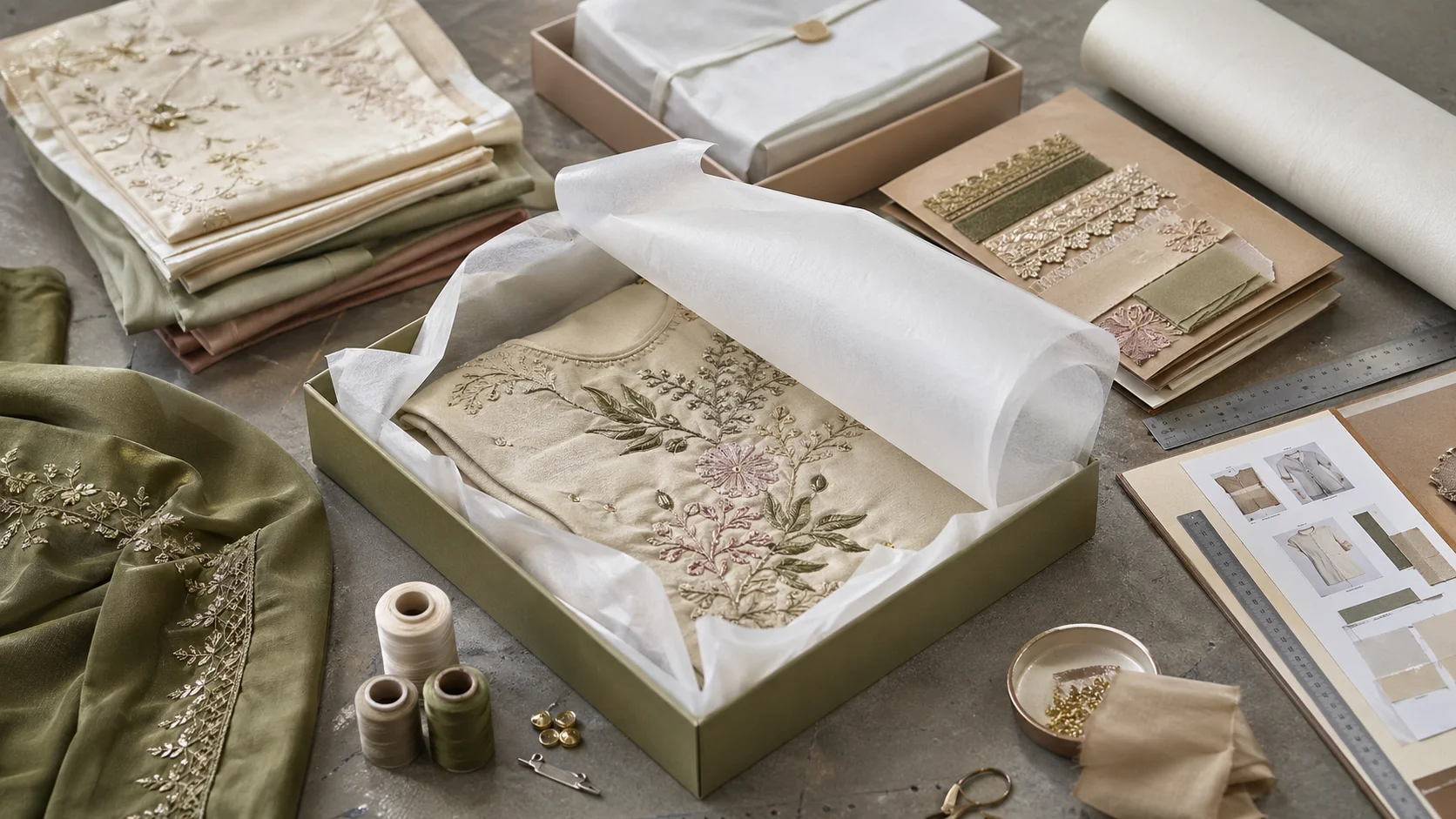
Wholesale Apparel Parcel Inserts with checks for samples, fit, MOQ, QC evidence, pricing terms, and delivery risk.
Fast answer: Wholesale Apparel Parcel Inserts: Cost, Message, ROI, and Packing should be judged by production evidence, not by a generic sourcing promise. The buyer needs sample proof, cost breakdowns, QC checkpoints, and delivery buffers in writing.
Ask for recent sample photos, measurement tolerances, fabric or print test assumptions, decoration test notes, packing examples, and a named inspection checkpoint. These details show whether the team can repeat an approved sample at bulk volume.
Separate garment cost, decoration, labels, packaging, sampling, testing, freight, and rush charges. When every cost line is visible, it becomes easier to reduce colorways, adjust size depth, or reserve more time for sampling.
The parcel opens in a blink, and the brand either looks sharp or looks cheap. I’ve watched a £35 sweatshirt feel more considered than a £120 knit simply because the insert was neat, useful, and human. That’s the quiet power of branded inserts for clothing parcels wholesale: a 20-gram card can change the verdict before the customer has even unfolded the garment.
Those first seconds shape perceived value, sharing, refund behavior, and whether the box gets kept or dumped straight into recycling. Budget brands often lean on discount cards because the math is easy. Premium labels use inserts to defend margin, especially when the garment itself is beautifully made but visually plain.
On production lines from Portugal to Vietnam, I’ve seen managers track pack-out time to the second. A clean insert can save 3 to 6 seconds per parcel. That sounds modest until you’re shipping 5,000 orders a day.
Clarity usually beats ornament. A single, well-written card on 300 gsm uncoated stock can outperform a three-piece bundle with foil, lamination, and two wandering promo slips. I’ve seen it happen with £18 basics and with £180 tailored pieces.
Most buyers begin with a thank-you card and end up needing half a dozen print assets: size guides, care cards, return instructions, discount cards, and product-cross-sell prompts. The smarter version of branded inserts for clothing parcels wholesale folds those jobs into one or two pieces instead of scattering them through the parcel like confetti.
Material choices are straightforward, but the details matter. Common specs sit around 250-350 gsm card, with recycled kraft, uncoated stock, or coated stock depending on the look. Soy-based inks are common in Europe; water-based inks are often chosen for softer brand language and easier recycling. Lamination adds stiffness and protection, though it makes waste handling messier. Spot varnish and foil stamping can lift perceived value, but they belong on higher-margin lines where a £0.08 to £0.18 uplift per insert is acceptable.
European sportswear brands often use matte uncoated 300 gsm cards for authenticity. South Asian manufacturers push bright promotional flyers on lighter 170-200 gsm paper to keep freight down. East Asian suppliers lean into high-gloss coated sheets for luxury aesthetics. The shift in perception is real. So is the cost curve.
Compliance is dull, but it saves pain. Recycling labels need to be clear. Care wording should match the garment. Multilingual inserts matter in the EU and Gulf markets, where one parcel may pass through several language preferences before it reaches the buyer. Some regions require specific terms around discount validity and redemption rules. A well-designed single insert can replace three slips, cut pack-out time by 15% to 25% in busy warehouses, and keep the carton cleaner.
That logic reaches categories as different as custom bra manufacturing and children’s apparel. The message changes. The operational need doesn’t: one insert should answer the main questions fast.
Unit price is only the opening bid. I break branded inserts for clothing parcels wholesale into five cost lines: print price, setup fees, freight, storage, assembly labor, and spoilage. A supplier quoting £0.04 per insert can still end up dearer than a £0.07 supplier once you add £180 in setup fees, £220 in freight, and 2% spoilage from color mismatch or trimming errors.
Short-run digital printing makes sense at 500 or 1,000 units, especially for seasonal drops or test markets. Offset printing usually wins at 5,000 or 10,000 units because the unit price falls hard after plates are paid for. I’ve seen digital cards land at £0.16 each at 500 units, then offset drag that down to £0.05 at 10,000. But offset with a 4-week lead time is a poor fit if the launch is in 10 days.
MOQ tiers usually break down like this: 500 for pilots, 1,000 for region tests, 5,000 for steady replenishment, and 10,000 for major seasonal campaigns. Break-even often sits around 2,500 to 4,000 units, depending on artwork reuse and whether tooling can be shared across inserts. If your brand runs bodywear or sleepwear ranges, a unified insert can support private label clothing across multiple SKUs without changing the print base.
Turnaround is where discipline shows. Local suppliers often need 3 to 7 days for artwork approval, 2 to 4 days for proofing, 5 to 10 days for production, and 1 to 3 days for freight. Offshore suppliers can quote 30 to 45 days end to end, though the print price may be 12% to 20% lower. In practice, the brands that win often choose the supplier with fewer errors and shorter lead times, even if the quote is 8% to 12% higher. One avoided reprint can wipe out the difference.
Assembly labor belongs in the quote too. If your warehouse needs 6 seconds to fold, insert, and verify each card, 10,000 parcels a month becomes 16 to 17 labor hours. For a cut-and-sew label shipping mixed styles, that time matters. If the supplier cannot explain pack-out format clearly, I walk away and call a cut and sew manufacturing partner who understands the full parcel workflow.
Insert design should follow the product, not the mood board. Basics need fit reassurance and care clarity. Athleisure wants performance cues and wash guidance. Formalwear needs handling instructions. Luxury asks for restraint. Children’s apparel needs plain language and fewer moving parts.
Copy earns its keep when it cuts friction. I’ve seen returns fall when a card explains that cotton jersey may relax after the first wash, or that a slim fit runs half a size small. Styling tips help too. A line on pairing a blazer with a ribbed tank can drive repeat purchase without sounding preachy. QR codes work when they solve something: size exchanges, loyalty sign-ups, post-purchase care education. A QR code that only says “follow us” is a wasted square.
Color and format shape memory. Minimal black-and-white inserts often perform well in premium markets because they match the garment’s price discipline. Bright promotional cards can work better in value-led categories where the goal is immediate redemption of a £5 or 20% offer. Fold format matters too. A single A6 card may be enough for a £28 top, while a tri-fold makes sense for bundling returns, care, and cross-sell instructions into one piece.
The factory-floor reality is less glamorous than creative directors like to admit. Designs that simplify line-side packing reduce mistakes more than visually busy layouts. I’ve watched workers misfold ornate inserts with four panels and tiny icons, then watched the error rate drop when the design was cut to one card, one fold, one message. In a batch of 2,000 parcels, that can mean 40 fewer packing errors and a cleaner customer experience.
I’m skeptical of green print claims because the numbers often don’t hold. Recycled paper, FSC certification, compostable claims, and water-based inks can help, but none of them fix overproduction. A 320 gsm recycled card that is laminated, overprinted, flown 8,000 kilometers, and then binned does not become responsible just because the stock came from reclaimed fiber.
According to Textile Exchange, brands are being pushed to document material choices with more precision than they did five years ago. Paper suppliers are under the same pressure. FSC certification helps with chain-of-custody clarity, but it says more about sourcing governance than total footprint. Water-based inks are generally better for recyclability, though heavy foil or plastic film can erase that advantage fast.
Uncoated stock usually recycles more cleanly than coated stock because it avoids the film or clay layer that can complicate fiber recovery. In consumer waste streams, a simple uncoated card is more likely to be accepted without sorting confusion. Coated sheets may still be recyclable in some municipal systems, but they need cleaner separation and stronger local infrastructure. That is why a matte 300 gsm card often beats a glossy one in real-world recovery, even if the glossy option looks more premium on camera.
Vague language is the fastest road to greenwashing. “Eco-friendly,” “planet-positive,” and “sustainable choice” mean little without percentages, certificates, and supplier documents. Ask for recycled content by percentage, FSC or equivalent paperwork, ink specifications, and proof of local recycling compatibility. If the supplier cannot show it in writing, it should not go on the card.
The part nobody says out loud: the most sustainable insert is often the one that removes a separate leaflet, not the one with the greenest-sounding paper spec. I’ve seen a brand cut three print components down to one A5 insert and save 18% in material use, 22% in pack-out time, and a solid amount of warehouse handling. That is what good sustainability looks like: less paper, less confusion, fewer parts.
For buyers comparing branded inserts for clothing parcels wholesale across regions, it also helps to check independent standards and trade guidance. The OEKO-TEX certification framework can support material confidence, while the U.S. Commercial Service trade resources are useful when you are evaluating cross-border supply chain risk.
A clean brief prevents expensive reprints. Start with audience, then message hierarchy, dimensions, print method, finishes, quantities, and delivery deadlines. If the customer is buying a £14 lounge set, the insert should not read like a luxury lookbook. If it is a premium silk blouse, the wording must match the price point and the photograph style needs to hold up in print.
Proofing should happen in stages. First comes PDF approval for copy and layout. Then a hard proof for color and trim. Luxury labels care more about exact color match than discount-led brands because a deep navy can read cheap if it prints too purple. I’ve rejected cards where the black leaned warm by a visible margin under warehouse lighting. On screen, it looked minor. In the parcel, it didn’t.
Approval should move through merchandising, operations, finance, and sustainability. Merchandising checks the message. Operations checks pack speed. Finance checks unit economics. Sustainability checks material claims. Skip any one of them, and the insert tends to fail at the last gate. For region testing, send small batches of 100 to 300 units to two or three markets and track response rates, complaint volume, and packing speed over 2 to 4 weeks.
My practical rule is simple. If a design cannot be packed at line speed without training, it is too complicated. Sleepwear, tailoring, a seasonal drop with 12 colorways — same rule. Order the sample, run it through the warehouse, and measure the clock.
Start with three quotes, not one. Request material samples, compare total landed cost, and run a pilot order before committing to a full run. If a supplier cannot deliver a clear spec sheet with paper weight, ink type, fold format, and lead time, the quote is incomplete. A decent buyer can narrow the field quickly by asking for MOQ 500, 1,000, and 5,000 pricing on the same artwork.
I recommend a 30-60-90 day rollout. In the first 30 days, sign off artwork and samples. By day 60, complete the pilot and review returns, insert redemption, and warehouse feedback. By day 90, launch the scaled run, assuming the first batch held up. Negotiation should be tied to volume, artwork reuse, and shared tooling for future campaigns. If the supplier knows the same dieline may be reused for 2 or 3 seasons, they will usually sharpen the price.
Track the numbers that matter: repeat purchase rate, insert redemption rate, return rate, pack-out time, and waste volume. A card that lifts repeat purchases by even 2 points can justify a modest print premium quickly. I’ve seen brands save more by reducing warehouse handling than by shaving £0.01 off the unit price. Scale changes the math.
If your assortment already runs through private label clothing or made-to-order categories, bring the insert supplier into the buying calendar early. They need the same visibility as the garment factory, or the finished parcels will miss launch dates. Get the quote. Test the proof. Measure the outcome.
The biggest mistake is overprinting versions. Brands create one insert for men’s, one for women’s, one for sale, one for full-price, one for winter, one for summer, and then wonder why 12,000 sheets sit in a warehouse after a SKU switch. Seasonal churn turns “just in case” ordering into dead stock fast. I’ve watched a £1,400 print job become a storage problem inside 8 weeks.
Generic copy is another trap. “Thanks for your purchase” is not a message. Neither is a vague discount with no expiry. If sizing advice is unclear, returns rise. If care instructions are weak, complaints rise. Compare the cost of a reprint, perhaps £250 to £600 for a small run, with the cost of holding obsolete stock for 6 months. The warehouse bill usually wins.
Cheap inserts become expensive when they trigger handling issues. A flimsy flyer that curls at the edges is harder to pack than a 250 gsm card. A six-panel fold takes longer than a one-card format. A discount-heavy insert can train customers to wait for offers instead of buying at full price. The cheapest insert is the one that earns its keep in the parcel, not the one that merely lowers the quote.
For simple thank-you cards or care cards, I typically see £0.04 to £0.12 per unit, depending on paper weight, print method, and order size. Setup, freight, and assembly can add another £100 to £500 to the order. At 500 units, the landed cost is usually much higher per piece than at 5,000 units.
Local suppliers often take 7 to 14 days from artwork approval to delivery. Offshore production can take 30 to 45 days, including freight. If you need proofing, add 2 to 4 days before production starts.
Yes. Recycled paper is common, especially in 250-350 gsm uncoated formats. Ask for the recycled content percentage, FSC or equivalent certification, and confirmation that inks and finishes will not block recycling in your target market.
Start with one core version if possible, then add a second version only if markets, languages, or product categories truly need it. Multiple versions increase setup cost, inventory risk, and warehouse confusion. For many brands, one insert serves 3 to 6 months of shipments.
Test in 100 to 300 parcel batches across one or two markets, then compare redemption, complaints, returns, and pack-out time over 2 to 4 weeks. The best results usually come from testing in a warehouse with real line speed, not in a desk review.