
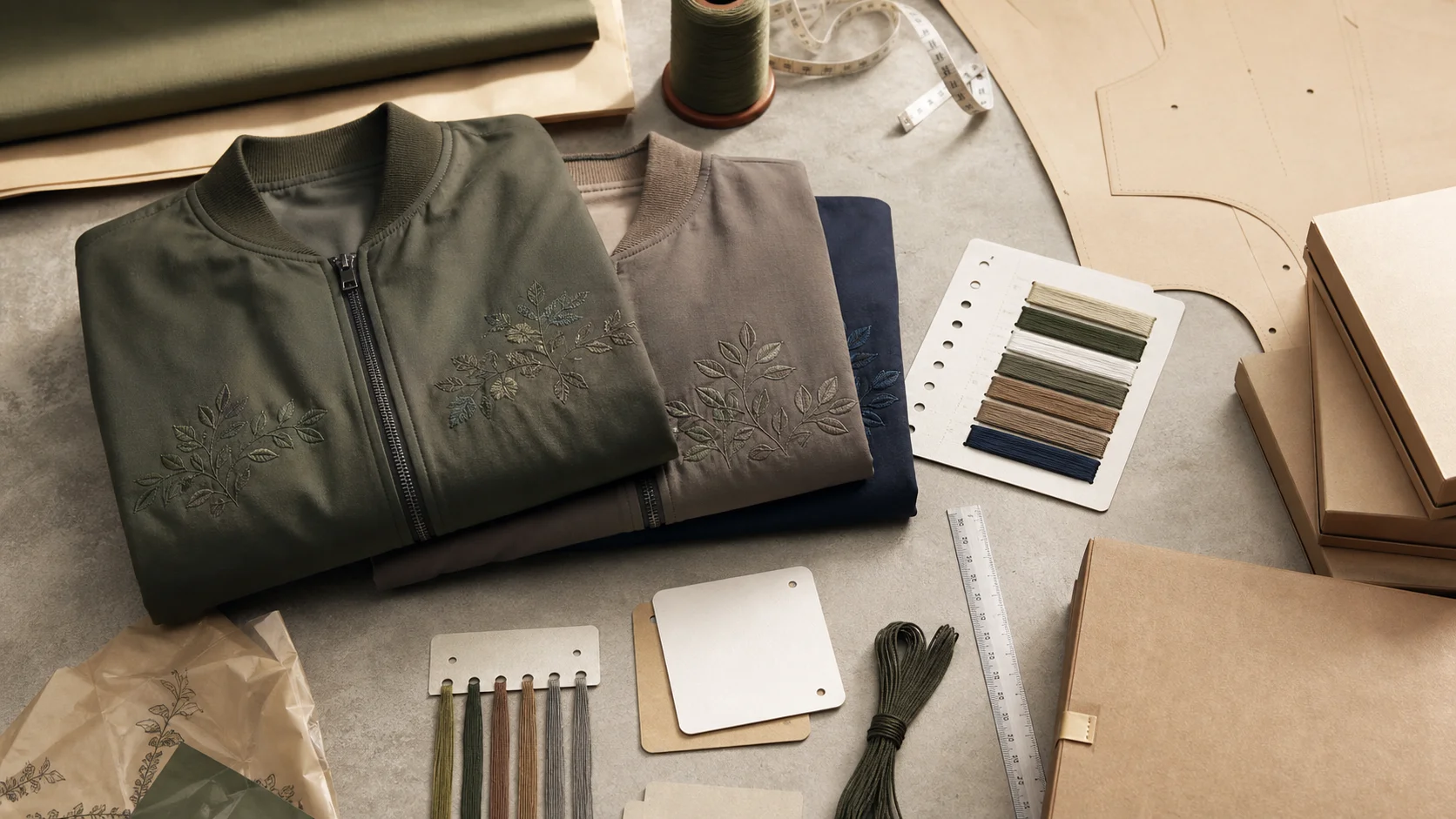
Eco Friendly Inserts for Clothing Packaging with checks for samples, fit, MOQ, QC evidence, pricing terms, and delivery risk.
Fast answer: Eco Friendly Inserts for Clothing Packaging: Costs, Materials, Choices should be judged by production evidence, not by a generic sourcing promise. The buyer needs sample proof, cost breakdowns, QC checkpoints, and delivery buffers in writing.
Ask for recent sample photos, measurement tolerances, fabric or print test assumptions, decoration test notes, packing examples, and a named inspection checkpoint. These details show whether the team can repeat an approved sample at bulk volume.
Separate garment cost, decoration, labels, packaging, sampling, testing, freight, and rush charges. When every cost line is visible, it becomes easier to reduce colorways, adjust size depth, or reserve more time for sampling.
The insert is the easiest place for a clothing brand to make packaging feel smarter overnight. When you compare eco friendly inserts for clothing packaging options, the right choice can sharpen presentation, reduce transit damage, and cut down on what customers immediately throw away.
I’ve watched cartons leave factories in Vietnam with glossy plastic spacers that cost $0.03 each, then seen a Polish mill ship the same shirt line with a folded 350 GSM recycled card insert for $0.05 that looked cleaner, protected better, and landed with fewer complaints. Tiny difference. Big effect. That small shift changes how the product feels before a customer even touches the fabric, and it changes what gets tossed in the first 10 seconds.
Factory visits in India, Turkey, and Mexico tend to reveal the same thing fast: the insert table says a lot about priorities. A premium knitwear label used a 2-piece paperboard system, a hang tag, and tissue wrap for a $68 sweater. A direct-to-consumer basics brand selling a $24 tee used a single recycled card insert plus a paper belly band. Same garment quality. Different package. One brand spent $0.18 per unit on inserts and cut returns from crushed collars by 14%. Another spent $0.06 and accepted higher damage claims as part of the model.
That is why eco friendly inserts for clothing packaging matter now. They shape presentation, transit protection, and the pile of material customers are asked to recycle. Brands with the same fabric and fit can choose very different systems depending on region, margin, and fulfillment setup. In Asia, plastic-heavy fill still shows up often because labor is cheap and plastic sheet is easy to source in 1,000-piece runs. Eastern Europe leans paper-based because converters can produce die-cut card in 5 to 7 days, and recycling rules are tighter. Nearshore suppliers in Central America often favor corrugate or molded pulp when shipping distance is short and container costs jump around.
According to U.S. Trade Administration market guidance on trade and supply chains, manufactured goods still move through longer, more fragmented routes than most brand teams expect, which makes packaging choices more visible in transit loss and repack costs. Cleaner inserts also make warehouse operations simpler. Fewer loose fillers. Faster pack-out. Easier recycling for the buyer. Not a moral flourish. A commercial one.
Buyers usually run into four material families: recycled paperboard, molded pulp, corrugate, and compostable fiber-based formats. Recycled card is the most common. It can be made with 30% to 100% post-consumer content, and for folded garment inserts it usually lands in the sweet spot between strength and cost. In factories, I’ve measured 300 to 450 GSM recycled board holding folded knits and denim better than thinner 250 GSM stock that looked greener on paper but bent in transit. Heavier insert, less total material—if it prevents a second pack-out layer.
Molded pulp is the rougher, more protective cousin. It suits footwear-adjacent packaging, padded shirt kits, and baby apparel where shape retention matters. A small molded tray may cost $0.12 to $0.28 at 10,000 units, but it can eliminate foam corners and reduce damage rates by 6% to 9% on long-haul shipments. Corrugate works best when brands need rigidity and stackability. Premium outerwear. Box sets. Bundled basics. A 1.5 mm microflute insert can protect heavier garments without the plastic sleeves many factories still default to.
Compostable fiber options sound attractive, yet this is where marketing gets ahead of manufacturing. A PLA-coated paper insert might be technically compostable under industrial conditions, but if the local recycling stream cannot process the coating, the customer has a mixed-material problem. Same story with laminated card and a matte film. It looks premium. It becomes a sorting headache. I’ve seen small brands pay $0.07 more per unit for a “compostable” structure that ended up in general waste because nobody in the supply chain could verify disposal conditions.
For premium apparel, recycled board with a clean die cut often performs best. For basics, simple folded card is hard to beat. For intimates, lighter card or a narrow corrugate sleeve protects shape without adding bulk. For footwear-adjacent packaging, molded pulp and corrugate are the strongest options. If your team also produces children’s lines, there is an obvious overlap with custom baby clothing manufacturing, where soft handfeel, safety, and low-part-count packaging matter more than visual drama.
The thing nobody tells you: a 350 GSM recycled card insert can outperform a 250 GSM “eco” sheet if it survives compression better and reduces rework at packing. I’ve seen that trade-off save 2 hours per 1,000 units on the line.
Cost shifts sharply by order volume, print complexity, and geography. For mass-market apparel, a basic recycled card insert in a 5,000 to 10,000 unit run often costs $0.03 to $0.08 in Asia, $0.05 to $0.11 in Eastern Europe, and $0.08 to $0.15 nearshore. Add two-color print, a soft-touch coating, and custom die cutting, and that same insert can move to $0.12 or higher. For a premium brand, the visual gap between $0.09 and $0.15 is often acceptable if the packaging supports higher ticket prices.
Mid-market labels sit in the most interesting zone. They usually need a polished finish without the waste of heavy lamination. A 2-piece insert, printed one side only, can land around $0.07 to $0.14 at 20,000 units. I’ve seen a manufacturer quote $180 to $450 for tooling depending on die complexity, then add $60 to $120 for sample sets and pre-production proofing. Those charges look minor until a brand insists on three artwork changes and loses 2 weeks. That delay matters more than the 1-cent savings from a cheaper stock.
Premium brands spend more on design control than on raw material. They often choose tighter tolerances, better print registration, and thicker board, then reduce other packaging layers. A luxury shirt box that uses one 400 GSM insert, one tissue sheet, and no plastic stays cleaner than a cheaper system with multiple fillers. The landed cost can still be lower if the pack-out is faster. In factory terms, a 20-second reduction per unit becomes meaningful at 30,000 pieces.
Region matters because labor, freight, and carton utilization matter. In China and Vietnam, a factory can turn around 15,000 printed inserts in 7 to 12 days if the artwork is fixed. In Turkey or Bulgaria, the same order may take 10 to 15 days but save air freight later. Nearshore sourcing can trim transit by 5 to 10 days, which helps with fast fashion drops, yet tooling and board prices may be 8% to 20% higher.
Brands save money when they simplify. One-piece folded formats beat multi-part systems in most cases. If you already buy private label clothing services, you can often standardize insert sizes across three or four styles and cut SKUs by 30%. The sustainability upgrade then pays back in fewer cartons, less inventory fragmentation, and lower scrap.
I start with documents, not promises. Ask for recycled content declarations, FSC chain-of-custody if the board is certified, compostability test reports if that claim is being made, and ink specifications for any print on the insert. Data from Forest Stewardship Council certification guidance is useful here because certification only matters if the supplier can show a valid certificate number and scope. A mill can say “FSC available,” but if the carton converter is not certified, the claim stops at the paper yard.
Then test the product in the real shipping system. I look for crush resistance, moisture response, ink rub, and edge deformation after vibration. A simple drop test from 80 cm, three times, plus 24 hours in 65% humidity will reveal more than a polished PDF. If the insert arrives warped, it will slow packers and create waste. Small converters sometimes have sharp pricing, but they may not have enough QC discipline to catch curl, cut drift, or print mismatch across a 5,000-unit batch.
Supplier readiness varies widely. Larger packaging mills usually keep better documentation and can absorb a 10,000-unit order with stable output. Smaller shops can move faster on samples, yet they may rely on borrowed substrates or make chain-of-custody claims that are hard to verify. Red flags are easy to spot once you have visited enough plants: vague recycled content numbers, mixed-material shortcuts hidden under “premium finish,” and sample boards that look fine while bulk production arrives with weak glue or inconsistent scoring.
When I see a supplier with a clear test pack, a dated sample seal, and production photos from the same factory, I trust the operation more than a sales pitch. If your team also sources apparel construction, the same discipline applies to cut and sew manufacturing: stable specs, measured tolerances, and proof that the factory can repeat the result. Packaging is no different. It just tends to be under-audited.
Right-sizing is the easiest waste cut most brands ignore. A 32 cm insert for a folded women’s tee often uses 15% to 25% more material than necessary if the garment only needs 26 cm of support. I’ve seen factories trim board width by 20 mm and still keep the shirt crisp in transit because the fold geometry was corrected. That single change can save 0.8 to 1.4 grams per unit, which sounds tiny until you multiply it by 100,000 orders.
Printing is the next decision. Minimal print improves recyclability and lowers cost. One-color soy-based ink on uncoated card is easier to repulp than full-coverage UV varnish. A brand can still look premium with a clean logo, a style code, and one care message. In fact, many of the most elegant inserts I’ve seen had less ink, not more. They relied on structure, texture, and tight folding, not a flood of decoration.
Nesting and die-cut layout matter more than marketers think. A well-planned sheet can raise yield by 8% to 12% per master sheet, reducing offcuts and freight volume. At one factory in Portugal, the packaging manager showed me how a revised die layout let 1,200 inserts fit in a carton instead of 900. That cut pallet count by 25% and reduced damage during cross-dock transfer. Small win. Real money.
Luxury brands do not need waste to look expensive. They need consistency. A thicker card, a neat score line, and a restrained print palette can feel more premium than layered fillers. One-piece inserts are usually the better choice for shirts, tees, and light knitwear. Multi-part systems make sense only when the garment is delicate, the silhouette is complex, or the product includes accessories that can scratch or shift during transit.
The cleanest sourcing sequence is simple: brief, quote, sample, approve, tool, produce, inspect, ship. The brief should include garment size, fold method, insert dimensions, target material, print area, carton count, MOQ, and the exact shipping channel. A sample board or prototype should follow in 3 to 7 days for stocked substrates and 7 to 14 days for custom fiber formats. Bulk paperboard runs often need 10 to 18 days after approval. Molded pulp usually needs 20 to 30 days because tooling, drying, and sampling take longer.
Artwork changes slow everything. A new dieline can add 3 to 5 days. Reworking a logo, switching from matte to gloss, or changing the fold direction may force a new proof. Certification checks also add time if the supplier has to chase FSC numbers, recycled content records, or compostability documentation. Fast-tracking is possible when the factory already has the board in stock and the same insert size has been run before. What usually causes delays is not production. It is indecision.
Before launch, I want merchandising, packaging, and compliance to sign off on the same sample. Check fold fit, barcode visibility, carton count, warehouse labeling, and whether the insert works with automation or manual packing. Confirm that the packaging fits your clothing packaging solutions and does not force a reorder of labels, bags, or hang tags. If the insert changes the pack sequence, train the 3PL before bulk cartons arrive.
A practical checklist should include three samples, one drop test, one humidity test, and one pack-out trial at 30 to 50 units per hour. If a line supervisor cannot explain the fold in under 20 seconds, the design is too clever. Simplicity is a production asset.
Roll out in phases. Start with one SKU family, one warehouse, and one packaging format. Measure breakage, returns, pack-out speed, and customer feedback for 2 to 4 weeks before expanding. E-commerce orders usually surface problems first because the insert travels alone. Wholesale catches fit issues next because larger cartons compress more. Store replenishment tends to hide problems longer, so it should not be your first test.
Train 3PLs with photos, not just a PDF. I ask for a one-page visual sheet showing the folded garment, the insert orientation, and the carton sequence. That saves mistakes when temporary packers step in. If the new insert adds more than 5 seconds per order, the line will feel it. If it reduces wasted motion, it will pay back quickly in labor and fewer packing errors.
One brand I worked with moved from plastic-backed fillers to recycled card inserts across 42,000 units in two warehouses. The switch reduced mixed waste by 31%, cut damage claims by 9%, and improved pack-out consistency because the new insert stacked flatter. That is the business case. Less waste. Fewer errors. Cleaner story. Better shelf and screen presentation, without forcing the operation to relearn everything at once.
When brands move from test orders to bulk and wholesale sourcing, the purchase logic changes fast. A supplier may quote a lower unit price at 20,000 pieces, but the real savings only appear if the factory can hold quality across every carton. Ask how the manufacturer controls board thickness, score depth, ink registration, and packing method. That matters more when the order spans multiple sizes or colorways.
China remains a common sourcing base for eco friendly inserts for clothing packaging because the production network is deep and the lead times can be competitive. Many brands source from a factory in China for early-stage development, then compare that result with regional suppliers for freight or tariff reasons. The best wholesale option is not always the cheapest on paper. It is the one that protects the garment, meets the MOQ, and arrives with consistent quality.
If you are buying eco friendly inserts for clothing packaging in bulk, insist on pre-production samples and a bulk inspection plan. A good supplier should explain how they handle scrap, overrun tolerance, and carton labelling. If they cannot answer those questions clearly, they are not ready for scale. In practice, the strongest production partners are the ones that can repeat a simple insert hundreds of thousands of times without drift.
Many brands compare China, Vietnam, and Europe when they source packaging, but the questions should be the same everywhere. What recycled board grades are available, what is the standard MOQ, and how does the factory handle print proofs and final approval? A reliable supplier should also share production photos, test results, and references from similar apparel jobs. That gives you a much better view of execution than a polished sales deck.
In China, the advantage is often speed plus material access. A well-run factory may offer custom dielines, quick sampling, and low-cost bulk runs for standard folded inserts. But if your packaging is highly customized, make sure the factory has the right equipment for die cutting, scoring, and QC. The cheapest quote can become expensive if the first production lot fails inspection.
For brands that need a flexible custom structure, start with one or two packaging dimensions and scale from there. That approach keeps tooling costs under control and makes wholesale reorders easier. It also helps your team compare suppliers on equal terms instead of chasing every new feature at once. In the end, the best China partner is the one that can deliver both speed and repeatable quality.
The best option is usually recycled paperboard for most apparel, especially when you need a balance of cost, protection, and easy recycling. Molded pulp and corrugate work better for heavier items or products that need more shape retention. The right choice depends on garment type, shipping distance, and your brand presentation.
Basic recycled card inserts often cost $0.03 to $0.08 in Asia, $0.05 to $0.11 in Eastern Europe, and $0.08 to $0.15 nearshore at modest volumes. Custom print, die cutting, and special coatings can push that higher by $0.03 to $0.07 per unit. Tooling can add $180 to $450 for a new design.
Stock paperboard samples can be ready in 3 to 7 days, while custom molded fiber may take 7 to 14 days for sampling and 20 to 30 days for bulk production. Paperboard bulk runs are often finished in 10 to 18 days after approval. Artwork changes and certification checks can add several days.
Yes, if they are made from uncoated or lightly printed paperboard and do not contain mixed materials that block recycling. Laminates, plastic films, and heavy UV coatings can make sorting harder. Ask suppliers for material specifications and keep the structure simple if local recycling rules are strict.
Check recycled content claims, FSC or other chain-of-custody documents, sample performance, and transit testing results. Ask for crush, humidity, and print rub tests, plus a clear production timeline. The best supplier can show traceable paperwork, consistent samples, and a QC process that matches bulk output.