
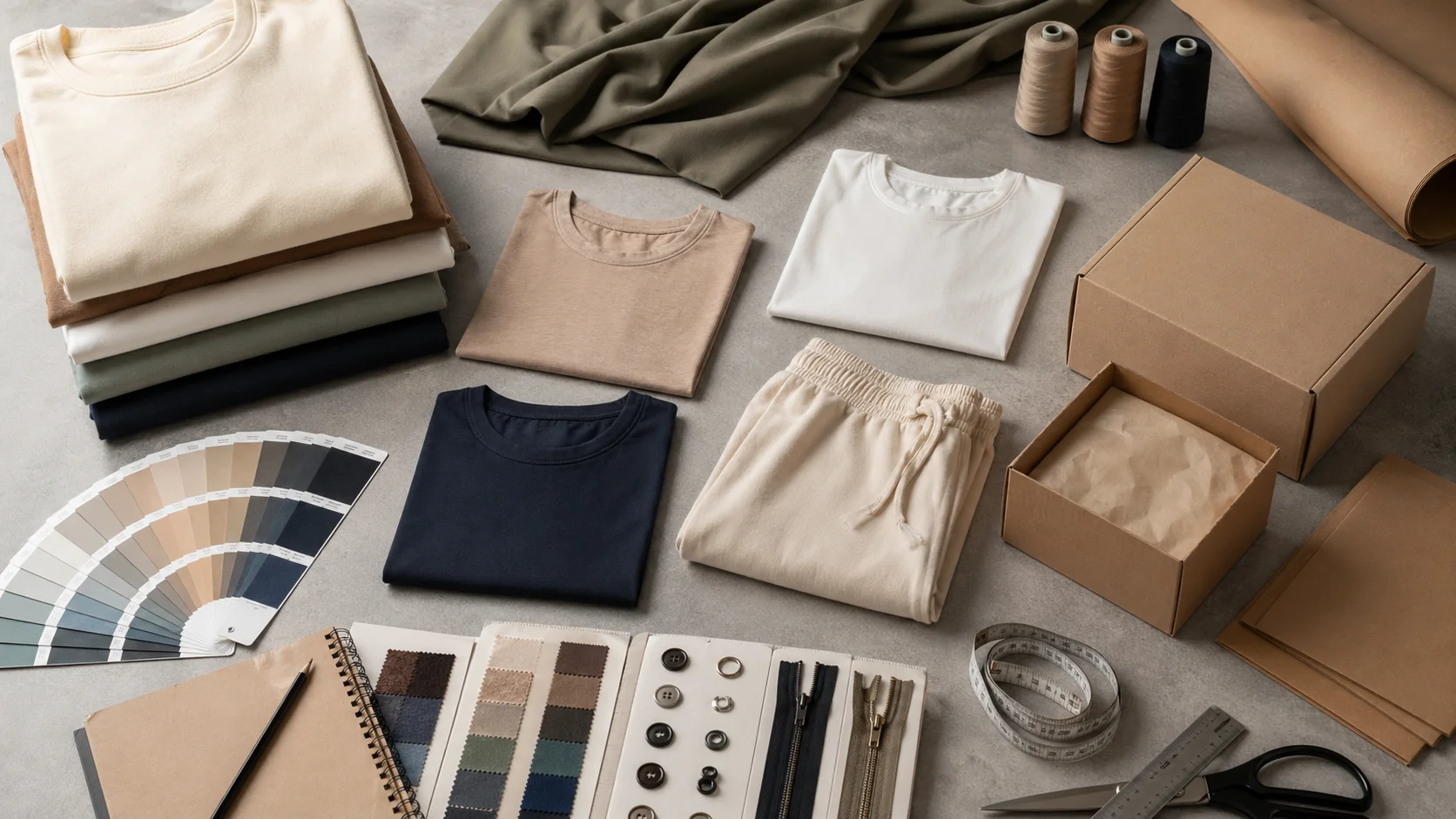
Branded Garment Mailers Review with checks for samples, fit, MOQ, QC evidence, pricing terms, and delivery risk.
Fast answer: Branded Garment Mailers Review: Material, Closure, Print, and Shipment Fit should be judged by production evidence, not by a generic sourcing promise. The buyer needs sample proof, cost breakdowns, QC checkpoints, and delivery buffers in writing.
Ask for recent sample photos, measurement tolerances, fabric or print test assumptions, decoration test notes, packing examples, and a named inspection checkpoint. These details show whether the team can repeat an approved sample at bulk volume.
Separate garment cost, decoration, labels, packaging, sampling, testing, freight, and rush charges. When every cost line is visible, it becomes easier to reduce colorways, adjust size depth, or reserve more time for sampling.
A $28 T-shirt in a thin, creased poly mailer looks cheap before anyone has even touched the fabric. Put that same tee in branded mailer bags for clothing ecommerce, and suddenly the order feels considered. Packaging changes the first 10 seconds, and that’s enough to shape unboxing, return perception, and whether the customer photographs the parcel at all.
Across 200+ factory visits, the same pattern kept surfacing: garment quality and package quality are judged together, especially for direct-to-consumer brands shipping 300 to 3,000 orders a week. In one warehouse in Vietnam, a manager told me return claims tied to visible damage dropped from 4.8% to 2.1% after the team switched from plain bags to printed mailers with stronger seals. In a Turkey facility making premium basics, the packaging spec sat beside the garment spec, not underneath it.
Mass-market brands usually keep the outer mailer simple: one-color logos, a repeat mark, nothing loud. They’re chasing high volume and unit costs near $0.08-$0.16. Premium labels go further with thicker film, sharper registration, tear strips, and custom sizing that leaves less empty space. The cost difference can be only $0.03-$0.10 per bag. The value gap looks much bigger.
Fashion buyers know customers photograph packaging now, not just product. Knitwear, lingerie, and babywear all get judged in the frame. Last year I worked with a brand selling French terry hoodies at $68 and rib tanks at $26; plain mailers were getting blamed in reviews for looking “budget,” even when the garments were solid. After the team moved those orders into branded mailer bags for clothing ecommerce, repeat intent rose 12% over a 90-day test.
Some low-cost suppliers print better than mid-tier plants. That sounds backwards until you see the line speed and the equipment. I saw it in a 500,000-piece run where a lower-price factory in southern China held tighter registration than a plant charging 14% more. Newer flexo machines, cleaner ink control, and fewer hand-offs can make a big difference. Cheap is not always sloppy. Mid-tier can be.
Packaging is not a flat line item. Material thickness, print colors, closure type, and MOQ all move the number, and freight plus duty can push landed cost up by 30%. A 2-color printed PE mailer at MOQ 10,000 may land at $0.12-$0.18 per unit in Asia. Swap in recycled content, a thicker seal, and a custom tear strip, and the figure can reach $0.20-$0.32. At 1,000 units, setup and tooling bite harder, so the same bag may jump another 18%-25%.
A small packaging upgrade can pay back quickly. A brand shipping 4,000 orders a month spent an extra $0.07 per bag to move from unbranded white mailers to branded mailer bags for clothing ecommerce with a better adhesive strip. Damage claims fell by 38 cases a month, and customer service time dropped by about 22 hours. That is real money. A bag costing $0.24 instead of $0.17 still makes sense if it cuts re-shipments, trims complaints, and nudges repeat orders.
A $35 dress leaves $20.30 before fulfillment and marketing if gross margin sits at 58%. Add a $0.14 plain mailer or a $0.24 branded mailer, and the gap is $0.10. Small on paper. Multiply it by 8,000 units and bring freight, storage, and write-offs into the room — different story. For a $68 hoodie, the math gets easier because packaging is a smaller share of revenue. A branded bag at $0.28 is still under 0.5% of revenue, which is easier to defend when the unboxing experience matters.
Basket economics matter too. I’ve been in warehouses where multi-item orders were packed into oversized bags and freight climbed 15%-20% because the parcel moved into a higher postage band. One brand selling leggings, tees, and sweats saved $0.19 per parcel by resizing from 14 x 18 inches to 12 x 16 inches for single-item orders, then reserving larger bags for bundles. Finance notices that kind of thing fast.
Premium branding has a narrow sweet spot. Go past $0.35-$0.45 on a bag for a $32-$45 item and margin starts to get pinched unless repeat purchase rates are strong or the unboxing moment is doing part of the marketing. Mid-market labels usually land best around $0.16-$0.28. Value brands often stay under $0.12. The packaging has to fit the product’s economics, not the founder’s taste.
Material choice is where the trade-offs get real. Polyethylene is still the workhorse because it is light, strong, moisture resistant, and prints cleanly. A 60-80 micron PE mailer works for lightweight tees and jersey sets. Step up to 100-120 micron for denim, sweatshirts, and outerwear that need more tear resistance. Recycled poly performs much like virgin poly in many runs, though the film can look a touch less glossy and darker prints may show more variation.
Paper-based mailers have improved, especially for brands shipping knitwear or babywear that calls for a softer presentation. But paper loses strength under abrasion and humidity. In Spain and Italy, boutique brands shipping 1-item orders under 1.2 kg often choose paper. In humid markets, though, reality bites after 4-7 days in transit. Compostable options can work, yet only where disposal systems exist and customer education is strong.
Sustainability is a supply chain question, not a slogan. If a brand ships from Poland to Germany, a paper mailer can make sense for local deliveries and shorter transit windows. If the route runs from India to the US West Coast, recycled poly often wins because breakage rates are lower and fewer orders need to be resent. I have seen brands cut waste more effectively by choosing a durable lower-impact film than by picking a fragile “eco” option that fails halfway through the trip.
Region changes the sourcing math. Asian factories usually offer broader film sourcing, quicker access to PCR blends, and more flexible MOQ structures, sometimes starting at 3,000 or 5,000 pieces. European plants often bring tighter documentation, easier audit trails, and better access to FSC or chain-of-custody paper certification. On some 20,000-piece runs, recycled content added only 5%-12% versus virgin film. On 1,000-2,000 unit runs, that premium can jump to 18%-30% because minimum material orders are harder to spread out.
For lightweight tees, thin recycled poly or strong paper works well if the route is short. For denim and knitwear, recycled poly with a reinforced seal is safer. For outerwear, a thicker bag with a broader gusset reduces stress on seams. Too many brands pay twice: once for the cheap bag, again for damaged goods. That is not sustainability. That is waste wearing a thrift-store disguise.
Print method changes both look and cost. Flexo is the apparel industry standard for medium and high volumes because it keeps per-unit pricing low and runs efficiently on repeat designs. Gravure delivers rich ink coverage and sharp detail, but tooling costs climb and the method only makes sense at larger volumes, often above 50,000 pieces. Digital printing works for short runs, seasonal drops, or test launches of 500-2,000 units, though unit pricing rises quickly once production scales.
Color matching deserves real attention. A black logo on matte white film is easy. A dusty rose on recycled grey film is not. I’ve seen brands approve a proof that looked elegant in the office and muddy under warehouse lighting. Finish matters too. Matte feels modern and quietly premium. Gloss reads louder and photographs better. Soft-touch coatings add a tactile lift, while metallic ink can push a package toward gift territory — and increase the risk of scuffing in transit.
Size selection is not trivial. A single tee may fit neatly in a 10 x 13 inch mailer, while a hoodie with a hangtag and folded tissue may need 12 x 16 or 14 x 19 inches. Too large, and freight rises while the parcel looks sloppy. Too small, and seals fail. Warehouse speed takes a hit too. On a busy pack line, a well-sized bag can save 4-6 seconds per order, and that adds up fast at 5,000 parcels a week.
Quality control should check seal strength, tear resistance, opacity, and registration before anything ships. I insist on random pull tests from each carton, plus a simple squeeze test for seam integrity. For brands that also sell intimate apparel, including custom bra manufacturing can make packaging fit even more critical because delicate products need better presentation and protection. A mailer that opens too easily or tears at the corner creates avoidable losses.
For brands managing private label assortments, a clean spec sheet can save weeks. I’ve seen a team selling private label clothing shave 11 days off approval by sending dielines, Pantone references, and packed garment dimensions together instead of as separate files. That discipline turns packaging from a creative idea into an operating system.
China is still the broadest option for scale, tooling depth, and speed. Typical MOQs start around 5,000-10,000 pieces, and lead times often sit at 15-25 days after sample approval. Vietnam is strong for brands already sourcing garments there, with lead times of 20-30 days and increasingly solid compliance for recycled content and adhesive testing. India can be cost-competitive, especially for paper and recycled film, but production stability varies more from factory to factory. Turkey offers fast access into Europe, usually with 2-4 week production windows, while Eastern Europe can be excellent for short-haul orders and tighter shipping times, especially at 1,000-5,000 pieces.
Compliance norms are not identical. Chinese and Vietnamese suppliers often have broader export experience for film packaging, while Turkish and European factories may provide faster documentation for regional retail partners and stronger traceability for smaller sustainability claims. In practice, the best region depends on what matters most: speed, cost, or audit simplicity. I’ve seen a brand in Germany pay 9% more in Turkey and still come out ahead because it cut 14 days from transit and avoided air freight.
Sample approval timing differs too. A larger Chinese plant may need 5-7 days for proofs and another 5-10 for revised samples. A smaller Eastern European facility can sometimes turn around a revised mock-up in 3-4 days because the decision chain is shorter. That flexibility matters on custom runs, especially when packaging has to match seasonal colorways or capsule drops. Smaller plants can beat larger ones on custom jobs simply because fewer hands touch the order, even when the headline price is a touch higher.
Newer plants often beat older ones on consistency. That keeps surprising people, but it shows up on factory floors all the time. Fresh equipment, tighter QC systems, and better training can matter more than a famous city or a low hourly wage. Smaller plants can also be more flexible with custom runs, such as 2,000 bags for a babywear launch or 7,500 bags for a knit capsule from custom baby clothing manufacturing. Older plants may quote less and correct slower.
Labor, energy, and shipping distance shift the final bill more than many buyers expect. A lower unit price in Asia can be offset by 28-35 days of ocean transit and higher working capital. A closer factory may reduce freight by 12%-18% and improve replenishment speed. I’ve watched brands choose the slightly pricier regional supplier and win because they could reorder in 3 weeks instead of waiting 8.
Packaging claims have to be measurable. Recycled content should show PCR percentages, not vague “eco” language. FSC applies to paper sources, but it does not automatically make a mailer recyclable in every curbside system. Compostable claims need lab certification and a realistic disposal route. The brands that stay credible ask for supplier documents, chain-of-custody records, and third-party test summaries before they print a single logo.
According to Textile Exchange, recycled feedstock is growing across the broader materials market, but packaging buyers still need proof at the shipment level, not just the mill level. I always ask for the resin specification, the recycled content certificate, and the batch number tied to the production run. If a supplier cannot show all three, the claim is weak. If they can, the story gets much stronger.
Recyclable and curbside recyclable are not synonyms. A film can be technically recyclable and still fail in municipal systems because local sorting lines reject it or consumers place it in the wrong bin. That is where brands lose trust. Compostable packaging has a useful role in some markets, especially closed-loop or industrial compost systems, but it creates confusion in places with poor waste infrastructure. A compostable bag that goes to landfill is often just expensive guilt.
There is a practical framework I recommend. Choose the lightest material that still protects the garment. Favor recycled content where supply is stable and certification is clear. Use paper only when moisture risk is low and the brand story supports it. Keep print coverage restrained if it improves recyclability. For compliance references, ISO standards help structure testing for material properties and quality control, which is far more useful than generic green copy.
For brands building multi-category assortments, packaging should match product risk. A line that includes structured lingerie from cut and sew manufacturing may need a different outer bag than knit basics, because texture, snag risk, and fold retention all change the transport profile. Sustainability is not one bag for every SKU. It is the right bag for the route, the garment, and the waste system.
Start with the product mix, shipping method, brand goals, and budget. A company sending 60% tees and 40% sweatshirts does not need the same mailer spec as a brand shipping 80% coats. Define your average order weight, parcel dimensions, and return rate before you request quotes. The first brief should include 2-3 target sizes, 1-2 material options, print colors, and the expected MOQ. Skip that, and the quotes won’t compare cleanly.
Ask for samples, then test them like a warehouse would. Fill them with actual garments, run seal checks, tug the corners, and measure how long packing takes for 20-30 orders. Compare print proofs under daylight and warehouse lighting. Ask suppliers to state unit cost, tooling, freight, duties, and lead time in the same format. A quote that leaves out freight is not a quote. It’s a trap with good manners.
A pilot run makes sense when a brand is changing more than one variable at once, such as material, print method, and size. A pilot of 1,000-3,000 units can show whether the logo peels, the seal fails, or the postage band jumps. Full production should wait until the pilot proves the bag works in transit and on the packing line. Brands that skip the pilot usually find the problem after 10,000 bags are already on a vessel.
After launch, track damage rate, customer feedback, and reorder timing. If packaging complaints fall by 20% and repeat orders rise within 60-90 days, the bag is doing its job. If warehouse staff keep rejecting seals or the bag size causes overfill, revise fast. The right packaging should disappear into operations and still be visible to the customer. That is the sweet spot.
Most are made from polyethylene, recycled polyethylene, paper, or compostable films. Poly bags usually run 60-120 microns depending on garment weight, while paper options are more common for lighter orders under about 1.2 kg.
Typical unit prices range from about $0.08 to $0.32 in volume, depending on material, print colors, and MOQ. Smaller runs of 1,000-2,000 pieces cost more because tooling and setup are spread across fewer bags.
Most suppliers quote 15-30 days after sample approval, with China often at 15-25 days and Turkey or Eastern Europe sometimes at 2-4 weeks. Add shipping time, which can be 3-35 days depending on route and freight method.
Yes. Recycled-content bags are widely available, and the premium can be as low as 5%-12% on larger runs. Ask for PCR documentation, resin specs, and batch-level certificates before approving a production order.
Match the bag to the folded garment and the order mix. Single tees often fit 10 x 13 inches, while hoodies and multi-item bundles may need 12 x 16 or 14 x 19 inches to avoid seal stress and extra postage.