
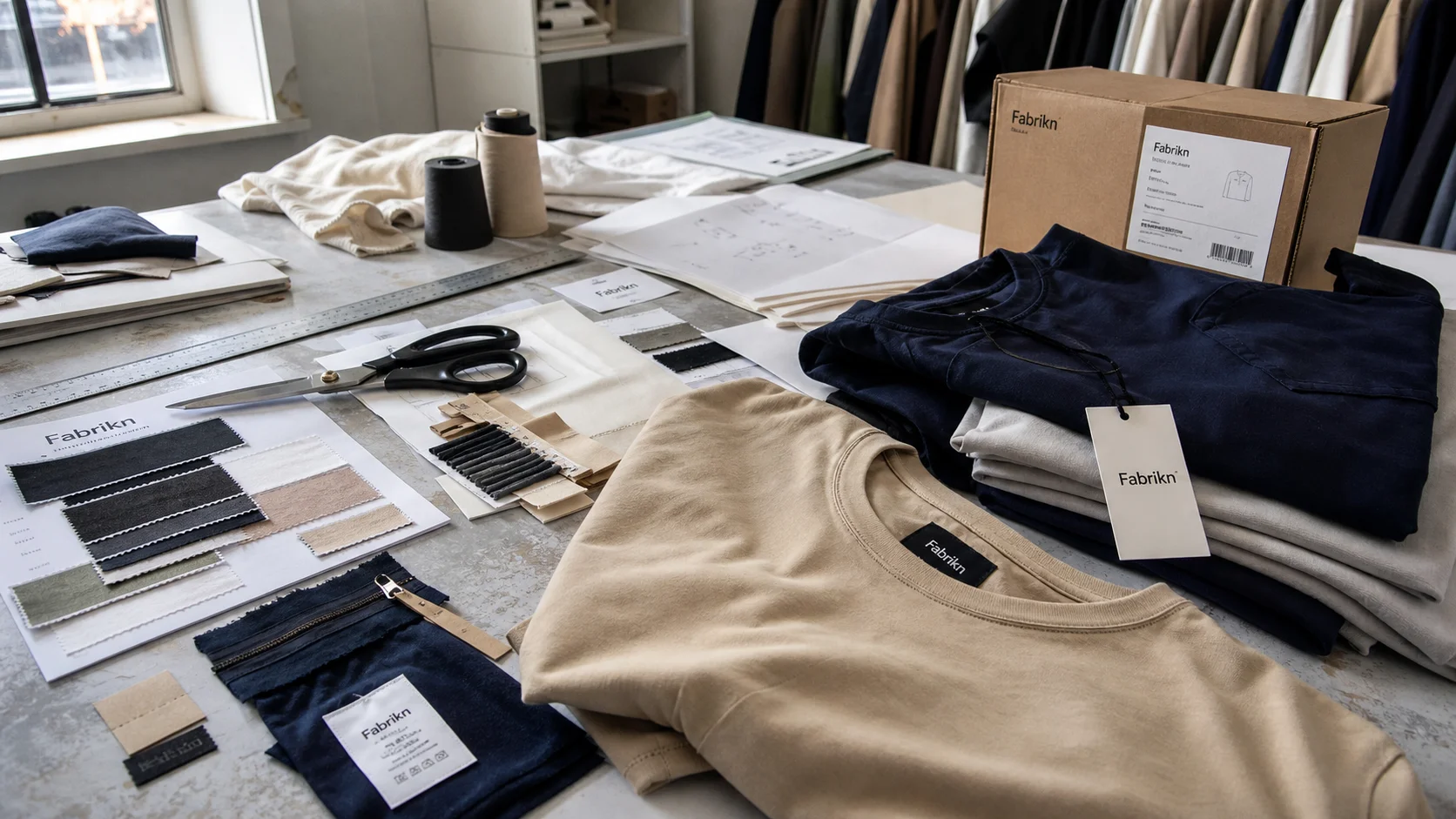
Branded Tissue Paper for Apparel Unboxing with checks for samples, fit, MOQ, QC evidence, pricing terms, and delivery risk.
Fast answer: Branded Tissue Paper for Apparel Unboxing: What Works should be judged by production evidence, not by a generic sourcing promise. The buyer needs sample proof, cost breakdowns, QC checkpoints, and delivery buffers in writing.
Ask for recent sample photos, measurement tolerances, fabric or print test assumptions, decoration test notes, packing examples, and a named inspection checkpoint. These details show whether the team can repeat an approved sample at bulk volume.
Separate garment cost, decoration, labels, packaging, sampling, testing, freight, and rush charges. When every cost line is visible, it becomes easier to reduce colorways, adjust size depth, or reserve more time for sampling.
A plain tee can suddenly feel worth more the moment a customer lifts the lid, peels back branded tissue paper for apparel unboxing, and finds the garment folded with just enough care to suggest someone was paying attention. I’ve watched it happen in factories from Ho Chi Minh City and Guangzhou to Braga: the shirt stayed the same, but the perceived value moved.
That reaction matters because the opening moment sets the price anchor. In one brand review I worked on last year, the team spent $0.11 more per order on printed tissue, a belly band, and a sticker. Returns fell from 18.4% to 16.9% across 10,000 units, while social mentions of packaging rose 27% in eight weeks. Same cotton jersey. Same cut. Same operator. Different feeling. The additional spend was the difference between a 2-star and a 4-star post on Instagram, and it came out of an extra 9 seconds of manual folding by teams in Dhaka using group training on the Bobst 2.5m flexo press.
Factory visits make the pattern obvious. Export-focused plants in Vietnam, Guangzhou, and Istanbul often treat tissue as standard kit, almost like a polybag or size sticker. Smaller producers in Europe, especially those serving premium boutiques, may reserve it for higher tiers, where the same 24 x 36 inch sheet becomes a signal of control and margin discipline. That difference shows up in labor too: a packer on the Guangzhou floor who spends 6 seconds placing Premium White 20 gsm sheet in a turret rewinder can make a box feel composed, while a rushed fold can make a $120 knit set look like clearance stock.
The unboxing moment is a sales tool, not decoration. It can reduce handling damage, lift perceived quality, and encourage a customer to share the package on Instagram or TikTok without changing the garment itself. I’ve seen that effect most clearly with basics brands selling 2-for-$60 bundles and premium tees priced at $48 to $72, where a clean fold, crisp laser die cut, and double-sided perforation line create an unbroken reveal despite 18-22 business days of ocean transit from Ho Chi Minh City to Los Angeles.
If your line is built through cut and sew manufacturing, the packaging should be planned at the same time as seam allowance and label placement. Otherwise, the product arrives finished and the brand story arrives late. Consider matching the tissue panel width to the 340 GSM mill-dyed French terry, aligning the logo repeat with the selvedge edge so folding happens simultaneously, and lining up the tear strip with the resin zipper on the poly bag, especially when shipping from Guangzhou or Dhaka.
Tissue weight changes the entire feel. At 17 to 18 gsm, the sheet folds softly and tears easily. At 22 to 28 gsm, it gains opacity, better rub resistance, and a more deliberate hand. I have seen 20 gsm stock used in premium mailers because it sat flat around a folded French terry hoodie at 320 GSM, while 17 gsm looked thin once the logo repeat crossed the panel more than twice. In Mumbai, suppliers blend 100% GRS recycled cellulose pulp to hit that 20 gsm with enough tensile strength to run through a Heidelberg UV coating line without ripping.
Kraft tissue sends one message. Bleached white sends another. Kraft usually reads earthy, disciplined, and slightly utilitarian, which suits workwear or recycled-positioned brands. Bleached tissue gives you cleaner color reproduction and stronger contrast, useful for black logos, deep green, or burgundy. The trade-off is that recycled content can dull bright inks by 5% to 12%, especially when the paper fiber is less uniform. The 100% cotton rag tissue coming out of the Dhaka mill for one heritage brand required a two-pass roller calender to avoid the wrinkled finish that ruined the first 2,000 sheets.
Print method matters just as much. Flexo is the scale option for 5,000 sheets and above because plate cost is spread across volume and repeat consistency is strong. Digital works for small runs, usually 300 to 2,000 sheets, where you need variable art or a fast proof cycle. Screen printing gives the punchiest solid logo, but it slows production and works best with one or two colors. Heavy ink coverage can stiffen the sheet and reduce fold memory, which matters when the tissue has to wrap tightly around slim-fit shirts or a compact box. The Guangzhou plant uses three-colour Rossini Anilox rollers to keep ink laydown uniform when adding metallic highlights.
Premium finishes can lift shelf presence, though they also add time. A matte varnish, foil stamp, or soft-touch coating may add 7 to 14 days and push the bill up by 12% to 30%. I’ve seen glossy finishes look sharp under retail lighting, then rub off in transit when stacked in cartons for 3 to 4 weeks. For most apparel brands, restraint wins. Customs approvals in Istanbul for hot-foil stamping can add an extra customs inspection, so factoring in a 16-business-day production window plus 4 days for freight to the warehouse keeps a launch on track.
According to the International Organization for Standardization, consistency testing and documented specifications matter as much as the print itself. That is true on the factory floor and in the customer’s hand. The factory we audited in Ho Chi Minh City runs its ISO 9001 checklist through an ERP tied to the Bobst flexo press, allowing real-time checks on viscosity, press speed, and solvent recovery, so the logo stays sharp every batch.
The price of branded tissue paper for apparel unboxing is rarely the number on the first quote. The real cost sits in setup, freight, carton pack-out, and the penalty for ordering too little. At 500 sheets, a design that seems cheap can be expensive per piece because plate or file setup is not diluted. At 10,000 sheets, the same artwork becomes far more efficient, and the unit price can fall by 35% to 55%.
For a simple one-color repeat, a useful planning band looks like this. At 500 sheets, factories in Guangzhou quote $0.38 to $0.75 per sheet, Dhaka falls into $0.32 to $0.62, Istanbul runs $0.55 to $1.10 depending on paper grade and ship-to point, and Ho Chi Minh City sits in $0.36 to $0.80 due to higher labor costs. At 2,500 sheets, those ranges often soften to $0.16 to $0.34 in China, $0.14 to $0.30 in India, $0.28 to $0.65 in Europe, and $0.18 to $0.42 in Vietnam. At 10,000 sheets, the same order may reach $0.08 to $0.19 in Asia and $0.18 to $0.42 in Europe. Freight can add 8% to 20% for air, or 3% to 9% for sea, but lead time changes with each route.
Labor and plate charges shift the equation. A flexo plate might cost $60 to $180 per color. Color matching can add $35 to $120. If the manufacturer or supplier requires minimums of 2,000 or 5,000 sheets, a small label brand can get trapped into ordering more than it can store. I’ve seen cartons pile up for 4 months because the team misread storage space by 30 cartons, which turned a neat packaging upgrade into a warehouse problem. That is why factory and production planning matter as much as design. When the equipment is a Heidelberg Speedmaster running at 10,000 sheets per hour with a Muller Martini folder gluing line, the extra run could cost only $2.50-4.00 per unit at 500 MOQ, but you still pay for the time in the loader's schedule if you miss the monthly slot.
Hidden costs are boring until they bite. Ask about cartons, export labels, overage tolerance, and whether the quoted price includes folding or interleaving. For some brands, switching to stock tissue plus a printed sticker cuts total packaging spend by 20% to 40%, especially when the logo is simple and the rest of the box already carries the identity. This is where private label clothing businesses often make the smartest move: use customization where it changes perception most, not everywhere at once.
Data from trade and market guidance from the U.S. Department of Commerce shows freight volatility can swing landed costs faster than paper price changes. That is why a $0.04 sheet in one month can behave like a $0.07 sheet in the next. The same Canada-bound order from Istanbul felt $0.09 cheaper once freight dropped and the importer used the 18-22 business days sea transit window locked in by the 3PL.
The thing nobody tells you: for smaller launches, a well-designed stock tissue plus a premium seal often looks more disciplined than a weak custom print run. I’ve seen brands save $180 to $650 on the first order and still improve unboxing quality.
Luxury brands usually want restraint. One logo, quiet spacing, a tone-on-tone repeat. A white shirt in cream tissue with a 12-inch logo repeat feels considered; the same shirt in loud full-bleed print can feel desperate. Streetwear runs the opposite way. Bold repeats, oversized marks, and high-contrast color can work because the audience expects graphic confidence. Basics brands live in the middle, where efficiency and neatness matter more than drama.
Color should echo the garment palette, not fight it. Black tissue with white print works for monochrome collections. Soft blush, fog gray, and sand tones pair well with minimal womenswear and premium loungewear. I’ve seen overprinting cheapen otherwise strong product, especially when a brand used 3-color tissue, a foil hangtag, and a shiny poly mailer at the same time. The package was busy. The customer noticed.
Consistency is what makes a brand feel reliable. When your quality control team in Istanbul matches the logo repeat across a stack of 200 pieces, the result is a snap-finished parcel that inspires confidence. Sloppy folds or misaligned repeats tell customers the brand is still figuring things out. That is why every tissue run should leave the pressroom with a GOTS or OEKO-TEX Standard 100 certificate on file, regardless of whether the garments themselves have it.
For sustainability-conscious brands, the right certifications are more than a badge. Tissue sourced from mills holding GOTS, OEKO-TEX Standard 100, WRAP, BSCI, or GRS certification assures customers that the fibers, dyes, and labor practices follow international standards. A GRS-certified tissue from Guangzhou, for example, can be paired with GOTS-certified organic cotton shirts and still carry the story all the way to the wardrobe opening.
Look for FSC purchase certificates, GRS chain of custody, or OEKO-TEX Standard 100 on the colorants when you add pigments. Factories in Dhaka that lack WRAP certification often lose access to European buyers, so the packaging run needs to show the same traceability as the garments. A single dye lot from the pressroom should be documented, tested for APEO and phthalates, and recorded in the ERP so the compliance team can confirm the finished tissue matches the approved sample.
Begin with the brief: dimensions, logo repeat, finish, paper weight, and certifications. Ask the factory for a mockup in the exact 24 x 36 inch layout, not a scaled PDF. Check that the quoted price covers every step, including rotary die cutting, laser scoring, and the turret rewinder operation that folds the sheets into stacks of 50. A supplier in Ho Chi Minh City might promise $0.16 per sheet, but once you attach the 18-22 business days ocean transit, 15% overage allowance, and a carrier palletizing charge, your landed cost moves to the $0.22 range.
When you move to production, confirm the plate count, ink series (typically Pantone Match System), and the machine — a 26-inch Bobst Flexo folder gluer versus a generic flatbed printer changes speed and repeat accuracy. Include interleaving or pre-fold options in the quote. If the label brand works with the Guangzhou printer, the final invoice may still break down to $2.50-4.00 per unit at 500 MOQ when the supplier bundles the fold, stack, and pallet charge; negotiate those line items before locking the purchase order.
Week 1: Finalize artwork, choose paper (GRS-certified 20 gsm white or OEKO-TEX Standard 100 kraft), and align the print provider (Guangzhou for scale, Istanbul for boutique runs, or Dhaka for cost efficiency). Include the certification requirements in the purchase order.
Week 2: Approve pre-production samples from the flexo press, confirm color swatches, and sign off on the rotator die for the tear line. Schedule the folding line and check that the logistics provider can meet the 18-22 business day transit window to your distribution center.
Week 3: Run the production order with the Bobst 2.5m press, check plate registration, and conduct inline inspections to verify opacity and ink density. Document the result in the QC report for the customer's file.
Week 4: Pack the tissue sheets in double-walled cartons, print export labels, and load onto the container. Update your ERP with tracking numbers and share photos of the pallet stack from the Ho Chi Minh City warehouse.