
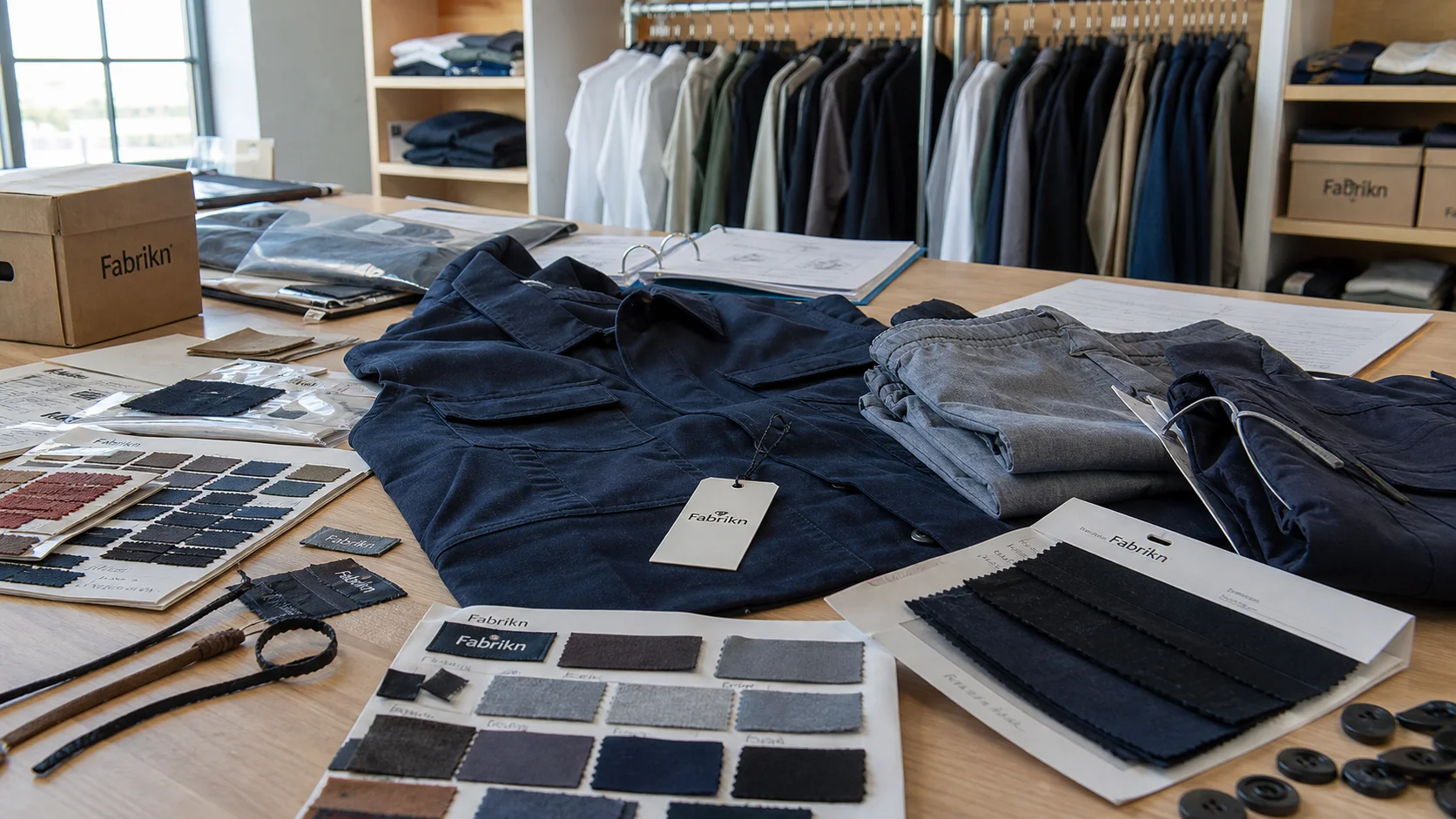
Branded Tissue Paper for Clothing Parcels with checks for samples, fit, MOQ, QC evidence, pricing terms, and delivery risk.
Fast answer: Branded Tissue Paper for Clothing Parcels: Costs, Impact, ROI should be judged by production evidence, not by a generic sourcing promise. The buyer needs sample proof, cost breakdowns, QC checkpoints, and delivery buffers in writing.
Ask for recent sample photos, measurement tolerances, fabric or print test assumptions, decoration test notes, packing examples, and a named inspection checkpoint. These details show whether the team can repeat an approved sample at bulk volume.
Separate garment cost, decoration, labels, packaging, sampling, testing, freight, and rush charges. When every cost line is visible, it becomes easier to reduce colorways, adjust size depth, or reserve more time for sampling.
Before the garment appears, the wrap has already made its case. A customer opens a parcel and meets branded tissue paper for clothing parcels first — folded, slightly crinkled, taped down, doing the quiet work that says someone cared.
I’ve seen that moment in packing rooms from Leicester to Dongguan. Same rule, different product: a $14 T-shirt and a $140 knit both arrive behind paper, and the paper gets judged before the item does. Plain polybag? It can make the whole order feel stripped bare. Printed tissue does the opposite.
Luxury brands spend on theatre. Contemporary labels usually spend less, maybe a few cents per parcel, and still get a real lift in perceived value. Value brands often ignore the detail until returns, gifting, or reviews force the issue.
The cheapest insert can outperform the most expensive outer carton. Boxes get photographed; inner packaging gets touched. That touch changes the story.
There’s a protection angle too. Tissue reduces scuffing, helps delicate knits slide less, and keeps trims from snagging. On one run of 12,000 shirting parcels I reviewed, damage claims dropped after the brand added tissue and changed the fold. The savings beat the tissue cost.
Mid-priced products feel the effect most sharply. A $38 top in clean packaging reads as considered; the same top in a battered mailer reads like a rush job. I’ve watched brands spend more on the mailer and still fail to build trust. A six-cent insert did the better work.
If you’re comparing a factory, a supplier, or a manufacturer, ask how they handle tissue integration alongside garment packing. In the right production workflow, the tissue is not an afterthought; it becomes part of the parcel’s quality standard.
Paper weight changes the hand-feel the moment the parcel opens. In the 18-22 GSM range, tissue folds easily and keeps costs down, which suits high-volume basics. Move up to 28-35 GSM and the sheet feels fuller, hides more, and protects embellished garments better. Thin stock can work, sure — until logo coverage gets heavy and the whole thing looks flimsy.
Print method shifts both quality and price. Flexo is usually the budget option at scale, especially for repeats and one- to three-color jobs, with setup costs that start making sense around 20,000 sheets or more. Offset gives sharper fine detail and tighter color control, which suits editorial branding, but the plates and setup can push smaller runs out of reach. Digital is the quick-turn route; short runs move fast, although the price per sheet climbs once volumes get serious.
Finish changes the mood. Matte feels softer and more premium. Gloss can look loud, even a little plastic under packing-room light. Metallic inks grab attention, but they also add coverage and can complicate recyclability claims if used carelessly. Watermark-style logos stay understated. All-over patterns work for streetwear, youth labels, and brands that want the sheet itself to carry the identity. One rule I keep seeing: if the design still looks good when wrinkled 30%, it will survive the line.
According to the OEKO-TEX standard framework, buyers should ask about ink safety and chemical compliance rather than assuming “pretty print” means safe print. FSC certification matters when virgin fiber is involved, and recycled content needs proof, not just a line on a deck.
At a cut-and-sew unit in Portugal, I saw a brand move from 18 GSM to 28 GSM FSC paper, keep the same two-color flexo print, and switch to a matte finish. Cost rose about 18%. But the parcel opened cleaner, ink transfer dropped, and crushed cards stopped showing up in 6% of shipments. Small increase, visible payoff.
Split the price into material, print, and setup, and the picture gets clearer. At 5,000 sheets, branded tissue paper for clothing parcels can run around $0.12-$0.28 per sheet depending on size, ink coverage, and paper grade. At 20,000 sheets, the same spec often drops to $0.06-$0.14. Push to 100,000 sheets and I’ve seen buyers land at $0.03-$0.08 per sheet, especially when the artwork stays fixed and the mill can keep the machine running.
Where you source from changes the math too. UK and EU suppliers usually cost more, but they can turn proofs quickly and keep production windows tight. Turkey tends to sit in the middle, balancing freight and minimums. India can be very competitive on print and labor, although jobs with special inks or multiple revisions often run 1-2 weeks longer. China frequently gives the lowest factory price on large orders. Freight volatility can erase that advantage fast if the vessel window is missed.
Hidden costs are where budgets wobble. Artwork revisions may add $40-$150 each time. Plate charges often sit between $60 and $300, depending on the print method and color count. Sampling is rarely free once you ask for several proofs. Storage bites too; 100,000 sheets can take 3-6 pallets, which is fine in a warehouse and annoying in a studio.
Compared with other parcel branding options, tissue is usually cheap. Stickers are lower per unit, but they don’t protect the garment. Belly bands sit in the middle and suit folded knitwear. Printed mailers hit harder visually, yet they ask for much more material and freight. Cut tissue to save $500, then spend $3,000 replacing damaged returns. I’ve seen it happen.
There’s still room to save without wrecking the result. Drop the design from four colors to two. Trim sheet size by 10-15% if the fold allows it. Keep print coverage moderate so the ink doesn’t distort the paper. Don’t cut opacity or cut precision. A torn edge or misaligned repeat makes the parcel look sloppy, no matter how good the product is.
Trade.gov trade data on freight and sourcing shows how sensitive trade flows are to shipping delays and capacity changes. A lower unit price is only half the equation. I’ve watched a buyer save 2 cents per sheet and lose 9 days in replenishment. Wrong trade.
Sustainable tissue isn’t a slogan. It’s a spec, a paper trail, and a print choice. Recycled fiber lowers virgin pulp demand, but batch-to-batch color and softness can drift. FSC-certified virgin pulp gives more consistency and usually better whiteness, which premium brands like. Mixed-fiber options land in the middle on cost and appearance, though buyers should ask for the exact split — recycled, virgin, and everything in between.
Price tends to follow that same ladder. Recycled tissue can be a touch cheaper or a touch pricier, depending on region and supply. In bulk, I’ve paid $0.04-$0.07 per sheet for recycled stock and $0.05-$0.09 for FSC virgin stock when the print stayed simple. The difference shows up in hand-feel. Recycled sheets can feel rougher; virgin tissue folds around corners and hardware more neatly.
Ask for chain-of-custody documents, substrate certificates, and ink safety data. Ask whether the paper is chlorine-free bleached, whether the inks are water-based, and whether the final parcel stays recyclable in local collection systems. Compostable claims need caution. Heavy print, lamination, or metallic coating can weaken them fast. I’ve seen brands print 70% of the sheet and still call it “eco-friendly.” That’s marketing, not proof.
What people miss most: ink load can damage the sustainability story faster than paper choice. A 22 GSM recycled sheet with a light one-color print is easier to defend than the same sheet covered edge to edge. Yes, the paper can still be recyclable, but the print density may make local recycling harder. Factory teams usually know this. Sales decks rarely say it outright.
Positioning matters. Sustainable tissue works best when it stays honest and restrained. A label selling outerwear at £220 can use a recycled sheet with a simple logo and the message lands cleanly. A brand selling £18 tees covered in gold foil and a long sustainability paragraph? Customers spot the mismatch in a second. Transparency beats decoration.
For brands moving from private label clothing into more responsible sourcing, tissue is a useful first step because the spec is visible without pretending to fix the whole supply chain. It should back up the story, not carry it alone. If you want to benchmark claims and materials, Textile Exchange guidance on preferred fibers is a useful reference point.
Good tissue design has to survive bad light, rough folds, and rushed hands. Packing rooms aren’t studios. They’re fluorescent, fast, and messy. If the logo only works on a screen, it won’t survive the first off-center fold or the first sticker sealing over it.
Placement needs to read at 30-40 cm and still hold together when the paper creases 20-30%. Bold repeats suit streetwear and high-volume brands because they stay visually stable even after three folds. Monograms fit premium labels, especially knitwear, tailoring, and lingerie. Editorial prints can work for seasonal drops, but they need discipline. Too much image and the parcel turns noisy once the garment sits inside.
Color accuracy deserves more attention than most teams give it. Dark navy can go muddy when the paper drinks too much ink. Pale pink can disappear against white garments. Black-on-black looks sharp, but if the stock is too soft, the impression weakens and turns gray. Humidity plays a part too; after 48 hours in a warehouse at 70% relative humidity, I’ve seen tissue shift enough to change how the print sits after folding.
Color-coded collections can be a smart move. White-on-white reads clean and luxurious. Black-on-black fits minimalist brands. One accent color can separate drops without rebuilding the supply chain each season. I worked with a brand that used cream for cashmere, blue for denim, and charcoal for outerwear. Packing speed improved because staff could identify the line before opening the polybag.
Design mistakes usually look obvious later. A sportswear label used a pretty gradient on screen, then found the pattern broke at the fold line and left a seam every 120 mm. Another brand picked a fine serif logo that looked elegant in proofs and vanished under tape. Thousands of parcels later, those choices still looked bad. If the paper is for private label clothing, the design has to survive both growth and daily packing.
Sampling is where the real problems show up. I ask for a blank substrate, a printed proof, and a folded pack sample before any volume order gets approved. Then I run a simple transit check: rub test, crease test, and 24-48 hours of humidity exposure. If the print smudges after 20 firm rubs, it’s not ready. If the sheet tears along the fold after one rough pack, the line will slow down.
Lead times depend on the method. Digital print can be ready in 7-12 days once artwork is final. Flexographic work usually takes 14-21 days because the plate setup and testing add time. Offset may take the same or longer, depending on color count. Seasonal demand matters. Before Q4, I’ve seen schedules stretch by 30-40% because tissue sits low on the priority list compared with garment production. That’s why buyers need to move early.
Quality control should cover sheet count, cut precision, dusting, odor, ink rub-off, and moisture resistance. Sharp cuts matter because dull edges slow the folder and frustrate pickers. Dusting is real with recycled stock; too much fiber shed clings to dark garments. Odor matters more than buyers expect, especially for fragrance-sensitive customers. Strong solvent smell, weak parcel.
Packing-line speed is another hidden variable. Sheet size decides whether workers can fold in one motion or need two. A sheet that’s 20 mm too wide can add 1-2 seconds per pack, and that compounds fast at 2,000 units a day. Fold style matters too. V-folds are quicker. Multiple wraps look richer, but they also raise error rates, especially when teams pack different SKUs in the same shift. At a factory running lingerie and knitwear side by side, the packaging manager told me tissue choice affected line efficiency more than the outer box. He was right. The custom bra manufacturing team needed smaller, softer sheets because delicate trims snagged on rough folds, while the knitwear line could handle a stiffer grade.
Ask factories for waste rates, reprint thresholds, and allowed color variation, usually written as a delta-E target or a simple visual tolerance. A supplier that can’t explain reprint policy in plain language isn’t ready for scaled work. Better still, one that tells you how many sheets get rejected if the cut drifts 3 mm or the print density shifts by 10%.
Start with the job, not the artwork. Decide what the tissue must do: protect a knit, support gifting, reduce scuffing, or simply sharpen presentation. Then set the budget per parcel, sheet size, print coverage, and sustainability requirements. A brand shipping babywear at 1,000 units a month has different needs from a denim label moving 25,000 units across three markets. A buyer of custom baby clothing manufacturing will often prioritize soft stock, low-odor inks, and clean folding because trust starts with presentation and safety.
Request the basics before you place an order: MOQ, lead time, substrate certificate, print method, ink spec, freight terms, sample cost, and reprint policy. If a supplier can’t send those in one email, sourcing gets slower later. I also ask for carton dimensions and pallet counts, because 50,000 sheets can be cheap on paper and awkward in a warehouse.
Run a pilot next. A 5,000 to 10,000 sheet run is enough for most brands to test live orders. Track customer feedback, pack time, damage rates, and social share frequency over 30 days. Don’t judge by likes alone. Judge by return rate, dispatch speed, and whether customers mention the unboxing at all. A 0.5% reduction in damage or a 10-second improvement in pack time can justify the project fast.
If the tissue sits inside a broader factory relationship, tie it to the apparel workflow. Brands using cut and sew manufacturing should align tissue size with fold style early, because the garment’s final silhouette affects how the parcel opens. For brands producing cut and sew manufacturing lots in multiple factories, standardizing the tissue spec prevents inconsistent presentation across regions and keeps brand quality visible from batch to batch.
In the next 30 days, I’d do it this way: brief two or three suppliers, compare three samples, run a transit test, approve one design, place a short-run order, then review the first 500 parcels. If cost per parcel stays under 10 cents, pack time holds steady, and returns don’t rise, expand it. If not, revise the spec before scaling. Procurement, not optimism. For brands buying in bulk or comparing China-based production with regional options, this process keeps quality and cost in balance.
When volumes rise, branded tissue paper for clothing parcels works best if the buying team treats it like a proper packaging component, not a decorative extra. That means defining the custom spec early, confirming the wholesale price breaks, and checking whether the factory can keep quality consistent across repeat orders. If you need bulk replenishment, ask the supplier how they manage production scheduling, storage, and export packing before you approve the artwork.
It also helps to compare suppliers on more than price. A China manufacturer may offer aggressive factory rates, but the best result still depends on paper grade, print control, and response time. A regional supplier may charge more and still win on speed, sample turnaround, and fewer revision cycles. The right choice depends on your MOQ, lead time, and how tightly the tissue must align with the rest of the garment packaging workflow.
If you are shortlisting a supplier, ask a few direct questions: What is the MOQ? Which factory handles the print run? How do you verify paper quality and ink consistency? What is included in the production quote, and what changes pricing later? A reliable manufacturer will answer clearly and provide proof, not just promises.
For buyers who want a cleaner due-diligence process, request samples from more than one source and compare them side by side. Look for sheet accuracy, odor, dusting, folding behavior, and how the tissue looks after packing. That comparison usually reveals whether the supplier can handle wholesale and bulk orders without sacrificing presentation.
Compliance matters as much as appearance, especially when the tissue is part of a broader packaging claim. If your brand references recycled content, safe inks, or lower-impact sourcing, make sure the documentation matches the statement. Independent frameworks such as Textile Exchange and OEKO-TEX certification guidance can help buyers ask better questions and avoid weak claims.
That’s particularly important for brands producing across multiple countries, because requirements can shift by market. A packaging spec that works in one region may need adjustment elsewhere based on recycling systems, import rules, or customer expectations. Keep the paperwork, not just the artwork, in order.
Small runs of 5,000 sheets usually land around $0.12-$0.28 per sheet, depending on size, paper grade, and print coverage. At 20,000 sheets, many buyers get into the $0.06-$0.14 range, and 100,000-sheet orders can fall to $0.03-$0.08. Setup, plates, and freight can still add plenty to the total.
Digital print is often the fastest, with 7-12 days after artwork approval. Flexographic orders usually take 14-21 days, while offset can take a little longer if the design has several colors. In peak season, schedules can stretch by 30-40%.
Most high-volume fashion brands use 18-22 GSM for lower cost and easy folding. Premium parcels usually perform better at 28-35 GSM because the paper feels fuller and protects garments better. If the print coverage is heavy, a slightly thicker sheet usually handles it better.
Yes, but expect more variation in color and softness than with virgin pulp. Recycled stock can still look premium if the print stays restrained and the sheet is cut well. Ask for FSC, chain-of-custody documents, and ink safety data before you buy.
Ask for MOQ, lead time, substrate certificates, print method, freight terms, sample packs, and reprint policy. Then test the tissue in live packing conditions for 500 to 1,000 parcels before you commit to scale. The best supplier answers clearly and proves consistency in samples.