
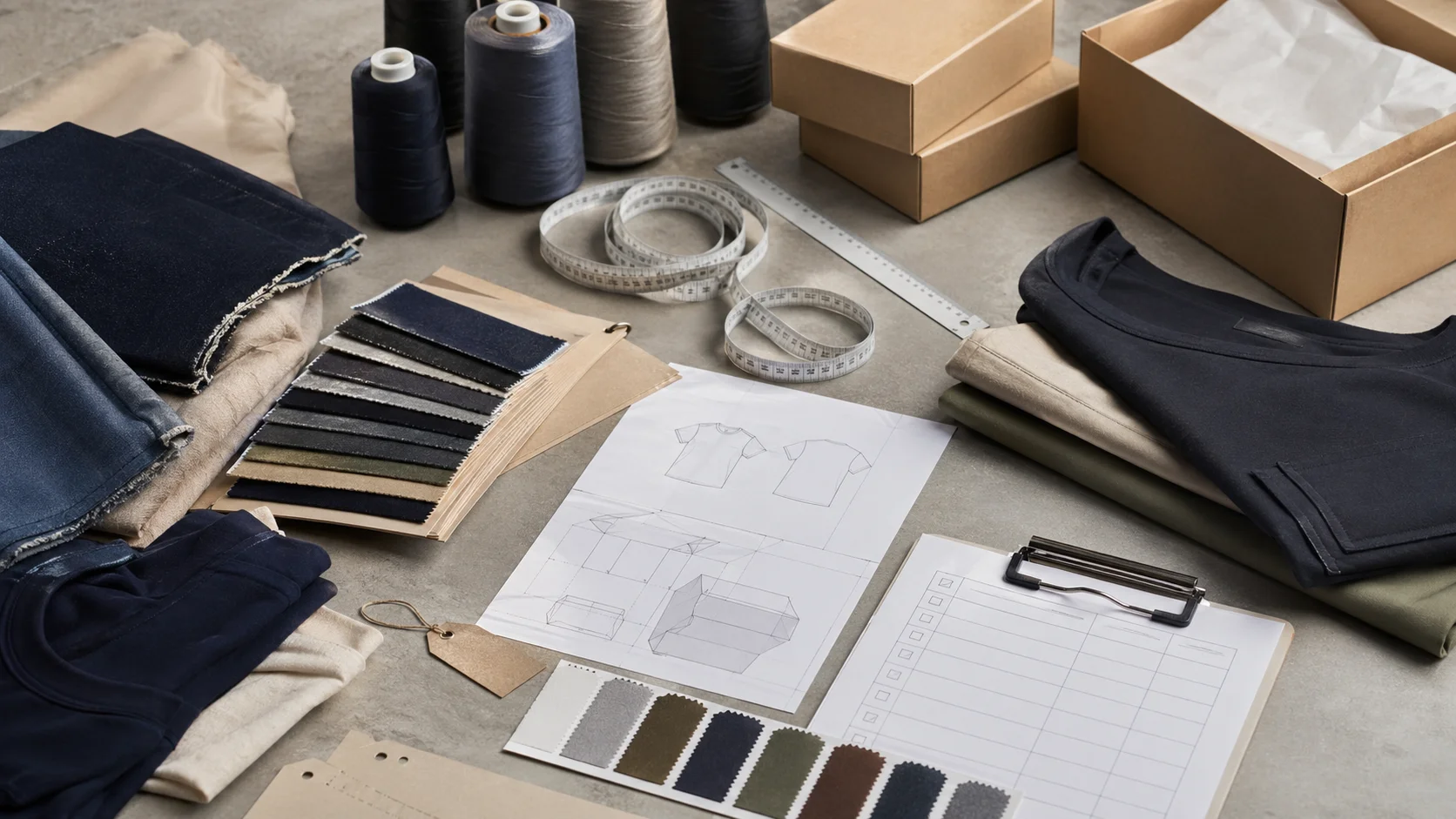
Branded unboxing inserts for clothing launches with checks for samples, fit, MOQ, QC evidence, pricing terms, and delivery risk.
Fast answer: Branded unboxing inserts for clothing launches: what works should be judged by production evidence, not by a generic sourcing promise. The buyer needs sample proof, cost breakdowns, QC checkpoints, and delivery buffers in writing.
Ask for recent sample photos, measurement tolerances, fabric or print test assumptions, decoration test notes, packing examples, and a named inspection checkpoint. These details show whether the team can repeat an approved sample at bulk volume.
Separate garment cost, decoration, labels, packaging, sampling, testing, freight, and rush charges. When every cost line is visible, it becomes easier to reduce colorways, adjust size depth, or reserve more time for sampling.
The first thing a customer touches can set the tone for the whole launch, and branded unboxing inserts for clothing launches do exactly that. Before the tee, dress, or jacket ever reaches the hanger, the insert is already doing the quiet work of making the brand feel considered. And it ought to feel deliberate, not a flimsy slip tossed into the box because someone had half a day free. I’ve watched packing teams in Ho Chi Minh City, Guangzhou, Dhaka, Porto, and Tiruppur place that card on top of folded apparel with almost ceremonial care, using rotary die cutters to trim the edges to +/-0.5 mm tolerance. Tiny object. Serious job.
The first 10 seconds matter because buyers decide fast whether a brand feels thoughtful or careless. And I’ve seen this repeatedly across 200+ factory visits, including BSCI and WRAP-certified facilities in Istanbul and Guangzhou. A $12 tee can get away with a single folded card printed on 150 gsm uncoated stock from a Heidelberg Speedmaster 6-color press, with a straightforward care note. A $180 jacket needs a different signal: GOTS-certified 220 gsm cotton-linen blend card, cleaner type, more restrained language, and tighter folding tolerances controlled on a Kolbus folder. Same paper size, very different message.
Heavy packaging is not always the answer. Shareable unboxing content can lift reach, but the insert has practical jobs too: care, returns, sizing, repeat purchase prompts, and a reminder that the brand exists after checkout. According to ISO packaging standards and compliance frameworks, clarity and consistency matter because packaging is part information system, part product protection. And that’s exactly how I treat inserts— not decoration. The first layer of after-sales service.
Expensive-looking inserts are not always the thickest ones. I’ve seen a 300 gsm card look cheap because the typography was loose, the fold was off by 2 mm, and the ink density varied across the run when an offset press operator on a Heidelberg XL 106 miscalibrated the form. And I’ve also seen a 220 gsm GRS-certified recycled sheet feel premium because the type was sharp, the margins were disciplined, and the black UV ink held cleanly. Buyers notice precision before they notice paper weight.
And that matters more than many brands admit. A launch insert should behave like part of the product experience, not a decorative afterthought dropped into the box because someone had a spare budget line. If the garment is engineered carefully, the insert should be too. I’ve worked with brands using private label clothing programs where the insert carried the only direct explanation of fit, return policy, and brand story. The paper did real work. It earned its place.
Good branded unboxing inserts for clothing launches pull several duties at once: say thank you, explain care, guide sizing, communicate sustainability honestly, and prompt the next purchase. It is a lot for one card, sure, but the right kind of pressure. Online apparel returns are often driven by fit uncertainty and care confusion, and both can be reduced with a 2-sided insert that answers the obvious questions before the customer has to email support. In several factory audits, particularly at OEKO-TEX Standard 100 factories in Dhaka handling delicate knits, I found support teams spending 15-20% of their time on questions that a well-written insert could have handled.
Decorative inserts earn a photo. But functional inserts reduce friction. That distinction matters because apparel brands pay twice for confusion: once in returns, and again in customer service labor. I have seen a 30-second improvement in product understanding lower repeat “how do I wash this” tickets by 18% for a small run of 5,000 units produced with digital inkjet on a Memjet-powered press. The best inserts are concise, legible, and brutally useful.
And regional buying habits shift the balance. Premium shoppers in the UK, Japan, and parts of the Gulf often expect a refined note card with a polished thank-you and a quiet brand voice. Value-driven shoppers in the US, India, and much of Southeast Asia respond better to a practical prompt: reorder, review, referral, or bundle discount. The same launch can need different insert logic by market, especially if your average order value sits between $25 and $250.
And sustainability should reduce clutter, not add another brochure to the bin. Fewer, smarter inserts beat oversized collateral that gets discarded before the first wash. Brands selling essentials, such as a 3-pack tee drop at $39 or a denim capsule at $120, usually get better results from one folded insert than from separate cards for care, marketing, and story. If you are working with a supplier on custom baby clothing manufacturing, this becomes even more important because parents want fast answers on fabric safety, washing, and size growth, not a pile of glossy paper. For those projects, we often demand GOTS, OEKO-TEX Standard 100, and WRAP documentation before approving the insert board supplier in Istanbul.
And the practical formula is simple. One insert should cover brand story, care, fit, and a single action. That action might be a QR code to register a warranty, a discount on a second purchase, or a size-exchange page. Anything extra has to earn its space. The moment an insert asks for attention without solving a problem, it starts losing value.
Paper choice says a lot before a word is read. Recycled uncoated stock, FSC-certified paper, kraft, soft-touch laminate, and heavier premium card each carry a different signal, and the wrong one can make a launch feel mismatched. For a $15 basics drop, a 170 gsm recycled uncoated sheet from a GRS-certified mill in Guangzhou is often enough. For a $220 outerwear line, 250-300 gsm premium card with a crisp matte finish produced on an HP Indigo Digital Press usually lands better. Luxury launches may justify soft-touch or spot UV. Mass-market lines usually need the design to do the heavy lifting on a sensible budget.
Finish choices should support the garment category. Athleisure often benefits from a clean matte card with one bold message, because the customer expects performance and clarity. Denim can tolerate a slightly rougher kraft feel, especially if the brand story leans into heritage or wash process. Occasionwear usually needs a more polished stock, because the purchase itself is emotionally loaded. Kidswear should stay practical, with readable care steps and a size note that survives frantic parent handling.
Often, print failures come from bad file prep, not bad paper. Color management, bleed setup, and image resolution are where launch teams quietly lose money. A manufacturer can use excellent stock and still produce dull red, muddy black, or misaligned folds if the artwork arrives in the wrong format. I have rejected proofs where the paper was fine but the cyan shift made the brand mark look tired. The problem was not the press. It was the PDF.
Recycled fibers may reduce whiteness slightly. And that tradeoff can strengthen credibility if the design is intentional. A cream-toned insert with strong black type often reads more considered than a bright-white card pretending to be luxury. According to Textile Exchange, brands are under rising pressure to prove material choices with clear documentation, and packaging choices now sit inside that same expectation. If the insert claims sustainability, the stock, ink, and message need to agree.
I have seen a woven-label-heavy brand with a strong technical identity use a 210 gsm uncoated insert for a launch of 8,000 pieces, and it performed better than a glossy version at half the weight. The reason was the way the uncoated board felt in hand, matching the ruggedness of the garments and making the whole package feel like it belonged together.
A strong brief makes the supplier's job narrower and the quote more reliable. For branded unboxing inserts for clothing launches, include the target customer, sales channel, expected order quantity, size range, decoration needs, packaging requirements, and delivery market. Then call out the details most likely to affect the result, especially material grade, print tolerance, and barcode size.
The brief should also explain what cannot change. Some brands care most about hand feel, some about price, some about launch timing, and some about retail compliance. When those priorities are not written down, suppliers tend to optimize for whatever is easiest to quote. Clear priorities help the factory make better tradeoffs before the first sample is cut or printed.
Ask the supplier to respond with assumptions, not just a price. A useful reply states MOQ, sample route, production capacity, inspection plan, packing method, and freight handoff. If the answer is vague, the project may still work, but it needs a tighter pre-production stage before money and calendar pressure build up.
The best time to catch problems is before the pre-production sample is approved. Check measurements, color, placement, material behavior, shrinkage, construction, labels, and packaging in the same review instead of approving each item in isolation. Many bulk issues are not caused by one dramatic mistake; they come from several small unchecked assumptions.
For branded unboxing inserts for clothing launches, pay special attention to folding method, pack-out sequence, and retail compliance. These details often look minor in an email but become expensive once cutting, printing, sewing, packing, or shipping begins. A simple checklist with owner, due date, and approval status keeps the brand team and factory aligned.
Bulk production should not start until the supplier can explain how the approved sample becomes a repeatable production standard. That means reference sample storage, line instructions, inline checks, final inspection, and defect handling. A factory that can describe this process clearly is usually safer than one that only promises speed.
Price differences are useful only when the quotes cover the same work. Compare sample cost, material source, trims, decoration, packaging, testing, inspection, and freight assumptions. A low unit price can become expensive if it excludes items the brand needs before launch.
Timeline promises deserve the same scrutiny. Ask what happens if the first sample needs revision, whether materials are in stock, when the production slot is reserved, and how export packing is handled. The most reliable supplier is often the one that gives a realistic calendar instead of the fastest optimistic answer.
Before making the final decision, write down the specification, approval owner, delivery expectation, and the one or two risks that would cause the most trouble if missed. For branded unboxing inserts for clothing launches, this usually means checking material grade, print tolerance, barcode size, and the support process after the order is placed.
This last review does not need to be complicated. It simply makes the decision easier to repeat, easier to explain, and easier to verify when the finished product or jewelry arrives.
One useful way to pressure-test the decision is to ask what would happen if the order had to be repeated in six months. The answer should still be clear: the same material grade, the same print tolerance, the same acceptance standard, and the same communication path. If a second order would depend on memory or guesswork, the first order is not documented well enough yet.
Another useful check is to separate preference from requirement. Preference is the look, wording, or finish the brand likes. Requirement is the measurement, tolerance, certificate, material, or delivery condition that cannot fail. Good buying decisions keep both visible, so the final choice is not pushed around by the last email, the cheapest quote, or the prettiest sample photo.
Finally, ask who owns each approval. A project with one accountable owner for sample review, one owner for final content or artwork, and one owner for delivery sign-off usually moves faster than a project where every decision is shared loosely across a team. Clear ownership reduces delays and makes the finished result easier to judge.