
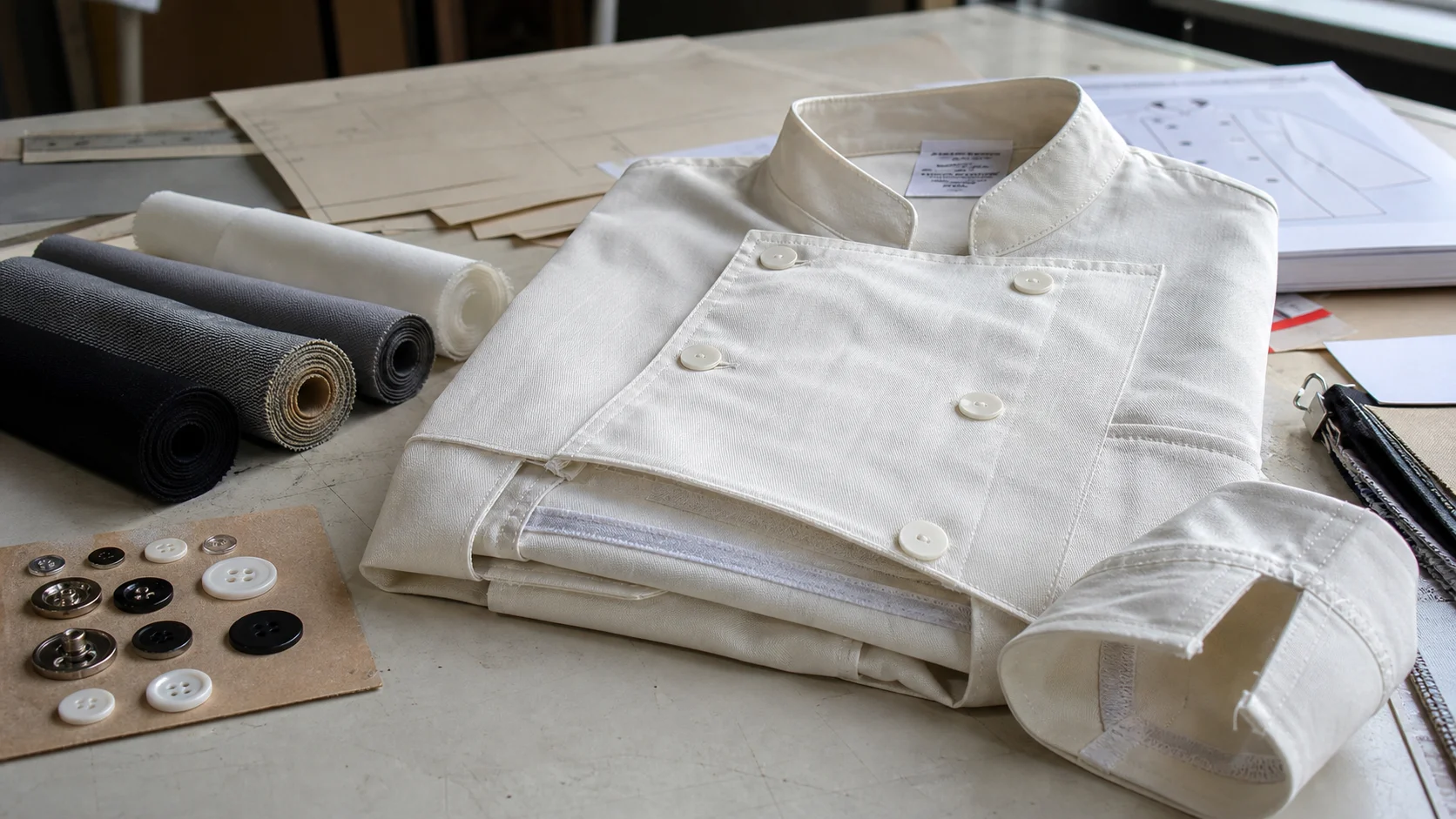
A practical audit outline for field service teams vetting bulk chef coat vendors on quality, fit consistency, decoration accuracy, lead times, and compliance before placing repeat orders.
A bulk chef coat vendor audit is not a branding exercise. It is a commercial and quality check that tells a buying team whether a supplier can repeat the same garment at scale, on time, with acceptable risk. Field teams need a brief that is practical, observable, and tied to purchasing decisions. The goal is to avoid vague supplier claims and focus on the few things that actually move cost, lead time, and rejection rates.
This brief is written for sourcing managers, QA staff, and field service teams evaluating chef coat factories for bulk programs. It covers minimum order quantities, pricing structure, fabric and trim specifications, sample approval, production timing, and the inspection risks that matter most when the order size increases. For broader support, see our services page, about the company, and contact us for sourcing discussions.
Bulk Chef Coat Vendor Audit Brief for Field Teams - Fabrikn production reference
Bulk chef coats sit in a category where buyers often underestimate complexity. The garment looks simple, but scale exposes every weak point: shrinkage, inconsistent shade, poor button strength, uneven embroidery placement, and trim shortages. Field teams need a brief that checks whether the supplier can maintain consistency across sizes, colors, and repeat orders.
The best audit brief does three things. It tests capability, it tests control, and it tests honesty. Capability means the factory can sew the garment correctly. Control means the supplier can keep the same quality from approval sample to bulk shipment. Honesty means the factory does not overstate capacity, trim availability, or turnaround time just to win the order.
For chef coat programs, the commercial stakes are straightforward. A bad bulk order can create replacement cost, delayed opening schedules, and lost confidence from restaurant operators or uniform programs. Field teams should treat the audit as a risk filter, not a formality.
An audit brief should be narrow enough to be actionable and broad enough to catch supply failure early. For bulk chef coats, field teams should verify the following areas during supplier review and factory visits.
Field service teams should not stop at a facility tour. A clean floor and a polished sales pitch do not prove bulk readiness. The stronger signal is evidence of process control: records, inspection logs, ticketed work orders, shade control procedures, and a production plan that matches the quoted lead time.
Not every garment factory is a useful chef coat vendor. Some suppliers are good at T-shirts or athleisure and still struggle with woven uniforms that need structured collars, reinforced seams, and stable shrink performance. Chef coats are closer to a workwear program than a fashion item. The supplier has to understand pattern stability, trim consistency, and repeatability across size runs.
A practical vendor fit assessment should look for these signs:
Field teams should also ask what the factory considers a standard order versus a custom order. A stock-style white chef coat with simple embroidery is very different from a branded program using custom fabric weight, contrast piping, sleeve tabs, and special labeling. The more customization involved, the more the buyer should expect tradeoffs in MOQ, sample time, and unit cost.
MOQ is one of the first numbers to challenge. For bulk chef coats, practical MOQs often start around 300 to 500 pieces per color or style in factories comfortable with uniforms, while more customized programs can push MOQ to 1,000 pieces or more. Smaller factories may quote lower numbers, but the real question is whether they can repeat the same quality across all units.
Field teams should separate MOQ by component. A supplier may accept a low garment MOQ but require higher minimums for fabric dyeing, labels, or custom buttons. That can distort the true cost. Buyers should ask for MOQ by style, by color, and by size ratio if the order includes multiple variations.
Cost structure should be reviewed line by line. A good vendor quote usually reflects these elements:
The cheapest quote is often the least useful. A supplier that bids low by using unstable fabric, undercounting trimming, or assuming short labor time usually creates downstream cost. Better purchasing judgment looks at total landed risk, not only the ex-factory number.
Audit Item What to Verify Risk if Weak MOQ Style, color, size, and trim minimums Hidden surcharges, overbuying, or split production Fabric Weight, composition, shrinkage, shade consistency Fit drift, comfort complaints, return risk Trim Buttons, snaps, labels, thread, piping availability Production delays and substitutions Sampling Fit approval and pre-production sign-off steps Bulk deviation from approved sample Lead Time Fabric, trimming, sewing, finishing, shipping buffers Late delivery and missed launch dates Inspection In-line, final, and packing checks Defects in bulk shipmentField teams should verify that the technical pack is specific enough for production. A weak spec creates room for interpretation, and interpretation becomes variation. Bulk chef coats need defined fabric weight, composition, finish, and construction details.
Common fabric options include cotton-rich twill, poly-cotton blends, and performance blends with moisture management. Each option carries a tradeoff. Cotton-rich fabrics usually feel better in heat and kitchen work, but they can shrink more if laundering control is weak. Poly-cotton blends often improve durability and reduce wrinkling, yet they may feel less breathable in high-temperature environments. Performance blends can improve comfort but may raise cost and require better supplier control.
Useful spec points to confirm during audit:
Trim risk is usually underestimated. A supplier can source a garment shell easily and still fail on buttons, snaps, labels, or contrast piping if the trim vendor is not stable. Field teams should ask whether trim stock is already on hand or has to be procured after order confirmation. Long lead trims can hold up production even when fabric is ready.
A supplier that treats trims as an afterthought is usually not ready for bulk chef coat work. The garment may be simple, but the supply chain is not.
Sampling discipline is one of the strongest indicators of factory maturity. Chef coat programs should not move from quote directly into bulk cutting. A basic approval path should include a proto sample, a fit sample, and a pre-production sample if the order is custom or large enough to justify the step.
Field teams should confirm who approves what. The buyer, the brand owner, the end user, and the technical team may each need to sign off on different details. If roles are unclear, the factory may begin bulk production against an incomplete approval set.
A practical sample process includes the following steps:
One weak point in many bulk programs is sample substitution. A factory may present a beautiful sample using premium materials, then replace them with lower-grade inputs during bulk production. Field teams should ask whether the bulk fabric lot, trim lot, and thread specification match the approved sample. If the answer is vague, the risk is high.
Lead time for bulk chef coats depends more on inputs than on sewing speed. The factory may claim a 30-day or 45-day turnaround, but that figure is only credible if fabric, trims, approvals, and inspection windows are already aligned. Field teams should break lead time into stages.
Typical dependencies include fabric sourcing, lab dips or shade approval, sample revisions, bulk cutting, sewing, finishing, inspection, packing, and freight booking. Each stage can expand if there are late changes to size ratio, decoration, or packaging.
Lead time is especially sensitive when the order includes custom fabric dyeing, private labeling, or multiple sizes and colorways. A simple white coat order may move faster than a branded hospitality program, but the gap closes quickly once logo work and special trims enter the schedule.
Field teams should ask the supplier for a production calendar that identifies critical path items. A credible calendar lists when fabric arrives, when pre-production sample approval is due, when bulk cutting begins, and when final inspection is expected. A vague promise with no dates for each stage is not a useful plan.
Chef coats have several predictable failure points. Field teams should inspect for them early, because they are easier to catch in process than in a finished shipment.
Inspection should not rely only on final QA. In-line inspection matters because it catches process drift while correction is still cheap. A well-run factory will check cut parts, first pieces, seam quality, and finishing accuracy before packing begins. The more complex the order, the more valuable these intermediate checks become.
Field teams should also review AQL expectations and inspection ownership. Some buyers will use third-party inspection before shipment. Others rely on internal QA plus line audits. The commercial decision depends on order value, delivery urgency, and tolerance for rework. Large hospitality programs usually justify stronger inspection because replacement costs are more painful than a modest pre-shipment QC fee.
Commercial terms shape the actual buying risk. A vendor with strong sewing quality can still create a weak purchase if payment terms, packaging, freight handling, or replenishment logic are unclear. Field teams should confirm these areas during the audit.
Packaging deserves more attention than it usually gets. Chef coats are often white or light-colored, so packing dirt, creasing, or moisture damage becomes visible quickly. Field teams should verify polybag quality, carton strength, desiccant use if needed, and palletization standards. A poor packing setup can erase the quality achieved on the sewing line.
Repeat-order behavior is another commercial test. Some factories perform acceptably on a first order and then struggle when a buyer reorders six months later using the same spec. The risk often appears in shade drift, trim substitution, or sizing inconsistency. Buyers should confirm whether the supplier maintains archived samples, spec records, and approved material references for reorders.
Field teams should treat the following signs as warnings, not minor issues.
A weak answer to any one of these issues does not always kill the order. A pattern of weak answers usually does. Buyers should not confuse eagerness to accept the order with readiness to produce it well.
A simple pass-fail model is usually enough for field teams. Score the vendor on capability, control, cost, and responsiveness. Capability covers whether the factory can make the garment. Control covers whether it can repeat the result. Cost covers whether the quote is realistic and complete. Responsiveness covers how quickly and clearly the team handles technical questions, sample revisions, and commercial terms.
If the supplier is strong in capability but weak in control, the buyer should consider a limited trial order. If the supplier is strong in control but too expensive, the buyer should ask whether the spec can be simplified. If the supplier is weak in both, the cleanest decision is to move on.
For bulk chef coat programs, the best vendor is rarely the cheapest or the largest. The best vendor is the one that can hold the spec, deliver the quantity, and stay predictable across repeats. That is the standard field teams should use when closing the audit brief.
Get a free quote from Fabrikn — your trusted B2B clothing manufacturer with 10+ years of experience. MOQ as low as 200 pieces.
Get a Free Quote →Many uniform-capable factories quote around 300 to 500 pieces per style or color, while more customized programs can require 1,000 pieces or more. The true MOQ may be split across fabric, trim, and decoration, so the buyer should confirm each element separately.
There is no single best option. Cotton-rich fabrics improve comfort in hot kitchens, poly-cotton blends usually improve durability and wrinkle control, and performance blends can add comfort features at a higher cost. The right choice depends on wash frequency, climate, and the user environment.
A basic program may need a proto sample and a fit sample. Larger or more customized orders often need a pre-production sample as well. The safest practice is to approve the exact bulk materials before bulk cutting begins.
Late fabric approval, trim shortages, sample revisions, and changed logo or label details are the usual causes. A lead time quote is only reliable when all inputs are already available or already reserved.
Weak stitching, poor button or snap attachment, shade variation, embroidery puckering, size inconsistency, and shrinkage after washing are the most common issues. Final inspection should also check carton packing and label accuracy.
No. Final inspection is useful, but in-line checks catch defects earlier and lower the cost of correction. A supplier with weak process control may still pass one final check and ship inconsistent bulk product if no one monitors production.
Start with the technical brief, supplier screening, and sample plan. If the project needs support across development, production, or vendor communication, review the services page, then use the contact form to discuss scope and timelines.