
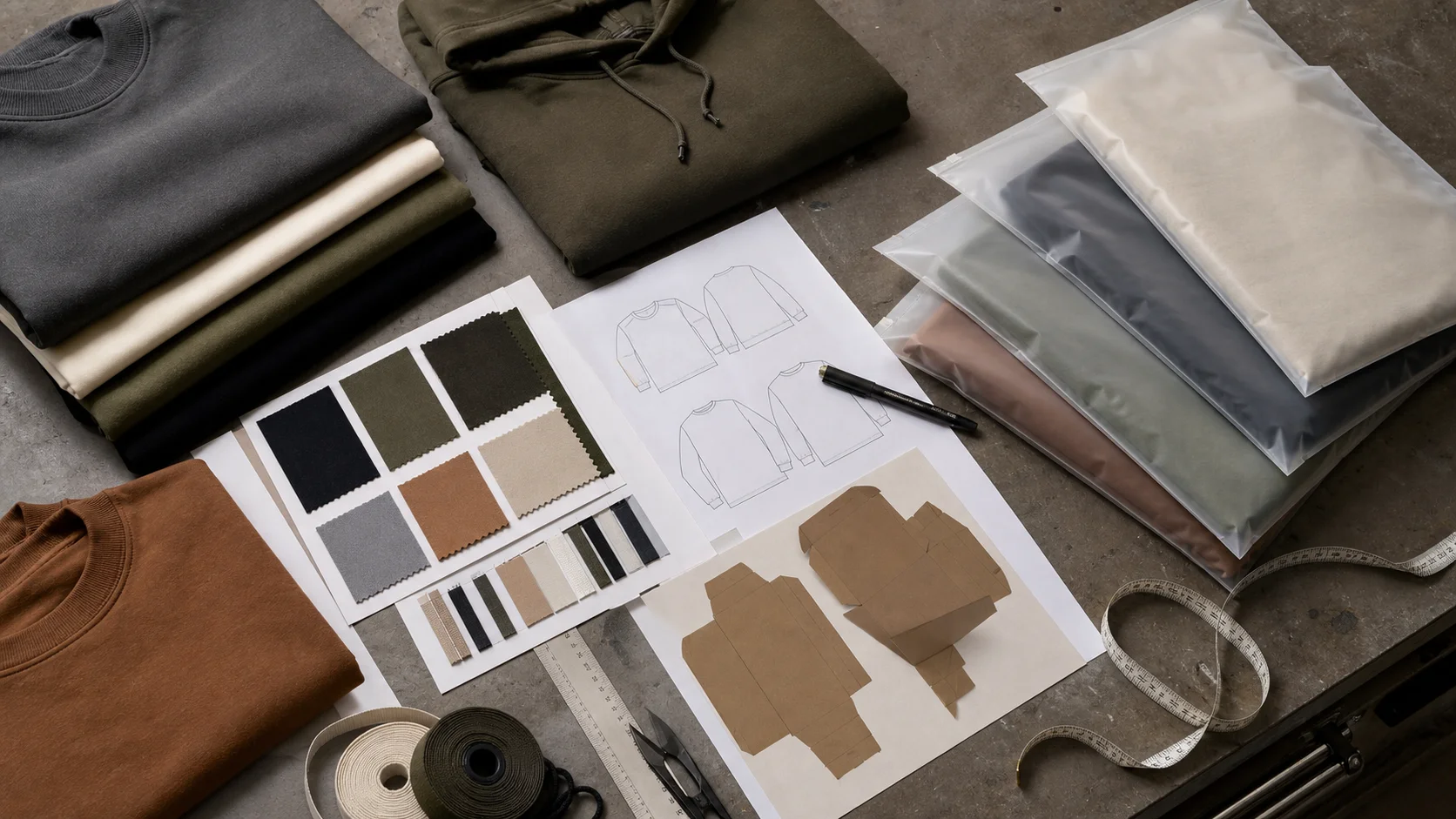
Clothing Brands Switch to Bulk Compostable Poly Bags compared by sample evidence, fabric or trim specs, MOQ, AQL terms, cost lines, delivery timing, and...
Fast answer: Clothing Brands Switch to Bulk Compostable Poly Bags: Material, Print, MOQ, and QC Terms should be judged by production evidence, not by a generic sourcing promise. The buyer needs sample proof, cost breakdowns, QC checkpoints, and delivery buffers in writing.
Ask for recent sample photos, measurement tolerances, fabric or print test assumptions, decoration test notes, packing examples, and a named inspection checkpoint. These details show whether the team can repeat an approved sample at bulk volume.
Separate garment cost, decoration, labels, packaging, sampling, testing, freight, and rush charges. Clear cost lines make it easier to reduce colorways, adjust size depth, or reserve more time for sampling.
How Clothing Brands Switch to Bulk Compostable Poly BagsSwitching to bulk compostable poly bags for clothing ecommerce sounds simple on paper. Pick a greener bag, replace the old one, and move on. Real life is messier. The bag has to protect the garment, survive fulfillment, fit your packing machine or hand-pack workflow, pass retailer expectations, and still make margin sense. I have seen brands get this wrong by chasing a "planet-friendly" label first and asking the practical questions later. That usually gets expensive.
The good news is that the move is very doable. In fact, for many apparel brands, compostable poly bags can be a smart packaging upgrade when the sourcing, print specs, and warehouse process are set up properly. The key is to treat the change like a packaging project, not a branding exercise. A standard custom run from a Guangzhou film converter or a Ho Chi Minh City bag maker is often 18-22 business days after artwork approval, while a first sample can still take 5-7 days if the resin and print plates are already in house.
This guide walks through what to expect, what to ask suppliers, how much it usually costs, and how to avoid the mistakes that turn a good sustainability story into a fulfillment headache. If you are comparing factories in Guangzhou, Dhaka, and Ho Chi Minh City, the differences are usually less about the headline quote and more about whether they can run a stable blown-film line, control seal strength, and prove the film passes the right compostability tests.
How Clothing Brands Switch to Bulk Compostable Poly Bags - Packaging manufacturing guide
Most clothing ecommerce brands start the search for compostable poly bags because the old packaging no longer fits the brand story. Customers notice plastic. Retail partners notice it too. Buying teams in the U.S. and Europe are asking harder questions about packaging waste, and marketplace sellers feel pressure from reviews, social posts, and internal sustainability targets. A lot of sourcing teams are also reacting to retailer scorecards that ask for packaging reduction by SKU, not just a broad ESG statement.
There are also practical reasons. A well-made compostable bag can still do the basic job of a poly mailer-style inner package: keep the garment clean, folded, and ready for shipping. For ecommerce basics like T-shirts, sleepwear, leggings, and lightweight knitwear, that matters. A bag does not need to be glamorous. It needs to work. In many plants, the bag is handled on a simple belt conveyor, folded by hand, and closed with a 10-12 mm adhesive strip, so the operator experience matters almost as much as the film spec.
In my experience, the best switches happen when brands want three things at once:
That last point is the hard one. A "green" bag that tears, fogs up, slows packing, or blows out the return rate is not a win. It is just expensive virtue signaling. I say that bluntly because I have seen it happen, especially when a brand swaps a 50-micron LDPE inner bag for a thinner PLA/PBAT blend without checking drop performance or hot-room storage stability.
Most compostable garment bags are made from plant-based and compostable polymer blends such as PLA, PBAT, and sometimes starch-based materials. The exact formulation varies by factory, and that matters more than many buyers realize. Two bags can look almost identical on a sample desk and behave very differently in a cold warehouse or on a humid dock. A lot of the better bags are produced on a blown-film extrusion line, then slit and converted on a side-seal or bottom-seal bag machine with a hot-knife seal head.
For clothing ecommerce, the common formats include:
When brands ask me whether compostable means "the same as plastic," I usually answer no. It is close in use, not identical in behavior. Some compostable films are stiffer. Some feel softer. Some are more prone to static. Some lose clarity in warm conditions. A good supplier will tell you the truth up front. A bad one will just hand you a pretty sample and hope you do not test it. The best converters will tell you whether the film was made with a 3-layer co-extrusion setup, whether the print is flexographic or gravure, and whether the adhesive strip is water-based or solvent-based.
"If the bag looks perfect but the seal fails in your warehouse at 8 a.m. on a Monday, it is not the right bag. Packaging should solve problems, not create them."
Not every brand needs to move immediately. The right timing depends on your product mix, sales volume, and packaging architecture. Some companies are already using recycled outer mailers, tissue, stickers, and paper inserts. For them, replacing the inner garment bag is a logical next step. Others are still relying on a fragile, multi-layer plastic setup that needs a complete redesign. In a warehouse running 1,500 to 3,000 units per day, even a 3-second change in bagging time can decide whether the switch is worth it.
Switching to bulk compostable poly bags usually makes sense when:
It may not make sense yet if your items are extremely heavy, very sharp-edged, or packed in a highly automated line that depends on film behavior a compostable blend cannot match today. A lot of companies pretend every solution fits every use case. It does not. If you are running a high-speed auto-bagger or an impulse sealer on a packed line, you need to verify the seal window, tear initiation, and film memory, not just the color and logo placement.
Buying compostable bags is not just about picking a size. You need a technical spec that matches your operation. This is where a lot of ecommerce teams get stuck, because procurement wants a quote, marketing wants a sustainability statement, and operations wants bags that pack fast. All three need to agree. The difference between a good launch and a bad one is often whether the supplier can lock the spec to a real production standard instead of a loose "about 40 microns" promise.
For clothing ecommerce, common thickness ranges are roughly 25 to 60 microns, depending on bag size and material blend. A thinner bag may look elegant and save cost, but if it splits during packing or in transit, you lose the saving instantly. Larger outer bags for jackets or multi-piece orders usually need more body. For a folded hoodie shipped with a cardboard insert, 40 to 50 microns is a more realistic starting point than a lightweight 25-micron film.
Self-seal adhesive strips are popular because they speed up packing. In a 10,000-unit test I once saw at a knitwear factory in Southeast Asia, switching from manual folding to adhesive close saved around 7 to 10 seconds per pack. That sounds small. It is not. Over thousands of orders per day, it adds up fast. On a good line, a trained packer can close 300 to 450 bags per hour with a self-seal strip, versus 220 to 280 when the bag has to be folded and taped by hand.
Most brands want a clean logo, a short sustainability note, and maybe a QR code or disposal instruction. Keep it simple. Compostable film is not a billboard. Excess ink coverage can affect flexibility and cost. A tight, well-placed print often looks more premium than a crowded layout. If you are printing on a matte PBAT/PLA film, ask whether the converter is using water-based flexo inks and whether the print deck has a 150- to 180-line screen; that usually gives cleaner type than a rough, high-ink flood.
Compostable materials are more sensitive to heat and humidity than standard polyethylene. If your warehouse sits in a hot climate or your bags spend weeks in non-air-conditioned storage, ask for shelf-life guidance. A reliable supplier should give you real storage recommendations, not a vague "keep cool" note. In practice, I like to see bags stored below 30 C and under 65% relative humidity, away from direct sun and roof heat, especially in Guangzhou, Dhaka, or Ho Chi Minh City during peak summer.
Look for relevant compostability certifications and ask exactly which standards apply in your target market. Do not rely on marketing copy alone. Ask for documentation. Ask for test reports. Ask for the certificate numbers. Good sourcing teams do this as routine. For the factory side, WRAP and BSCI audits are useful for social compliance, while OEKO-TEX Standard 100 is helpful when inks, adhesives, or garment-adjacent packaging are in the same facility. If the packaging program sits next to a GOTS-certified apparel line, the mill usually already understands restricted substances, batch traceability, and audit discipline.
Spec Typical Range Why It Matters Thickness 25-60 microns Controls strength, feel, and cost MOQ 10,000-50,000 pieces Impacts pricing and customization Lead time 18-22 business days Affects launch and replenishment planning Sampling time 5-7 business days Needed before bulk production approval Unit price $2.50-$4.00 per unit at 500 MOQ; $0.18-$0.42 at 10,000+ units Depends on size, print, thickness, and volumeLet's talk money. This is where the conversation becomes real.
For bulk compostable poly bags for clothing ecommerce, I commonly see pricing in the ballpark of $2.50 to $4.00 per unit at a 500 MOQ for a highly custom printed bag, especially if the supplier has to run a small trial on a newer PLA/PBAT blend or a special matte finish. Once the order moves into standard production quantities, pricing usually falls much harder than first-time buyers expect. At 10,000 to 25,000 pieces, I more often see $0.18 to $0.42 per bag, with the exact number depending on size, print complexity, film thickness, and whether the bag includes a reinforced seal strip.
MOQ is often 10,000 to 25,000 pieces for standard custom work, though some factories will quote 5,000 if the bag is a stock size. That is useful for testing, but the per-unit price is usually much less attractive. Once a brand gets to 50,000 pieces or more, pricing usually improves in a meaningful way. A Guangzhou converter with an in-house flexo press can often quote faster than a Dhaka subcontractor, while a Ho Chi Minh City factory may be more flexible on mixed-SKU packing if the artwork is already finalized.
Lead time for sampling is often 5 to 7 business days. Bulk production commonly runs 18 to 22 business days after sample approval and deposit for a standard run, and a more complex print job can stretch to 28 business days if new plates, a custom adhesive, or a special bag gauge is involved. Ocean freight then adds another 3 to 6 weeks depending on route and customs timing. If your launch date is fixed, build that into the schedule early. Too many teams forget shipping time and then blame the factory for a calendar problem. If you are replenishing from Asia into a U.S. East Coast warehouse, you can easily lose 12 to 18 days just to port-to-door movement alone.
At Fabrikn, a lot of packaging projects start with a simple service conversation. If you are still shaping your specification, it is usually worth reviewing the packaging support on a supplier's site and asking whether they can show actual production photos from Guangzhou, Dhaka, or Ho Chi Minh City rather than only studio mockups. A real plant will be able to show roll width, seal bars, corona treatment, and packed cartons with the final count per case.
The cleanest rollout is usually a phased one. Start with one or two SKUs, not the entire catalog. Pick a low-risk style, like a 180 gsm sweatshirt or a folded knit tee, and run it through your normal pack bench. Time the process, check the seal, and inspect the first 200 units for curl, static, and print scuffing. If your team uses a carton sealer, scale the test to the real bench length so you are not comparing a lab sample to a real warehouse line.
Then do a simple stress check. Put the packed garment through a drop test, a compression test, and a storage check in a warm room if you can. I like to see 24 to 48 hours in a 30 C, 70% RH environment before signoff, because that is where weak film usually reveals itself. If the adhesive strip starts lifting or the seal edge turns cloudy, the bag is probably too soft or the film blend needs adjustment.
When you train the warehouse team, keep the instruction sheet short and visual. The operator needs to know whether the bag opens from the top or side, where the adhesive strip starts, and whether the fold line must sit 15 mm from the edge. Small details matter. A good bag can still create waste if every tenth pack has to be reopened because the opening direction is unclear.
If you are working across multiple fulfillment centers, send the same master sample to each site. Do not let one warehouse approve a variant that another site has never handled. That is how you end up with inconsistent pack times and a dozen different opinions about whether the bag is "too sticky" or "too soft."
I look for five things in a supplier: material honesty, real production capacity, proof of compliance, decent communication, and the ability to make the same bag twice. That last one is underappreciated. A supplier that can make a beautiful one-off sample but cannot repeat it on the third lot will cost you time and trust.
Ask the supplier where the film is extruded and where the bags are converted. A good answer might be, "Film blown in Guangzhou, converted on a separate side-seal line in the same district, with print done on a 6-color flexo press." That is a real operation statement. A vague answer like "factory in China" is not enough. For South Asia, many apparel programs are linked to Dhaka factories with WRAP or BSCI audits, while Vietnam suppliers in Ho Chi Minh City often work on tighter garment timelines and may be better at smaller replenishment runs.
Also ask for the documentation package. The better suppliers should be able to provide:
If the supplier works with GOTS-certified apparel clients, that is often a sign they understand restricted chemical lists, paperwork discipline, and traceability expectations. It does not automatically certify the bag, but it does tell you they have handled more demanding compliance workflows than a basic low-cost converter.
The biggest mistake is choosing the bag before choosing the use case. Brands fall in love with a sample, then discover the gauge is too light for their jackets or the adhesive is too aggressive for their folding pattern. Another common error is ignoring climate. Compostable film that behaves fine in a 22 C sample room can get limp or tacky in a 34 C warehouse with poor ventilation.
Another one is overprinting. A logo, size note, and disposal instruction is enough for most programs. When brands try to fill every square centimeter with copy, they often increase cost and make the bag look cheap. On a 1-color flexo job, the sweet spot is usually under 18% ink coverage unless the material and curing system are specifically tuned for heavier print.
Procurement mistakes are just as common. Teams compare unit price without comparing case count, bag count per carton, or freight density. A bag priced $0.02 lower can still cost more landed if it ships with 500 pieces per carton instead of 1,000 and takes more pallet space. I also see buyers forget to ask about shelf life. If the bags will sit for six months, the supplier needs to say whether the film is stable over that period or whether you need a first-in-first-out plan.
The last mistake is weak internal ownership. If merchandising, sustainability, and operations all think someone else is managing the switch, the launch will drift. One person needs to own the spec, the sample approval, the calendar, and the production signoff.
Be specific and stay within the facts. Say what the bag is made from, what certification it has, and where it is meant to break down. Do not call it "zero waste" or "environmentally neutral." Those phrases invite trouble. Use language like "compostable packaging option" or "made with compostable materials" and make sure the claim is backed by the certificate and the market you sell into.
If the bag is certified to a recognized standard, say so. If it is certified to EN 13432 or ASTM D6400, state the applicable region and keep the scope clear. If you are using a supplier with WRAP or BSCI audited production, mention the factory compliance story rather than pretending the packaging itself carries that social certification. That distinction matters.
The smartest brands pair the packaging update with one practical line, such as: "We switched to compostable garment bags for our folded basics to reduce fossil-based plastic in our fulfillment process." That is a concrete claim. It is better than saying "We saved the planet," which no buyer in a procurement meeting will believe anyway.
Get a free quote from Fabrikn — your trusted B2B clothing manufacturer with 10+ years of experience. MOQ as low as 200 pieces.
Get a Free Quote →How long does it usually take to get a custom bag made? A standard run is typically 18-22 business days after artwork approval and deposit, and a first sample is usually 5-7 business days if the factory already has the film and plate setup ready.
What is a realistic order size for testing? Many brands start at 500 to 1,000 pieces for a mockup or a small pilot, but the price is usually much higher at that level, often $2.50-$4.00 per unit for a fully custom bag.
Which materials are most common? PLA and PBAT are the usual starting point, sometimes blended with starch-based content. The exact ratio changes the feel, stiffness, and heat resistance, which is why two samples from different factories can feel completely different.
Which certifications should I ask for? Ask for compostability documentation for your market, plus factory compliance evidence such as WRAP or BSCI. If inks or adhesives are part of the concern, OEKO-TEX documentation can be relevant. GOTS is useful context when the supplier also serves certified apparel programs and understands stricter chemical and traceability rules.
Can I use these bags in humid warehouses? Yes, but only if the film blend and storage conditions are controlled. In practice, I want to know the warehouse temperature, humidity, and whether the bags will sit for weeks before use. A hot, humid room in Dhaka or Ho Chi Minh City needs more testing than a climate-controlled fulfillment center.
What is the first thing to check in a sample? Check the seal, the opening direction, and the pack speed. If the bag slows down the line or the adhesive fails during a normal folding cycle, the sample is not ready for production, no matter how good the print looks.
If you want, I can also turn this into a tighter SEO version or tailor it for a specific factory region like China, Vietnam, or Bangladesh.
Use these related guides to compare specs, costs, quality checks, and buyer decisions before making the final call.