
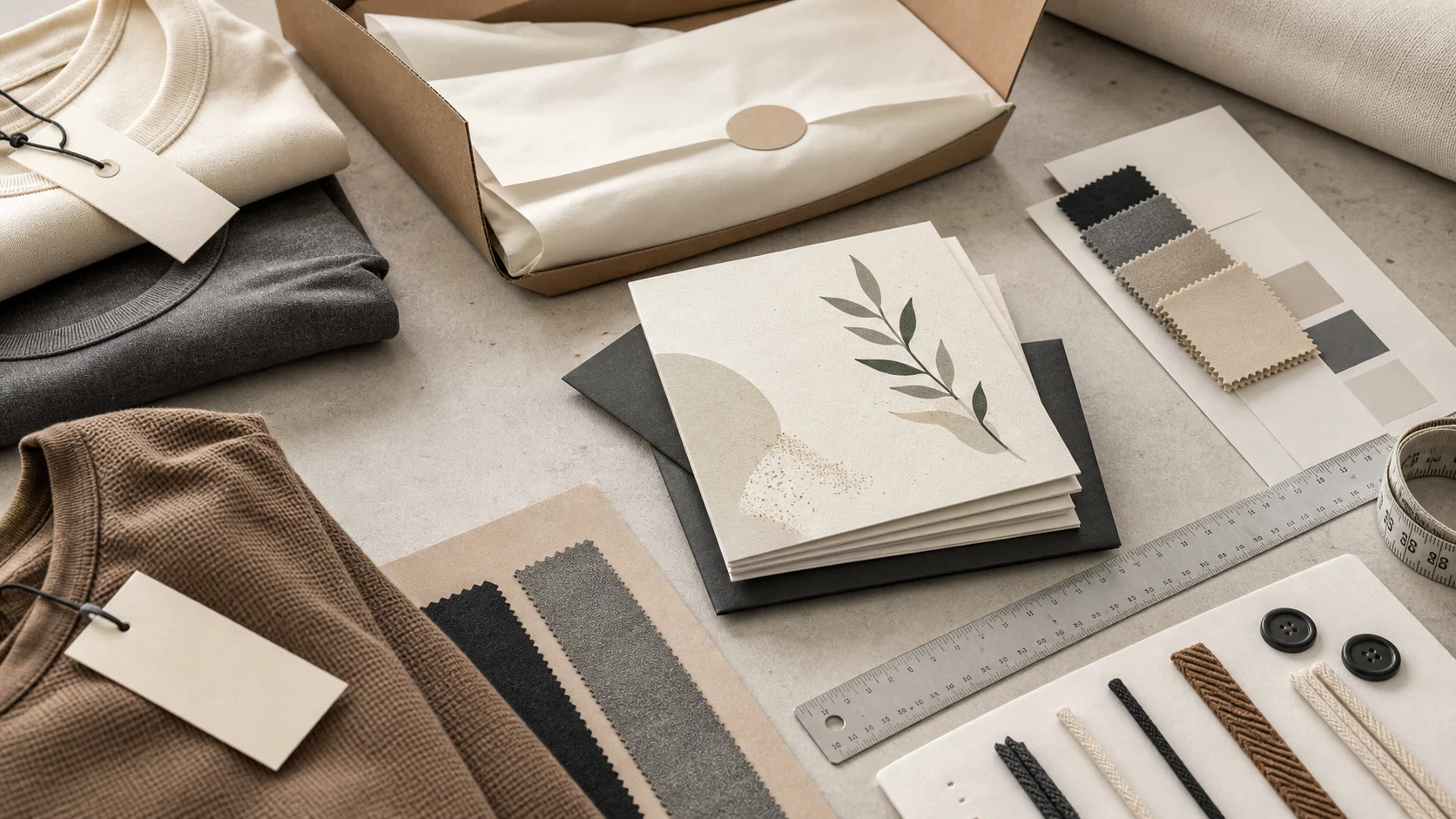
Use Soy Ink Thank You Cards for Clothing Packages compared by sample evidence, fabric or trim specs, MOQ, AQL terms, cost lines, delivery timing, and...
Fast answer: Use Soy Ink Thank You Cards for Clothing Packages: Material, Print, MOQ, and QC Terms should be judged by production evidence, not by a generic sourcing promise. The buyer needs sample proof, cost breakdowns, QC checkpoints, and delivery buffers in writing.
Ask for recent sample photos, measurement tolerances, fabric or print test assumptions, decoration test notes, packing examples, and a named inspection checkpoint. These details show whether the team can repeat an approved sample at bulk volume.
Separate garment cost, decoration, labels, packaging, sampling, testing, freight, and rush charges. Clear cost lines make it easier to reduce colorways, adjust size depth, or reserve more time for sampling.
How to Use Soy Ink Thank You Cards for Clothing PackagesSoy ink printed thank you cards for clothing packages are one of those small details that quietly do a lot of heavy lifting. They make a parcel feel finished. They make a new customer feel noticed. They also give clothing brands a chance to show personality without adding much cost to the box. In most print programs, a 90 x 55 mm or 100 x 70 mm card is the sweet spot because it fits neatly into a folded tee pack, a 35-45 mm tissue wrap, or a standard poly mailer pocket without creasing.
I have seen this play out in factories again and again. A basic mailer with no insert arrives, gets opened, and is forgotten. A well-designed thank you card arrives inside a neat folded tee pack, and suddenly the whole order feels more premium. That matters, especially in apparel, where touch, presentation, and repeat purchase behavior are tied together more than many brands admit. In a Guangzhou or Ho Chi Minh City packaging plant, that difference often comes down to one extra pass on the folding line and a cleaner count at final inspection.
If you are building a packaging system for a fashion label, boutique, DTC shop, or private-label clothing line, soy ink cards are a smart place to start. They are practical. They print well. They fit cleanly into poly mailers, rigid boxes, garment bags, and tissue-wrapped bundles. Best of all, they support a more sustainable story without forcing your brand into a dull, generic look. A lot of brands pair them with FSC-certified board, recycled kraft sleeves, and a 1-color offset job to keep the total landed cost around $2.50-4.00 per unit at 500 MOQ for the full insert package, not just the card.
How to Use Soy Ink Thank You Cards for Clothing Packages - Packaging manufacturing guide
Soy ink is a vegetable-based printing ink made with soy oil instead of the heavier petroleum base used in many conventional inks. In packaging, it is appreciated for clean color, good rub resistance when handled properly, and a softer environmental profile. For thank you cards, it is especially useful because the print area is small, the message is simple, and the visual quality matters more than dense technical detail. On coated stock, a well-calibrated soy ink offset job can hold a solid 280-320% total ink coverage without the muddy look that shows up when prepress is rushed.
Clothing packages tend to live in a crowded world of materials: mailer bags, hang tags, tissue paper, stickers, fold cards, inserts, care labels, and branded sleeves. Soy ink thank you cards cut through that clutter. They are simple to produce and easy to brand. They also work beautifully on recycled paper, kraft stock, uncoated white board, and textured card stock, which gives apparel brands more room to match their packaging style. In practice, a 350 gsm recycled board with a matte aqueous coating is one of the most common combinations for premium basics brands because it survives warehouse handling and still feels tactile in the hand.
In my experience, the most effective insert cards do two things at once. They say thank you, and they give the customer a reason to come back. That second part is where soy ink printing earns its keep. You can print a QR code, a care tip, a discount code, or a social handle cleanly on a card that still feels refined rather than overworked. I have seen brands get better scan rates when the QR code is at least 18 x 18 mm with a 3 mm quiet zone and printed in a single dark tone on matte white board.
A thank you card is not filler. It is a small retail touchpoint. If it feels cheap, the whole package feels cheap. If it feels considered, customers notice immediately.
The best thank you card is clear at first glance. That sounds obvious, but I still see brands cram too much onto a 90 x 55 mm card and expect it to do the work of a landing page. It cannot. A package insert should be easy to read in one hand, with one message that lands quickly. In production terms, that usually means keeping live copy inside a 3 mm safe margin and avoiding fine serif type below 7 pt when the card is printed on uncoated stock.
Start with the purpose. Is the card meant to thank the buyer, explain care instructions, promote social sharing, or push a repeat order? Pick one primary goal. A secondary goal is fine. Three goals is where the card starts to look confused. A common factory-side layout is front side brand message only, back side thank you plus QR and one offer code, because it keeps the imposition clean and avoids registration problems across both sides of the sheet.
Keep the typography readable. Fashion brands often lean too hard into thin fonts because they look elegant on screen. On coated or uncoated card, thin fonts can disappear. I usually advise at least 7 pt body copy and stronger contrast than designers expect. A card that looks delicate in the studio should still read well under warehouse lighting and in a kitchen or bedroom where the customer opens the package. If the job is being printed on a Komori Lithrone G40 or Heidelberg Speedmaster CX 75, the pressroom will usually prefer a font weight that survives slight dot gain instead of something ultra-light.
Color choice matters too. Soy ink works especially well with earthy palettes, charcoal, navy, forest green, warm black, and muted neutrals. Bright colors are possible, but they need controlled printing and good prepress checks. If your brand leans minimalist, a single-color black or deep brown on kraft stock can look elegant and honest. If your brand is louder, a limited two-color design often beats a cluttered full-color card. In many Guangzhou print shops, a 2-color job on 300 gsm board is easier to keep consistent than a full CMYK build, especially when the run is under 2,000 pieces.
For clothing packaging, thank you cards usually perform best on 250 gsm to 400 gsm card stock. Anything lighter can feel flimsy in the hand. Anything much heavier starts to cost more without giving a major benefit unless you are building a luxury unboxing experience. For a premium retail feel, 300 gsm to 350 gsm recycled board is the most common spec I see from factories in Guangzhou and Dhaka, especially when the cards need to survive automated packing without curling at the corners.
A factory I worked with in Guangdong once ran a series of inserts for a loungewear brand on 300 gsm recycled board with soy ink and a matte finish. The cards were simple, but they felt calm and premium. Production cost stayed under control, around $0.06 to $0.12 per card depending on quantity and print coverage. That is a very workable range for most apparel brands ordering in volume. If the same card includes spot UV, a rounded corner die, and individual polybagging, the price usually moves closer to $0.14 to $0.24 each at 1,000 pieces.
Finishing should match the brand. A matte aqueous coating is usually enough for inserts. It gives a clean feel and helps with scuff resistance. Spot UV can work if you want a subtle highlight on a logo, but it is easy to overdo. Foil stamping looks sharp on luxury lines, though I would not use it unless your clothing price point can justify the extra spend. A 500-piece capsule collection can sometimes handle it. A mass-market basics line usually should not. If you need better durability, ask for a 1-side aqueous coat instead of full lamination, because it keeps the paper feel while improving rub resistance during packing.
In a well-run packaging factory, the process is straightforward. Artwork is prepared in CMYK or spot colors, the stock is selected, plates are made for offset printing or the file is set up for digital print, and the cards move through print, drying, cutting, and inspection. For soy ink printed thank you cards for clothing packages, the most common production method is offset printing because it delivers stable color and good unit pricing at scale. Digital print is often used for runs under 300-500 pieces or when the brand needs variable data, such as a unique promo code on every card.
A typical factory setup may use a 4-color Heidelberg or Komori offset press for larger runs. Smaller quantities can be handled digitally, especially if the brand wants fast turnaround or variable data such as unique discount codes. After printing, the sheets go through cutting on a guillotine or die-cut line, then stacking and counting. If the cards have rounded corners, that is added in a later finishing step. If the brand wants perforations or fold lines, those are built into the production tooling. A Polar guillotine, MBO folder, and automatic counting stacker are common in plants that ship to apparel brands every week.
Prepress is where many jobs succeed or fail. Bleed, safe margins, font outlines, and color expectations need to be checked carefully. A small thank you card has no room for sloppy setup. One missing 2 mm margin can make a design look crowded and cheap. That is the kind of thing that bothers customers even if they cannot explain why. Good factories will also check the board grain direction before die cutting, because running the grain the wrong way can cause a card to crack at the fold or curl after coating.
Price depends on size, paper, print coverage, finish, and order quantity. A simple black-and-white thank you card on recycled stock can be very affordable. A full-color card with custom die cutting and special finish will cost more. That is normal. For most vendors, lead time is driven more by finishing than by printing, especially if you add foil, embossing, or custom corner radius.
Order Quantity Typical Unit Price Estimated Lead Time 500 pieces $0.12 to $0.28 5 to 8 days 1,000 pieces $0.08 to $0.18 7 to 12 business days 5,000 pieces $0.03 to $0.07 18 to 22 business daysThose numbers are realistic for a standard offset job with soy ink, 300 gsm board, and one coating pass. If you are sourcing from Dhaka, you may see a lower print price on larger runs, but the total can rise if you need extra QC, export packing, or air freight. In Ho Chi Minh City, many apparel packaging suppliers quote fast reorders because they keep common board grades in stock, which helps when you need a 7-10 day turnaround on a repeating style.
One thing many brands miss is the cost of assembly. If you need the cards inserted into folded garments, counted into sets of 50, or polybagged with a sticker seal, that is not included in the print price. A manual packing labor charge of $0.01 to $0.04 per unit is common depending on the market and complexity. Asking for a full landed quote avoids surprises later.
The placement of the card changes how it feels. A thank you card tucked directly on top of a folded shirt gets seen immediately. A card buried under tissue paper may be missed. For e-commerce apparel, I usually recommend placing the card on top of the fold, under the outer belly band, or in a clear envelope pocket if the presentation is part of the brand story. If you are shipping in a rigid box, the card can sit under the top layer of tissue or alongside a care insert so it looks intentional, not loose.
The message should match the purchase context. A first-time buyer might get a warm thank you plus a 10% discount code with a 30-day expiration. A repeat buyer might get an early-access note or a referral offer instead. If the brand sells technical apparel, the card can also include a short fabric care note, like wash cold, line dry, and avoid fabric softener, which is especially useful for cotton jersey, modal blends, and merino knitwear.
Brands also use these cards to support post-purchase behavior. A QR code to a care page, returns portal, or styling guide can reduce customer service tickets. Just make sure the QR code is tested after print. On matte uncoated stock, an offset-printed QR code at 300 dpi equivalent is usually fine. On textured kraft board, a slightly larger code often scans more reliably because the fibers can break up small modules.
The first mistake is trying to do too much. A thank you card is not the place for a full brand manifesto, six product links, and three hashtags. If the customer needs a microscope to read it, the design has already failed. In production, overcrowded layouts also increase the chance that a cutter trims too close to the text block.
The second mistake is choosing the wrong stock. Thin paper can feel like a flyer, not an insert. Overly glossy stock can feel disconnected from a clothing package, especially if the rest of the order uses kraft mailers or recycled tissue. A 300 gsm uncoated or lightly coated sheet is usually the safest choice for standard apparel packaging.
The third mistake is ignoring color consistency. If your logo needs a specific navy or warm black, say so with a Pantone reference and ask for a drawdown on the actual paper. Ink looks different on white matte board, kraft stock, and recycled board. A factory in Guangzhou can hit a clean result very quickly if you give them a physical sample, but not if they have to guess from a screen capture alone.
The fourth mistake is skipping proofing. I have seen jobs where the QR code linked to the wrong page, the discount code expired before launch, or the social handle used an old username. Those errors are expensive because the cards are often inserted after print and are hard to recover. A final sign-off checklist prevents that.
Fabrikn is the kind of supplier that helps clothing brands turn a simple insert into a controlled packaging system. The value is not just printing a card. It is matching the card stock, coating, and folding method to the way your garments are packed. That matters whether your products are cut-and-sew basics, private-label activewear, or small-batch knitwear.
In practice, Fabrikn can coordinate supply from factories in Guangzhou, Dhaka, and Ho Chi Minh City depending on the spec, lead time, and order volume. That is useful because not every plant is strongest at the same thing. Guangzhou is often the fastest for short-run packaging and tight color matching. Dhaka is commonly strong for apparel-linked assembly and lower labor cost on manual packing. Ho Chi Minh City can be a good fit for repeat packaging programs where the board grade and finishing spec stay consistent across seasons.
For certification-sensitive brands, Fabrikn can source papers and partner factories aligned with GOTS for organic programs, OEKO-TEX for materials that need tested chemical safety, WRAP for socially compliant production, and BSCI for audit-backed supply chain oversight. Those certifications do not all apply to the same item in the same way, so the key is matching the right certificate to the right part of the program. For example, the card stock itself may be FSC or recycled certified, while the packaging facility carries BSCI or WRAP documentation.
If you are building a private-label line, ask Fabrikn for a sample pack that includes a 300 gsm recycled board, a 350 gsm white matte board, and a kraft option with soy ink print on each. That lets you compare how the same artwork behaves across substrates before you commit. It is a small step, but it often prevents a bad full-scale run.
Get a free quote from Fabrikn — your trusted B2B clothing manufacturer with 10+ years of experience. MOQ as low as 200 pieces.
Get a Free Quote →Q: Are soy ink thank you cards actually better for apparel packaging? A: They are a strong fit because they print cleanly on recycled and uncoated stocks, and they pair well with the natural look many clothing brands want. The practical advantage is consistency: a 1-color or 2-color soy ink job is easier to keep on spec than a heavily layered full-color design.
Q: What size is most common for clothing inserts? A: 90 x 55 mm and 100 x 70 mm are both common. The 90 x 55 mm size fits neatly into small folded garments and standard mailer inserts, while 100 x 70 mm gives you slightly more room for a QR code or a short care message.
Q: What certification should I ask for? A: For apparel-linked programs, ask whether the paper, factory, or finished packaging can be supported by GOTS, OEKO-TEX, WRAP, or BSCI documentation where relevant. If the cards are paired with garment production, the most important thing is clarifying which certificate applies to which component.
Q: How long does production usually take? A: For a standard soy ink card, 7 to 12 business days is common at 1,000 pieces, and 18 to 22 business days is normal at 5,000 pieces if the job includes coating, die cutting, or custom packaging. Rush jobs are possible, but only if the artwork is final and the stock is already in hand.
Q: Do I need offset printing or digital printing? A: Offset is usually better once you get past a few hundred pieces because the color is stable and the unit price drops quickly. Digital printing is better for small runs, testing new artwork, or variable-data cards with unique promo codes.
Q: Can I use kraft stock with soy ink? A: Yes, and it is one of the most common combinations in apparel packaging. Just remember that kraft absorbs ink differently, so the design should use stronger contrast and fewer tiny details if you want the text to stay crisp.
Use these related guides to compare specs, costs, quality checks, and buyer decisions before making the final call.