
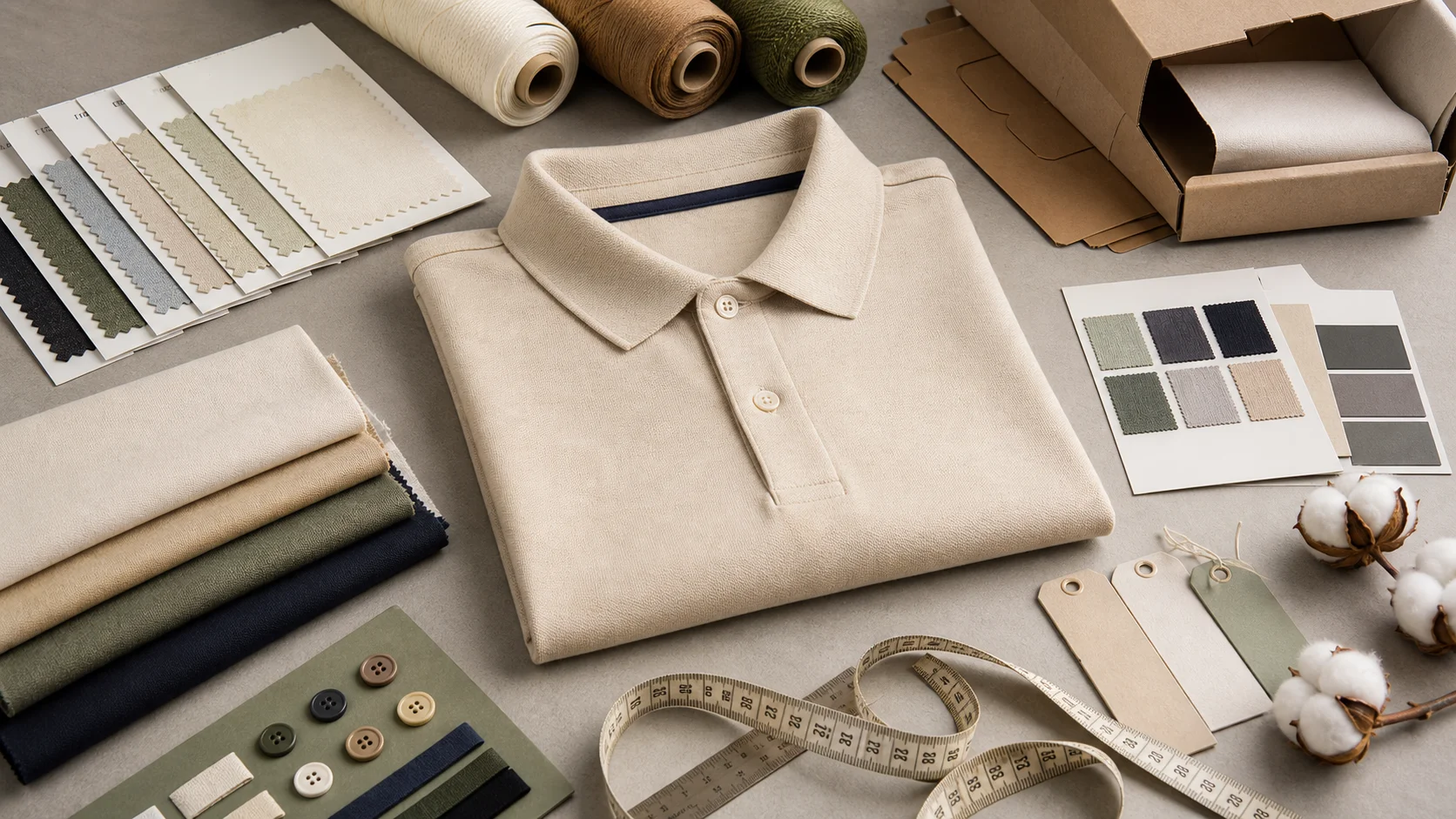
Bulk Polo Shirt Manufacturer for Brands compared by sample evidence, fabric or trim specs, MOQ, AQL terms, cost lines, delivery timing, and rework...
Fast answer: Bulk Polo Shirt Manufacturer for Brands: Sample Fit, Trim, AQL, and Delivery Risk should be judged by production evidence, not by a generic sourcing promise. The buyer needs sample proof, cost breakdowns, QC checkpoints, and delivery buffers in writing.
Ask for recent sample photos, measurement tolerances, fabric or print test assumptions, decoration test notes, packing examples, and a named inspection checkpoint. These details show whether the team can repeat an approved sample at bulk volume.
Separate garment cost, decoration, labels, packaging, sampling, testing, freight, and rush charges. Clear cost lines make it easier to reduce colorways, adjust size depth, or reserve more time for sampling.
Polos have a quiet talent for making margins look smarter than they have any right to. Factory quote sheets may start at 500 or 1,000 pieces, but the real economics usually open up at 3,000 units and improve again near 10,000. If you are working with a bulk polo shirt manufacturer for brands, that sweet spot matters: polos sit neatly between basic tees and over-engineered woven shirts, which means they scale well without feeling cheap.
I have seen the same pattern in Bangladesh, Vietnam, Guangdong, and nearshore plants across Turkey and Mexico. No romance in it. Just arithmetic. A bulk polo shirt manufacturer for brands can protect margin because the product is simple enough to run efficiently, yet premium enough to support better retail pricing.
During a visit to a knitwear plant outside Dhaka, the manager laid a price ladder on a steel table. It dropped 18% between 1,000 and 5,000 pieces, then another 7% at 12,000. In Dongguan, sample development was quoted at $35 per style. A nearshore supplier in Portugal wanted $120 for the same work. Yarn supply, dye-house load, and carton consolidation moved landed cost more than the logo ever did.
MOQ is never just a number on a quote. It tells you how the plant buys yarn, plans cutting, and handles leftover shade lots. A factory chewing through 800-piece runs all month tends to create more waste than one that locks in 3,000-piece orders by color block. Scrap rates of 4% in organized knit plants and 11% in chaotic ones are not unusual. That gap can erase the savings from a low sticker price.
The cheapest quote often ends up the priciest after delays, rework, and freight. One brand I worked with accepted a $4.10 FOB price on 6,000 polos, then got hit with $0.38 per unit for re-labeling, $0.22 for re-embroidering, and $1,900 in air freight after a six-week slip. Cheap. Then expensive.
Premium brands like polos because customers will pay for them. A solid pique polo at $38 retail can hold a gross margin far healthier than a $28 tee, especially when the garment uses 220-240 GSM cotton or a cotton-poly blend with stable shrinkage. Construction stays simple: collar, placket, sleeve cuff, side seam, hem. Fewer moving parts, fewer surprises.
South Asia often wins unit cost by 15-35% versus local production, while China usually wins on speed, trim sourcing, and finishing discipline. Nearshore factories in Mexico or Morocco can cut 2-6 weeks from lead time, which matters when retail windows are fixed or replenishment lands every 4-8 weeks. Margins depend far more on fabric choice, trim specs, and QA discipline than on logo placement.
A serious factory has to prove it can source knit fabric, hold collar rib consistency, deliver colorfast dyeing, manage embroidery or print, control shrinkage, and pack without adding defects. Miss one of those links and value leaks out of the order. I have walked into plants with polished showrooms and broken knit programs. I have also seen plain buildings run by sharp technicians who held shrink to 3% and kept shade variation under 0.5 Delta E across 8,000 pieces.
The CMT versus full-package split matters more than most brands want to admit. A CMT shop cuts, makes, and trims what you hand over. A full-package supplier takes on yarn, knitting, dyeing, trims, sampling, production, and freight coordination. For speed, accountability, and fewer handoffs, full-package is usually the better fit. It also works neatly with private label clothing programs where brand consistency has to hold across 2 styles or 20.
Start the first call with numbers. Monthly capacity. Machine count. In-house versus outsourced work. Lead time by order size. Ask how many flat-knits, collar-finishing machines, and embroidery heads sit on the floor. Ask whether they knit fabric themselves or buy from a mill. Ask how they manage shade bands and whether inline inspection records are kept. Exact answers usually mean the plant knows its own operation. Adjectives mean the opposite.
Spec sheets, lab results, GSM data, and photos from live orders should all be on the table. Brochure shots from 2019 are useless. In a good knit plant, machines are calibrated, rolls are tagged, bundles are traceable, and trims are sorted by color and lot number. Those details go hand in hand with lower defect rates. They also cut approval time by 1-2 weeks because everybody knows what is being checked.
The sample room should turn out proto samples in 5-10 days and pre-production samples in 7-14 days, depending on yarn availability. Knitting quality shows up in course count, wale count, and pilling behavior after wash testing. Dyeing quality shows up in shrink control and lightfastness. Poor dye-house control can make a navy polo arrive in three shades of navy. I have seen that on orders of 1,200 pieces and 18,000 pieces alike.
According to the standards published by OEKO-TEX and the testing frameworks from AATCC, buyers should verify colorfastness, dimensional stability, and chemical compliance with current test data, not old PDFs. For sustainability claims, ask for water and chemical records from the mill and dye house, not just a certificate on the wall. A recycled fiber claim without a transaction certificate is marketing copy.
Offshore bulk manufacturing often lowers unit cost by 15-35%, while local production can shave 2-6 weeks off lead time. Sounds tidy on paper, until sampling, freight, and customs friction get added back in. Domestic suppliers may quote $8.50 per polo with a 2-3 week sample cycle. An overseas factory may quote $5.40 FOB on a first order that takes 6-8 weeks. The catch shows up in the calendar and on the freight invoice.
I have lined up identical polo programs across the U.S., Mexico, Vietnam, and China. The U.S. sample came back in 4 days and cost $65. Vietnam took 12 days and cost $28. China posted the lowest quote on paper, but the brand still paid $0.42 per unit for inspection, $0.18 for cartons, and $1,300 in customs brokerage. Local suppliers move faster to market. Not always the best gross margin.
South Asia can be cheap on fabric and labor, but lab dips may drag 7-10 days longer when the dye house is overloaded. China usually moves faster on trims, and embroidery setup tends to be disciplined, though sampling fees may run 20-40% higher than in Bangladesh or Pakistan. Nearshore factories win on transit, not raw price. That matters when stock-outs cost more than production savings.
Repeat orders move quickly once fabric is approved and capacity is booked. I have seen a first order take 70 days from tech pack to delivery, then a repeat order drop to 38 because the mill already had 240 GSM pique in stock and the shade band was signed off. For brands running 4-6 seasonal drops, that time gap protects sell-through and cash flow.
Small batches look flexible, but they usually carry the highest hidden cost per unit. A 300-piece order may absorb the same embroidery digitizing fee, lab dip cost, and pattern correction work as a 3,000-piece order. On that 300-piece run, the extras can add $1.20-$2.50 per unit. At 3,000 pieces, the same overhead may shrink to $0.18-$0.35. Bulk polo programs should be planned like a rollout, not bought at the last minute.
A slightly higher factory price can still lift gross margin if defect rates fall and air freight disappears. One brand I advised moved from a $5.90 FOB factory with a 7% defect rate to a $6.30 FOB supplier with a 1.5% defect rate. Returns dropped. Complaints fell. Final landed cost improved by 4%. Price tags lie. Finished goods invoices do not.
Begin with numbers, not promises. Ask for current monthly output, machine count, in-house versus outsourced steps, and lead time by order size. Then ask what happens when an order jumps from 1,000 to 5,000 units. A factory that can explain workload smoothing, line balancing, and yarn reservation usually has real control. A factory that says yes to everything usually has none.
Compliance documents need to be current. Social audits, chemical testing, and fiber traceability should be dated within the last 12 months, not buried in an old PDF folder. I want to know who issued the report, which site was audited, and whether the scope matches the exact product category. If the factory claims recycled content, ask for mill records and transaction certificates tied to the actual yarn lot.
Ask for three recent customer references and one live production update before you sign. A real photo set, dated this month, showing cutting, stitching, finishing, and packing. Ask how sample naming conventions work, how revisions are tracked, and who signs off on collar shape or button color. Small stuff? Not really. One mislabeled sample can push a 4,000-piece order back by 10 days.
Communication standards matter just as much as fabric quality. A supplier replying in 12 hours with clean line-item notes usually runs better than one sending vague replies after 4 days. In Ho Chi Minh City, the strongest signal I saw was not the showroom. It was the change-control board on the wall, where every sample revision had a date, an owner, and a status.
Overpromised output, empty cutting rooms, too many unfinished orders, and messy trim libraries should make you pause. If the same button shows up in seven shades of off-white, the factory is disorganized. If the cutting room has no bundles marked for your style, your order is not a priority. If the compliance folder is older than the current season, walk away.
For brands that also source knit intimates or activewear, the same discipline applies across categories, whether the product is a polo or custom bra manufacturing. A factory either respects process or it does not. No halfway version stays reliable for long.
Fabric usually makes up 45-60% of FOB price, while decoration can add 8-20% depending on complexity. A basic 220 GSM cotton pique polo may cost $2.20 in fabric, $1.10 in labor, $0.35 in trims, and $0.25 in packing before freight. Move to organic cotton or recycled polyester and the fabric line can jump by 12-28%. Add high-density chest embroidery, and decoration climbs fast.
Volume changes the unit price in hard steps. At 300 units, the mix of fabric, labor, and setup fees can push FOB to $8.00-$10.50. At 1,000 units, the range often drops to $5.80-$7.20. At 3,000 units, $4.80-$6.10 is common. At 10,000 units, savings flatten because the factory has already absorbed setup costs, and the real swing comes from fabric contracts and shipping terms.
Cotton pique is still the safest commercial choice for polos because it balances breathability, structure, and wash stability. Cotton-poly blends reduce shrink and can cut fabric cost by 8-15%. Organic cotton adds certified input costs and stricter traceability. Recycled polyester can improve moisture management, but it demands cleaner sourcing records and may need different dye recipes. Cost changes here echo into returns and customer perception.
Trims add up. A branded woven label might add $0.06. A heat-transfer neck print may add $0.12. Pearl buttons can add $0.08 each, while custom tuck boxes can add $0.30-$0.70. Freight can swing the whole model by 3-9% if consolidation is sloppy. I have watched brands underestimate cartons, testing, and embroidery digitizing, then discover the low FOB quote excluded all three.
Order volume matters most after the first approval cycle. Once fabric is locked and the factory has a repeatable spec, price breaks come from better marker efficiency, fewer changeovers, and lower setup waste. A 3,000-piece order can often beat a 1,000-piece order by $1.00-$1.60 per unit. A 10,000-piece order may only shave another $0.35-$0.70, but that still matters on a 20,000-unit annual program.
When brands pair polos with other knit categories, the sourcing logic gets sharper. Bulk production can share yarn forecasts, test plans, and QC systems across styles, much like a well-run cut and sew manufacturing program spreads overhead across multiple silhouettes. Consistency saves money. Chaos charges interest.
I do not trust sustainability claims that stop at a hangtag. For polos, the scrutiny should start at the mill, move through dyeing, and finish with wastewater treatment. Dyed knits and collar ribbing can hide more water and chemical intensity than plain tees because they involve multiple components, color matching, and often extra washing steps. If a supplier cannot show where the fiber came from, the rest is theater.
Preferred mills, restricted chemical lists, and third-party traceability should be the baseline. Data from Textile Exchange shows how material sourcing decisions shape environmental impact, but factory-level controls still decide whether claims hold up. A certified mill is not automatically clean if the dye house dumps poorly treated wastewater or skips batch documentation. I have seen excellent certificates attached to weak operations and mediocre certificates attached to better-managed plants.
Ask for GOTS, GRS, OEKO-TEX, and ISO-related management systems only when they fit the material and process. Then check the scope. A GRS certificate for yarn does not guarantee a finished garment program is traceable. A wastewater treatment record should show volume, pH, chemical oxygen demand, and dates of discharge tests. I want at least 3 recent readings, not one snapshot from last year.
According to ISO, process control and documented systems matter because repeatability reduces variation. That is not an audit checkbox. It is a cost control measure. Factories with tighter wastewater and chemical systems also tend to manage shade consistency better, which lowers re-dyeing, rejects, and delays. Sustainability, in this category, is a quality strategy wearing a cleaner shirt.
Some certificates are useful. Some are wallpaper. I look for chain-of-custody records tied to actual PO numbers, mill invoices, and batch dye logs. If a factory claims recycled content, ask which supplier provided it, in what percentage, and whether the claim covers the yarn or only the finished fabric. If they say organic, ask for transaction certificates and scope numbers.
Bluntly: sustainability claims without factory-level data are branding, not sourcing strategy. If a supplier cannot tell you water usage, chemical compliance status, and the exact source of the fiber, the claim is too thin to build a program on.
Start with a complete tech pack. Measurements. Graded specs. Fabric composition. GSM. Collar construction. Button count. Label placement. Packaging details. Then request side-by-side quotes that separate fabric, labor, decoration, testing, and shipping. A clear RFQ cuts out vague pricing and gives you leverage without guesswork. If you need a starting point, you can get a free quote and compare it against two other bids.
Move to a pilot order of 300-1,000 units. Test fit, shrinkage, color retention, embroidery quality, and on-time delivery. A 30-60-90 day plan works well: first 30 days for sampling and costing, next 30 for pre-production approvals, final 30 for the pilot and evaluation. If the first order misses its date by more than 7 days or runs over your defect threshold by 2%, pause and reset before scaling.
The best factory relationship runs on clear specs, not endless haggling. I have seen brands save more by tightening the collar spec by 2 mm than by arguing over 15 cents on labor. Precision wins. So does patience. Choose the bulk polo shirt manufacturer for brands that answers plainly, proves its numbers, and treats your order like a system, not a guess.
For a standard cotton pique polo, FOB pricing often lands around $4.80-$7.20 at 1,000-3,000 units, depending on fabric, decoration, and country. At 300 units, prices can rise to $8.00-$10.50 because setup costs are spread over fewer garments. Testing, cartons, and embroidery digitizing may add $0.20-$0.80 per unit if they are not included.
Many factories quote 500-1,000 pieces as a minimum, but better pricing usually appears at 3,000 units or more. If the factory is handling custom yarn, special trims, or heavy embroidery, the practical MOQ may climb to 5,000 pieces. Repeat orders can sometimes be smaller, especially if fabric is already reserved.
A first order usually takes 45-75 days from approved tech pack to delivery. Sampling can take 7-14 days, fabric booking another 10-20 days, and bulk production 20-35 days. Repeat orders are faster, often 30-45 days, if the fabric, fit, and trims are already approved.
Check current capacity, machine count, monthly output, in-house versus outsourced steps, and live production photos from the last 30 days. Ask for spec sheets, lab tests, GSM data, and three customer references. If the factory cannot show current documentation, treat the quote as provisional.
Yes. A pilot order of 300-1,000 units helps you test fit, shrinkage, color retention, packing, and delivery reliability before committing to 5,000 units or more. It also reveals whether the factory communicates clearly during production. If the pilot goes well, scaling becomes faster and cheaper.