
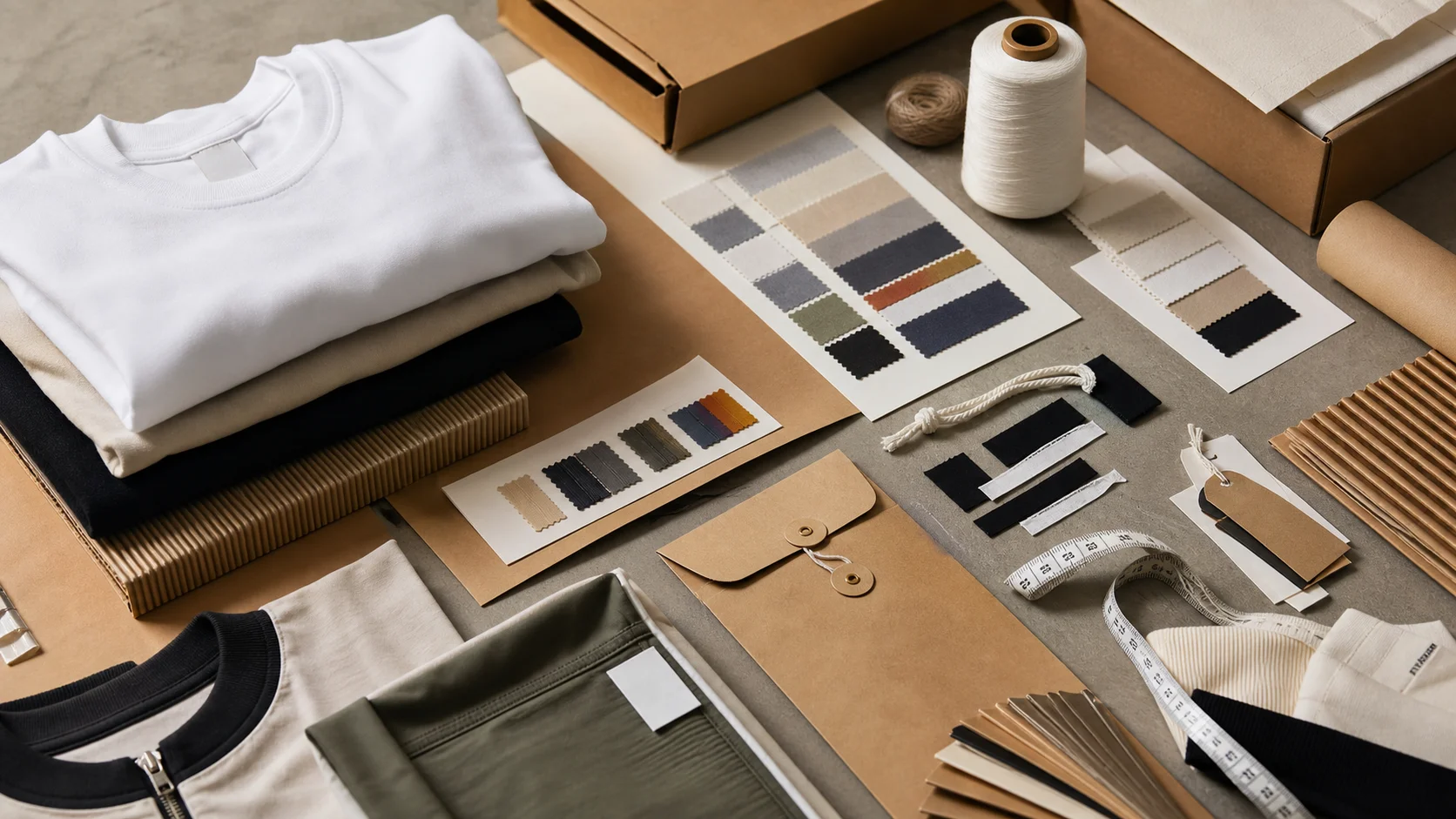
Cut and Sew in Clothing Manufacturing compared by sample evidence, fabric or trim specs, MOQ, AQL terms, cost lines, delivery timing, and rework responsibility.
Fast answer: Cut and Sew in Clothing Manufacturing: Tech Pack, Sample Gate, MOQ, and QC Terms should be judged by production evidence, not by a generic sourcing promise. The buyer needs sample proof, cost breakdowns, QC checkpoints, and delivery buffers in writing.
Ask for recent sample photos, measurement tolerances, fabric or print test assumptions, decoration test notes, packing examples, and a named inspection checkpoint. These details show whether the team can repeat an approved sample at bulk volume.
Separate garment cost, decoration, labels, packaging, sampling, testing, freight, and rush charges. Clear cost lines make it easier to reduce colorways, adjust size depth, or reserve more time for sampling.
A 200-piece boutique run and a 20,000-piece retail order can come off the same line, but they will never cost the same. Half a day can vanish into setup, and then the math starts speaking in a very unfriendly tone. I watched a small team in Portugal spend hours staging a 200-unit French terry hoodie, then saw a larger Vietnamese factory spread the same burden across thousands of units and cut labor cost per garment by 15-30%. That gap is why what is cut and sew in clothing manufacturing still matters so much to private label brands.
Cut and sew means the manufacturer sources or approves the fabric first, then cuts it into panels and sews those panels into the finished garment. Simple on paper, not in practice. The model gives brands control over fit, construction, labeling, and fabric handfeel, which is why premium basics, activewear, babywear, and wholesale merchandise lean on it so heavily. I have seen brands pay $4.80 per unit for a custom private label tee and sell it for $32, because the garment looked and fit like a higher-tier product instead of a commodity blank.
Here is the part many buyers miss: some low-cost factories still lose money on small cut and sew orders because setup time eats the margin. A factory may need 2-3 hours to stage fabric, cut test pieces, and calibrate machines before the first panel is stitched. On a 200-piece order, that overhead hurts. On a 20,000-piece bulk run, it fades into the background.
Price point changes the math fast. Entry-level retail may need a $2.20 landed cost to preserve margin. Premium price points can still work at $7.50 landed if the fit is better, the handfeel is heavier, and returns are lower. In my experience, the strongest private label programs do not chase the cheapest sewing minute. They chase consistency, because a consistent collar, a clean armhole, and a stable shrink rate can carry a brand across seasons.
What is cut and sew in clothing manufacturing? It is the sequence that turns approved fabric and a technical spec into a finished garment, step by step, with each stage creating its own risks and costs. Brands arrive with only a sketch and a hope, then wonder why the factory quote varies by 40%. The answer sits in the production process.
The flow is usually design, pattern making, marker making, fabric cutting, sewing, finishing, quality control, and packing. A tech pack enters the factory with measurements, stitch types, fabric weight, trim callouts, and construction notes. Pattern makers translate that into panels. Marker makers arrange those panels to reduce waste. Cutters lay fabric, cut panels, bundle pieces, and send them to sewing. After that come pressing, trimming loose threads, measurement checks, folding, polybagging, and carton packing.
Precision matters most at the cutting stage. A 2-3 mm error sounds tiny until you see it shift sleeve balance, side seam alignment, or a hood opening that no longer sits flat. On denim, that small miss can distort topstitching. On activewear, it can upset stretch recovery. On children’s wear, the same miss can push a size 2T out of tolerance. I have inspected factories where the sample looked perfect, yet bulk production drifted because operators were cutting too fast under pressure.
Sample development exists to reduce that pain. A pre-production sample, sometimes followed by a size set and a gold seal, gives both buyer and factory a point of reference before bulk begins. The brands that save money are not the ones skipping samples. They are the ones approving them with discipline.
Sewing operations vary by product. T-shirts may use overlock and coverstitch. Hoodies need rib attachment and pocket bar tacks. Denim requires heavier thread, chainstitch, and reinforcements. Tailoring involves canvassing and more handwork. For babywear, I would never skip safety checks; the margin may look appealing, but products handled by infants need far tighter compliance, as seen in specialist custom baby clothing manufacturing programs.
The three models solve different problems. Blanks are pre-made garments you decorate. ODM means the factory owns a base design and you customize within limits. Cut and sew gives the brand the most control, but it also asks for more time, more decisions, and more money upfront. If you are comparing what is cut and sew in clothing manufacturing to blanks, the main difference is construction control. With blanks, the fit is fixed. With cut and sew, the fit is yours to shape.
Blanks usually move faster and cheaper. A screen-printed blank tee might land at $3.25 with low minimums and 7-14 day decoration timelines. A cut and sew tee may start at $5.00-8.50 depending on fabric, trims, and shrink testing, with 4-8 weeks after approval. ODM sits between the two. The supplier already has a pattern, a fit block, and a production path, so development is faster, but your custom options are narrower.
I often lay the models side by side for buyers:
The counterintuitive finding I keep seeing is this: a higher unit price can still improve profit if returns fall by 10-20% because the fit is more consistent. A direct-to-consumer jogger program in Spain showed it clearly. The per-unit cost rose from $6.10 to $7.35, but returns dropped from 18% to 6%, and net margin improved.
Geography changes the equation too. Nearshore factories in Mexico, Turkey, or Portugal can cost 10-25% more per unit than Asia, yet they may cut lead times by 2-6 weeks. That speed can save a seasonal brand from markdowns. For private label clothing services, the best choice depends on inventory risk, not just factory quote sheets. A cheaper blank program can be smart for test launches, while full private label clothing services make sense once a fit has proved itself.
Fabric choice can change both the look and the machine settings. Knit versus woven matters. Stretch content matters. Weight matters. A 180 GSM single jersey tee behaves differently from a 320 GSM French terry hoodie, and both behave differently from rigid denim or a viscose woven blouse. Shrinkage and dye consistency can force extra testing, extra rejects, and extra time. I have seen a $1.10 fabric decision add $0.45 to the final garment because the factory needed tighter handling and more washing control.
Trims are not minor. Zippers, elastics, labels, interlinings, snaps, embroidery, drawcord tips, and wash treatments all alter the quote. An exposed YKK zipper may add $0.60-1.40. A woven label might add $0.05. A custom silicone patch can add $0.20-0.50. Enzyme wash is usually cleaner and more controlled than stone wash, but it still adds cost. For products that need low-friction performance or stretch recovery, the testing list can grow fast.
Testing matters especially in children’s wear, sportswear, and flame-resistant products. Data from Textile Exchange, OEKO-TEX, and ISO matters here because shrinkage, colorfastness, and dimensional stability are not marketing details. They are compliance details. A factory that already works with approved mills and trim suppliers often protects your timeline, because one failed dye lot can stall a 5,000-piece order for 10-14 days.
Marker efficiency matters too. A 3% improvement in marker efficiency can save meaningful money on a 10,000-piece order, especially on higher-cost fabric. One factory in Bangladesh showed me a pattern layout that reduced waste by 2.8% on a hoodie program. That single change dropped fabric consumption enough to offset part of the sewing increase. Small gains matter here. They compound.
A realistic cut and sew budget includes development, pattern making, sampling, fabric procurement, cutting, sewing, finishing, freight, duties, and QA. The first production batch often carries setup fees that add 20-40% to the landed cost because the factory must absorb pattern corrections, line setup, and sample approvals before bulk efficiency appears. On a 300-piece run, that is painful. On a 5,000-piece run, the same fees spread out more gently.
The process timing usually looks like this: tech pack review and pattern work take 3-10 days, sample creation takes 7-21 days, material sourcing takes 2-6 weeks, production takes 2-8 weeks, and inspection plus packing takes 3-7 days. Offshore orders often land in 8-16 weeks or longer, especially if fabric is custom-dyed. Local or nearshore production can move in 4-8 weeks after approval if the mill has stock and the line has capacity.
Delays usually happen in the same places. Fabric mills miss the shade band. Strike-offs need a second round. A sample gets revised because the collar height is off by 5 mm. Final inspection holds the shipment for loose stitching or mislabeled cartons. I have seen a knit program lose 11 days because the rib supplier sent the wrong elasticity profile. That kind of delay is common enough to plan around, not hope away.
For better cost clarity, ask for a line-by-line quote. A strong quote separates fabric, trims, labor, washing, labeling, packaging, freight, duties, and inspection. That makes it easier to spot whether the manufacturer is padding labor or hiding an expensive fabric assumption. Quotes without detail are not quotes. They are guesses with a logo on top.
For brands that need a specialist partner, cut and sew manufacturing is not just about sewing skill. It is about coordination between sourcing, sampling, and production. The best factories can explain each hour and each material line, not just the final number. That transparency is what keeps margins alive.
Choose the factory by product category, not by quote alone. A knitwear plant may be excellent at jersey tees and terrible at structured denim. A tailoring factory may produce immaculate blazers but struggle with bonded seams on activewear. I have walked through facilities in Italy, India, and Vietnam where the machinery looked similar, yet the output quality diverged sharply because the operators were trained for different garments.
Before signing, ask about MOQ, sampling cost, production capacity, inspection standards, subcontracting rules, and compliance documents. Ask how many pieces the line produces per day, not just per month. Ask whether they can handle 500 units of one style or only 10,000 across multiple styles. Ask who owns the patterns. Ask whether they inspect fabric on a 4-point system. Ask which third parties audit them. Data from WRAP and buyer-facing compliance standards can help you screen suppliers more cleanly.
Do not judge by samples alone. Check 3-5 finished garments from past bulk orders if you can. Look at seam density, thread trimming, label placement, fabric storage, and shade sorting. I have rejected factories after seeing fabric rolls stored under open windows with no humidity control. I have also walked out of spotless sample rooms only to find bulk garments with puckering at the armhole and twisted side seams.
Red flags are visible if you know where to look. Inconsistent seam density. Overpromised delivery dates. Thin documentation. Missing inspection records. Poorly labeled trim bins. A factory that cannot explain why one quote is $1.80 and another is $2.95 for the same garment is not giving you a clean comparison.
Use the same scorecard across regions and price points. Rate communication, sample speed, compliance, bulk quality, and capacity on a 1-5 scale. That makes quotes from Pakistan, Peru, or Poland actually comparable, instead of letting the lowest number win by default.
Build a cleaner spec before you request quotes. I always want a tech pack, a reference sample, a size spec, a trim list, and a target retail price before the first factory email goes out. If you send only a sketch, you will get only a rough guess back. The sharper your inputs, the sharper the quote. That is true whether you are making tees at $4.20 landed or outerwear at $18.50 landed.
Ask every factory for a costing breakdown line by line. You want to see fabric, trims, labor, washing, packaging, freight assumptions, and duty estimates. If the factory hides the math, your margin risk rises. I have seen brands save 8-12% simply by catching an expensive carton spec or an unnecessary trim upgrade before sampling began.
Start with a controlled pilot order of 100-500 units, depending on category. That is enough to test quality, communication, and consistency without tying up too much cash. Inspect the first shipment for seam quality, measurements, shade variation, packaging accuracy, and carton counts. For activewear, test stretch recovery. For tees, wash a few pieces twice. For jackets, check zipper function and cuff symmetry.
The first order is often less about profit and more about proving whether the factory can repeat a result. If the line misses the spec by 4 mm on the sample and 8 mm on bulk, the problem is structural. If the factory cannot explain its process, it is not ready for a serious cut and sew program.
If you need a faster route to market, you can start with custom hat manufacturing or other narrower product categories while building your broader apparel program. That gives you a smaller compliance and fit surface to manage before you commit to complex cut and sew lines.
Stitching quality is not cosmetic. Seam slippage, puckering, uneven topstitching, and measurement drift all shape how customers judge the garment in the first 30 seconds. I have seen a premium sweatshirt lose reviews because the neckline twisted after one wash. The fabric was fine. The construction was not. That is where a brand can lose trust fast.
There is a real gap between sample-room quality and repeatable bulk production quality. A skilled sample mechanic can make one perfect jacket in a quiet room with a full day to spare. A production line may need to produce 600 jackets across 2 shifts with changing operators and a supervisor balancing throughput. Those are not the same conditions. A lot of brands mistake a great sample for a reliable factory. They are not the same thing.
Premium brands spend more on QC because one bad run can erase margin gains. I have seen a $9.40 landed hoodie program wiped out by a 14% return rate caused by crooked pocket placement and inconsistent sizing. The factory quote was attractive. The hidden cost was not.
Lower labor cost regions do not automatically mean lower total cost. I have visited factories where wages were low, but training was weak and line supervision was thin, so defects stayed high and rework ate the savings. I have also seen higher-cost factories in Europe outperform cheaper competitors because operator training was tighter and inspection was built into every stage. Quality is not just a sewing line issue. It is a management issue.
Quality control is cheaper than chargebacks, returns, and rework. Every time. If a factory cannot hold tolerance, sort shades, and repeat the same stitch on the 500th piece that it showed you on the first sample, your margin will leak somewhere else.
It is a production method where approved fabric is cut into pattern pieces and sewn into a finished garment. The process usually includes pattern making, cutting, sewing, finishing, and quality control. Brands use it for better fit, construction control, and custom branding.
Small runs often cost more per piece because setup is spread across fewer units. A simple tee may land around $4.20-$8.50, while hoodies, denim, and tailored pieces can be much higher depending on fabric and trims. Setup fees can add 20-40% to the first batch.
Blanks are pre-made garments that you decorate, while cut and sew builds the garment from fabric to finished piece. Blanks are usually faster and cheaper upfront, but cut and sew gives more control over fit, stitching, and branding. That control can reduce returns by 10-20% in some programs.
After approval, nearshore production can take 4-8 weeks, while offshore runs often take 8-16 weeks or longer. Sample development, fabric sourcing, and final inspection are common delay points. Custom fabric dyeing or repeat sample revisions can add 1-3 weeks.
Yes, but the MOQ varies by factory and category. Many cut and sew programs start around 300-500 pieces, though some specialist suppliers will handle 100-200 pieces at a higher unit cost. Pilot orders are useful for testing fit, communication, and quality consistency.