
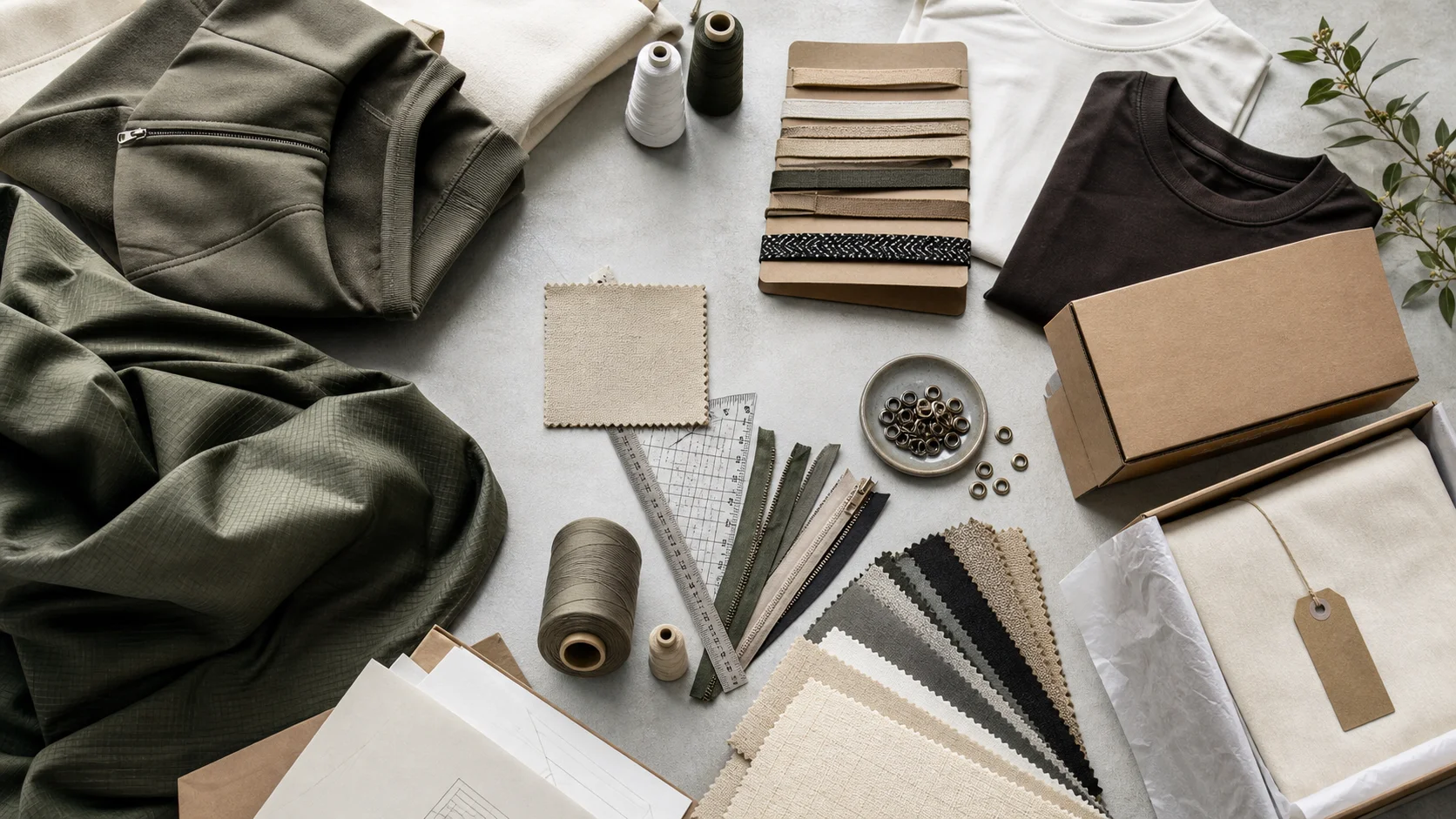
CMT Clothing Manufacturer for Brands with checks for samples, fit, MOQ, QC evidence, pricing terms, and delivery risk.
Fast answer: CMT Clothing Manufacturer for Brands: What Labels Must Know should be judged by production evidence, not by a generic sourcing promise. The buyer needs sample proof, cost breakdowns, QC checkpoints, and delivery buffers in writing.
Ask for recent sample photos, measurement tolerances, fabric or print test assumptions, decoration test notes, packing examples, and a named inspection checkpoint. These details show whether the team can repeat an approved sample at bulk volume.
Separate garment cost, decoration, labels, packaging, sampling, testing, freight, and rush charges. When every cost line is visible, it becomes easier to reduce colorways, adjust size depth, or reserve more time for sampling.
In Dongguan, one brand team had rolls of 320 GSM French terry stacked by the door and was arguing over shade bands with a mill rep. That scene says everything. A cmt clothing manufacturer for brands keeps the fabric, trims, and margin structure in the brand’s hands while the factory handles cut, make, and trim execution. Control stays put. Costs stay visible.
Bangladesh, Turkey, Portugal, and parts of Italy all run this model, but the details shift by region. Turkish CMT units often want 1,000 pieces per color and can turn knitwear quickly. Portuguese workshops may take 150 to 300 pieces and still produce sharper tailoring. In Bangladesh, volume plants can push 20,000 units a week, though spec discipline matters more than people expect. “Same service everywhere”? Not even close. I’ve lost money believing that.
Brands with in-house product development lean into CMT because design intent survives the trip. If your team already sourced fabric, tested the wash, and approved trims, why pay a factory to mark up every component again? That extra margin stack is how a $7.80 target tee becomes a $12.40 quote and everyone nods like the math is cloudy. It isn’t.
Lower labor cost can still lose the race on total cost. I once watched a brand chase a $0.42 sewing rate in South Asia, then swallow three sample rounds at $180 each, $1,900 in air freight, and another $0.28 per unit in rework because the neckline spec never landed. The “cheap” option cost more than a slightly pricier Portuguese factory with better first-pass quality. Landed cost wins. Every time.
For brands comparing sourcing models, the best decisions come from clear cost data and compliance checks. Industry guidance from the U.S. International Trade Administration and sustainability standards from Textile Exchange can help you benchmark production choices more realistically.
On paper, the CMT workflow looks tidy.
In real life, it never is.
Tech pack approval comes first, then pattern making, grading, sampling, marker making, cutting, sewing, finishing, quality control, and packing. Working with a cmt clothing manufacturer for brands means the factory executes your product; it does not dream it up from a sketch on a napkin. That belongs somewhere else.
Your side usually supplies fabric, trims, labels, hangtags, and packaging. The factory covers labor, machines, line setup, and production management. Thread, elastics, zippers, or polybags may be sourced by the factory, but that is support, not full-package ownership. Write it down. If roles stay fuzzy, someone will “assume” and you will pay for the assumption.
Three choke points eat time: fabric arrival, sample approval, and the first bulk run. Sampling often takes 7 to 21 days, depending on complexity and how many things changed after the last email. Bulk lead times usually run 30 to 90 days. A simple 500-piece jersey order may move in 4 to 6 weeks after approvals. A tailored jacket with lining, shoulder pads, and bonded seams can take 10 to 12 weeks without blinking.
I’ve seen brands blame the factory when fabric showed up late. I’ve also seen factories sit on approved trims because the cutting room never got scheduled. Both sides can burn days. The cleanest jobs I’ve run had a signed BOM, a sealed sample, and one person on the brand side answering within 24 hours. Not glamorous. Just effective.
For specialized categories, the steps get more specific. A bra program needs precise grading, cup testing, and bonded edges, which is why many brands split that work to custom bra manufacturing specialists. Babywear flips the challenge: softer seams, stricter compliance, and trims that cannot turn into hazards. If you’re managing a custom baby clothing manufacturing order, you already know one loose snap can become a mess nobody wants.
CMT and full-package are operating choices, not belief systems. CMT gives you sourcing control and tighter margin control. Full-package saves time for smaller teams without a fabric team, a trim library, or the patience to chase five vendors across three time zones. I’ve used both. Both work. Both can fail in expensive ways.
For a startup order of 500 units, CMT can cost more per piece if fabric minimums bite hard. You may need 1,200 meters of one fabric to get mill pricing even when you only need 500 garments. A full-package factory may bundle fabric, trims, and production into one quote and save 20 hours of sourcing chaos. Move up to 5,000 units, though, and brand-owned sourcing often wins because duplicated factory markups on fabric and trims finally disappear.
Take T-shirts. In Asia, a CMT tee in combed cotton jersey might land at $2.10 to $3.40 labor plus trims, while full-package can sit at $4.20 to $6.00 depending on fabric origin. In Europe, the same tee may run $4.50 to $7.50 CMT if the fabric is sourced locally, and $6.80 to $10.00 full-package. North Africa often lands in the middle on labor, but freight and fabric origin can swing the total fast. Quote comparisons without fabric specs are office theater.
Here’s the comparison I use with clients:
If your brand already owns product development, CMT usually protects design intent better. If your team is small and sourcing is shaky, full-package can be the cleaner first move. I worked with a private-label brand that used private label clothing to test the market, then shifted to CMT once repeat styles settled down. Sensible. Not common, but sensible.
A good factory is not a glossy website and a wall of sewing machines.
Category depth is the real value.
Look for knit versus woven expertise, denim washing, embellishment, bonding, activewear construction, and specialty finishing handled by people who have seen those problems before. A factory that “can sew anything” usually doesn’t know your category well enough.
During plant visits, I ignore the sales pitch and go straight to process control. The strongest operators use fewer buzzwords and more visible discipline: inline checks, defect logs, needle management, line balancing sheets, and approved sample libraries hanging where people actually reach for them. A polished showroom won’t fix sloppy bundling on the floor.
Regional strengths are real. Portuguese CMT factories tend to be sharp on small-batch precision, crisp finishing, and low-volume luxury pieces. Larger South Asian units usually handle volume better, especially on tees, fleece, and simple wovens. Italy can be outstanding on premium tailoring, but nobody is getting bargain pricing there. I once quoted a wool coat at €68 CMT in Italy and watched a brand team react like the room had cracked open. Normal quote.
Machine count matters less than the right attachments and operators. If you need flatlock on activewear, ask whether they run it daily. If you need bonded hems, ask who sets it up and what the failure rate looks like. Cut-and-sew programs expose skill gaps fast, which is why many brands keep activewear and basics with different partners. Weak control over cut parts creates waste in a hurry; that’s where cut and sew manufacturing experience shows up in the first bulk run.
Pricing is really a stack of small decisions pretending to be one number. Fabric type is the biggest lever. A 180 GSM ring-spun cotton tee is not priced like a 320 GSM French terry hoodie. Construction complexity matters too. A basic T-shirt may take 12 to 18 labor minutes. A tailored shirt can take 25 to 40. A technical jacket with seam sealing, waterproof zippers, and lining can eat 90 minutes or more.
Wash processes change the math quickly. Enzyme wash is usually cheaper and cleaner-looking on knits. Stone wash adds abrasion, variance, and labor. Garment dyeing can add $0.40 to $1.20 per piece depending on color depth and batch size. Trims shift the quote too. A basic woven label and polybag are cheap. Custom zipper pulls, embossed snaps, and specialty hangtags are not.
Small orders can carry 20% to 60% higher unit costs because setup, sampling, and fabric minimums get spread across fewer units. Ugly math. If your MOQ is 300 and the factory has to buy 1,000 meters of fabric, the garment starts carrying dead inventory cost before the first piece ships. I’ve watched brands lose $4,000 on leftover fabric because they wanted to “test demand” with impossible order sizes.
Hidden costs show up fast. Freight can add $0.25 to $1.80 per unit depending on lane and weight. Duty changes with HTS code and country of origin. Lab testing for colorfastness, azo dyes, pilling, or flammability can run $150 to $500 per style. Product development revisions add more when fit keeps changing. Late approvals can trigger chargebacks or air freight to rescue a booking. According to standards and testing guidance from AATCC and certification bodies such as OEKO-TEX, testing and compliance are not extras in regulated markets.
Fastest comparison method? Sort by product class. T-shirts are cheap, denim sits in the middle, tailored shirting needs more labor, and technical outerwear punishes weak factories. If a quote looks too neat, something is missing. Usually freight. Sometimes testing. Occasionally your sanity.
Start with documents, not charm. Ask for the business license, social compliance audits, machine list, capacity chart, client references, and sample room photos that show actual work. Then ask to see the production floor. A factory can say it does 50,000 units a month. Fine. Show the line plan, the style mix, and the real output by category.
Verify category fit. A supplier that sews basic woven shirts may be useless for bonded activewear. A factory that does babywear may not have the setup for heavyweight denim. I look at samples, not the sales deck. If quality swings wildly from round to round, that isn’t “flexibility.” That’s inconsistency wearing a tie.
Red flags are easy. Vague lead times. Refusal to share capacity. Overpromising on MOQ. No clear defect-handling process. A salesperson who says yes to everything but can’t explain how a sleeve is set or how seam allowance is controlled. Theater. I’ve paid for it before. Once.
Use a scorecard during the visit. Rate communication speed, production visibility, defect handling, ethical standards, sample accuracy, and willingness to say no when the spec is bad. The best factories do not pretend every job is easy. They ask hard questions. That’s a good sign.
Before contacting factories, pull together a tech pack, BOM, size spec, target cost, required certifications, and forecast volume. If your first email says “we have a cool idea,” the factory will price high or ignore you. Facts get better answers. Measurements get better quotes. Construction notes cut down the nonsense.
For the first run, I prefer a pilot order of 300 to 1,000 units depending on category. A basic tee can go higher. A jacket, bra, or baby garment should stay tighter. The point is not to prove you can flood a warehouse. The point is to test quality, fit, and delivery reliability without betting the company.
Structure approvals in stages: fabric handloom, pre-production sample, size set, and bulk sealing sample. Skip one and you’re gambling. Build a 10% to 15% contingency into both timeline and budget. Sampling revisions happen. Freight delays happen. Factories get busy. People get sick. The universe does not care about your launch date.
If you are comparing CMT to private label, keep the data clean and the assumptions boring. That’s how you avoid expensive guesswork and choose the right production model for the next 2,000 units.
How much does a CMT order cost? For a basic cotton tee, I usually see $2.10 to $4.50 per unit in Asia depending on fabric, trims, and wash. In Portugal, the same item can land at $4.50 to $7.50. Add testing and freight, and the landed number moves fast.
What is the MOQ for a cmt clothing manufacturer for brands? Asia often starts around 500 to 1,000 pieces per style or color. Portugal can go as low as 100 to 300. Turkey and North Africa are often in the middle, but fabric minimums can still push your real commitment higher.
How long does production take? Sampling usually takes 7 to 21 days. Bulk production is often 30 to 90 days after approvals, depending on order size and complexity. If fabric is not in stock, add more time. If you want miracles, call a magician.
Can a CMT factory handle technical products? Yes, if it has the right equipment and operators. Ask for proof on your category, not just general sewing experience. Activewear, bras, denim washes, and babywear each need different discipline and QC standards.
What should I send before requesting a quote? Send the tech pack, BOM, size spec, target cost, certifications, and forecast volume. If you can include fabric references, wash references, and construction callouts, even better. That is how you get a quote you can actually use.
A CMT factory handles cut, make, and trim. You supply the fabric, trims, labels, and packaging unless the supplier agrees to source small items for you. Their job is execution, not product development from scratch.
Asia is usually cheapest on labor, with basic tees often around $2.10 to $4.50 per unit. Portugal and Italy cost more, often $4.50 to $10.00 depending on complexity. North Africa often sits between those ranges.
Plan on 7 to 21 days for sampling and 30 to 90 days for bulk production after approvals. If fabric is custom dyed, add another 2 to 4 weeks. Simple basics move faster than jackets, denim, or technical garments.
Yes, but small runs can cost 20% to 60% more per unit because setup and fabric minimums get spread across fewer pieces. Some Portuguese factories accept 100 to 300 units, while Asia often wants 500 to 1,000.
Check their category experience, machine list, capacity chart, and sample consistency. If you make activewear, bras, denim, or babywear, ask for examples in that exact category. A good fit shows up in the samples, not the sales pitch.