
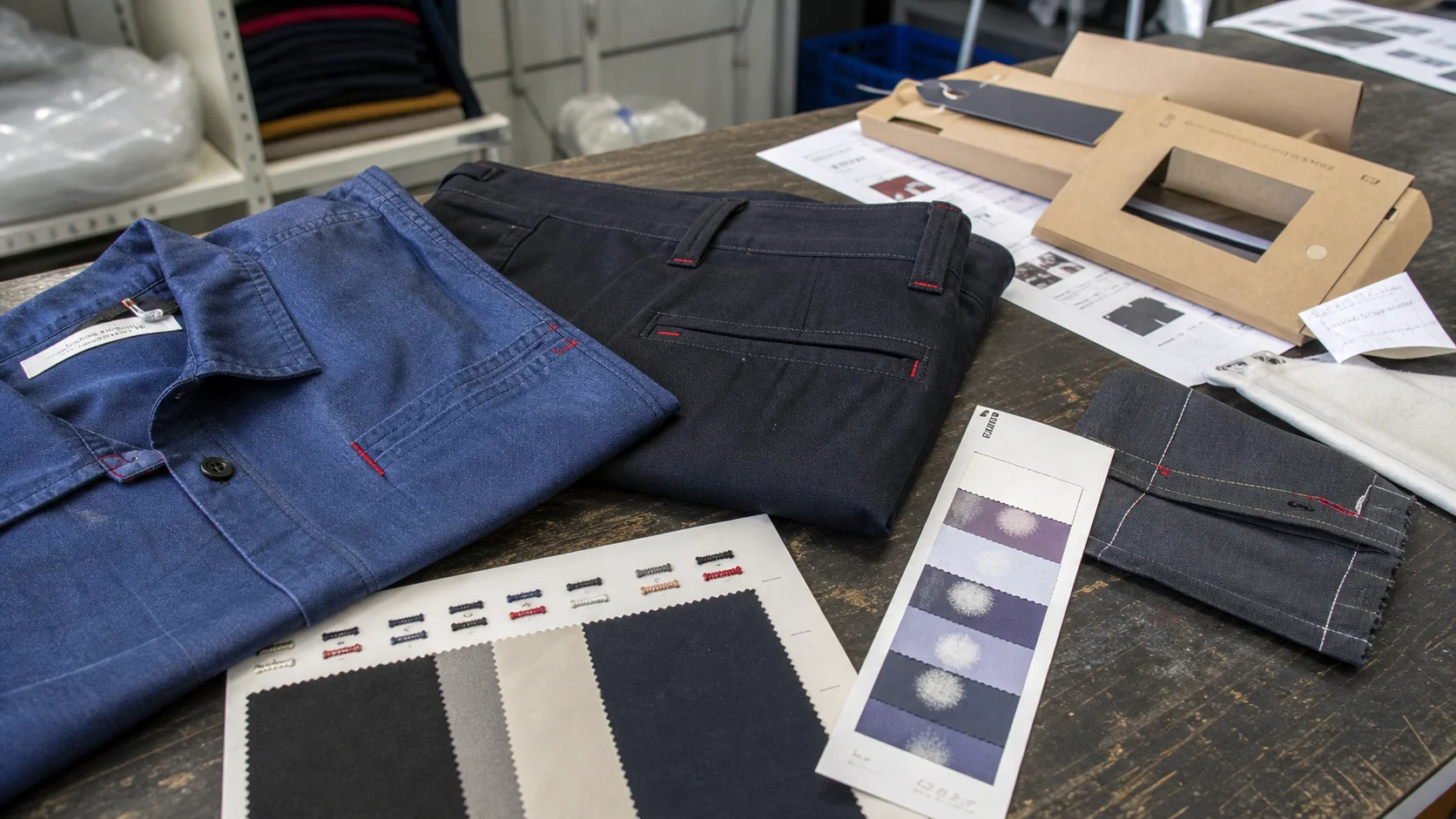
A practical SEO outline for food hall operators who need to evaluate contrast bartack map production, colorfastness performance, and audit-ready documentation for high-wash, high-traffic uniform programs.
Contrast bartack map audits matter more than many buyers expect. In a food hall environment, garments and branded textiles are exposed to grease, steam, frequent laundering, abrasion, and constant visual scrutiny. A contrast bartack that looks clean in a showroom can fail quickly when the thread bleeds, the base fabric distorts, or the stitch density creates puckering after repeated wash cycles. For food hall operators, the issue is not fashion detail alone. It is a durability, consistency, and brand-control question.
This guide covers how a contrast bartack map manufacturer should be audited for colorfastness, what a buyer should specify before production, where quality failures usually appear, and how to compare suppliers on practical terms. The focus is decoration and printing, but the same discipline applies to any garment or soft-goods program where visible contrast stitching is part of the design language.
Contrast Bartack Map Audits for Food Hall Buyers - Fabrikn production reference
A contrast bartack map audit is a controlled review of where bartacks are placed, how they are stitched, what thread is used, and whether the color and appearance hold up under intended use. The “map” is the placement plan. It identifies each bartack location on the garment or textile component, such as pocket corners, strap joins, stress points, hems, tabs, or reinforcement areas.
In a food hall setting, those bartacks may appear on aprons, staff uniforms, server totes, table accessories, signage carriers, or soft goods tied to a branded environment. The audit checks whether the decorative contrast stitch remains stable after laundering and whether the manufacturer can repeat the same result across a production run.
A strong audit looks at three layers at once:
For buyers, the value is simple. A clean bartack map reduces ambiguity. Ambiguity is what creates mismatched samples, delayed approvals, and avoidable rework.
Food hall operations put unusual pressure on visible textile details. Uniforms and branded accessories are washed often, handled by many people, and seen by customers at close range. A minor defect can quickly become a brand inconsistency across multiple stalls or service points.
Contrast bartacks are especially sensitive because they combine function and decoration. They reinforce high-stress areas while also acting as a design element. That means the buyer is paying for both performance and appearance. If the thread fades faster than the base fabric, the detail starts to look tired even when the garment is still usable. If the thread bleeds into adjacent fabric, the brand palette changes and the item may be rejected.
Food hall buyers should care about colorfastness for a few reasons:
That is why the right supplier is not just a sewing shop. The right supplier is a manufacturer that can manage thread selection, map accuracy, wash testing, and inspection discipline in the same workflow. If a program needs broader production support, it can help to review the supplier’s services and capabilities before sending a brief.
The fastest way to reduce risk is to write the spec in enough detail that the factory cannot interpret it loosely. Buyers sometimes focus on the visible thread color and leave out the variables that determine whether the result survives production and laundering. That approach usually creates expensive back-and-forth.
The map should show each bartack location, orientation, and count. Use annotated artwork or technical flats rather than verbal instructions. Mark the distance from seam edges, pocket corners, strap anchors, and label zones. A supplier should not guess placement from a photo.
Specify the thread composition, ticket size, finish, and color standard. Polyester thread is common because it generally offers better wash durability than weaker decorative alternatives, but the exact choice depends on fabric, wash process, and price target. If contrast is critical, define the shade with a physical standard or a well-controlled reference sample, not a screen image alone.
State the wash test expectation. Many buyers work with a target based on standard lab methods such as wash, crocking, or lightfastness tests. The exact test depends on the garment use case and market requirement, but the principle is the same: the thread must keep its appearance and must not stain adjacent materials.
Fabric weight, weave, finish, and dye method all affect bartack performance. A dense bartack on a lightweight fabric can cause puckering. A highly textured base cloth can make thread color appear uneven. Trim materials such as labels, binding, webbing, and snaps can also react differently in the wash. Buyers should ask the manufacturer to review the full build, not just the stitch.
Too much density can create a stiff patch and visible distortion. Too little density can weaken the reinforcement and make the contrast look underfilled. A manufacturer should confirm the bartack length, width, stitch count, and tolerance range for the approved sample.
Define what failure looks like. Examples include excessive shade shift, bleeding onto adjacent fabric, puckering beyond an agreed threshold, broken stitches, thread slippage, or inconsistent placement across the batch. If the buyer does not define failure criteria, the factory will define them informally.
A practical audit follows a sequence. Each step should narrow uncertainty before bulk production begins. Skipping steps is a cost-saving move only on paper.
The first review checks whether the bartack map is technically buildable. The factory should confirm that placement is feasible on the target fabric and that the stitch line does not conflict with seams, folds, hardware, or print areas. A buyer should also verify that any printed or decorated zones will not be compromised by needle penetration or thread tension.
If the contrast color is important, ask for a thread strike-off or color swatch against the approved fabric. This is the point where many programs save time later. A sample that looks acceptable under one lighting condition may be too loud, too dull, or too warm in actual use. Review the contrast under daylight and indoor lighting before authorizing bulk.
The pre-production sample should use production-intent fabric, thread, and machine settings. A sample built from substitute materials is useful for layout review, but it is not enough for colorfastness sign-off. The buyer should inspect stitch formation, placement accuracy, wash appearance, and interaction with other trims.
Colorfastness should be checked after the intended wash cycle, detergent exposure, and drying method. For food hall operators, this is not theoretical. Staff garments often face repeated laundering and stain treatment. Inspect the sample after multiple cycles if the program will require that level of use. Check for thread fading, bleeding, haloing, shrink distortion, and seam torque.
Once bulk starts, the factory should inspect early output, not wait for final packing. Inline checks catch machine drift, thread tension changes, and operator inconsistency. This is especially useful if several bartack positions are used on one product line. A supplier with disciplined inline control is more dependable than one that relies on final inspection alone.
The final audit should compare the bulk goods to the approved sample, verify carton labeling, and confirm that mixed shades or mixed batch dates are not being combined without permission. If the buyer has ordered multiple colorways, the final review should also check shade consistency across lots, because a weak lot-control system can undermine the entire program.
For teams that need manufacturing guidance before sourcing, a contact path matters. It is reasonable to compare options and ask for production input through contact-us before issuing a large order.
MOQ depends on the complexity of the garment, number of bartack positions, thread color count, and whether the factory is producing woven, knit, or technical items. For simple contrast bartack programs, typical MOQ ranges often fall between 300 and 1,000 pieces per style and color, though some suppliers will quote lower if the artwork is simple and the production schedule has room. More complex programs can require higher minimums because setup time and thread matching work are not trivial.
Sample approval often takes longer than buyers expect. A realistic path may include:
Lead time depends on fabric availability, thread sourcing, approval speed, and factory capacity. A straightforward run may move in 3 to 6 weeks after sample approval. Programs that require custom fabric, special thread shades, or additional wash testing can run longer. Buyers should treat lead time as a chain of dependencies, not a single promise.
Rush orders deserve caution. If a supplier says the order can move quickly, the buyer should ask what gets compressed. Usually it is sample iteration, test duration, or inspection depth. That tradeoff can be acceptable only when the risk is already understood and signed off.
Decision Point Typical Range or Issue Buyer Action MOQ 300 to 1,000 pieces per style/color for many simple programs Confirm whether setup cost is separate from unit cost Sample rounds 1 to 3 rounds in common cases Lock the spec before approving bulk Lead time 3 to 6 weeks after approval, longer with custom inputs Build buffer for testing and revisions Colorfastness risk Bleed, fade, or crocking after wash Require wash-tested approval samples Placement risk Misaligned bartacks or uneven density Use a measured map and tolerance notesMost problems are predictable. The challenge is not identifying them in the abstract. The challenge is forcing the supply chain to address them before production starts.
If the thread dye system is weak, color can migrate into nearby fabric or lose clarity after washing. This is especially visible on light-colored garments. Buyers should not assume that a good first sample guarantees long-term color stability unless the sample has been tested under the actual care method.
Puckering usually signals a mismatch between stitch density, fabric weight, and machine tension. Lightweight woven fabrics are vulnerable. A factory may be able to hide the issue in a hanging sample, but it becomes obvious once the item is washed and pressed.
Even a small shift in bartack position can make a run look uncontrolled. If one pocket corner sits higher than another, the discrepancy is obvious in a branded environment. Use a clear measurement system and inspect against a master sample.
Different thread dye lots may look close in isolation and still read as mismatched on a finished garment. This risk increases when orders are split over several production weeks. Good lot control is essential for repeat programs.
Some suppliers quote colorfastness in broad terms without proving the result on the exact fabric and thread combination. That is not enough for a customer-facing food hall program. Ask for test evidence tied to the approved construction.
Buyers should decide early whether the contrast bartack is a minor decorative feature or a primary brand element. If it is secondary, the program can tolerate a simpler thread and fewer test rounds. If it is central to the visual identity, the buyer should spend more time on thread specification, wash testing, and approval control.
The lowest unit price is not always the best buy. A slightly higher quote can be the better business decision if it includes stronger sample discipline, tighter inspection, better thread sourcing, or more reliable lead times. That said, there is no value in paying for features the end user will never notice. Good sourcing is about allocating spend where failure would hurt the most.
Tradeoffs usually fall into four categories:
A cautious buyer will ask whether the manufacturer can explain the tradeoff rather than simply promise that all targets can be met at once. If the answer sounds too easy, the risk usually appears later in production.
Manufacturers that work on broader brand programs often have useful coordination capacity, especially when decoration, sewing, and packaging need to stay aligned. A background review of the company can help establish whether the supplier is set up for repeatable work. The about-us page is a sensible place to understand that positioning before requesting quotes.
Good questions reveal whether a supplier understands the real risk points. The goal is not to create friction. The goal is to prevent vague answers from becoming costly mistakes.
If the supplier cannot answer these questions clearly, the buyer should treat that as a risk signal. A manufacturer does not need to be perfect, but it should be able to explain how it prevents repeat defects.
Before releasing a contrast bartack order for a food hall program, the buyer should confirm the following:
This is the practical difference between a tidy sample and a stable production program. A strong checklist turns subjective review into a repeatable procurement process.
In decorative sewn details, the buyer should not ask only whether the sample looks good. The better question is whether the approved appearance can survive bulk production, laundering, and repeat orders without drift.
Get a free quote from Fabrikn — your trusted B2B clothing manufacturer with 10+ years of experience. MOQ as low as 200 pieces.
Get a Free Quote →A contrast bartack map is a technical placement plan showing where bartacks go, how they are oriented, and how many are used. It helps the factory reproduce the same reinforcement and decorative effect across production.
Food hall garments and branded textiles are washed often and seen by customers at close range. A poor-colorfastness thread can fade, bleed, or look uneven after laundering, which weakens brand presentation and can trigger rejects.
Many simple contrast bartack programs fall in the 300 to 1,000 piece range per style and color, though the actual MOQ depends on complexity, thread sourcing, and factory workload. More custom programs can require higher quantities.
One to three rounds is common when the spec is clear. Extra rounds are often needed if the thread color is custom, the fabric is difficult, or the buyer changes placement after seeing the first sample.
Wash performance matters most. Buyers should verify that the thread holds color, does not bleed onto adjacent fabric, and keeps acceptable appearance after the intended laundering cycle.
Thread and fabric mismatch is one of the biggest risks. It can cause puckering, shade shift, or weak reinforcement. Poor lot control is another major issue, especially on repeat orders.
No, not for a program where laundering is part of normal use. Visual approval alone is not enough if the item will be washed repeatedly in service.
For buyers who want to compare production support or start a sourcing conversation, the most efficient next step is to review the available services and then use the contact-us page to request a quote with the full bartack map and color reference attached.